How to Increase Customer Lifetime Value and Boost Profits
Dec 13, 2025
|
Published
Growing your store is less about chasing one-time sales and more about building long-term customer relationships. It's a strategic pivot away from just closing a deal to creating a brand experience that brings people back. The best place to start is right in the shopping cart, where you can swap out margin-killing discounts for value-added rewards like free gifts, free shipping, and other incentives that boost average order value (AOV) and encourage loyalty.
Why Customer Lifetime Value Is Your True North Metric
In ecommerce, it’s all too easy to get trapped in the endless cycle of customer acquisition. We pour money into ad campaigns and flash sales, hoping for a quick revenue spike. But this overlooks the goldmine right under our noses: our existing customers. The key to building a sustainable, profitable brand is to shift your focus to Customer Lifetime Value (CLV)—the total revenue you can realistically expect from a single customer over their entire relationship with you.
This single metric changes your entire perspective. You stop asking, "How do we make this one sale?" and start asking, "How do we create an experience so good that this person becomes a customer for life?" It’s a fundamental shift that impacts everything from marketing to product development. Digging into the key strategies for increasing customer lifetime value is the first step toward unlocking that sustainable growth.
The Downside of a Discount-Driven Mindset
So many brands get stuck on the discount treadmill. A 20% off sale might juice your numbers for a weekend, but it also trains customers to wait for the next promotion. Over time, this devalues your products and eats away at your profit margins, harming your lifetime value goals.
You end up with a transactional relationship, not a loyal following. The customers you attract with deep discounts are rarely the ones who stick around for the long haul.
The most successful brands don't just sell products; they cultivate relationships. They understand that the real value lies in creating an experience so compelling that customers choose to return again and again, even at full price, because they see the value beyond the discount.
This is where you move from a discount model to a value-added model. The image below perfectly illustrates this transition—shifting from margin-eroding price cuts to exciting rewards that actually build loyalty and increase customer lifetime value.
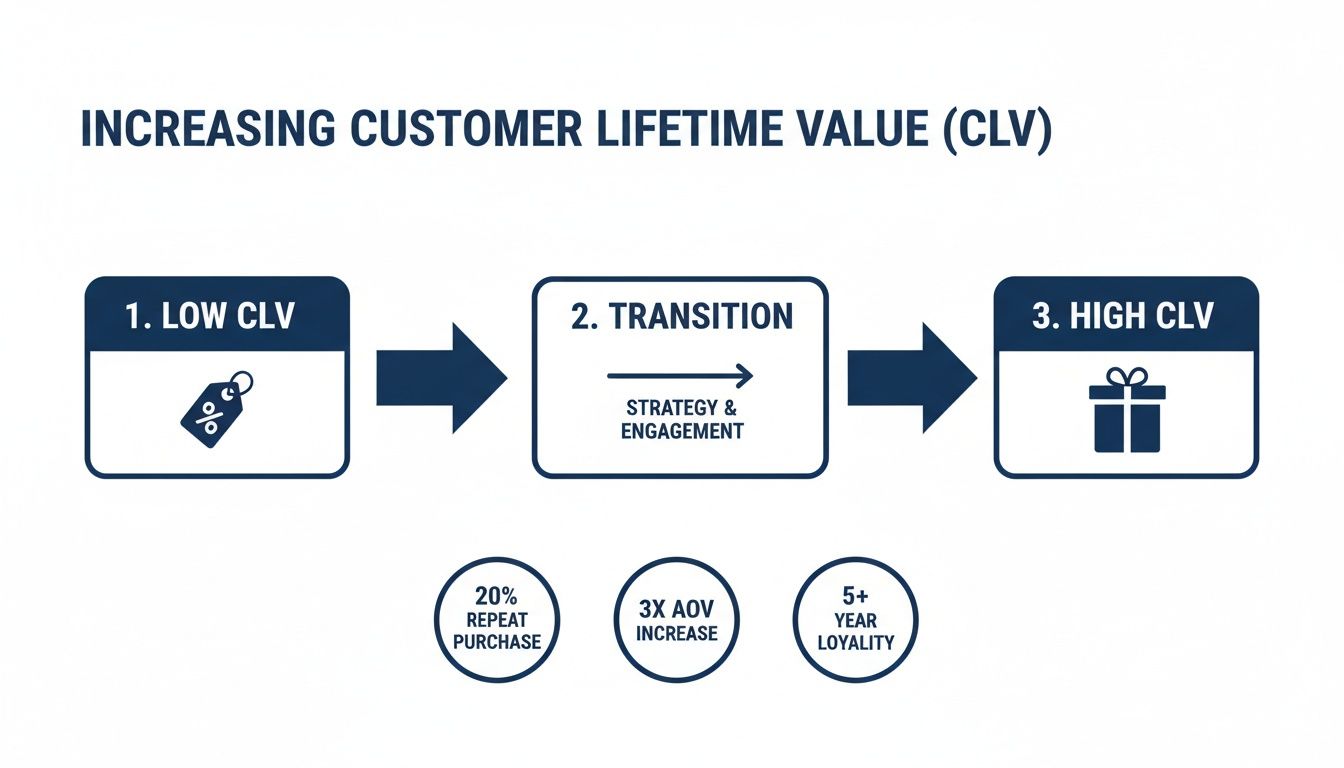
As you can see, the path to a high-CLV model isn't paved with hefty discounts. It's built by giving customers tangible value that fosters genuine, long-term loyalty and increases what they're willing to spend.
Breaking Down the CLV Growth Levers
To truly boost CLV, you need to pull the right levers. The old way relied heavily on discounting, which hurts margins and lifetime value. The new, more effective approach focuses on adding value to every part of the customer's journey.
This table shows exactly how to make that shift:
CLV Growth Levers At a Glance
CLV Component | Traditional Tactic (Lower Impact) | Value-Driven Tactic (Higher CLV Impact) |
|---|---|---|
Average Order Value (AOV) | Sitewide % or $ discount | Free gift with purchase, free shipping thresholds, bundle offers |
Purchase Frequency | "Come back" discount emails | Loyalty points, subscriptions, exclusive member perks |
Customer Lifetime | Reactivation campaigns with discounts | Personalized communication, post-purchase flows |
By focusing on the value-driven tactics, you're not just making a sale—you're investing in a more profitable, long-term customer relationship that increases lifetime value.
The Financial Upside of a CLV Focus
The numbers don't lie. A study found that just a 10% increase in customer lifetime value can lead to a massive 30% jump in overall company valuation. This is why smart businesses are prioritizing retention over acquisition.
Think about it: acquiring a new customer can cost 5 times more than keeping an existing one. Optimizing for CLV isn't just a "nice-to-have"; it's a direct path to better profitability.
Instead of slashing prices, you can use value-driven incentives like offering a free gift when a customer hits a certain spending threshold. This boosts your Average Order Value (AOV) without sacrificing your profits. For merchants ready to go deeper, our Revenue Optimization Course is a complete playbook for building a high-growth, retention-first ecommerce strategy.
Optimize Your Cart for Immediate CLV Growth
Most Shopify merchants treat their shopping cart like a waiting room—a simple final step before a customer pays. This is a huge mistake. Your cart isn't just a placeholder; it's your single best opportunity to influence a customer's behavior and immediately boost the lifetime value of every single order.
Think about it. This is where you have their undivided attention. By shifting your mindset from a purely transactional checkout to a dynamic, rewarding experience, you can increase your Average Order Value (AOV) and make customers feel fantastic about their purchase. The secret is to move away from deep, margin-killing discounts and instead offer value-added incentives like a free gift or free shipping that make people feel smart for spending more with you.
Gamify the Experience with Tiered Rewards
One of the most powerful tactics I've seen work time and again is gamifying the cart with tiered rewards. Instead of a single, flat offer, you create a "ladder" of escalating value that customers can climb as they add more items. This plays directly into our natural desire to hit goals and unlock achievements.
Imagine a customer adds a $40 product. The old way might be to dangle a 10% off coupon. The new, smarter way is to show them a progress bar that says, "You're just $10 away from a free gift!" This simple change reframes the entire interaction from saving money to earning value, which is a critical step towards increasing customer lifetime value.
Here’s a practical example of how you could structure your tiers:
Spend $50: Unlock free shipping.
Spend $100: Unlock a free gift.
Spend $150: Unlock a premium gift plus free shipping.
This structure gives shoppers clear, tangible goals. As they hit each threshold, they get that little hit of dopamine from the immediate positive feedback, which builds excitement and strengthens their connection to your brand. They spend more now, and the great experience makes them far more likely to come back later.
The goal is to make customers feel like they are earning rewards, not just spending money. This transforms the checkout process from a necessary chore into an engaging part of the shopping experience, which is fundamental to increasing customer lifetime value.
Leverage Progress Bars for Maximum Impact
Visuals are everything here. A dynamic progress bar that updates in real-time is the engine that makes this entire strategy purr. It’s a powerful psychological nudge, showing customers exactly how close they are to the next reward and making the goal feel totally achievable.
A simple line of text ("add $10 for free shipping") is easy to ignore. But a progress bar that visibly fills up as they shop? That’s compelling. It turns the experience into a mini-game where the prize is something they actually want, like a free gift. This works especially well for unlocking free shipping, since unexpected shipping costs are a notorious driver of cart abandonment. In fact, studies show 93% of shoppers will buy more if it means qualifying for free shipping.
This kind of visual cue immediately tells shoppers they’re on the verge of a win, making it a no-brainer to add one more item to their order and boosting their lifetime value from the very first purchase.
Automate Your In-Cart Strategy for Success
Trying to manage complex, tiered reward systems manually is a recipe for disaster. This is where the right tool becomes indispensable. An app like Monster Cart can automate this entire process, swapping out your default Shopify cart with a fully customizable, on-brand slide cart that handles all the logic behind the scenes.
You can set up multiple reward tiers, design custom progress bars, and configure free shipping or free gift thresholds in minutes. As customers shop, the app automatically tracks their cart total, displays their progress, and adds the free gift to their cart the second they unlock a tier. This seamless automation creates a flawless user experience that naturally increases AOV and customer lifetime value.
This approach doesn't just bump AOV for first-time buyers; it sets a new, higher baseline for their future purchases, directly contributing to a healthier CLV. For a deeper dive into these techniques, check out our complete guide to shopping cart optimization and learn how to turn every checkout into a revenue opportunity.
Increase Order Value with Smart In-Cart Cross-Sells
Once you've made the cart feel like a rewarding experience, the next step is to get strategic with cross-selling. I'm not talking about those generic "You might also like" widgets that everyone ignores. This is about making thoughtful, genuinely helpful suggestions that feel like a natural part of the shopping flow. Get this right, and you'll see a lift in not just your Average Order Value (AOV) but also in long-term customer happiness and lifetime value.
Think about it: a higher initial AOV does more than just boost that one sale. It sets a stronger foundation for the entire customer relationship. When a shopper's first purchase is more substantial, they become more invested in your brand. That positive first impression, where they find more value than they expected, sets a higher bar for their future spending and is a cornerstone of how to increase customer lifetime value.
Implement Frequently Bought Together Bundles
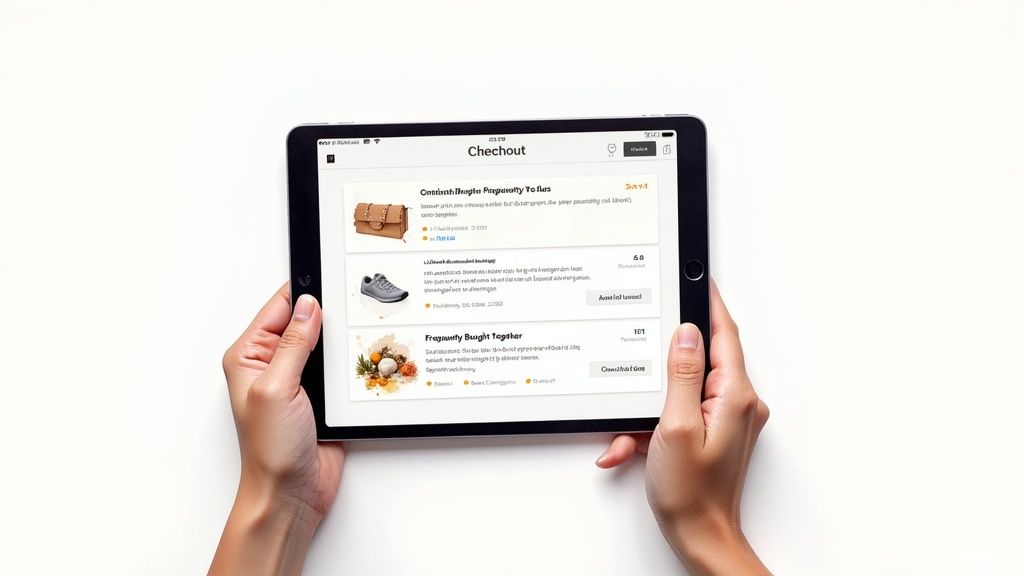
One of the best ways I've seen merchants introduce relevant products is through "Frequently Bought Together" (FBT) bundles. This tactic simply uses your own sales data to show customers what other people are actually buying together. It’s a subtle form of social proof that comes across less like a sales pitch and more like a helpful tip.
For example, if someone adds a premium espresso machine to their cart, an FBT offer could pop up with a one-click bundle that includes your signature espresso beans and a set of matching cups. This isn't a random upsell; it's a curated package that genuinely improves the customer's experience with the product they already decided to buy.
The secret here is to make it ridiculously easy. A single "Add Bundle" button removes all friction. The offer has to be contextual, relevant, and framed as a way for them to get the most out of their main purchase—a value-add, not a discount.
You're not just showing them more products; you're offering a complete solution. This is far more powerful than a simple discount and positions your brand as a trusted expert, which is key to lifetime value.
Capitalize on Low-Cost, High-Margin Add-Ons
Those final moments right before checkout are a golden opportunity to offer low-cost, high-impact add-ons. These are the small, impulse-buy items that don't require much thought from the customer but can seriously pad your profit margins and AOV.
Here are a few real-world examples I've seen work incredibly well:
A skincare brand offers "priority processing" for a couple of bucks, letting eager customers jump the fulfillment queue.
An electronics store suggests adding shipping protection or an extended warranty right there in the cart.
A fashion retailer prompts shoppers to add a gift-wrapping service, especially during the holidays.
These small additions are almost pure profit. They don't need deep discounts and tap directly into a customer's peak buying intent. The beauty of this strategy lies in its simplicity. A shopper who is already committed to a larger purchase is often more than willing to tack on a small, convenient item that improves their order. Tools like Monster Cart are built to integrate these one-click offers seamlessly into the cart experience.
By automating these smart cross-sells directly within an optimized cart drawer, the whole process becomes seamless. When you present the right offer at just the right moment—without annoying pop-ups—you turn every checkout into a bigger opportunity. This is a non-negotiable step for any merchant serious about building a more profitable, sustainable business by focusing on customer lifetime value.
Extend the Journey with Post-Purchase Experiences
The sale isn't the finish line. It's the starting gun.
Too many Shopify merchants celebrate a successful checkout and then immediately go quiet, missing the single most important window to forge a real connection. That moment right after a customer clicks "buy" is when they are most excited about your brand and most receptive to you. This is your chance to turn a simple transaction into a lasting relationship and increase their lifetime value.
The post-purchase experience is where you prove you're more than just a store—you're a brand they can trust and get behind. It's how you turn one-time buyers into repeat customers, and repeat customers into your biggest fans.
Create Post-Purchase Flows That Add Value
After a purchase, your customer's inbox is prime real estate. But instead of immediately hitting them with another sales pitch, your goal should be to add genuine value. Show them you care about their experience with the product, not just their wallet.
A thoughtful email or SMS flow should be helpful and reassuring. It makes the customer feel smart for choosing you, which is exactly the feeling that brings them back again and boosts their lifetime value.
Here are a few ideas for value-first post-purchase messages:
Product Care & Use-Case Guides: Send a quick video or PDF showing them how to get the most out of their new purchase. A skincare brand could send a "morning routine" tutorial. A fashion brand might share a lookbook with styling tips for their new piece.
Exclusive Content Access: Welcome them to the inner circle. Give them a password to a customer-only resource hub with expert articles, behind-the-scenes content, or early podcast episodes.
Community Invitations: Invite them to a private Facebook Group or Discord server. This is where they can connect with other fans, swap tips, and get a direct line to your team.
This kind of communication reinforces their decision and makes them feel like they've joined a community, not just completed a transaction.
Design Loyalty and VIP Programs That Actually Reward
Let's be honest: most loyalty programs are boring. A few points here and there for a discount rarely gets anyone excited. A truly great VIP program makes your best customers feel seen, appreciated, and genuinely special. It's less about the discount and more about the status and access.
The trick is to build a tiered system where the perks get better and more exclusive as customers climb the ladder. This gamifies the experience and gives people a real reason to keep coming back to your store.
Instead of thinking about loyalty programs as a way to offer discounts, think of them as a system for delivering exclusive value. The best programs reward engagement and repeat business with perks that deepen the customer's connection to your brand, directly increasing their lifetime value.
A simple points-per-dollar system is a good foundation, but the real magic happens when you layer in experiential rewards. Think about perks like:
Early Access: Let your top-tier members shop new drops 24 hours before anyone else. Scarcity is a powerful motivator.
Exclusive Products: Create a limited-edition colorway or a special bundle available only to VIPs.
Priority Support: Give them a dedicated support email or phone number. Knowing they can skip the line is a huge perk.
These non-monetary benefits create a powerful emotional bond and make customers think twice before shopping with a competitor.
Harness the Power of Subscriptions
If you sell consumables—think coffee, supplements, pet food, or skincare—subscriptions are the ultimate CLV-boosting machine. They put repeat purchases on autopilot, creating a predictable and reliable revenue stream from a single customer decision.
It's a win-win. For the customer, it’s all about the convenience of "set it and forget it." They never have to worry about running out of their favorite product. For your business, you lock in future sales and drastically increase the total lifetime value of that customer.
Don't underestimate the impact of a great experience here. E-commerce benchmarks show that improving the customer journey can rocket customer lifetime value (CLV) by up to 2.3 times. Why? Because happy customers stick around longer, and we know that repeat buyers spend 67% more on average than new ones. You can dig into more e-commerce benchmarks to see the data for yourself.
By making every customer feel valued through smart post-purchase flows, compelling loyalty programs, and seamless subscriptions, you're not just selling products—you're building a brand that's built to last.
Weave Loyalty Through Smart Segmentation and Personalization
Let's be honest: a generic, one-size-fits-all marketing strategy is a surefire way to kill your customer lifetime value. In a world with endless options, people expect brands to get them. When your communication feels personal and relevant, it cuts through the inbox clutter and makes a shopper feel seen. That feeling is the bedrock of long-term loyalty.
The real trick is to stop shouting the same message at everyone and start having thousands of individual conversations at scale. This all starts with smart customer segmentation. By grouping your audience based on their actual behavior and purchase history, you can tailor everything—your messaging, your offers, your product recommendations—for maximum impact. You’re building a relationship, not just processing a transaction.
Practical Ways to Segment Your Customer Base
You can get started right now with the data you already have in Shopify. You don't need a fancy, expensive platform to begin; you just need a clear plan for grouping your customers into meaningful buckets. This is what lets you create targeted campaigns that actually connect with people.
Here are a few high-impact segments you can build today:
Purchase History: This is the most obvious, yet most powerful, place to start. Group customers into buckets like first-time buyers, repeat customers (2-3 purchases), and your loyal advocates (4+ purchases). A brand-new customer needs a warm welcome, while a loyalist deserves the red-carpet treatment.
Average Order Value (AOV): It makes sense to talk to your big spenders differently than your bargain hunters. Your high-AOV segment might jump at a premium product bundle, while the lower-AOV group might be more motivated by an offer that helps them hit a free shipping threshold.
Product Category Preference: If you sell a variety of products, segment customers based on what they've bought before. Someone who only buys your skincare line shouldn't be getting hammered with emails about a new makeup launch—unless you smartly frame it as a complementary addition to their routine.
Personalization Tactics That Actually Drive Repeat Purchases
Once your segments are defined, the fun begins. This is where you can start personalizing their experience, and I don't just mean using {{first_name}} in an email subject line. It’s about delivering the right message, with the right offer, through the right channel, at precisely the right moment.
Think about your VIP segment—the customers with high AOV and multiple purchases. Instead of another discount, why not create an exclusive offer for early access to a new product? You frame it as a reward for their loyalty. This reinforces their status, makes them feel like insiders, and strengthens their connection to your brand.
For first-time buyers, the entire game is about securing that crucial second purchase. A post-purchase email flow that offers a small, value-added incentive—like a free gift or bonus loyalty points with their next order—can be far more compelling than a generic percentage-off coupon. Implementing effective customer loyalty programs is one of the most direct ways to nurture these relationships and see your CLV climb.
The whole point of personalization is to show your customer you're paying attention. When you acknowledge their past behavior and anticipate what they might need next, you shift the dynamic from transactional to relational. That's the key to a higher lifetime value.
Creating a Unified Omnichannel Experience
Personalization is most powerful when it's consistent everywhere a customer interacts with you—email, SMS, your website, and even inside the shopping cart. The data doesn't lie: omnichannel shoppers deliver 30% higher customer lifetime value (CLV) than those who only shop through a single channel. A unified experience builds trust and makes your brand feel solid and reliable. For more on this, check out these CLV growth stats for marketing leaders.
This is where your tech stack can really shine. For example, an app like Monster Cart can extend this personalization directly into the cart itself. You could set up a special in-cart offer that only appears for customers who have a "VIP" tag. Imagine them seeing an exclusive free gift that nobody else gets. That's a powerful moment that makes them feel genuinely special, cementing their loyalty right before they click "checkout."
Got Questions About Customer Lifetime Value? We've Got Answers.
As you start putting these CLV strategies into action, you're bound to have some questions. That's a good thing—it means you're thinking critically about your business. Here are some of the most common questions Shopify merchants ask, along with some straight-to-the-point answers to help you move forward with confidence.
What’s a “Good” Customer Lifetime Value to Aim For?
This is probably the number one question I get, and the answer isn't a specific dollar amount. The real metric that matters is the relationship between your CLV and your Customer Acquisition Cost (CAC).
The gold standard here is a CLV to CAC ratio of at least 3:1.
Think of it this way: for every dollar you spend to bring a new customer in the door, you should be making at least three dollars back from them over time.
Let's say your average order value (AOV) is $75, but it costs you $50 in ad spend to get that first sale. You'd need that same customer to come back and buy at least twice more just to hit that healthy 3:1 ratio. So, instead of chasing a magic number, focus on widening that gap. That’s the true sign of a profitable, sustainable business.
How Long Does It Really Take to See an Increase in CLV?
You can actually see some results almost immediately. Certain components of CLV, like your Average Order Value, can get a quick lift. When you implement smart in-cart strategies—like tiered free gifts or a progress bar for free shipping—you can nudge customers to spend more on their very next order. It's a quick win that proves your efforts are working.
However, a big, noticeable jump in your overall CLV metric usually takes about 3-6 months to really show up in your analytics. Why? Because CLV also factors in purchase frequency and the total customer lifespan, and those things just take time to play out. Be patient. If you consistently apply the post-purchase, loyalty, and personalization tactics we've talked about, you'll see a solid rise in repeat purchases and overall CLV within a couple of quarters.
Can I Actually Increase CLV Without Offering Discounts?
Absolutely. In fact, you should. This is the whole point of building sustainable CLV growth. Constantly offering hefty discounts just trains your customers to wait for a sale, which eats into your margins and can cheapen your brand perception.
The much smarter play is to focus on value-added incentives that make customers feel like they're getting something special.
Forget the price tag for a moment. Try these powerful, non-discount alternatives:
Free Gift with Purchase: Offer a cool, relevant product when a cart hits a certain value.
Free Shipping Tiers: That little progress bar showing how close they are to free shipping is incredibly motivating.
Loyalty Points: Reward them for coming back with points they can cash in for exclusive items or perks.
Exclusive Access: Treat your best customers like VIPs with early access to new product drops.
These strategies make the order feel more valuable and build genuine loyalty. Customers come back because they love the experience you provide, not just because you were the cheapest option.
I'm Ready to Start. Which CLV Strategy Should I Tackle First?
For the fastest, most direct impact, start with your in-cart experience.
Every single person who buys from you—whether it's their first or fifteenth time—has to go through the cart. This makes it your highest-leverage point for immediate improvement.
Adding tiered rewards, progress bars, and some smart in-cart cross-sells can boost your AOV literally today. This is the low-hanging fruit. It doesn't require complicated customer segmentation or long email sequences to get off the ground.
Tools built specifically for this make it incredibly simple. You can turn a standard, boring cart into a dynamic little engine that encourages people to spend more on every single order, setting a strong foundation for a higher customer lifetime value. An app like Monster Cart is designed for exactly this.
Once you have your in-cart strategy humming along, the most logical next step is to build out your post-purchase email flows and a basic loyalty program. This creates a powerful one-two punch: you maximize the value of that first order, then immediately start building the relationship to lock in that crucial second sale.
Ready to turn your cart into a profit engine? With Monster Cart, you can effortlessly build tiered reward systems, add one-click upsells, and gamify the checkout experience to boost AOV and delight your customers—all without hefty discounts. Discover how Monster Cart can increase your customer lifetime value today.
Join 7000+ brands using our apps