The Best Shopify Apps to Increase Sales Without Hurting Your Brand
Dec 28, 2025
|
Published
If you're hunting for the best Shopify apps to increase sales, you might think the answer is more discount codes. But the real secret to sustainable growth lies in creating a shopping experience that rewards customers and naturally nudges up your average order value (AOV) while fostering long-term loyalty.
Growing Sales Sustainably Beyond Constant Discounts

Are you trapped in a cycle of running one sale after another? It's a common problem that eats away at profit margins and can even make your brand feel cheap over time. The modern path to growing a Shopify store isn't about constantly slashing prices; it's about making the shopping experience itself more valuable and focusing on customer lifetime value.
This guide is all about moving past that outdated reliance on store-wide discounts. We'll dive into a smarter, more profitable strategy: creating an interactive and rewarding journey that encourages customers to spend more with every order. This isn't because you're having a sale, but because they genuinely see more value in the experience.
Shift Your Focus from Discounts to Lifetime Value
When you constantly offer hefty discounts, you're basically training your customers to wait for a sale. This behavior can seriously damage your brand's perception and your bottom line. A value-driven approach, on the other hand, is all about rewarding customers for their loyalty and spending habits with perks like free gifts or free shipping. This not only feels more premium but also helps build a much stronger, lasting relationship with them.
By focusing on lifetime value (LTV) instead of one-time transactions, you create a more resilient business. Happy, loyal customers are more likely to return and recommend your brand, driving organic growth that outlasts any temporary sales bump.
Making this mental shift is a game-changer for long-term success. It’s about making your customers feel appreciated with thoughtful rewards, not just a lower price tag.
Introducing a Smarter Way to Boost AOV
The key is to use app-driven rewards that motivate customers to add just one more item to their cart. This creates a positive feedback loop: as their spending goes up, they unlock more value, which makes the whole shopping process more fun and engaging, ultimately building that crucial lifetime value.
Here’s what that strategy looks like in action:
Gamified Rewards: Think progress bars and visual cues that show shoppers exactly how close they are to unlocking a reward, like free shipping or a cool bonus product.
Tiered Incentives: Roll out "spend more, get more" campaigns. Maybe they unlock free shipping at $50, then a free sample at $75, and a premium gift at $100.
Value-Added Perks: Offer things that feel more valuable than a simple percentage off. A free gift with purchase, for example, often has a much higher perceived value. If you want to master this tactic, check out our guide on creating compelling free gift with purchase offers.
When you build these strategies directly into the cart experience, you create a seamless and persuasive journey. Apps like Monster Cart are built specifically for this, turning your shopping cart into a powerful engine for boosting AOV—no steep discounts required. Next, we'll explore the key app categories that make this all possible.
Unlocking Higher AOV with In-Cart Upsell and Reward Apps
Think about your shopping cart for a second. Most store owners see it as the final, boring step before checkout—a simple holding area for products. But what if it could be your most powerful sales tool for boosting AOV and lifetime value?
That’s where in-cart upsell and reward apps come in. They’re a world away from those annoying, disruptive pop-ups that just make people want to close the tab. Instead of interrupting the flow, they make the shopping experience better. They turn the cart into an interactive space that actually encourages customers to spend a little more, not by being pushy, but by showing them what's in it for them with valuable rewards.
Rethink Your Cart from Utility to Sales Engine
The standard Shopify cart is purely functional. It does its job, but it doesn't sell. An optimized cart, on the other hand, becomes an active part of the sales process. It’s the difference between a silent cashier and a helpful one who points out a great deal you’re close to getting.
The secret to boosting AOV isn't just asking people to buy more; it's making them want to. When you offer real, tangible value in return for a slightly higher spend, you’re not just making a sale—you’re building a relationship that increases lifetime value.
This is where you can get clever. When a customer can see a progress bar inching closer to a reward like a free gift, it triggers a powerful psychological need to complete the goal. Modern tools like Monster Cart are built entirely around this idea. It replaces the default Shopify cart with a dynamic, on-brand slide-cart that feels like it’s always been part of your store.
The Power of Visual Progress and Rewards
Let’s be honest, seeing a message that says you’re just $10 away from free shipping is incredibly compelling. It completely reframes the decision. It's no longer about "Should I spend more money?" but "What little thing can I add to get my reward?" That small mental shift is often all it takes to increase the basket size without resorting to discounts.
Here’s how this plays out with an app like Monster Cart:
Tiered Rewards: You can set up a chain of incentives. Maybe free shipping unlocks at $50, and a free gift appears at $75. The cart visually tracks the customer's progress, showing them the very next cool thing they can get.
'Buy More, Save More': Instead of coupon codes, you can have discounts that automatically apply as the cart total grows. Seeing that next savings tier is a huge motivator to add one more item.
One-Click Add-Ons: This is where you can easily offer things like shipping protection, a product warranty, or small, complementary items right in the cart, ready to be added with a single click.
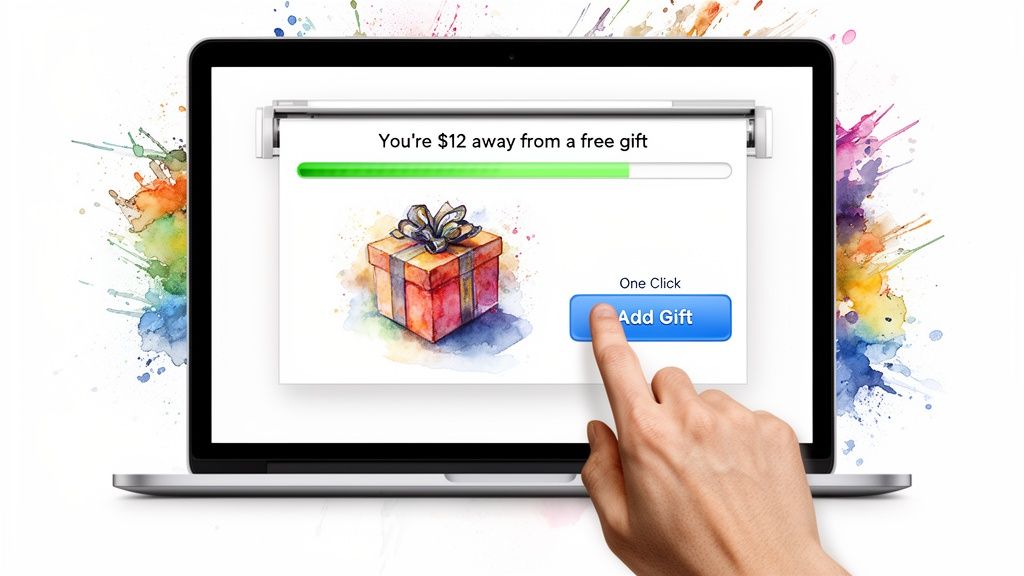
This screenshot from Monster Cart shows exactly what I mean. The gamified progress bar makes it crystal clear how close the shopper is to unlocking a free gift.
It turns the cart into a mini-game. It’s engaging, it’s fun, and it directly nudges the customer toward a higher spend.
Frictionless Upsells that Actually Convert
The best upsells are the ones that don't feel like upsells at all. Post-purchase pop-ups or aggressive on-page suggestions create friction—they get in the way. But when you recommend 'Frequently Bought Together' items or other relevant products right inside the cart, it feels like a helpful suggestion. You can find a whole range of these powerful techniques in tools like Monster Upsells.
The Shopify app ecosystem is exploding for a reason. Merchants who install just a handful of the right apps often see a huge jump in performance. With the Shopify App Store growing to over 11,905 apps by late 2024, there are endless ways to optimize your store. And with mobile traffic hitting 79% of all visits in major markets, a fast, seamless cart experience is non-negotiable. Check out more of these app store trends on uptek.com.
By bringing these strategies into your cart, you’re not just processing orders. You’re guiding customers along a rewarding path that naturally leads to a higher AOV. You’re turning your cart into your store’s best salesperson.
Building Your High-Impact App Stack
A killer in-cart upsell app is a brilliant start, but to really scale your store, you need a well-rounded app stack. Think of it like building a championship sports team. You can have a star player (your in-cart rewards engine), but you still need a solid defense, a clever offense, and reliable special teams to win game after game.
Each app category plays a specific, vital role in turning casual visitors into repeat customers. The goal is to create a lean but powerful toolkit where every app works together. For instance, your email marketing app can pull shoppers back who abandoned a cart, reminding them of the great rewards you’ve set up with an app like Monster Cart. This kind of teamwork is how you maximize lifetime value without constantly slashing prices.
This simple diagram shows the powerful logic behind using in-cart rewards to drive up your average order value (AOV).
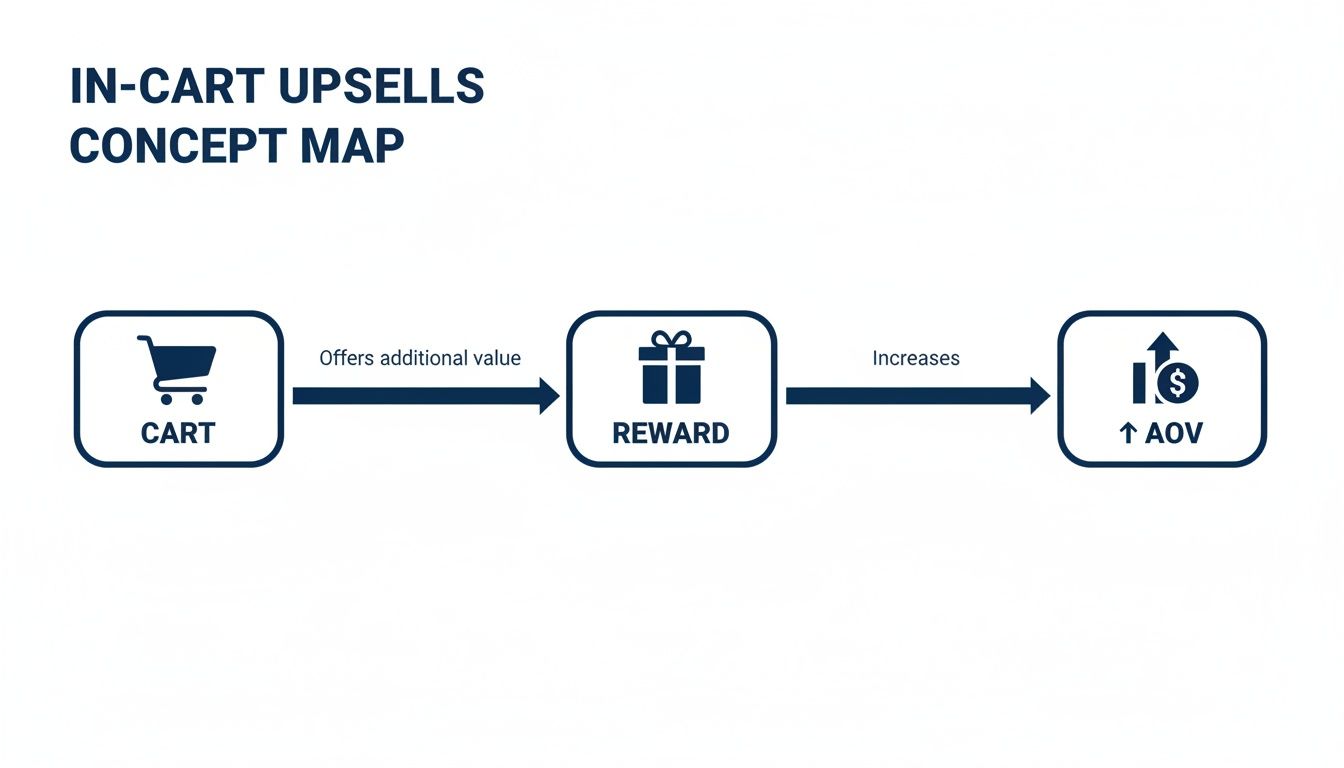
As you can see, it creates a clear path: the customer adds an item, they see an opportunity to unlock a reward, and that incentive directly leads to a bigger cart and a higher AOV for you.
To build a truly effective tech stack, it's helpful to understand the key players. Each category solves a different piece of the puzzle, from getting customers to your site to keeping them coming back.
Shopify App Categories and Their Impact on Sales
App Category | Primary Goal | Key Sales Metric Impacted |
|---|---|---|
In-Cart Upsell & Rewards | Increase Average Order Value (AOV) | AOV, Items Per Order, Conversion Rate |
Conversion Rate Optimization (CRO) | Reduce friction and improve user experience | Site Speed, Conversion Rate, Bounce Rate |
Social Proof & Reviews | Build trust and buyer confidence | Conversion Rate, Add-to-Cart Rate |
Email & SMS Marketing | Nurture relationships and drive repeat sales | Customer Lifetime Value (CLV), Repeat Purchase Rate |
Product Bundling (FBT) | Increase AOV by suggesting related items | AOV, Items Per Order |
Subscriptions | Create predictable, recurring revenue | CLV, Customer Retention |
Analytics & Reporting | Provide data for informed decision-making | All metrics, Return on Ad Spend (ROAS) |
This table gives you a bird's-eye view of the essential tools that drive growth. Let's dig into a few of the most critical categories.
Conversion Rate Optimization (CRO) Apps
First things first, you need a solid foundation. That's where Conversion Rate Optimization (CRO) comes in. These apps are all about making your store faster, more intuitive, and just plain easier to shop.
A slow site is a conversion killer. We're talking a single second of delay causing a major drop in sales. CRO apps tackle this by focusing on site speed, image optimization, and overall user experience to make sure your store runs like a dream. By creating a frictionless path to checkout, these tools make every other app in your stack work that much better.
Social Proof and Reviews Apps
Next, you have to build trust, and you have to do it fast. That’s the job of Social Proof and Reviews apps. These tools make it incredibly easy to gather and display customer reviews, photos, and star ratings right on your product pages.
When a new shopper sees that dozens of other people have bought and loved your products, their hesitation melts away. It’s the digital version of a friend’s recommendation, and it’s one of the most powerful ways to convince someone who's on the fence. Authentic reviews help people imagine the product in their own lives, giving them the confidence they need to hit "Add to Cart."
Email and SMS Marketing Apps
The sale doesn't end at checkout. In fact, that's where the real relationship begins. Email and SMS Marketing apps are your go-to for nurturing those customer connections and driving repeat business.
These platforms let you automate everything from abandoned cart reminders to personalized post-purchase follow-ups. Staying in touch with special offers and useful content is what turns a one-time buyer into a loyal fan. This consistent communication is absolutely essential for boosting customer lifetime value. For more great strategies, you can find helpful insights from the copycat247 blog.
Product Bundling and Subscription Apps
Two other powerhouse categories for boosting AOV and creating predictable income are Product Bundling and Subscription apps. These are fantastic for making shopping easier and more valuable for your customers.
Product Bundling Apps: These apps group complementary items together, often with a small incentive. Think of "Frequently Bought Together" sections that let customers add related products in a single click. It’s a low-pressure way to increase the cart value.
Subscription Apps: For any product that gets used up, subscriptions are a complete game-changer. They lock in customer loyalty and create a reliable, recurring revenue stream for your business.
Shopify now has over 11,000 apps, giving you an incredible amount of power to customize your store. The data doesn't lie: 89% of online retailers report a sales lift from using personalization apps, and with repeat purchase rates hitting 44%, keeping customers happy is more important than ever. These tools are proven to work, and they do it without being pushy or disruptive—a principle that Monster Cart was built on.
How to Pick Apps That Help, Not Hurt, Your Store
With over 11,000 apps on the Shopify App Store, it's easy to get overwhelmed. We've all been there—you start adding tools you think you need, and before you know it, you're left with a bloated, slow-loading site that's actually killing sales. Building a great app stack isn't about collecting the most popular tools; it's about being strategic.
The goal is to find apps that solve a specific problem for your business. It’s about thinking past a cool list of features and focusing on the real impact an app will have on your store's performance and, most importantly, your customer's experience.
A well-chosen app should feel like it was built right into your store, not tacked on as an afterthought. Think about an in-cart rewards app: it should blend so seamlessly into your design that it feels like a natural part of the checkout process, gently nudging customers to spend a little more. This is the whole philosophy behind an app like Monster Cart—it enhances the shopping journey instead of interrupting it.
Performance and Speed Come First
Before you get dazzled by features, your absolute first priority has to be performance. A slow website is a conversion killer. Seriously, even a one-second delay in page load time can send your conversion rate plummeting.
When you're looking at a new app, grill it with these questions:
Is it built on modern code? Apps designed for Shopify’s Online Store 2.0 architecture are typically much more efficient.
How does it load? You want apps that load their code asynchronously—meaning in the background—so they don't stop the rest of your page from appearing.
What are recent reviews saying about speed? Do a quick search in the reviews for terms like "slow," "speed," or "performance" to see what other merchants are experiencing.
A fast, feature-rich app is an asset. A slow, feature-rich app is a liability. Never trade your store’s speed for a new feature. You'll almost always lose more in sales than you gain.
User Experience and Customization
The best apps just make sense, both on the back end for you and on the front end for your customers. If an app is a nightmare to set up, you probably won't use it to its full potential. Even worse, if it creates a clunky, confusing experience for your shoppers, you can kiss those conversions goodbye.
An app also has to look like it belongs on your site. A generic, unbranded pop-up or cart drawer instantly cheapens your store and can erode the trust you've worked so hard to build. Look for tools that give you full control over colors, fonts, and text so every customer touchpoint feels 100% on-brand.
This is especially critical for anything happening inside the shopping cart. A tool like Monster Cart really shines here because it offers deep customization. You can design a rewards system that looks and feels like a native part of your store, encouraging customers to hit that next spending tier without ever breaking the brand experience.
Look at Support and Lifetime Value
Finally, remember that you’re not just buying a piece of software; you're entering a partnership. Good support is non-negotiable. Dig into the reviews and see what people say about the development team. Are they responsive? Do they actually solve problems? A great support team can be the difference between a five-minute fix and a full-blown sales disaster.
At the end of the day, your app choices should be about increasing customer lifetime value (LTV), not just grabbing a single sale. Steer clear of apps that rely on aggressive, one-and-done discount tactics. Instead, choose tools that help you build a real relationship, rewarding loyalty with things like free gifts or exclusive perks. That’s how you turn one-time buyers into lifelong fans and build a brand that lasts.
Your First High-Converting Reward Campaign with Monster Cart
Alright, let's move from theory to actual results. Launching your first high-impact reward campaign is way simpler than you might think, and it’s the best way to see how a few tweaks to your cart can pump up your Average Order Value (AOV). We’re going to walk through a proven winner: the ‘Free Gift with Purchase’ offer.
This strategy is so effective because it flips the script from price-slashing discounts to value-added perks. Instead of chipping away at your margins, you’re making the shopping experience better. Customers feel like they're being rewarded, not just catching a temporary sale. That's how you build goodwill and nudge shoppers toward long-term loyalty.
Using a tool like Monster Cart, setting this up is a breeze. You’re not just slapping an offer on the page; you’re building an interactive, almost game-like journey that gives shoppers a real reason to spend a little more to unlock a reward they’ll love.
Step 1: Install and Customize Your Cart Drawer
First things first: the experience needs to feel like it’s a part of your brand, not some clunky add-on. Once you install Monster Cart from the Shopify App Store, your top priority is to customize the slide-out cart drawer. Think of this as your new sales engine—it needs to look the part.
Dive into the settings and match your brand's colors, fonts, and overall vibe. The goal is for the cart to feel like a premium, built-in feature of your store. A seamless design builds trust and makes the rewards feel natural, which is absolutely critical for getting people to engage and ultimately convert.
Step 2: Define a Strategic Spending Threshold
This is where you put your strategist hat on. You need to pick a spending goal that’s both tempting for the customer and profitable for you. A great place to start is to find your current AOV and set the threshold about 15-20% higher.
For example, if your store’s AOV is $50, setting the free gift threshold at $60 is a perfect, achievable nudge. It encourages shoppers to just add one more small thing to their cart to get the prize. This is the sweet spot where you maximize order value without setting a goal so high that people give up.
Remember, the key is to make the next step feel easy and worthwhile. You want the customer thinking, "Oh, I'm so close! What else can I get?" not abandoning their cart because the goal feels impossible.
This thoughtful approach is what separates sustainable AOV growth from desperate discounting. You're gently guiding customer behavior in a way that helps both of you, building a healthier, more profitable business.
Step 3: Add Your Gift and Craft Compelling Messaging
Now for the fun part! Choose a free gift that feels valuable but doesn't cost you a ton. Trial-sized versions of your bestsellers, exclusive accessories, or even overstocked items you want to clear out are all fantastic options.
Next, write your in-cart messages to create a little excitement and urgency. Monster Cart lets you display dynamic messages that update in real-time as people shop. Use clear, encouraging language like:
"You're only $12 away from your free gift!"
"Add one more item to unlock an exclusive reward."
"Congratulations! You've unlocked a free [Product Name]!"
This kind of real-time feedback turns shopping into a mini-game, keeping customers hooked and focused on hitting that next reward tier.
Ready to put this into action? Here's a simple checklist to guide you through setting up your first 'Free Gift' campaign with Monster Cart. Following these steps ensures you don't miss any key details.
Monster Cart Reward Campaign Setup Checklist
Step | Action | Pro Tip |
|---|---|---|
1. Install App | Install Monster Cart from the Shopify App Store. | Do this during off-peak hours to test everything before your customers see it. |
2. Brand Customization | Match the cart drawer’s colors, fonts, and button styles to your store’s theme. | Upload your brand's logo to the cart for a fully native feel. |
3. Calculate AOV | Check your Shopify Analytics to find your current Average Order Value (AOV). | Look at data from the last 30-60 days for an accurate baseline. |
4. Set Threshold | Create a reward tier that is 15-20% above your current AOV. | If your AOV is $75, a threshold of $90 is a great starting point. |
5. Select Gift | Choose a high-perceived-value, low-cost product as the free gift. | Overstock items or sample-sized products are perfect for this. |
6. Write Copy | Craft clear, motivating messages for progress and completion states. | Use emojis! "🎉 You've unlocked a free gift!" adds a human touch. |
7. Test Flow | Do a full test run: add items, hit the threshold, and claim the gift. | Make sure the gift product has available inventory so the offer works. |
8. Activate | Go live with your campaign! | Announce the new offer on social media or via email to drive immediate traffic. |
Once you've ticked off these boxes, you’re ready for the final step.
Step 4: Activate and Monitor Your Campaign
With everything dialed in, it’s time to launch. Activate your campaign in the Monster Cart dashboard and start watching the results come in. The built-in analytics will give you the inside scoop on key metrics like attributed revenue, AOV lift, and conversion rate.
This data is your roadmap. Use it to A/B test different reward thresholds, try out new gift items, and see what really connects with your audience. By constantly monitoring and tweaking your campaigns, you’ll turn your shopping cart into your most reliable salesperson—one that drives sales and delights customers without ever having to offer a discount.
So, What's the Big Takeaway?
After everything we've covered, it all boils down to one simple truth. The smartest way to grow your Shopify store isn't by slashing prices and running endless sales. It's about making the shopping experience so good that customers happily spend more, boosting your Average Order Value (AOV) and turning them into loyal fans.
We’ve seen how a well-chosen stack of apps can make this happen, but the real magic often lies in optimizing that final step: the shopping cart.
It’s time to stop thinking of your cart as just a place to checkout. For a deeper dive, a practical guide to increasing ecommerce conversion rates offers some fantastic perspectives on this. Your cart should be your most valuable employee—a tireless salesperson working for you 24/7.
The modern path to sustainable growth is paved with value, not discounts. By rewarding customers for their loyalty and spending, you increase AOV while strengthening your brand and encouraging repeat business, which is the key to lifetime value.
This is where you can really start to see a difference. An app like Monster Cart was built specifically for this mission. It turns a static summary of items into a dynamic, interactive experience with gamified rewards like free gifts and shipping progress bars.
You’re not just selling products; you’re creating an engaging moment that encourages customers to add just one more thing to their order. You can find more strategies like this in our guide to shopping cart optimization.
Don’t just take my word for it. Give it a try. A free trial is the best way to see the impact on your AOV and conversion rates firsthand. Your brand—and your bank account—will be glad you did.
Frequently Asked Questions
Diving into the world of Shopify apps always brings up a few questions. That's a good thing. Getting the right answers means you can build a powerful tech stack that actually drives sales, without wrecking your store's performance or brand vibe. Let's dig into what merchants usually ask.
How Many Shopify Apps Are Too Many?
Honestly, there’s no magic number. It's all about quality over quantity. I've seen stores with just five killer apps run circles around stores bloated with twenty slow, buggy ones that are constantly fighting with each other. The real question is, do your apps play well together?
The line is crossed the second your site speed takes a nosedive or the customer experience feels clunky. That's when you know you have too many. Your goal should be to pick tools that do a specific job well, are coded for speed, and integrate cleanly. Often, a single powerhouse app like Monster Cart can do the job of three or four separate tools, keeping your store lean, mean, and fast.
Can Upsell Apps Increase Sales Without Annoying Customers?
Yes, absolutely—but how you do it is everything. Most merchants get nervous because they've seen those awful, screen-hijacking pop-ups that just get in the way. That kind of approach creates friction and sends people running for the exit. The trick is to enhance the shopping journey, not interrupt it.
That’s why in-cart rewards work so well. Instead of a jarring pop-up, you’re offering helpful incentives right inside the cart. Think about it: a little progress bar showing a customer they're just $10 away from a free gift feels like a helpful tip, not a pushy sales pitch. It’s positive reinforcement that nudges them to spend more in a way that feels natural and respectful, ultimately boosting AOV and making them feel good about their purchase.
What Is a Good Alternative to Discounts for Increasing Sales?
Running constant sales is a dangerous game. You can accidentally train your customers to wait for a discount, which kills your profit margins and cheapens your brand over time. A much smarter, more sustainable play is to offer value-added rewards that make customers feel special, not just like they got a bargain.
The goal is to shift the customer's mindset from "How can I pay less?" to "How can I get more value?" This subtle change is crucial for building a premium brand and fostering long-term loyalty.
Instead of slashing prices, try these powerful alternatives:
Free Gifts with Purchase: A free product often feels more valuable than a small percentage off, and it’s a brilliant way to let customers sample other items you sell.
Free Shipping Thresholds: Unexpected shipping costs are the #1 reason for abandoned carts. Turning that pain point into a reward is one of the most effective motivators you can use.
Exclusive Product Unlocks: Create a little excitement by offering access to a special product only after a customer hits a certain spending level.
These are the kinds of strategies that boost your average order value while actually strengthening your brand—and they’re all easy to set up with a tool like Monster Cart.
Ready to turn your cart into your best salesperson with value-driven rewards? Monster Cart makes it easy to set up high-converting in-cart upsell and reward campaigns without slowing down your store. Start your free trial today and see the AOV lift for yourself!
Join 7000+ brands using our apps