Finding the Best Upsell Apps for Shopify to Boost Your AOV
Dec 27, 2025
|
Published
If you're looking for the best upsell apps for Shopify, you've probably noticed that most of them are just glorified pop-up generators. The real winners, though, are the apps that weave valuable, in-cart rewards—like free gifts, tiered discounts, and shipping progress bars—right into the shopping experience to nudge that Average Order Value (AOV) higher without derailing the customer or slashing your margins.
Moving Beyond Pop-Ups to Increase Your AOV
Tired of trying to boost your store's AOV without annoying customers with aggressive pop-ups or killing your margins with sitewide discounts? It’s a common frustration. For years, the standard playbook was to interrupt shoppers with offers they probably didn’t want, creating friction at the worst possible moment—right before checkout.
This guide is all about a smarter, more customer-friendly approach. Instead of forcefully pushing sales with hefty discounts, we’ll focus on pulling customers toward a bigger cart by rewarding their loyalty. The idea is to offer genuine value through incentives that feel like a perk, not a sales pitch, nurturing a higher lifetime value.
A Smarter Way to Boost AOV
The secret is to shift your mindset from one-off sales to long-term customer lifetime value (LTV). When shoppers feel appreciated and rewarded, they come back. They spend more over time. This builds real brand loyalty and a much more sustainable growth path than just throwing discounts at everyone, which can cheapen your brand.
By building rewards directly into the shopping cart, you turn the experience into a mini-game. Customers get motivated to hit the next spending goal, and it feels less like a sales tactic and more like a perk for being a good customer.
So, ditch the generic pop-ups and try these more effective, on-brand solutions that fit smoothly into the buying process:
Tiered Rewards: Encourage shoppers to spend more by offering better rewards as their cart total climbs. Think: spend $50 and get a free sample, spend $100 and get a deluxe travel-size product.
Free Shipping Thresholds: Nothing works quite like a visual progress bar showing a customer how close they are to free shipping. It's one of the most effective ways to get them to add just one more item to their cart.
Free Gift with Purchase: Tossing in a complimentary item is a classic for a reason. It adds a ton of perceived value without you having to discount your main products. You can dive deeper into making a free gift with purchase campaign a hit with your customers.
At the end of the day, any good upsell app should help you execute proven strategies to increase average order value across your entire store. By switching to an integrated, in-cart rewards system, you can do this in a way that actually strengthens your brand and customer lifetime value. This is exactly where tools like Monster Cart come in, designed to make these value-packed incentives a natural part of shopping.
A Fresh Look at Upsells and In-Cart Rewards
Think of modern upselling less like a pushy salesperson and more like a smart, helpful store assistant. It’s not about interrupting the customer; it's about making genuinely useful suggestions at just the right time. The goal is to boost AOV by enhancing the experience, not by offering margin-killing discounts.
This whole approach is built on a simple idea: when a customer feels understood and rewarded, they're happy to spend more. You're turning a simple transaction into a fun, game-like experience that gets them excited to see what else you have, encouraging them to return again and again.
The Three Make-or-Break Moments for Upselling
A customer's journey through your store has a few distinct stages. The best upsell apps know exactly how to engage at each one, tailoring the offer to where the customer's head is at. Nailing this timing is how you boost sales without ever feeling annoying.
There are really three golden opportunities to present an offer:
Pre-Purchase: This is on the product or collection page, before anything is even in the cart. The classic "Frequently Bought Together" bundle is a perfect example, showing customers items that make their primary choice even better.
In-Cart: This is that critical window after an item is added to the cart but before checkout begins. Here, you can motivate them to hit a spending goal with rewards like a free shipping progress bar or a surprise free gift.
Post-Purchase: This happens on the thank-you page, right after they’ve paid. Trust is at an all-time high, making it the perfect moment for a one-click offer on a related product since their payment info is already saved.
Why Post-Purchase Offers Are So Powerful
While all three moments have their place, post-purchase upsells are absolute game-changers. Once someone has committed and clicked "buy," their intent is sky-high. They've already trusted you with their money, making them incredibly open to a relevant, easy-to-add offer.
The smartest upsell strategies weave offers through the entire buying journey. But if you're looking for the biggest impact, capitalizing on that post-purchase moment is a surefire way to lift revenue without risking the initial sale.
The proof is in the numbers. Take Aftersell, a major player in the Shopify upsell space. They consistently help D2C brands see up to a 30% increase in average order value (AOV). That lift comes from focusing on post-purchase upsells, which can convert 3-5 times higher than offers shown before checkout. Their blog has some great data on why post-purchase is so effective.
Building Lifetime Value with In-Cart Rewards
Post-purchase offers are fantastic for a quick revenue boost, but the in-cart experience is where you lay the groundwork for long-term loyalty. Instead of just pushing another product, in-cart rewards pull the customer toward a higher cart value by making them feel like they're winning. This small shift makes a huge difference to their lifetime value (LTV).
When a shopper sees that progress bar getting closer to free shipping, or a "You've Unlocked a Free Gift!" message pops up, it creates a little jolt of satisfaction. This positive feeling encourages them to finish the purchase and, more importantly, makes them want to come back. It’s the entire philosophy behind apps like Monster Cart, which turn the cart into a rewards engine to grow both AOV and customer loyalty at the same time.
How to Choose the Right Upsell App for Your Store
The Shopify App Store is a crowded place. With so many options, how do you find an upsell app that will actually move the needle for your business? A flashy 5-star rating can be misleading—it doesn't guarantee a smooth customer experience or a real impact on your bottom line.
To cut through the noise, you need a solid game plan. The goal isn't just to tack on offers; it's to find a partner that helps you grow your average order value (AOV) for the long haul. This means thinking about customer lifetime value, not just quick, margin-killing discounts. The best strategies often revolve around smart rewards like free gifts and free shipping.
Key Features and Flexibility
First things first: can the app actually do what you need it to? It has to go beyond simply suggesting another product. You're looking for a tool that can adapt to your marketing goals and help you create compelling, reward-based offers that genuinely excite your customers.
A truly versatile app should give you a full toolkit. Can you easily set up things like:
Tiered Rewards: Create campaigns that encourage customers to spend more to unlock better rewards. For example, spend $50 to get a free sample, but spend $100 to unlock a deluxe product.
Free Gifts: Offer a complimentary item when a cart hits a specific value or contains a certain product. It’s a classic for a reason.
Free Shipping Thresholds: Nothing motivates a purchase quite like free shipping. A dynamic progress bar that updates in real time shows customers exactly how close they are.
Product Bundles: Suggest complementary items with a "Frequently Bought Together" style offer. It’s a natural and helpful way to increase cart size.
An app with this kind of flexibility allows you to build a sophisticated rewards program that feels generous, not pushy. This is where a comprehensive solution like Monster Cart really shines, bringing all these features together into one seamless in-cart experience.
Customer Experience and Site Speed
How an upsell feels to a customer is just as critical as the offer itself. A clunky, disruptive pop-up can send a shopper straight for the exit, completely defeating the purpose. The best upsell experience is so smooth that it feels like it was always part of your store's design.
An upsell should never be an interruption. It should be a helpful suggestion or a rewarding discovery that enhances the shopping journey, making the customer feel valued and understood.
This is why in-cart upsells are often so much more effective. They present offers right within the shopping flow, gently guiding the customer toward a higher spend without yanking them out of the experience with annoying pop-up windows.
Just as important is the app's impact on your site speed. A slow-loading app is a conversion killer and can even hurt your SEO rankings. Always comb through reviews for comments about performance. You’ve worked hard to create a great user experience—don't let a sluggish app undo it.
This flowchart illustrates how different upsell timings—pre-purchase, in-cart, and post-purchase—create very different customer journeys.
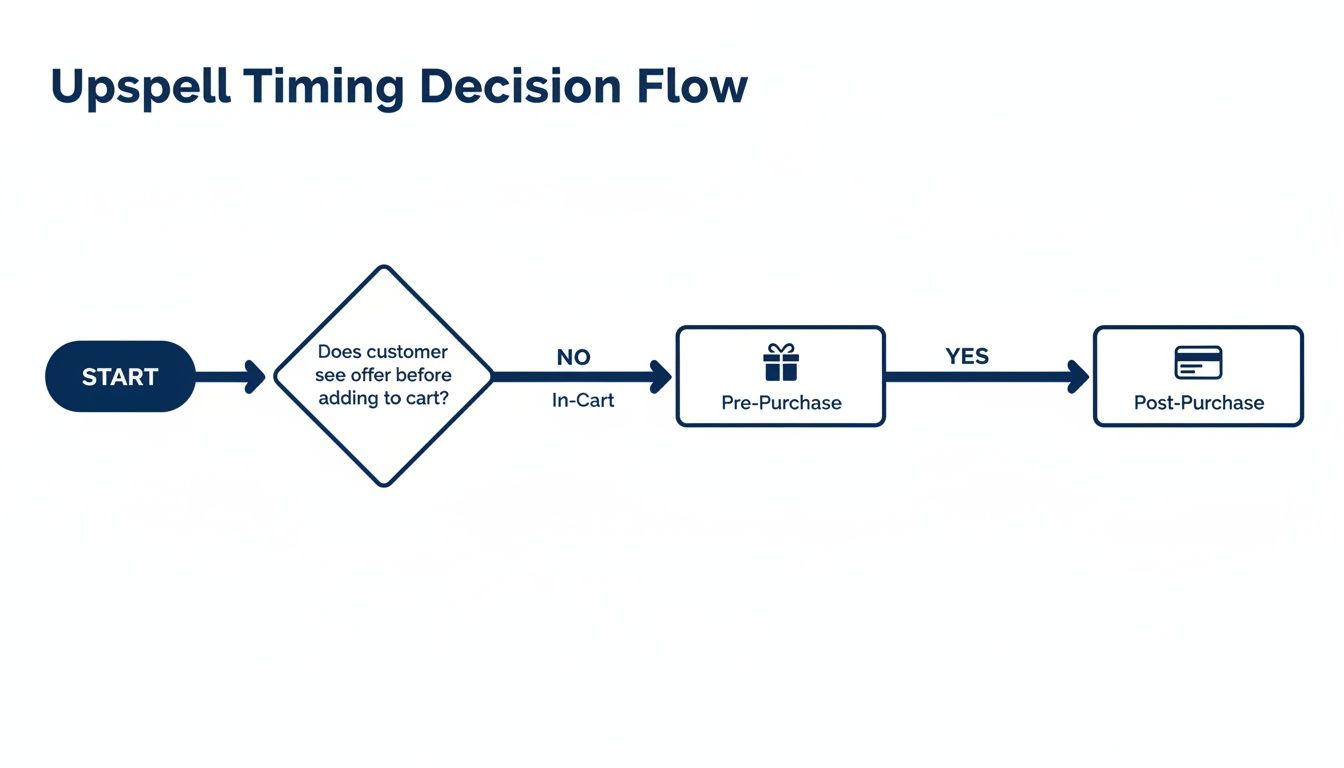
As you can see, in-cart offers are unique because they engage shoppers who have already shown clear buying intent by adding an item to their cart. It's the perfect moment to make a relevant suggestion that builds value and boosts AOV without risking the sale.
Analytics, Customization, and Support
Finally, a great app puts you in the driver's seat with data and control. Without solid analytics, you're just guessing. You need to track key metrics like offer acceptance rates, AOV lift, and total revenue attributed to your campaigns to truly understand what’s working and what isn’t.
Your upsell app should also look and feel like it belongs on your site. Look for deep customization options that let you match your store's fonts, colors, and overall design aesthetic. A seamless look builds trust and reinforces your brand. Many apps also connect with your other tools, which is a huge plus. You can see how Monster Cart integrates with other popular Shopify apps to create a more unified marketing system.
And please, don't overlook support. When something goes wrong (and eventually, it will), you need a responsive and knowledgeable team you can count on. Good support can be the difference between a minor hiccup and a major sales disaster. Once you’re up and running, a virtual personal assistant for Shopify sellers can also be a huge help in managing and optimizing your campaigns.
Upsell App Evaluation Checklist
To make this process easier, use this checklist to score potential upsell apps. It covers the critical features and performance metrics that really matter for growing your store.
Evaluation Criteria | What to Look For | Why It Matters |
|---|---|---|
Offer Flexibility | Does it support tiered rewards, free gifts, free shipping bars, and bundles? | A diverse toolkit lets you create engaging, non-discount-based campaigns that protect your margins. |
User Experience (UX) | Are the offers presented in-cart or via disruptive pop-ups? Is the design clean and intuitive? | A smooth, non-intrusive experience increases conversion rates and prevents cart abandonment. |
Site Speed Impact | Is the app lightweight? Do reviews mention any slowing down of the store? | Slow load times kill conversions and harm SEO. Your app should be built for performance. |
Customization | Can you easily match the app's design (fonts, colors, layout) to your brand's theme? | A seamless look builds customer trust and reinforces your brand identity. |
Analytics & Reporting | Does it track AOV lift, conversion rates, and revenue generated by upsells? | Data-driven insights are essential for optimizing your strategy and proving ROI. |
Integrations | Does it connect with your other essential apps (e.g., email marketing, review apps)? | A connected tech stack creates a more powerful, automated marketing engine. |
Support Quality | Is support responsive, knowledgeable, and available when you need it? | Reliable support minimizes downtime and helps you resolve issues quickly before they impact sales. |
This framework gives you a clear, structured way to compare apps beyond their surface-level marketing claims, ensuring you choose a tool that truly aligns with your business goals of increasing AOV and lifetime value.
A Look at the Top Shopify Upsell Apps
Now that we have a solid framework for judging what makes an upsell app great, let's dive into some of the most popular options on Shopify. Each app comes at the problem from a slightly different angle, whether it's capturing sales after checkout or building complex product bundles. Knowing their specific strengths will help you figure out which tool—or combination of them—is the right fit for your store.
The Shopify upsell space is crowded and competitive, but a few key players stand out. For example, Upsell & Cross Sell — Selleasy has earned a 4.9-star rating from over 2,022 reviews by becoming the master of "frequently bought together" suggestions and accessory bundles. It's a classic strategy that has proven to boost AOV by 15-30% for DTC brands all over the world. You can find more details about top-performing Shopify apps and their impact on AOV to see how effective these can be.
What's clear is that merchants are shifting their strategy. They’re moving away from generic, in-your-face pop-ups and toward offers that feel integrated and genuinely valuable. The goal is no longer just to sell more; it’s to make customers want to add more to their cart by rewarding them.
Aftersell for Post-Purchase Power
Aftersell has carved out its niche by focusing on that golden moment after a customer completes their purchase. Once payment is confirmed, trust is at its absolute peak. Aftersell leverages this by presenting one-click offers right on the thank you page, letting customers add another item to their order without having to pull out their credit card again.
It's a brilliant strategy because it never jeopardizes the original sale. If the customer isn't interested, they simply move on, and you've still got the order. It’s a low-risk, low-friction way to tack on some extra revenue. The only real limitation is its timing—it only works after checkout, which means you miss out on chances to increase the cart value and build loyalty before the customer pays.
Bundler for Complex Product Combinations
As the name suggests, Bundler does one thing and does it exceptionally well: it creates product bundles. You can build classic bundles, let customers mix and match, or even set up tiered discounts like "Buy 3, get 10% off." It’s a fantastic way to increase the perceived value of a purchase and nudge shoppers toward buying items that naturally go together.
By grouping products, you encourage a larger initial spend right from the product page. While this pre-purchase approach is highly effective, especially for stores with complementary product lines, it's less flexible for rewarding customers based on their total cart value, which can limit its impact on overall lifetime value.
ReConvert for Thank You Page Optimization
Much like Aftersell, ReConvert also operates in the post-purchase space, but it’s much more than just an upsell tool. ReConvert aims to turn your entire thank you page into a powerful marketing engine. You can add everything from product recommendations and customer surveys to a birthday collector.
It’s an incredible tool for driving repeat business and gathering customer insights. The main goal here is to secure the next sale and build a stronger, long-term relationship. While it does have upsell capabilities, its core mission is re-engagement, setting it apart from apps designed purely to boost AOV on the spot.
Monster Cart for a Holistic In-Cart Experience
This is where the strategy pivots from a single-point solution to a fully integrated system. While the apps we've looked at are great at what they do, they often rely on pop-ups or separate funnels that can feel disconnected from the core shopping journey. Monster Cart walks a different path, transforming the native cart drawer itself into a dynamic rewards engine.
Instead of interrupting the shopper, it weaves rewards directly into the experience they're already having. A customer can see their real-time progress toward free shipping, watch as they unlock a free gift, and browse relevant add-ons—all within a single, branded interface that feels like a natural part of your store.
The most effective upselling feels less like a sales pitch and more like a personalized service. By integrating rewards directly into the cart, you make the customer feel like they are earning perks, not being sold to. This subtle shift is crucial for building lifetime value.
This integrated approach gets to the heart of boosting AOV without just throwing discounts at people. You're offering real value—a free gift, free shipping—in exchange for a higher spend. It creates a fun, "gamified" feeling where the customer is motivated to hit that next reward tier, naturally pushing their order value higher. By keeping everything contained within the cart, Monster Cart delivers a smooth, frictionless journey that avoids the jarring nature of pop-ups, ultimately creating a superior, brand-aligned experience that builds real loyalty.
Why an Integrated In-Cart Experience Delivers Better Results
We've all seen stores that feel... cobbled together. You add an item, and a clunky pop-up appears from one app. Then a slide-out from another. Maybe a banner from a third. While single-purpose apps have their place, relying on too many creates a fragmented, jarring experience for your customers. It's confusing, it's slow, and it feels cheap.
A much smarter approach is to use a unified, in-cart system. This isn't just about cutting down on the number of apps you're running; it's about creating a single, seamless shopping experience that feels intentional. It's a fundamental part of effective shopping cart optimization—when the journey is smooth, conversions go up. Simple as that.
From Standard Cart to Dynamic Rewards Engine
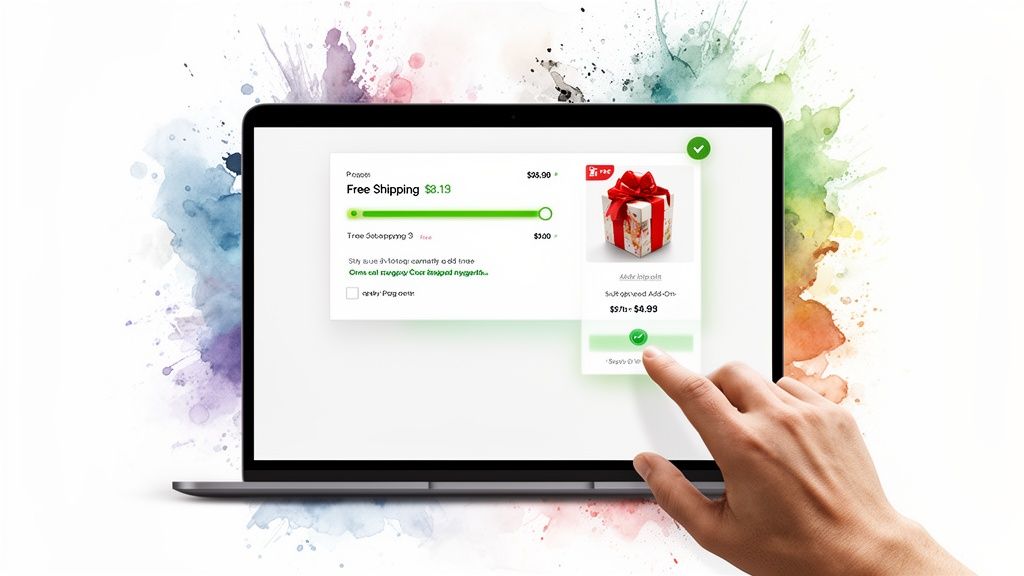
Let’s walk through a better scenario. A customer adds a product to their cart. Instead of an aggressive pop-up, a beautiful cart drawer slides out, perfectly matching your store's branding. Inside, they see a progress bar showing they’re getting close to free shipping. Right below it, a friendly nudge: "Spend just $15 more to unlock a free gift!" And just beneath that, a relevant add-on they can pop into their cart with a single click.
That's the magic of an integrated solution. It transforms the standard Shopify cart from a boring holding pen into a dynamic rewards engine. Every interaction happens in one place, gently guiding the customer toward a higher cart value without ever feeling pushy or interrupting their flow.
This one change accomplishes so much, all at once:
You boost your Average Order Value without having to slash your margins with big discounts.
You create a fun, gamified experience that makes people want to spend more and come back later.
The entire process is frictionless, which is key to cutting down on abandoned carts.
The Power of a Unified Customer Journey
This is precisely where an app like Monster Cart really shines. It rolls a free shipping bar, tiered free gifts, product recommendations, and one-click add-ons into a single, customizable slide-out cart. For your customer, it’s just one cohesive experience. For you, it's a powerful machine for increasing AOV and keeping shoppers happy.
And this strategy flat-out works. Brands using Monster Cart have generated over $712M in revenue directly attributed to the app. That’s real-world proof that a seamless, in-cart approach gets results.
An integrated system doesn't just sell more products; it sells a better shopping experience. When customers feel rewarded and guided—not pushed and interrupted—they are more likely to complete their purchase and return in the future.
This idea of a unified, on-brand experience is a huge trend right now, especially with the rise of AI-driven tools. Some of the newest AI upsell apps, for example, can drive post-purchase AOV increases of up to 30% by showing hyper-relevant offers based on a customer's history. They can pull data from review platforms and email services to create a truly personalized journey. It’s all part of the same philosophy: layer rewards and offers into the natural flow of the cart.
Ultimately, by bringing all your offers inside the cart, you’re creating a powerful, self-contained conversion funnel. It’s a more elegant and effective way to grow that respects your customer and strengthens your brand with every single click.
Frequently Asked Questions About Upsell Apps
Diving into the world of Shopify upsell apps always brings up a few key questions. Let's tackle the most common ones I hear from merchants, so you can move forward with a clear strategy that actually adds value for your customers, instead of just chasing a sale.
Will an Upsell App Slow Down My Store?
This is probably the most important question you can ask. The short answer? A poorly built app absolutely will, but a great one won't. Site speed is everything, and app bloat is a real problem on Shopify. Stacking multiple apps with conflicting scripts is a surefire way to slow your store to a crawl and tank your conversions.
Your best bet is to look for apps designed with performance in mind. An all-in-one tool like Monster Cart is often a smarter choice because it bundles several features (like a free shipping bar, gift rewards, and product add-ons) into a single, optimized script. This avoids the slowdown you get from installing three or four separate apps, keeping the experience snappy for your shoppers.
Won't Upsells Just Annoy My Customers?
They definitely will if you do them wrong. We've all been hit with those aggressive, irrelevant pop-ups right when we're about to check out. It’s disruptive and the fastest way to get someone to abandon their cart.
The trick is to reframe your thinking from interruption to enhancement. In-cart rewards don't annoy people; they delight them. When a customer sees they’re just $10 away from unlocking free shipping or a surprise gift, it feels like they’re winning. It becomes a positive part of their shopping journey. You're adding value and rewarding them for shopping with you, which is how you build loyalty and increase customer lifetime value.
A great upsell strategy should feel like a helpful store associate, not a pushy salesperson. By offering value-driven rewards instead of just pushing more products, you make the customer feel smart and appreciated, not targeted.
How Do I Actually Measure the ROI of an Upsell App?
Just looking at how many people accepted an offer doesn't tell you the whole story. A solid upsell app needs to give you clear, actionable analytics that connect directly to your bottom line.
You need to be able to easily see:
Attributed Revenue: How much extra cash is this app directly responsible for bringing in?
Average Order Value (AOV) Lift: What's the real percentage increase in AOV for carts that engage with your offers?
Offer Conversion Rate: Which specific rewards or upsells are resonating most with your customers?
Tracking these key metrics lets you stop guessing and start making data-backed decisions. This way, you can be sure your strategy isn't just making one-off sales, but is actually building a more profitable, sustainable business.
We've covered the big questions, but here are a few more that often come up. This table gives you the quick-and-dirty answers.
FAQ Quick Answers
Question | Key Takeaway |
|---|---|
What's the best place for an upsell? | In-cart is best. It's less intrusive than pop-ups and catches customers when they have the highest purchase intent, right before checkout. |
Should I offer a product or a reward? | Start with rewards. Free shipping and free gifts feel like a bonus, not a sales pitch. They build goodwill and are often more effective at boosting AOV. |
How many upsell offers are too many? | Keep it simple. One or two clear, tiered goals (e.g., free shipping, then a free gift) works best. Overwhelming customers with choices leads to paralysis. |
Do I need a developer to set this up? | No. Modern apps like Monster Cart are designed for merchants to install and customize themselves in minutes, with no coding required. |
Hopefully, these answers give you the confidence to start implementing a smarter upsell strategy that both your customers and your bottom line will love.
Ready to turn your shopping cart into a rewards engine that boosts AOV without annoying customers? With Monster Cart, you can create a seamless, on-brand in-cart experience with free gift tiers, shipping progress bars, and one-click add-ons.
Join 7000+ brands using our apps