Boost AOV with Buy More Save More Strategies
Dec 20, 2025
|
Published
A "buy more, save more" strategy is a powerful way to nudge your average order value higher. It's about offering customers smart incentives to purchase more, but it goes way beyond simple discounts. We're talking about using rewards like free gifts or free shipping to encourage bigger carts while actually protecting your profit margins and building real customer loyalty for greater lifetime value.
Rethinking the Discount Mindset
Let's get one thing straight: "buy more, save more" isn't just about slashing prices. The real goal here is to elevate your Average Order Value (AOV) and Customer Lifetime Value (LTV) in a way that strengthens your margins, rather than eroding them with constant sales.
This whole approach taps into some fascinating customer psychology. When a shopper unlocks a reward by adding another item to their cart, they get a little hit of dopamine. It feels like an accomplishment, a smart move. This simple shift turns a routine transaction into a genuinely rewarding experience that builds a foundation for long-term loyalty.
Moving Beyond Percentage-Off Deals
The most profitable "buy more, save more" campaigns almost always pivot away from hefty discounts and lean into value-added rewards instead. This is a critical distinction for building a sustainable business and increasing lifetime value. Think about offering things that delight customers without killing your bottom line:
Exclusive Free Gifts: Find a high-perceived-value, low-cost item and offer it as a gift when customers hit a spending goal. This is a fantastic way to introduce them to other products in your catalog and create a memorable unboxing moment.
Free Express Shipping: We all know high shipping costs are one of the biggest reasons for cart abandonment. Offering free—or even upgraded—shipping at a certain threshold is a proven tactic to get customers over the finish line. It often just takes one more item.
Future Store Credit: Reward today's purchase with a credit for their next one. This is a brilliant move for boosting LTV and practically guarantees a repeat visit.
This focus on adding value over just discounting is becoming a dominant strategy for smart brands. During a recent Black Friday season, a survey found that 27.4% of merchants chose product bundles or "buy more, save more" offers as their main promotion, beating out traditional tiered discounts.
To see just how different these approaches are, let's break down their long-term impact.
Value-Added Rewards vs Traditional Discounts
Metric | Value-Added Rewards (Free Gift, Shipping) | Traditional Discounts (10% Off) |
|---|---|---|
Profit Margin | Protected. The cost of the reward is fixed and often low, preserving the margin on the core purchase. | Directly reduced. A percentage-off discount cuts into the profit of every single item in the cart. |
Brand Perception | Enhanced. Perceived as a premium, customer-focused brand offering thoughtful rewards. | Can be devalued. Constant sales train customers to wait for discounts, cheapening the brand. |
Customer LTV | Increased. Free gifts introduce new products, and future credits encourage repeat purchases and build loyalty. | Often stagnant. The transaction is purely price-driven, with little incentive for future loyalty. |
AOV Impact | Strong. Customers add specific items to their cart to unlock a tangible, desirable reward. | Moderate. Can increase AOV, but often attracts bargain hunters who buy just enough to qualify. |
The takeaway is clear: value-added rewards build a healthier, more sustainable relationship with your customers.
The goal is to make your customers feel rewarded, not just like they caught a sale. This subtle but important distinction is the key to turning a one-time buyer into a long-term advocate for your brand.
By building a system that rewards spending with tangible value, you create a much healthier business model. You protect your profits, increase order sizes, and build a loyal customer base that comes back again and again. To truly grasp the potential of these strategies, explore examples from these successful 10 Ecommerce Ads That Made Millions.
Implementing this with a sophisticated tool like Monster Cart allows you to automate these value-driven campaigns directly in the cart, making the entire experience completely seamless for your shoppers and encouraging higher lifetime value.
Designing a Profitable Campaign Framework
A great "Buy More, Save More" campaign isn't about slapping a random discount on your store and hoping for the best. The most successful ones I've seen are built on a smart, data-driven framework designed to lift your average order value (AOV) without cannibalizing your profits. It's a delicate balance, but getting it right means finding the sweet spot between an irresistible reward for your customer and a healthy bottom line for you.
Before you even dream up a reward, you need to know your numbers. Seriously, get into your analytics and find your store's AOV over the last 90 days. This one metric is your North Star. A solid rule of thumb is to set your first reward threshold about 15-30% higher than your current AOV.
Let's say your AOV is sitting at $65. Setting your first tier at $80 is a fantastic starting point. It feels achievable to a shopper who's already close, nudging them to add just one more small item to their cart. Go too high, and they'll abandon the effort. Too low, and you won't see a meaningful lift.
Choosing Your Campaign Structure
Once you have your target threshold, you can get creative with the campaign's structure. This is where you can move beyond just percentage-off discounts. Instead of just slashing prices, think about what genuinely adds value to your customer's experience. This is how you build lifetime value, not just make a one-off sale.
Here are a few proven structures that I've seen work incredibly well:
Spend-Based Rewards: This is the classic model for a reason. It’s simple: "Spend $X, get Y." It works perfectly for high-value incentives like free shipping or a free gift. For a coffee brand, a great example would be, "Spend $60, get a free ceramic mug."
Quantity-Based Rewards: This approach is perfect for encouraging customers to stock up or try more from a specific collection. A skincare brand, for instance, could run an offer like, "Buy any 2 serums, get a free mini-cleanser." It's an excellent way to move specific inventory or highlight a new product line.
Tiered Rewards: This structure gamifies the shopping experience, offering bigger and better rewards as the customer adds more to their cart. An apparel store could set up tiers like this: "Spend $75, get free shipping. Spend $125, get a free tote bag, too!"
The goal is to turn a simple purchase into a cycle of reward and, eventually, loyalty.
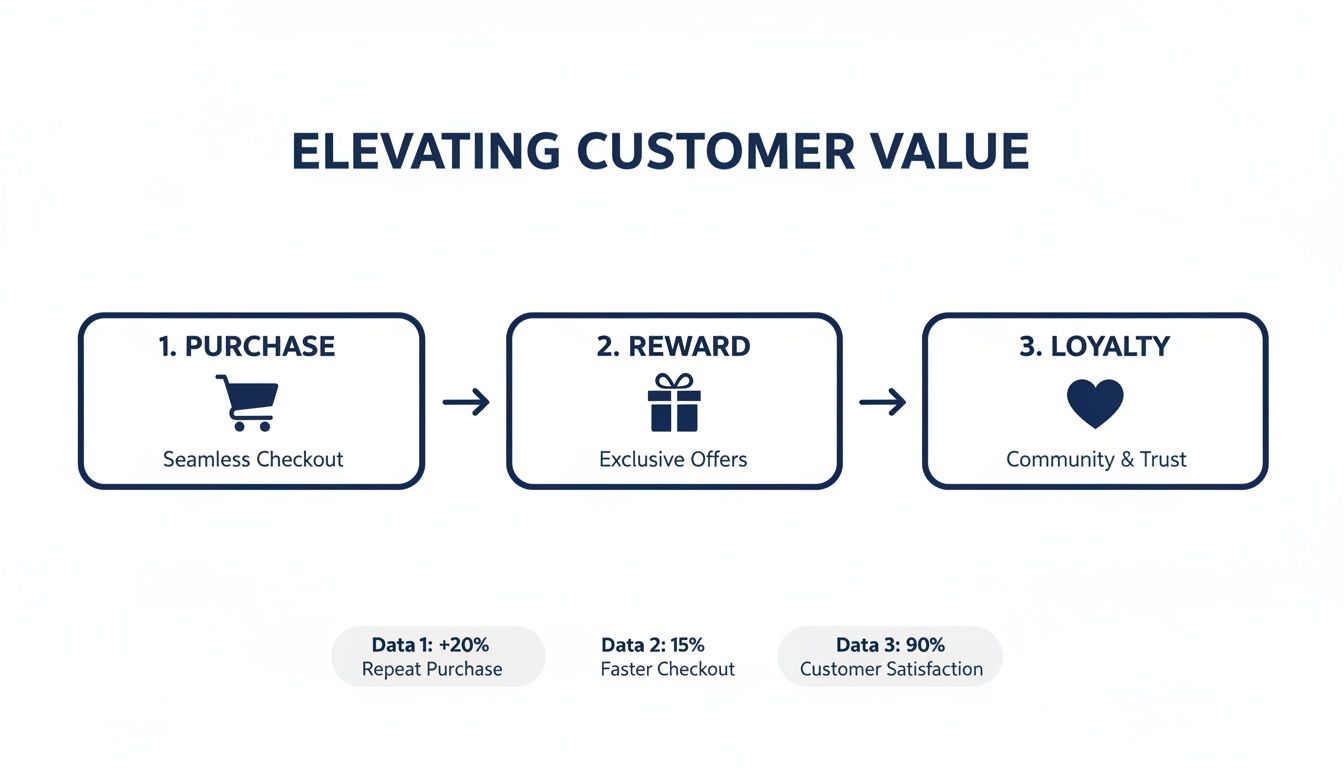
This process shows that the real win isn't just that first transaction; it's using a smart reward to create a lasting relationship with a happy customer.
Selecting Strategic Rewards and Products
The reward you choose is the star of the show. The best ones have a high perceived value for the shopper but a relatively low cost to you. A free gift, for instance, often costs you less than a 15% discount on a big order, but it feels far more special and creates a memorable unboxing experience.
You should also be strategic about which products you feature in these campaigns. This is your chance to direct customer behavior to meet specific business goals.
Bestsellers: Want to pour gas on the fire? Including your most popular products in a quantity-based deal can amplify their success and give your AOV a quick jolt.
Slow-Moving Items: Got some inventory that's collecting dust? Bundle a slower-moving item with a bestseller in a "buy one, get one" style offer.
High-Margin Products: You can protect your profits by attaching a compelling reward specifically to the purchase of your most profitable items.
By focusing on value-added incentives like a thoughtfully chosen free gift or the simple convenience of free shipping, you shift the customer's focus from "how much can I save?" to "what extra value can I get?" This mindset is crucial for protecting your brand's integrity, your margins, and building lifetime value.
Ultimately, the most profitable framework is one that feels like a win-win. The customer feels smart and rewarded, and you see a real, measurable lift in your AOV and profit. Using a tool like Monster Cart lets you automate all of this right inside the cart, creating a seamless experience that visually guides shoppers toward unlocking their next reward without any friction.
Crafting Irresistible Messaging That Converts
Once you've nailed down the numbers and margins for your campaign, the real work begins: communicating the offer. The most brilliant "buy more, save more" deal will completely miss the mark if the messaging is dry, confusing, or buried somewhere on your site.
Effective communication isn't just about stating the facts. It’s about crafting clear, compelling copy that guides customers toward the reward without sounding like an aggressive sales pitch. You have to shift your focus from simply stating the offer to highlighting the benefit for the customer. It's a subtle change in perspective, but it's incredibly powerful.
From Features to Benefits
Let's take a classic example: the free shipping threshold. Most stores just use a static, uninspired banner that says, "Free shipping on orders over $75." It gets the job done, I guess. But it's just a feature, a store policy. It doesn't create any excitement or urgency.
Now, let's reframe that into a benefit. Imagine a shopper has $60 worth of products in their cart. Instead of that static banner, what if the message changed dynamically to something like this?
"You're only $15 away from unlocking FREE shipping!"
"Add one more item to get your order delivered free!"
"So close! Your order is just about ready for free shipping."
See the difference? This kind of messaging accomplishes a few things at once. It clearly tells the shopper what to do next, creates a gentle nudge of urgency, and frames the action as a smart decision to unlock a reward. This is how you encourage a higher AOV while making the customer feel good about their purchase.
Gamifying the Cart with Visual Motivators
Good copy is essential, but let's be honest—visual cues often convert even better. The moment a customer adds something to their cart is a critical touchpoint. You can use this moment to gamify the experience and show them exactly how close they are to the next reward.
A dynamic, in-cart progress bar is one of the most effective tools I've seen for this. It’s the same psychological hook that makes fitness trackers or video game level-ups so addicting. As the shopper adds items, the bar fills up, visually reinforcing their progress toward the goal.
When a customer can see their progress, adding another item stops feeling like spending more money and starts feeling like winning a game. This simple visual transforms the transaction into an engaging, interactive experience.
This is where a dedicated cart app like Monster Cart really makes a difference. It can replace Shopify's default cart with an interactive rewards layer. As customers add items, Monster Cart's progress bar updates in real-time, showing them exactly what they need to do to unlock the next tier—whether it's free shipping, a discount, or a free gift. The cart itself becomes your most powerful conversion tool.
Consistent Communication Across the Journey
To really make your "buy more, save more" campaign work, the messaging can't just live in the cart. It needs to be consistent across the entire shopping journey. You have to broadcast the value clearly and creatively from the moment a visitor lands on your site.
Here’s a quick-and-dirty checklist for keeping your message front and center:
Homepage Banner: Use a prominent, site-wide banner at the top of your page. Keep it short and sweet, like "Unlock a Free Gift with any $100+ Order!"
Product Pages: Add a subtle reminder near the "Add to Cart" button. Think something like, "Add this and you're halfway to free shipping!"
In-Cart Notifications: This is where you use that clear, dynamic text we talked about, with messages that update as the cart total changes.
By weaving your message into every touchpoint, you create a seamless and persuasive experience. The goal is to gently guide, not aggressively push. You want customers to feel like they're making a smart choice that leads to a bigger, more valuable purchase—a win for them, and a win for you.
Building a Seamless In-Cart Experience
All your strategic planning can go right out the window if the checkout process is clunky. I’ve seen it happen: a brilliant "buy more, save more" offer falls completely flat because it creates friction right when a customer is ready to pay. The whole point is to turn your strategy into a smooth, automated reality that feels like a natural part of shopping.
This is where the in-cart experience becomes your most important asset. Forget disruptive pop-ups or banners that get ignored. You need to build your rewards directly into a dynamic, interactive cart. That’s where a tool like Monster Cart comes in, transforming the standard Shopify cart from a simple last step into a powerful rewards engine.
Automating Value with Every Click
Let’s walk through a real-world scenario. Imagine you run a skincare brand and know that offering a high-value, low-cost sample is a great way to boost your average order value (AOV) and customer lifetime value. You decide to run a "Spend $100, get a free travel-size bestseller" campaign.
Instead of just mentioning this in a header bar, you build this logic right into your cart. With an app like Monster Cart, you can set up this spend-based goal in a few minutes, no code required. You just define the $100 threshold and tell the app which free gift to automatically add once the customer hits that magic number.
This automation is what makes the experience feel so seamless. The customer doesn't have to remember a coupon code or click to a separate page to claim their gift. It just happens as a direct result of their shopping, which makes them feel smart and rewarded.
The Power of Visual Progress
The real magic, though, is what the customer sees in real-time. The most effective in-cart systems use visual motivators to guide shopper behavior, and a simple progress bar is a perfect example of this psychological nudge.
As a customer adds products to their cart, a bar fills up, showing them exactly how close they are to unlocking their free gift. The messaging updates dynamically, shifting from "You're $45 away from your free gift!" to "Just $10 more to go!" This gamifies the experience, turning the idea of spending more into a fun little challenge.
By transforming the cart into an interactive journey, you shift the customer’s focus from the total cost to the next reward they can unlock. This simple change in perspective is incredibly effective at encouraging those small, spontaneous additions that drive up AOV.
This visual feedback loop is critical. It preemptively answers the customer's questions, creating a frictionless path to a larger order.
Proving the Model with Real-World Results
This approach isn't just a neat theory; it delivers real, measurable results. Take a look at clothing retailer Eddie Bauer. They were facing inventory challenges and needed to boost key sales metrics, so they rolled out progressive discounts to incentivize bigger baskets. The results were staggering. Compared to their standard orders, the campaign delivered:
135% more units per order
A massive 7.72% surge in profit margins
These are the kind of numbers that prove the model works. You can get more details on how they did it by exploring promotion strategies for inventory management.
Here’s a glimpse of how easily you can set up these tiered rewards in Monster Cart, attaching a specific free gift to a spending goal.

The setup shows just how simple it is to create a spend-based goal and attach a high-value reward, turning a potentially complex offer into something totally seamless for the customer.
By automating these multi-level offers, you're not just pushing for a conversion. You're creating an experience that reinforces your brand’s commitment to providing real value. It’s about encouraging customers to spend more by rewarding them, not just by discounting. This focus on adding value is what drives not only a higher AOV today but also builds the kind of loyalty that leads to a much greater lifetime value down the road.
Fine-Tuning Your Campaign: Analysis and Optimization
Getting your "Buy More, Save More" campaign live is just the beginning. The real magic, and the real profit, happens in the weeks and months that follow. Think of your launch as your best-educated guess. Now it's time to let your customers' behavior tell you what really works. This is where you'll turn a decent promotion into a revenue-driving machine.
The goal isn't just a generic bump in sales. You need to understand the why behind the numbers. Are you successfully pushing your Average Order Value (AOV) higher without spooking customers and tanking your conversion rate? Are you protecting your profit margins? Answering these questions means getting comfortable with your data.
Focus on the Metrics That Actually Matter
To see the real impact of your campaign, you have to look beyond top-line revenue. Three key metrics will give you the full story of how your offer is changing shopper behavior.
Average Order Value (AOV): This is your north star. Is the offer actually compelling people to add more to their carts? A solid lift in AOV is the first sign that your thresholds and rewards are hitting the mark.
Conversion Rate: Watch this one like a hawk. If your AOV is soaring but your conversion rate plummets, it’s a red flag. Your offer might be too confusing, or the spending threshold is just too high for most visitors, scaring them away before they even check out.
Profit Margin Per Transaction: Are you actually making more money on each sale? A well-designed campaign, especially one using value-adds like a free gift, should protect or even boost your margin. Heavy discounts, on the other hand, almost always eat into it.
Interpreting this data is a bit of a balancing act. For instance, an AOV jump of 20% looks fantastic on its own, but if it comes with a 15% drop in conversions, you might not be any better off. The sweet spot is a healthy AOV increase while keeping your conversion rate stable or even seeing a small lift. To get a broader view on using analytics effectively, it's worth exploring different data-driven marketing strategies.
A Practical A/B Testing Framework
Your analytics tell you what happened. A/B testing tells you why. This is how you discover which rewards truly motivate your audience. You don't need a complex, expensive setup—just a simple, methodical approach to find your winning formula.
The key is to test one thing at a time. The most common and effective test for these campaigns is pitting two different rewards against each other at the same spending threshold.
Here's a real-world example:
Test A (Run for 2 weeks): "Spend $75 and get FREE shipping."
Test B (Run for the next 2 weeks): "Spend $75 and get a free travel-size bestseller."
By running each variation for a set period, you gather enough data to make a confident decision. Once the month is over, dive into the numbers. Compare the AOV, conversion rate, and total revenue from both periods. Did the practical appeal of free shipping win out over the excitement of a free product? The data will point you in the right direction for your next move.
You're not searching for a single "perfect" offer that will work forever. The goal is continuous improvement. Customer preferences shift, so what works today might be stale in six months. Regular testing is what keeps your strategy sharp and profitable.
And the proof is in the pudding. Recent Black Friday statistics showed that "buy more, save more" promotions were a massive driver of sales, contributing an extra $2-3 billion in online spending. This type of offer ranked just behind free gifts as a favorite tactic for merchants. This just goes to show how powerful these campaigns can be when you get the optimization right.
Ultimately, this cycle of analysis and testing is what separates the most successful brands. A tool like Monster Cart not only gives you the power to set up these tiered offers with ease but also provides the built-in analytics to see how they're performing. This creates a powerful feedback loop, allowing you to make quick, data-backed adjustments and ensure your in-cart strategy is always maximizing both revenue and customer lifetime value.
Common Questions About Buy More, Save More
Diving into a "buy more, save more" strategy can feel like a big move, but it’s hands-down one of the best ways to bump up your average order value and build a loyal customer base. As you get started, some questions are bound to pop up. Let's walk through the most common ones so you can launch your next campaign with total confidence.
Will a Buy More, Save More Campaign Hurt My Profit Margins?
This is always the first question, and for good reason. The short answer? Not if you do it right. The trick is to stop thinking about hefty discounts and start thinking about value-packed rewards. Instead of just slashing prices, consider incentives that feel like a big win for the customer but have a low actual cost for you.
For instance, offering a free gift that costs you $5 on a $100 order is only a 5% hit to your margin. Compare that to a blanket 15% off discount, which would cost you $15 on that same order. Suddenly, the free gift looks a lot more profitable, doesn't it?
Free shipping is another fantastic tool. The cost is predictable and often less than a percentage discount, yet it tackles one of the biggest reasons people abandon their carts. The goal isn’t to give away your profits—it’s to increase the total profit you make on each and every sale.
What Reward Works Better: A Free Gift or Free Shipping?
This really boils down to your specific audience and products, and honestly, the only way to know for sure is to test it out.
Free shipping has almost universal appeal. Nobody likes seeing that extra shipping charge pop up at the end, so removing it is a powerful and reliable motivator. It's a safe bet for pretty much any store.
A free gift, on the other hand, can create a much more memorable unboxing experience. It’s a chance to introduce customers to other products they might love, which can lead to future sales and boost their lifetime value. It makes the whole purchase feel less like a transaction and more like a treat.
The best way to get a definitive answer is to A/B test it. Run a "spend $75, get free shipping" campaign for two weeks. Then, for the next two weeks, switch it to "spend $75, get a free travel-size bestseller." Check your analytics to see which one drove a higher AOV and conversion rate. The data will tell you what your customers truly value.
How Do I Set the Right Spending Thresholds for My Offers?
Nailing the right spending threshold is a bit of an art and a science. You want to encourage customers to spend more without making the goal feel impossible. A proven sweet spot is to set your first reward tier about 15-30% above your current Average Order Value (AOV).
First, pull up your store's AOV from the last 90 days. Let's say it's $60. A perfect starting point for your first threshold would be around $75. This feels totally achievable for someone already planning to spend $60—they just need to add one more small item to their cart to unlock the reward.
If you set the bar too high (say, $150), shoppers might just give up. But if you set it too low (like $65), you won't see a meaningful lift in your AOV. Use your data to find that perfect balance, and don't be afraid to tweak it over time based on performance.
Can I Run These Promotions for Specific Products or Collections?
Absolutely! In fact, this is where these campaigns become a seriously powerful strategic tool. Using a flexible app like Monster Cart allows you to get creative and move beyond simple store-wide deals.
Imagine running targeted offers like these:
"Buy any 2 items from our new summer collection and get a free beach towel."
"Purchase our bestselling skincare kit and unlock a free mini-cleanser."
This approach is perfect for shining a spotlight on new arrivals, clearing out last season's inventory, or pushing high-margin products. Targeted offers feel more personal and relevant to the shopper, which often translates to much higher conversion rates than a generic, one-size-fits-all promo.
Ready to turn your cart into a revenue engine? With Monster Cart, you can build these intelligent, multi-tiered reward campaigns in minutes, increasing your AOV without the need for hefty discounts. See why thousands of Shopify's top brands trust Monster Cart to create a seamless, high-converting in-cart experience.
Join 7000+ brands using our apps