10 Smart Cross Sell Examples to Boost AOV Without Deep Discounts in 2026
Jan 15, 2026
|
Published
In the relentless pursuit of higher Average Order Value (AOV), merchants often turn to the most obvious tool: discounts. But what if slashing prices isn't the only, or even the best, way to grow? Relying on constant sales can erode profit margins and attract one-time bargain hunters, not loyal customers. To achieve sustainable growth beyond just discounts, it's crucial to implement strategic approaches to boost revenue. For a comprehensive look at increasing your cart size, explore these 11 proven tactics to increase average order value.
This article explores 10 powerful cross sell examples designed to increase both AOV and customer lifetime value (LTV) by genuinely enhancing the shopping experience. We'll move beyond generic pop-ups and focus on reward-based incentives like free gifts, shipping thresholds, and strategic product bundles. You will learn how to create a value-driven journey that encourages customers to spend more because they want to, not just because of a temporary price drop. This focus on rewards over discounts is key to building a loyal customer base and a healthier bottom line.
We will break down the psychology and strategy behind each example, providing actionable takeaways and replicable frameworks you can apply to your store immediately. The goal is to shift your AOV strategy from one of discounting to one of value-adding. You’ll see how a smart, interactive in-cart experience, like the one powered by Monster Cart, can transform your shopping cart from a simple checkout step into your most effective profit engine. Forget annoying pop-ups; it's time to build compelling offers that customers actually enjoy, right inside the cart, boosting both AOV and lifetime value. Let's dive into the examples.
1. Frequently Bought Together (FBT) Bundles
This classic cross-sell strategy leverages your store's sales data to recommend complementary products that customers often purchase in the same transaction. Instead of guessing what shoppers might like, FBT uses actual buying behavior to present highly relevant, data-driven suggestions, making it one of the most effective cross sell examples for boosting average order value (AOV). This method shifts the focus from discounts to genuine value, showing customers how to get more out of their primary purchase and building a foundation for higher lifetime value.
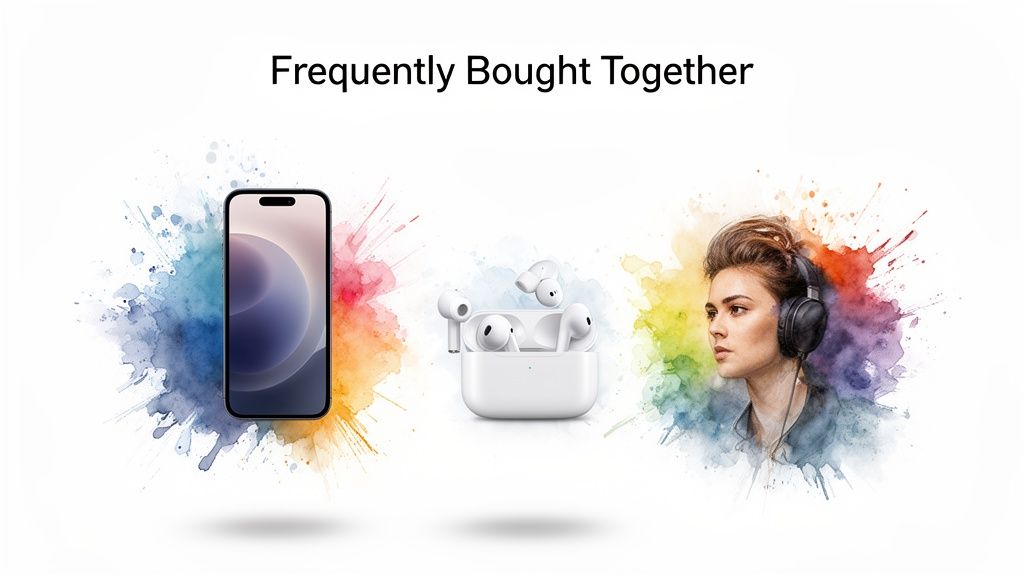
Pioneered by Amazon, the FBT model is incredibly powerful. It works by analyzing transaction patterns to identify natural product pairings. For example, a customer buying a new foundation from Sephora is often also in the market for a primer and setting spray to complete their routine. Displaying these items together simplifies the shopping experience and increases the likelihood of a larger sale without offering a hefty discount.
Strategic Insights & Actionable Takeaways
This approach excels because it feels like a helpful suggestion rather than a sales pitch. It capitalizes on an existing intent, making it a low-friction way to increase cart size and, ultimately, customer lifetime value.
Analyze Purchase Data: Dive into your sales history to find authentic pairings. Look at what your top 20% of customers are buying together to uncover your most profitable bundles.
Limit Recommendations: Avoid overwhelming the customer. Presenting 2-3 highly relevant items is far more effective than a long list of possibilities. This focused approach maintains a clean user experience.
Emphasize the "Complete Solution": Frame your bundle messaging around convenience and completeness. Use copy like "Complete your look" or "Get everything you need" to highlight the value proposition.
Prioritize Profitability: When multiple items could be bundled, use profitability weighting to feature higher-margin products in your recommendations, maximizing your return on each transaction.
With an app like Monster Cart, Shopify merchants can seamlessly integrate FBT bundles directly into the in-cart experience, encouraging add-ons just before checkout without disrupting the customer journey. This leads to an average AOV increase of 15-25% without relying on steep discounts.
2. Free Gift With Purchase (GWP) Tiers
This reward-based cross-sell strategy entices customers to increase their order value to unlock progressively more valuable gifts. Instead of offering a flat discount, GWP tiers create a gamified, in-cart incentive structure that encourages shoppers to add more items to their cart to reach the next reward threshold. This method drives higher AOV by framing the extra spend as a "win" for the customer, making it one of the most effective cross sell examples for boosting revenue while enhancing customer lifetime value.
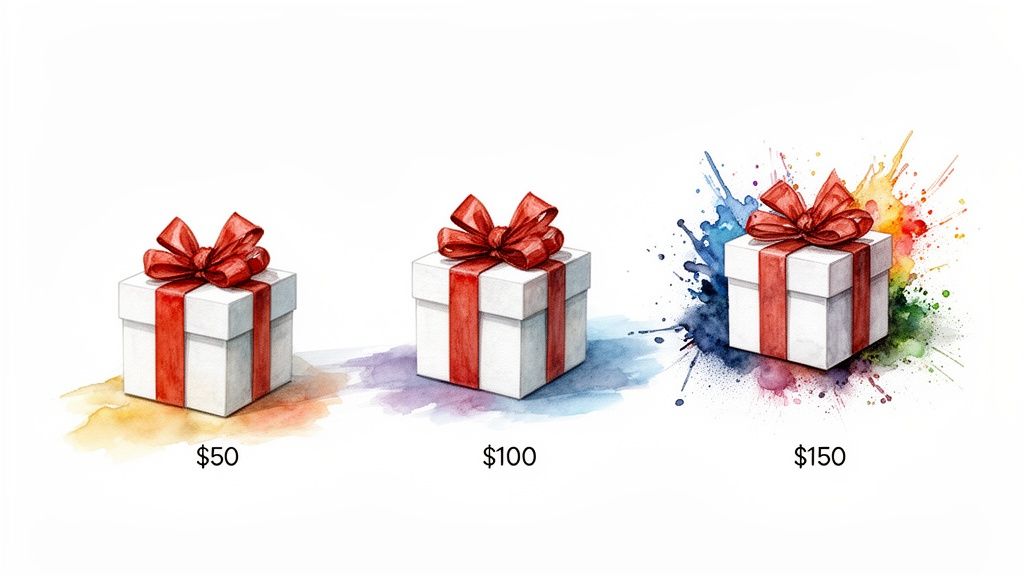
Popularized by beauty giants like Sephora and Ulta, this model turns the shopping cart into an interactive progress bar. A customer might see they are only $15 away from unlocking a deluxe sample or a full-sized product. This visual cue often motivates them to add a small, complementary item they were already considering, effectively cross-selling without a direct sales pitch. Luxury brands like Charlotte Tilbury also use premium gifts to maintain a high-end feel while encouraging larger basket sizes.
Strategic Insights & Actionable Takeaways
GWP tiers excel at increasing customer lifetime value because they are rooted in reward psychology, not price reduction. Shoppers feel appreciated and are more likely to return, knowing they can earn valuable extras with their purchases.
Choose High-Perceived-Value Gifts: Select gifts with a perceived value that is 2-3x their actual cost. Think deluxe samples, exclusive merchandise, or overstocked items that still feel premium.
Create Clear, Visible Tiers: Use a visual progress bar in the cart to show customers exactly how close they are to the next reward. Displaying 3-5 tiered levels is ideal to provide choice without causing decision paralysis.
Align Gifts with Products: Select gifts that naturally complement your product catalog. A skincare brand might offer a free facial roller, encouraging customers to build a complete routine with their products.
Test Gift Appeal: Before a full launch, use customer surveys or A/B testing on a small segment to validate the appeal of your chosen gifts. This ensures your offer resonates and drives the desired action.
With an app like Monster Cart, merchants can implement dynamic, visually engaging GWP tiers directly in the cart. This system automatically updates as customers add items, clearly highlighting their progress and encouraging them to hit the next spending goal to unlock their reward, boosting both AOV and lifetime value.
3. One-Click Add-On Upsells
This cross-sell strategy focuses on lightweight, friction-free product additions that customers can add to their cart with a single click. These are often complementary items or value-added services like warranties, gift wrapping, or shipping protection presented at key decision moments. The one-click mechanism is crucial as it removes barriers to purchase, dramatically increasing conversion rates for these small but profitable additions compared to sending a customer to a separate product page.

Popularized by Amazon's protection plans and shipping services like Route, this method excels by addressing customer pain points at the perfect time. A customer buying a fragile item is likely concerned about it breaking in transit, making a one-click shipping protection offer highly relevant. Similarly, offering gift wrapping in the cart for a popular birthday item simplifies the customer's life and adds an easy, high-margin sale to the order. These are powerful cross sell examples because they solve a problem rather than just sell a product.
Strategic Insights & Actionable Takeaways
The power of one-click add-ons lies in their simplicity and psychological timing. By presenting a solution to an anticipated problem (e.g., package theft, product damage, gift-giving hassle) at the moment of commitment, you create an impulse-driven purchase that feels both helpful and necessary, boosting lifetime value without discounts.
Address Customer Pain Points: Identify common anxieties in your customer journey. Offer shipping protection to combat delivery worries, extended warranties for high-ticket electronics, or priority processing for last-minute shoppers.
Keep It Simple: Limit your add-on offers to 1-2 highly relevant options within the cart or on the product page. Overwhelming customers with choices will lead to decision fatigue and reduce conversions.
Use Clear Copy & Icons: Make the offer instantly understandable. Use straightforward language like "Add Gift Wrap" or "Protect Your Order" paired with a simple icon to communicate the value proposition quickly.
Focus on High-Margin Services: Services like gift wrapping, warranties, and priority processing often have very high profit margins. Promoting them effectively is a great way to increase AOV without discounting your core products.
Tools like Monster Cart make it easy to implement one-click add-ons directly in the Shopify cart, ensuring the process is seamless and doesn't interrupt the path to checkout. This frictionless experience is key to achieving high attach rates for these offers. For more tools to enhance your store's capabilities, you can explore the best Shopify upsell apps available.
4. Buy More, Save More Progressive Discounts
This strategy encourages customers to purchase multiple units of the same item or items from a specific collection by offering tiered discounts. The more they buy, the higher the savings, creating a powerful psychological incentive to increase cart size. Unlike a flat percentage discount, this model frames the offer as a reward for higher spending, shifting the focus from a simple sale to a value-driven purchasing decision. It's an excellent way to boost AOV on best-selling or high-margin products without devaluing your brand.
This approach is highly effective because it gamifies the shopping experience. Customers can see their potential savings increase in real-time as they add more items to their cart. For example, a beauty brand might offer 10% off two best-selling serums, 15% off three, and 20% off four or more. Warby Parker famously uses this model by pricing single pairs of glasses higher and offering significant savings on additional pairs, encouraging customers to build a collection. This makes it one of the most compelling cross sell examples for moving more inventory per transaction.
Strategic Insights & Actionable Takeaways
This method excels by directly linking a larger purchase to a tangible reward, making customers feel smart about spending more. It's a fantastic way to increase units per transaction and customer lifetime value without devaluing your brand with site-wide sales.
Calculate Tiers Carefully: Before launching, analyze your product margins to determine your break-even points. Ensure each discount tier remains profitable while still offering a compelling incentive.
Visualize the Savings: Use in-cart messaging to clearly display how much the customer is saving and how close they are to the next discount tier. Phrases like "Add 1 more to save 20%!" create urgency.
Focus on High-Margin Products: Implement this strategy on products with healthy profit margins first. This allows you to offer attractive discounts while protecting your bottom line.
Keep It Simple: Start with 2-3 tiers to avoid decision fatigue. You can always add more complexity later after analyzing the initial performance data.
With an app like Monster Cart, you can automate these tiered offers directly in the cart drawer. The app dynamically updates the savings as customers add items, providing instant gratification and motivating them to hit the next spending threshold before they even reach checkout, which is a smarter way to discount and protect lifetime value.
5. Free Shipping Threshold Incentives
This strategic approach uses one of the most powerful psychological motivators in e-commerce: the desire to avoid extra fees. By setting a minimum purchase amount to unlock free shipping, you encourage customers to add more items to their cart to reach the threshold. This method masterfully reframes a potential cost (shipping) into a value-driven incentive, making it one of the most effective cross sell examples for increasing average order value (AOV) without offering product discounts.
The "free shipping" offer is a modern retail standard, popularized by giants like Zappos and Amazon, who turned it into a core customer expectation. It works because it taps into loss aversion; customers would rather spend more on products they want than on a service fee they perceive as a "loss." A shopper with $42 in their cart is highly likely to add a $10 item to meet a $50 free shipping threshold, transforming a potential abandoned cart into a larger, more profitable sale.
Strategic Insights & Actionable Takeaways
This strategy is less about a direct product recommendation and more about creating a compelling reason for customers to browse and add more to their order. It's a low-friction way to guide shoppers toward a higher spend while making them feel like they're getting a great deal, which in turn boosts customer lifetime value.
Set the Right Threshold: Analyze your current AOV and set your free shipping threshold approximately 30-40% higher. This makes it feel achievable but still requires customers to add an extra item or two.
Visualize the Goal: Use a prominent progress bar in the cart that shows customers exactly how close they are to unlocking free shipping. This visual cue gamifies the experience and keeps the incentive top-of-mind.
Suggest Helper Products: Don't leave customers guessing. Pair the progress bar with recommendations for low-cost, high-margin items that can help them easily reach the threshold, like accessories or travel-sized products.
Combine with Other Offers: For maximum impact, stack your free shipping incentive with other value-based offers. For example, "Spend $50 for Free Shipping, and get a Free Gift at $75," creates multiple tiers of engagement.
With an app like Monster Cart, you can easily implement a dynamic, visually engaging free shipping progress bar directly in your slide-out cart. This constant, non-intrusive reminder is a proven way to motivate customers to increase their cart size right before they complete their purchase, boosting AOV and lifetime value through rewards, not discounts.
6. Personalized Product Recommendations Based on Cart Content
This dynamic cross-sell strategy uses real-time data to generate product suggestions based on the specific items a customer adds to their cart. Unlike static recommendations, this method analyzes the immediate shopping context to offer highly relevant add-ons, making the suggestions feel like a natural part of the buying journey. It's a powerful way to increase Average Order Value (AOV) by focusing on value and relevance rather than discounts.
This approach transforms the shopping cart from a simple checkout step into an intelligent, personalized shopping assistant. For instance, if a customer adds a high-end camera body to their cart, the system can instantly recommend a compatible lens, a memory card, and a protective case. This contextual awareness makes the offer feel helpful, not pushy, mirroring the personalized experiences pioneered by platforms like Netflix and Amazon.
Strategic Insights & Actionable Takeaways
Personalized recommendations excel by tapping into the customer's current mindset and purchase intent. By showing shoppers items that genuinely complement what they’ve already chosen, you simplify their decision-making process and enhance their shopping experience, which is a key driver for improving customer lifetime value.
Leverage Multiple Recommendation Logics: Combine different algorithms for maximum impact. Use collaborative filtering ("customers who bought this also bought...") and content-based filtering ("products with similar features...") to provide diverse yet relevant suggestions.
Test Recommendation Placement: Don't just stick to one spot. A/B test different zones within the cart, such as a sidebar, a carousel below the item list, or even subtle in-line suggestions, to see which placement converts best for your audience.
Prioritize Relevance Over Quantity: Overwhelming customers with too many options can lead to decision paralysis. Focus on presenting 2-3 highly targeted recommendations that offer a clear benefit or complete a set.
Segment and Personalize Further: Go beyond cart contents. Use customer data like past purchase history or browsing behavior to refine recommendations. A returning VIP customer might see different suggestions than a first-time visitor.
With an app like Monster Cart, merchants can easily implement these smart, in-cart recommendations. The system automatically analyzes cart contents to display compelling offers that encourage customers to add more to their order just moments before checkout, seamlessly boosting AOV without disrupting the path to purchase.
7. Loyalty Program Points Incentives in Cart
This retention-focused strategy transforms the shopping cart into a real-time reward-earning experience. By displaying the loyalty points a customer accumulates as they add items, you gamify the purchase process and visualize the long-term value of their order. This powerful approach bridges the gap between the immediate transaction and future brand engagement, making it one of the most effective cross sell examples for fostering customer loyalty. Instead of a one-time discount, you're offering an investment in future rewards, which is the ultimate key to high lifetime value.
This technique was pioneered by brands like Sephora with its VIB program and Starbucks through its mobile app. They understood that showing customers they are making progress toward a tangible reward encourages them to increase their cart size to reach the next tier or unlock a specific perk. An Ulta Beauty shopper, for instance, might add a qualifying product to their cart specifically to take advantage of a "5x points" multiplier, directly increasing AOV.
Strategic Insights & Actionable Takeaways
This method excels by shifting the customer’s mindset from cost to value accumulation. It frames a larger purchase not as a bigger expense, but as a smarter way to earn more valuable rewards, directly boosting both AOV and lifetime value.
Visualize Reward Progress: Make point earning transparent and exciting. Use clear visuals in the cart to show "You've earned X points!" and "Add $Y more to earn Z bonus points."
Create Category-Specific Multipliers: Drive sales for specific product lines or clear excess inventory by offering bonus points. A message like "Earn 3x points on all skincare today!" can guide purchasing decisions.
Showcase Future Value: Don't just show the points earned; hint at what they can be redeemed for. A simple "Only 100 points away from a free gift!" message creates a powerful incentive to add another item.
Celebrate Milestones: Trigger a small, celebratory message or animation in the cart when a customer reaches a significant point threshold. This positive reinforcement enhances the shopping experience and encourages further spending.
By integrating a loyalty app with a tool like Monster Cart, you can display these dynamic point calculations directly within the slide-out cart. This creates a seamless and persuasive experience, encouraging customers to increase their order value to maximize their long-term rewards without you ever needing to offer a discount.
8. Limited-Time Flash Bundles and Dynamic Offers
This strategy injects a powerful sense of urgency into the cross-selling process by creating time-sensitive product bundles. Instead of a static offer, flash bundles leverage scarcity and Fear of Missing Out (FOMO) to encourage immediate action, driving customers to increase their order value on the spot. This is one of the most effective cross sell examples for turning consideration into conversion without resorting to deep, site-wide discounts.
This approach was popularized by retail giants like Amazon with its Prime Day flash deals, which create massive sales events by offering compelling bundles for a short window. In the beauty space, brands like Sephora and Ulta Beauty use limited-time bundles during seasonal campaigns to move inventory and create excitement. The goal is to present an irresistible combination at a special price that feels too good to pass up, prompting a swift purchase decision.
Strategic Insights & Actionable Takeaways
Flash bundles excel at capturing impulse purchases and can be a strategic tool for inventory management. The key is to make the offer feel both valuable and fleeting, compelling customers to add it to their cart before it disappears, all while fostering loyalty.
Create Natural Pairings: The bundle must make sense. Combine products that genuinely complement each other, like a face cleanser with a matching moisturizer, rather than forcing an arbitrary pairing.
Set an Optimal Timeframe: Create urgency without causing fatigue. A 24-72 hour window is typically most effective. Use prominent countdown timers directly in the cart or on the product page to make the scarcity tangible.
Promote Exclusivity: Reward your loyal customers. Give your email and SMS subscribers early or exclusive access to flash bundles, making them feel like VIPs and strengthening community ties.
Rotate Offers Strategically: Keep your promotions fresh and aligned with business goals. Use flash bundles to clear out seasonal stock, promote new product launches, or highlight high-margin items.
With a tool like Monster Cart, merchants can easily configure and display dynamic flash bundles in the cart drawer. Its visual interface makes the countdown timer and special offer highly visible, effectively encouraging customers to increase their AOV without needing a sitewide discount code.
9. Tiered Shipping Protection and Service Add-Ons
This specialized cross-sell strategy moves beyond physical products to offer high-margin services that address common customer anxieties. By presenting options like shipping insurance, priority processing, or extended warranties as simple, one-click add-ons, you provide tangible value and peace of mind. These service-based additions are excellent cross sell examples because they boost profitability without requiring additional inventory or discounts.
Popularized by services like Route and Affirm, this model offers customers a way to mitigate post-purchase risks. For example, a customer buying a fragile ceramic vase is likely concerned about it breaking in transit. Offering shipping protection directly in the cart addresses this specific fear at the exact moment it arises, making the small additional cost feel like a worthwhile investment. Similarly, luxury retailers like Sephora offer gift wrapping, turning a standard purchase into a complete, ready-to-give present.
Strategic Insights & Actionable Takeaways
This approach excels by transforming potential customer pain points into revenue opportunities. It builds trust by showing you care about the entire customer experience, from order placement to final delivery and beyond, which is a powerful way to increase customer lifetime value.
Address Specific Anxieties: Align your service add-ons with your products. Sell fragile items? Offer shipping insurance. Sell high-tech gadgets? Offer an extended warranty. This targeted approach ensures high relevance.
Price for an Easy "Yes": Keep the cost of add-on services low, typically between 3-5% of the average order value. This positions them as an accessible and fair price to pay for security and convenience.
Frame as a Premium Option: Use language that highlights the benefit, such as "Protect Your Purchase" or "Get It Faster." This frames the add-on not as an extra cost, but as an upgraded experience.
Ensure Transparency: Make the service optional and easy to decline. Forcing customers into protection plans erodes trust. A transparent, opt-in approach feels helpful rather than aggressive.
With an app like Monster Cart, you can configure these service add-ons to appear as one-click options directly in the cart. This frictionless presentation makes it incredibly easy for customers to add valuable, high-margin services to their order just before checkout, boosting AOV without relying on product discounts.
10. Category Expansion and Seasonal Upsells
This advanced strategy shifts the focus from selling individual complementary products to introducing customers to entirely new product categories. By leveraging purchase history and shopping context, you can guide loyal customers into adjacent verticals, effectively turning a one-time buyer into a multi-category brand enthusiast. This method is one of the most powerful cross sell examples for increasing customer lifetime value by solving a broader range of their needs.
Brands like Glossier masterfully executed this, expanding from a niche makeup line into skincare, body care, and fragrance. They understood that a customer who trusts them for makeup is likely to trust their recommendations for a complete beauty routine. Similarly, a fashion retailer like ASOS successfully cross-sells from apparel into accessories, shoes, and even home goods, transforming their store into a comprehensive lifestyle destination.
Strategic Insights & Actionable Takeaways
This approach excels at building long-term loyalty and increasing the share of a customer's wallet. Instead of just raising the AOV of a single transaction, you are fundamentally expanding the customer's potential value to your brand over time. It's about becoming their go-to source for a lifestyle, not just a product, which is the cornerstone of high lifetime value.
Create "Starter Kits": Introduce new categories with lower-risk, curated starter sets. A skincare brand entering haircare could offer a "Healthy Hair Starter Kit" with travel-sized items to lower the barrier to entry.
Leverage Seasonal Context: Use seasonal shifts as a natural entry point. A fashion brand can promote its new swimwear category as summer approaches, or a home goods store can introduce cozy blankets and candles in the fall.
Use Educational Content: Justify the expansion with valuable content. Create blog posts, videos, or guides that explain how your new category complements your existing products and solves a related customer problem.
Survey Your Best Customers: Before investing heavily in a new category, survey your top customers. Ask them what other products they wish you sold; their answers are a goldmine for identifying your most promising expansion opportunities.
With an app like Monster Cart, you can use in-cart offers to strategically introduce these new categories. For instance, when a customer buys a dress, you can display a visually distinct offer for a "First-Time Accessory Bundle," encouraging them to explore a new vertical right before checkout. This targeted approach increases AOV while seamlessly educating customers about your expanding product world.
Top 10 Cross-Sell Examples Comparison
Strategy | 🔄 Implementation complexity | ⚡ Resource requirements | 📊 Expected outcomes | 💡 Ideal use cases | ⭐ Key advantages |
|---|---|---|---|---|---|
Frequently Bought Together (FBT) Bundles | Medium — requires pairing logic and cart UI | Moderate — transaction history, ML/rules, integration | AOV +10–30%; improves with data | Mature catalogs with purchase history and complementary SKUs | Natural, low-friction cross-sell that scales |
Free Gift With Purchase (GWP) Tiers | Medium‑High — tier logic + inventory controls | Moderate — inventory for gifts, UI, marketing | AOV +20–40%; higher perceived value | Brands with margin to fund gifts and loyalty focus | Drives AOV without discounting; builds loyalty |
One-Click Add-On Upsells | Low — simple UI change at decision points | Low — select add-ons, integrate one-click | AOV +8–15%; conversions 5–10x vs multi-step | Add-on services, protection plans, small accessories | Frictionless purchase; high attach/fast wins |
Buy More, Save More Progressive Discounts | Medium‑High — quantity pricing rules | Moderate — pricing engine, margin analysis | Items/order +15–25%; better margin control vs blanket discounts | Multi-item product categories and repeat purchases | Encourages higher quantities while protecting margin |
Free Shipping Threshold Incentives | Low‑Medium — threshold + progress UI | Moderate — absorb shipping cost impact, UI | AOV +20–35%; reduces cart abandonment | Broad catalogs where shipping deters checkout | Strong psychological trigger; widely applicable |
Personalized Product Recommendations (cart) | High — real-time contextual algorithms | High — product data, ML, continuous training | CTR +30–50%; AOV +12–25% | Large catalogs seeking personalization at scale | Highly relevant, boosts conversion and product discovery |
Loyalty Program Points Incentives in Cart | High — loyalty integration and tracking | High — loyalty platform, legal/compliance, integrations | Increases AOV and retention; LTV lift (varies) | Repeat-purchase brands focused on retention | Drives repeat behavior and emotional customer investment |
Limited-Time Flash Bundles & Dynamic Offers | Medium‑High — timers, dynamic pricing, inventory-aware | Moderate — marketing ops, inventory monitoring | Conversion +15–30% during windows | Inventory clearance, launches, seasonal promos | Creates urgency/FOMO; effective for short-term spikes |
Tiered Shipping Protection & Service Add‑Ons | Medium — tiered options + clear messaging | Low‑Moderate — partners, pricing, trust-building | Attach rate 5–15%; typical margins 80%+ | High‑ticket, fragile, electronics categories | High-margin, addresses customer pain points, lowers returns |
Category Expansion & Seasonal Upsells | High — strategy, new SKUs, education content | High — inventory investment, marketing, analytics | LTV +20–40%; increases wallet share | Brands expanding adjacent categories or seasonal lines | Broadens revenue streams and long-term value |
From Cart to Conversion Engine: Putting It All Together
Throughout this guide, we've dissected numerous cross sell examples, moving beyond simple product suggestions to explore sophisticated, value-driven strategies. We've seen how brands leverage everything from tiered Free Gift With Purchase (GWP) offers and "Frequently Bought Together" bundles to dynamic one-click add-ons and loyalty point incentives. The core lesson is clear: the most successful cross-selling isn't about pushing more products; it’s about enhancing the customer's journey by offering genuine value at the perfect moment.
This strategic approach transforms a simple transaction into a memorable brand interaction. Instead of defaulting to margin-eroding discounts, you create positive reinforcement. A customer who receives a surprise gift or unlocks free shipping feels rewarded and appreciated, which is a powerful catalyst for building long-term loyalty and increasing customer lifetime value (LTV).
Key Strategic Takeaways
As you prepare to implement these ideas, keep these foundational principles at the forefront of your strategy:
Value Over Discounts: The central theme connecting all these cross sell examples is the shift from discounting to rewarding. A well-chosen free gift, an exclusive bundle, or a shipping upgrade often has a higher perceived value than a simple percentage-off coupon. This protects your margins while delighting your customers.
Relevance is Non-Negotiable: Whether you’re suggesting a complementary product, a GWP tier, or a service add-on, it must make sense in the context of the customer's cart. Irrelevant offers create friction and can feel like a cheap sales tactic, undermining trust and potentially leading to cart abandonment.
The Cart is Your Conversion Hub: The shopping cart is no longer a passive summary of items. It's the most critical touchpoint for increasing Average Order Value (AOV). This is where purchase intent is highest, making it the ideal stage to present compelling, frictionless offers that don't disrupt the checkout flow.
Friction Kills Conversion: Every extra click or page load is a potential exit point. The beauty of in-cart and post-purchase offers, especially one-click upsells, is their seamless integration. They make it incredibly easy for a customer to say "yes" without having to navigate away from the final steps of their purchase.
Your Action Plan for Smarter Cross-Selling
Feeling inspired? Good. Now it’s time to turn these examples into a tangible revenue stream for your Shopify store. Don't try to implement everything at once. Instead, follow a structured, data-driven approach.
Start with the Low-Hanging Fruit: Begin with one or two strategies that align best with your products and customer behavior. A free shipping threshold or a simple GWP offer are often the easiest to implement and measure.
Define Your Goals and KPIs: What are you trying to achieve? Is it a 15% lift in AOV? A 10% increase in the take rate of a specific product bundle? Set clear benchmarks so you can accurately measure success.
Leverage the Right Tools: Manually managing these offers is impractical. An optimized slide-cart solution like Monster Cart is designed to be the engine for these strategies. It provides the framework to build tiered rewards, GWP incentives, shipping progress bars, and one-click add-ons directly within a high-converting cart interface.
Test, Measure, and Iterate: Launch your first campaign and monitor the data closely. A/B test different gift thresholds, bundle combinations, and offer copy. Use the insights to refine your approach and continuously improve performance. Ultimately, all these cross-selling techniques contribute to overall Website Conversion Rate Optimization, transforming your cart into a robust conversion engine.
By embracing these cross sell examples and the value-first philosophy behind them, you will not only see a direct impact on your AOV but also cultivate a more loyal, engaged, and profitable customer base.
Ready to turn your cart into your most powerful sales tool? Monster Cart makes it easy to implement the advanced cross-sell strategies we've covered, from tiered free gifts to one-click upsells, all within a beautiful, high-converting slide-out cart. Stop leaving money on the table and start building a smarter, more profitable customer journey today with Monster Cart.
Join 7000+ brands using our apps