Cross Sell Or Upsell Driving Shopify Revenue Without Slashing Prices
Jan 4, 2026
|
Published
The real difference between a cross-sell or upsell strategy comes down to one simple question: are you adding more to the cart, or are you upgrading what’s already in it? Upselling is all about persuading a customer to buy a more premium version of an item, while cross-selling suggests related products that make their main purchase even better.
Getting this right is the key to boosting your store's Average Order Value (AOV) without having to constantly run margin-killing discounts. The goal is to build value, not just offer another sale.
Understanding Cross Sell Vs Upsell On Shopify
For anyone running a Shopify store, choosing between a cross-sell and an upsell is more than just a sales tactic. When done well, it’s about making the customer’s shopping experience genuinely better. These offers should feel less like a sales pitch and more like a helpful recommendation, guiding shoppers to the perfect solution.
The big-picture goal here is to sustainably increase your Average Order Value (AOV) and, even more importantly, your Customer Lifetime Value (LTV). Instead of leaning on hefty discounts, you should tie offers to value-added rewards—like a free gift, free shipping, or a small discount that unlocks at a certain cart value. This encourages customers to spend a little more while building long-term loyalty.
Quick Guide to Cross Sell Or Upsell
To build a solid strategy, you have to be crystal clear on the fundamentals. Let's quickly break down the core differences between these two powerful techniques, as each one has its own job to do at different points in the customer's journey.
Attribute | Cross-Selling | Upselling |
|---|---|---|
Primary Goal | Increase the number of items in the cart by adding complementary products. | Increase the value of a single item by offering a more premium version. |
Customer Action | Purchases an additional, related product. | Purchases a better, higher-quality version of the intended product. |
Example Offer | "You bought the camera, now add the memory card and case." | "Upgrade from the standard camera to the pro model with 4K video." |
Merchant Focus | Breadth of the order. | Depth of the primary purchase. |
Thinking through these distinctions helps you decide which offer makes the most sense at any given moment.
The most effective strategies don't just sell more; they build better customer experiences. A well-timed, value-driven offer shows you understand your customer's needs, turning a simple transaction into the foundation for long-term lifetime value.
At the end of the day, these tactics are about creating a smarter, more rewarding path to purchase. Integrating them directly into the cart is where you’ll see the best results. An intelligent slide-out cart, like the one powered by Monster Cart, creates the perfect space to present these offers without friction, turning checkout into an interactive and profitable experience.
When implemented thoughtfully, research shows that cross-selling and upselling can increase sales by 20% and profits by 30%. You can explore additional expert insights into building effective upsell funnels that turn one-time buyers into repeat customers.
How to Choose the Right Strategy for Your Products
Deciding between an upsell and a cross-sell isn't a coin toss—it's all about timing and context. Get it right, and you're a helpful guide improving their experience. Get it wrong, and you just seem pushy. The whole game is about matching your strategy to where the customer is, mentally, in that exact moment of decision.
Upselling hits the mark when a customer is still weighing their options within a single product category. They're actively comparing features, quality, or maybe size. That's your window to introduce a better version of what they're already considering.
Cross-selling, on the other hand, is a post-decision play. Once they've mentally committed to an item and added it to their cart, suggesting complementary products feels less like a sales pitch and more like you're helping them complete the puzzle.
Aligning Offers With Customer Intent
To make the right call, you have to read the room—or in this case, the customer journey. Are their actions telling you they need a better core product, or are they looking to build out a complete solution around something they've already chosen?
When to Upsell: Present an upgrade when the customer is still deep in the consideration phase. Think about suggesting a laptop with more RAM, a larger bottle of their favorite serum, or a premium subscription with features they'll actually use. The idea is to enhance the primary item they're focused on.
When to Cross-Sell: Bring in the accessories once the main item is in the cart. If someone adds a new camera to their cart, it’s the perfect time to show them a memory card, a protective case, or a tripod. These items add genuine value to their purchase without competing with it.
An upsell answers the question, "Is this the absolute best version for my needs?" A cross-sell answers, "What else do I need to make this perfect?" Knowing which question your customer is silently asking is the secret to boosting your Average Order Value (AOV) and building lifetime value.
This decision-making process really boils down to one thing: is the goal to improve the item they've chosen or add something new to their order?
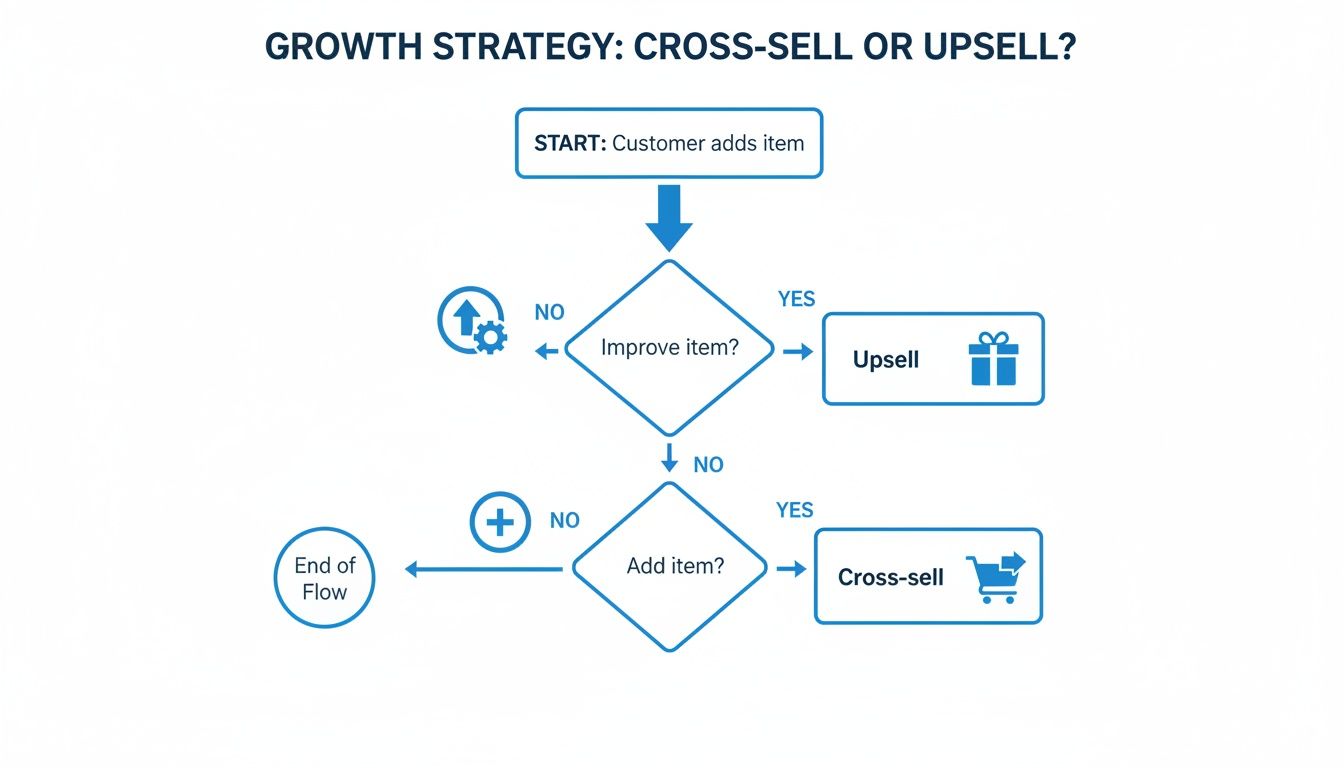
The flowchart above maps out this simple but powerful logic. Your offer should directly align with what the customer is trying to accomplish at that moment—either making their current choice better or expanding their cart.
Real-World Scenarios and Product Types
Let's break this down with a concrete example. Imagine a customer is about to buy a high-end espresso machine. An upsell here might be a model with an integrated grinder and more precise temperature controls. A cross-sell, however, would be a bag of artisanal coffee beans, a set of beautiful espresso cups, or a milk frothing pitcher. One improves the machine itself; the others complete the entire coffee-making ritual.
The trick is to build value, not just slash prices. Instead of a generic 10% off coupon, frame your offers as rewards. For instance, a shopper adding a basic yoga mat to their cart could be upsold to a premium, non-slip version for a better practice. Or, after adding the mat, they could be cross-sold a yoga block and strap that unlocks a free gift or free shipping. This approach drives up AOV while making the customer feel rewarded, which is fantastic for long-term lifetime value.
As you map out the best path for your products, consider how solid sales enablement best practices can empower your team to spot and act on these opportunities. Tools like Monster Cart make this incredibly easy by letting you present these smart, reward-based offers right in a slide-out cart, gently guiding customers toward a bigger, better order without ever being intrusive.
Actionable In--Cart Strategies To Increase AOV
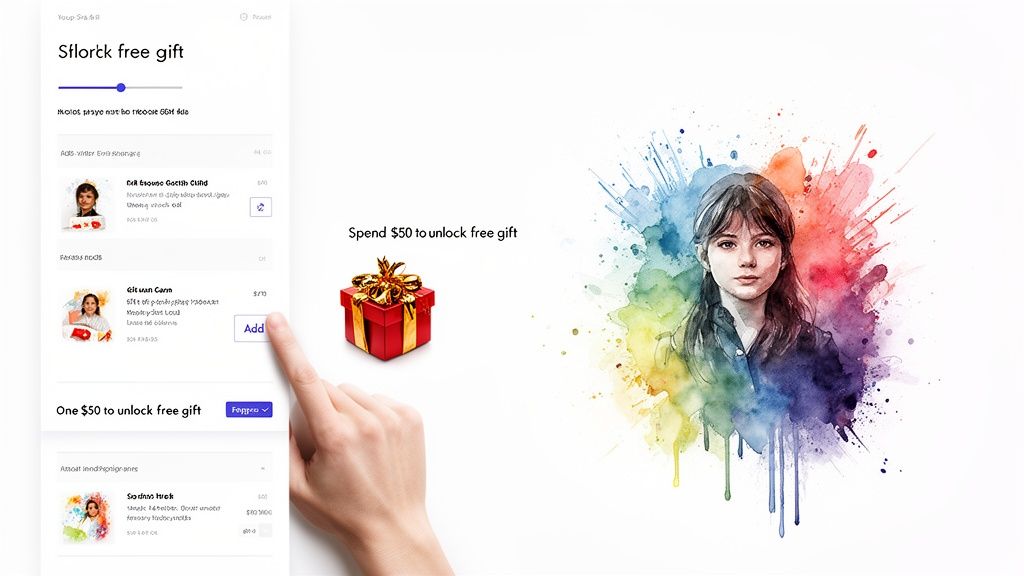
Let's move from theory to action and get your cross-sell or upsell strategy working right inside the shopping cart. The best in-cart offers aren't disruptive pop-ups; they’re subtle, helpful suggestions that feel like a natural part of the shopping flow, nudging customers to spend a bit more without ever feeling pressured.
This is where you can build a "rewards layer" into the experience. Instead of just asking for a bigger sale with a steep discount, you create compelling incentives that customers genuinely want to reach. You’re not just selling—you’re creating a rewarding experience that boosts your Average Order Value (AOV) and builds goodwill for long-term lifetime value.
Creating a Gamified Rewards System
Today’s shoppers are hardwired to respond to progress and achievement. When you frame your offers as milestones, you can transform the simple act of adding items to a cart into an engaging game. The trick is to show them their progress toward a reward, making the next spending goal feel both exciting and easy to reach.
A slide-out cart is the perfect place for this. As someone adds a product, a dynamic progress bar can instantly show how close they are to unlocking their next reward. This visual cue is a powerful motivator that keeps them focused on hitting that next threshold.
Here are a few reward-based offers that work wonders:
Tiered Free Gifts: Offer better gifts as the cart total increases. Think, "Spend $50, get a free sample" and "Spend $100, get a full-size product."
Unlockable Free Shipping: Free shipping is one of the most powerful motivators in e-commerce. Set a clear spending goal and watch customers add items to hit it.
Progressive Discounts: Roll out a "Buy More, Save More" model where a small discount (like 5% or 10%) unlocks at a higher spend threshold.
These strategies are fantastic for AOV because they encourage shoppers to add just one more thing to get their reward, all without resorting to sitewide discounts that can kill your margins and brand value.
Implementing One-Click Add-Ons
Once a customer has their main items locked in, you can introduce low-friction, high-margin cross-sells directly in the cart. These are usually low-cost items or services that offer convenience or peace of mind, making them an effortless "yes" for most shoppers.
Think of them as the impulse buys of the digital checkout lane. They don't require much thought and add immediate value.
A well-designed in-cart experience makes customers feel like they're earning rewards, not being sold to. The goal is to create a positive feedback loop where adding more to the cart unlocks tangible value, driving both AOV and customer lifetime value.
Effective one-click add-ons often include:
Gift Wrapping: A simple service that adds a personal touch, especially around the holidays.
Shipping Protection: For a small fee, offer insurance against loss or damage.
Priority Processing: Let customers pay a little extra to jump to the front of the fulfillment line.
These small additions might seem minor, but they have a massive cumulative impact on your bottom line. An advanced tool like Monster Cart can seamlessly integrate these offers into a branded cart drawer, letting customers add them with a single click. For a deeper look at getting the most out of your cart, check out these advanced shopping cart optimization strategies.
Leveraging "Frequently Bought Together" Bundles
Amazon perfected this for a reason—it just works. Showing complementary products that are often bought together is a classic cross-sell strategy that feels genuinely helpful to the customer. When you place this right in the cart, it acts as a final, useful suggestion before they head to checkout.
This tactic works best when the recommendations are data-driven and make perfect sense. If someone is buying a leather handbag, suggesting a leather cleaner and conditioner is a no-brainer.
The key is to frame these bundles as a "complete the set" or "get the full experience" opportunity. This shifts the focus from a sales tactic to ensuring the customer gets the most out of what they're already buying. By doing this, you not only increase the order value but also improve their experience after the purchase—a critical step in building long-term customer lifetime value.
Building Lifetime Value Beyond a Single Transaction
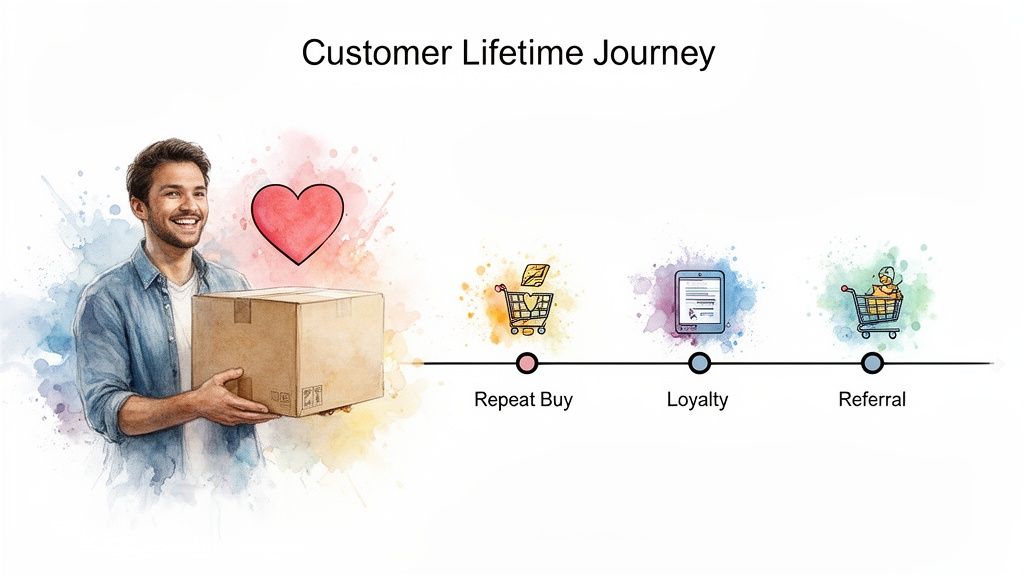
While boosting Average Order Value (AOV) gives you an immediate win, the smartest brands are playing the long game. The real goal isn't just a bigger first purchase. It’s about building a relationship that turns a casual shopper into a loyal customer for life. This is where a sharp cross sell or upsell strategy truly shines—it stops being a sales trick and becomes a powerful loyalty-building tool.
When you offer recommendations that are genuinely helpful, you're telling the customer, "We get you." That simple act builds a foundation of trust that drives repeat business far more effectively than any one-time discount ever could. It’s what separates a transactional interaction from a relationship that drives lifetime value.
From First Order to Brand Advocate
Every single customer interaction is a chance to strengthen your brand's reputation. Think about it: a positive, subtle offer in a slide-out cart leaves a much better impression than an aggressive, full-screen pop-up that shatters their shopping flow. The experience you create matters just as much as the offer itself.
By focusing on rewards like a free gift with purchase or complimentary shipping, you make the customer feel valued, not just squeezed for more money. That good feeling is what they’ll remember long after the package arrives. We dive deeper into this in our guide on creating compelling free gift with purchase offers that customers actually want.
The most profitable customer isn't the one who spends the most today, but the one who comes back again and again. A small, value-driven increase in their first order can be the catalyst that turns a one-time buyer into a genuine brand advocate with high lifetime value.
This shift in mindset is crucial. Stop asking, "How can I get more from this transaction?" and start asking, "How can this transaction deliver more value to my customer and build our relationship for the future?"
Connecting In-Cart Rewards to LTV Growth
A rewarding in-cart experience directly and measurably boosts Customer Lifetime Value (LTV). When a customer adds a useful accessory or unlocks a free gift, they leave feeling like they got an amazing deal. This positive reinforcement makes them far more likely to come back for their next purchase.
Here are a few strategic ways to make this happen:
Rewarding Milestones: Use a tool like Monster Cart to add progress bars that show customers exactly how close they are to unlocking their next reward. Gamifying the experience makes spending more feel like an accomplishment.
Helpful Suggestions: Ditch the random product suggestions. Instead, offer items that genuinely complement what’s already in their cart. This proves you know your products and care about their long-term satisfaction.
Exclusive Access: Frame certain small discounts or gifts as rewards for hitting a spend threshold. This makes the offer feel exclusive and earned, not just like a generic coupon.
These small, positive interactions add up. The data doesn't lie: cross-selling is a cornerstone of eCommerce, often generating between 10-30% of total revenue for stores that do it right.
In the end, your goal is to make every customer feel understood and appreciated. To truly build a brand that lasts, you need to understand and optimize these relationships, and a comprehensive customer lifetime value calculation guide is essential for that. By focusing on LTV, you’re not just making sales; you’re building a more resilient, profitable, and beloved brand.
How to Measure and A/B Test Your Offers
Launching a cross-sell or upsell strategy without measuring it is a bit like navigating without a map. You might be moving, but you have no idea if you're heading in the right direction. To create offers that actually boost AOV without hurting your margins or brand, you need to base your decisions on data, not just intuition.
It's tempting to focus on a single metric, but that can be misleading. A flashy offer might shoot your Average Order Value (AOV) sky-high, but what if it's also scaring away other customers and tanking your overall conversion rate? To get the real story, you need to track a few key performance indicators (KPIs) together.
Core Metrics to Monitor
When you put an offer in the cart, your goal isn't just to bump up AOV; it's to grow your business in a healthy, sustainable way. This means keeping a close eye on three interconnected metrics that, together, paint a full picture of your strategy's health.
Average Order Value (AOV): This is the most obvious one. It directly answers the question, "Is this offer getting customers to spend more on average?"
Conversion Rate (CVR): Think of this as your reality check. It reveals whether your offer is helping or hurting the final sale. An aggressive or confusing offer can easily spook customers, leading to abandoned carts even if a few people bite.
Revenue Per Visitor (RPV): This is your north star. By blending AOV and CVR, RPV tells you how much money you’re making from every single person who lands on your site. It gives you a complete, holistic view of an offer's true impact on your lifetime value goals.
Watching these three KPIs in tandem prevents you from chasing a higher AOV at the expense of your overall profitability.
Running Effective A/B Tests
Once you know what to measure, it's time to start testing your ideas. A/B testing lets you pit different reward-based offers against each other to find out what truly motivates your customers to click "buy."
Let's say you want to know what kind of incentive works best once a customer’s cart hits $75. You could test:
Offer A: Free Shipping at $75
Offer B: Free Gift at $75
By running a split test, you can see which version produces a better AOV, a stronger conversion rate, and—most importantly—a higher RPV. This data-driven approach takes the guesswork out of the equation, letting you optimize for what actually grows your bottom line and strengthens customer lifetime value.
The real goal of testing isn't just to pick a winner. It's to gain a deep understanding of what makes your customers tick. The insights from one small test can reshape your entire promotional calendar, helping you build a more profitable and customer-focused brand.
This is where a dedicated tool like Monster Cart really shines. Its built-in analytics dashboard is designed to track every offer's performance, making it simple to monitor your core metrics and run A/B tests on different rewards. You stop just throwing offers out there and start building a smarter, more responsive sales engine that boosts both immediate revenue and long-term customer lifetime value.
Your Go-To Implementation Checklist
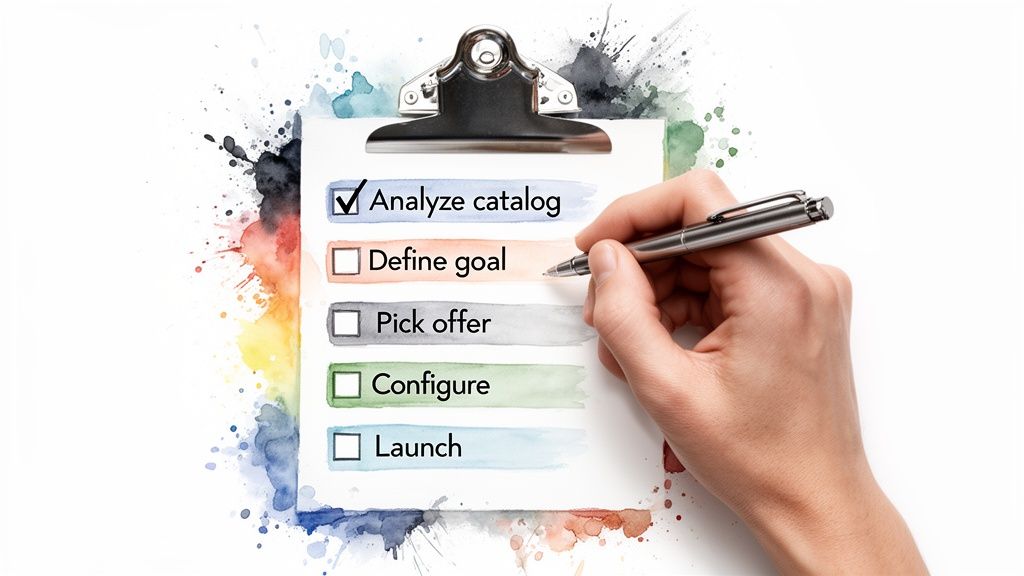
Ready to move from theory to actual revenue? A great cross sell or upsell strategy isn't something you just turn on. It's a thoughtful process of knowing your products inside and out, setting clear goals, and executing perfectly right inside the cart. This checklist is your simple roadmap for getting your first reward-based offer up and running.
The main objective here is to boost your Average Order Value (AOV) by adding real value for the customer—not just by slashing your margins with hefty discounts. Rewards like a free gift, free shipping, or a small discount make customers feel valued, nudge them to spend a bit more, and build loyalty for the long haul.
Your Five-Step Launch Plan
Walk through these steps to build an in-cart offer that actually connects with your customers and makes a real difference to your bottom line. This process keeps your strategy rooted in data and built for long-term growth.
Analyze Your Product Catalog: First things first, look for logical pairings. Dig into your sales data to find which products people naturally buy together—that’s your goldmine for cross-sells. At the same time, identify which products have obvious premium upgrades for upsells.
Define a Clear, Measurable Goal: What does a "win" actually look like? Get specific. Ditch vague goals like "increase sales" and aim for something you can measure, like "Increase AOV by 15% in Q3" or "Improve Customer Lifetime Value by 10% this year."
Select Your First Reward-Based Offer: Don't try to boil the ocean. Start with a classic that always works, like a free shipping threshold or a free gift unlocked at a certain cart value. Customers understand these instantly, which makes them incredibly effective at encouraging larger orders without cheapening your brand.
Configure Your Offer: This is where you bring it to life. Use a tool like Monster Cart to build the offer right into a branded slide-out cart. You can customize the look to match your store, set the rules, and add a visual progress bar that shows shoppers how close they are to snagging their reward. This turns the cart into a powerful tool for engagement and lifetime value.
Launch and Monitor: Set your offer live, but don't just walk away. Immediately start tracking your key KPIs—AOV, conversion rate, and take rate. This data will tell you exactly what's working and what isn't, so you can make small tweaks to optimize performance and drive sustainable, long-term growth.
Creative Offer Ideas to Get You Started
Feeling stuck for ideas? Here are a few battle-tested concepts you can steal and adapt for your own store.
Tiered Spending Rewards: Gamify the shopping experience with multiple reward levels. For example, "Spend $50, unlock free shipping; spend $100, unlock a free gift."
'Complete the Look' Bundles: When a customer adds an item—say, a shirt—offer complementary products like matching pants and a belt as a simple one-click bundle. This is perfect for fashion, home goods, or beauty.
Limited-Time Seasonal Add-Ons: Create a little urgency by offering exclusive, low-cost add-ons like themed gift wrapping or a seasonal sample product that's only available for a short time.
Following this checklist will help you confidently launch an in-cart strategy that does more than just boost short-term sales. It creates a better shopping experience that keeps customers coming back, which is how you build real lifetime value.
Frequently Asked Questions
What's The Real Difference Between A Cross-Sell And An Upsell?
The easiest way to think about it is by looking at what the customer is trying to do. An upsell is all about convincing a customer to buy a better version of the exact product they're already looking at—think more features, a larger size, or a premium material.
A cross-sell, however, is about suggesting a related product that enhances the original. If they're buying a camera, a cross-sell would be a memory card or a carrying case. One makes the core item better; the other adds a new, complementary item to the cart.
Which One Is Actually Better For Increasing My AOV?
Honestly, both are powerhouses for boosting your Average Order Value (AOV), but they get there in different ways. Upselling increases the price of a single line item, while cross-selling adds more line items to the order.
There's no single "better" strategy. The right move really depends on your specific product catalog and what makes sense for the customer at that exact moment. The best approach is often a mix of both, focusing on rewards that build lifetime value.
How Can I Pull This Off Without Giving Away Huge Discounts?
This is where smart brands separate themselves from the pack. Constant, hefty discounts can cheapen your brand and eat into your margins. The secret is to shift the focus from discounts to rewards.
Instead of just slashing prices, build a system where customers feel like they're earning something valuable.
Free Gifts: Frame it as an achievement: "Spend $50 and unlock a free mystery gift!"
Free Shipping: Show them the finish line: "You're just $15 away from unlocking free shipping!"
Small, Earned Discounts: A modest 10% discount for spending $100 feels more like a reward than a desperate sale.
These value-adds make the customer feel rewarded for spending more, which boosts not just the AOV for that one sale, but also their long-term lifetime value.
Is There A Risk Of Annoying Customers With Too Many Offers?
Yes, absolutely. We've all been attacked by those aggressive, full-screen pop-ups that just get in the way. That's the fastest way to lose a sale.
The trick is to weave your offers into the shopping experience so they feel helpful, not pushy. An intelligent, branded slide-out cart like Monster Cart is perfect for this. It can show progress towards a reward or suggest a relevant product without completely hijacking the user's screen.
The goal is to make your offers feel like a helpful, integrated part of the shopping experience, not a disruptive sales pitch. This builds trust and turns a single transaction into a long-term relationship with high lifetime value.
Ready to transform your cart into a revenue engine? See how Monster Cart helps thousands of Shopify brands boost AOV with reward-based upsells and a fully branded in-cart experience. Get started today at monsterapps.shop.
Join 7000+ brands using our apps