10 Smart Discount Pricing Examples to Boost AOV Without Hurting Margins in 2026
Feb 12, 2026
|
Published
Stop chasing sales with margin-killing discounts. This guide unpacks 10 strategic discount pricing examples that focus on a smarter goal: boosting your Average Order Value (AOV) and building long-term customer relationships. We'll show you how to move away from the race to the bottom and use rewards like free gifts, tiered savings, and free shipping thresholds to encourage customers to happily spend more, focusing on their lifetime value. To truly rethink discounts and build a more profitable store, the core objective is to learn how to effectively increase online sales by incentivizing behavior, not just transactions.
Each example is a complete blueprint. You will learn not just what these strategies are, but precisely how and when to use them in your Shopify cart. We will provide exact in-cart messaging, setup tips, and a special focus on creating an engaging, high-converting experience using tools like Monster Cart. Our approach prioritizes lifetime value over one-time sales, transforming your discount strategy from a necessary evil into a powerful engine for sustainable growth. Get ready to implement offers that protect your margins, delight your customers, and build a stronger, more profitable brand.
1. Tiered & Volume Discounts (Spend- and Quantity-Based)
Tiered and volume discounts are powerful discount pricing examples that incentivize customers to increase their order size by offering progressively better savings. This strategy works in two primary ways: spend-based tiers (e.g., spend $50, get 10% off; spend $100, get 15% off) or quantity-based breaks (e.g., buy 3 for $18 each, buy 6 for $15 each). The core psychological trigger is the "Buy More, Save More" principle, which directly ties a larger purchase to a greater reward, boosting AOV and customer lifetime value.
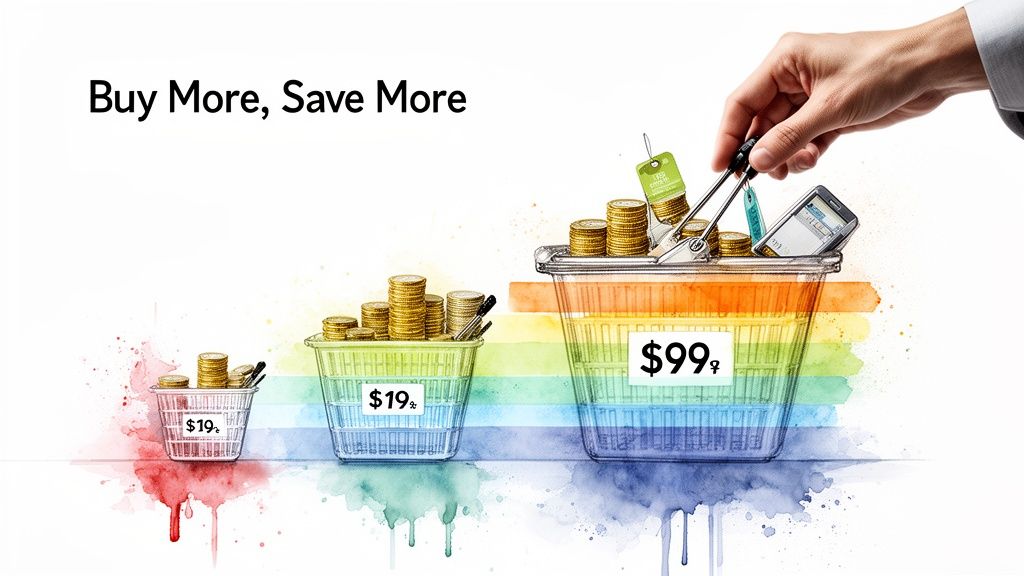
This method effectively boosts Average Order Value (AOV) by gamifying the shopping experience. Instead of a simple sitewide sale that can devalue your brand, you guide customers toward specific spending or quantity goals. Brands like Sephora master this with their tiered loyalty rewards, while Costco’s entire model is built on volume-based savings. This approach encourages shoppers to think in terms of value over the long term.
Strategic Implementation with Monster Cart
Monster Cart excels at implementing these tiers visually, turning the cart into a conversion tool that builds lifetime value.
When to Use: Ideal for stores with consumable products (quantity breaks) or a wide catalog where customers are likely to add multiple items (spend tiers). It’s a great way to boost AOV without eroding margins on single-item sales.
Expected Outcomes: Increased AOV, higher units per transaction (UPT), and improved customer lifetime value as shoppers learn that larger orders provide better value.
In-Cart Messaging:
Spend-Based: "You're only $12 away from unlocking 15% off your entire order!"
Quantity-Based: "Add 1 more to get them for $15 each and save $15 total!"
Monster Cart Setup: Use the in-cart upsell feature to create a progress bar that visually shows customers how close they are to the next discount tier. Configure multiple reward levels that automatically apply the discount once a spend or quantity threshold is met, making the savings feel earned and immediate.
2. Free Gift with Purchase (GWP) / Gift at Threshold
Offering a free gift with purchase (GWP) is a classic discount pricing example that boosts perceived value without directly slashing prices. This strategy rewards customers for reaching a specific spending milestone (e.g., a free tote bag on orders over $75), creating a powerful emotional incentive that often feels more special than a simple percentage-off discount. The goal is to make the customer feel rewarded for their spending, which in turn increases Average Order Value (AOV) and nurtures long-term loyalty.
This method moves the focus from "saving money" to "gaining value," which protects brand perception and margins far better than hefty discounts. Beauty giants like Sephora and Ulta have perfected this by offering exclusive sample sets, making customers eager to hit the spending threshold. The key is choosing a gift with high perceived value but a low cost of goods. This approach builds excitement and can be a fantastic way to introduce customers to new products, increasing their lifetime value.
Strategic Implementation with Monster Cart
Monster Cart transforms the GWP offer from a simple banner announcement into an interactive, in-cart experience.
When to Use: Excellent for introducing new products, clearing excess inventory, or boosting AOV during key sales periods. It's particularly effective for brands that want to avoid a "discount" image and instead foster a premium, value-added perception.
Expected Outcomes: Increased AOV, higher customer engagement, and a great opportunity for product discovery. GWP offers can also improve conversion rates by reducing cart abandonment at the final stages.
In-Cart Messaging:
Initial Prompt: "Spend just $19 more to unlock a free Radiance Serum with your order!"
Confirmation: "Congratulations! Your free gift has been added to your cart."
Monster Cart Setup: Use the in-cart upsell progress bar to show customers exactly how close they are to claiming their gift. Configure an automatic reward that adds the free product to the cart once the spend threshold is met, providing instant gratification and a seamless checkout experience.
3. Free Shipping Threshold
The free shipping threshold is a classic and highly effective discount pricing example where customers unlock complimentary shipping after their cart total reaches a specific value (e.g., “Free Shipping on Orders Over $75”). This strategy directly combats one of the leading causes of cart abandonment: unexpected shipping costs. It reframes shipping not as a fee, but as a reward for a larger purchase, motivating customers to add more items to their cart to meet the goal, thereby boosting AOV.
This method brilliantly boosts Average Order Value (AOV) by encouraging customers to spend just a little more to save on shipping fees. Instead of offering a direct percentage discount, which can devalue your products, you provide a high-value utility that customers universally appreciate. Brands from Amazon to nearly every modern DTC store leverage this tactic because it nudges customers toward a higher spend threshold in a way that feels helpful, not pushy, ultimately fostering loyalty and increasing lifetime value.
Strategic Implementation with Monster Cart
Monster Cart visualizes the path to free shipping, making it an interactive goal rather than a static banner.
When to Use: Essential for almost any e-commerce store. Set your threshold approximately 20-30% above your current AOV to encourage a meaningful increase in spending without making the goal feel unattainable.
Expected Outcomes: Significant increase in AOV, a sharp decrease in cart abandonment rates, and improved overall conversion rates. It builds customer loyalty by removing a common point of friction.
In-Cart Messaging:
Encouragement: "You're only $15 away from unlocking FREE shipping!"
Confirmation: "Congratulations! You've unlocked free shipping!"
Monster Cart Setup: Use the in-cart rewards feature to create a dynamic progress bar. This bar should visually track how close the customer is to the free shipping threshold. As they add items, the bar fills up, creating a compelling sense of progress that motivates them to reach the goal.
4. Add-On Upsells (One-Click Offers)
Add-on upsells are low-friction, complementary offers embedded directly in the cart that customers can add with a single click. These are often lower-priced, high-margin items like extended warranties, shipping protection, or gift wrapping. Unlike traditional discount pricing examples that cut into your margins, this strategy boosts revenue by increasing the value of an existing transaction without disrupting the path to purchase. The psychological principle at play is convenience; customers are more likely to accept a relevant, valuable add-on when it requires minimal effort.
This method is a masterclass in boosting Average Order Value (AOV) without resorting to broad, hefty discounts. Instead of lowering prices, you’re adding incremental value and profit to each order. Brands like Best Buy excel at this with their electronics protection plans, while many e-commerce stores now offer shipping protection. By focusing on value-adds, you train customers to see your brand as a helpful partner, which is key for long-term lifetime value.
Strategic Implementation with Monster Cart
Monster Cart makes it seamless to present these one-click offers as an integrated part of the cart experience.
When to Use: Perfect for products that have logical companions, like electronics (warranties), fragile items (shipping protection), or giftable goods (gift wrap, premium packaging). It’s an ideal way to increase profit on every order.
Expected Outcomes: Increased AOV and higher profit margins. It also enhances the customer experience by offering genuinely useful services, building trust and potentially increasing lifetime value.
In-Cart Messaging:
Protection: "Add Shipping Protection for just $1.99 to protect your order from loss, theft, or damage."
Gift Option: "Make it special! Add premium gift wrapping and a personalized message for $4.99."
Monster Cart Setup: Use the in-cart upsell feature to configure specific, high-margin add-on products to appear based on cart contents. Implement them as simple checkboxes or one-click buttons that instantly add the item to the order, ensuring a frictionless experience that boosts AOV without a discount.
5. Frequently Bought Together (Cross-Sell Bundle)
The "Frequently Bought Together" strategy, popularized by Amazon, is one of the most effective discount pricing examples for boosting Average Order Value (AOV). It works by suggesting complementary products as a bundle, often with a small incentive, directly within the shopping journey. This method leverages social proof and convenience, showing customers what others buy together (e.g., a coffee maker, filters, and a travel mug) to complete their purchase. The core principle is making a relevant, helpful suggestion at the peak moment of buying intent.
This strategy shifts the focus from deep, site-wide discounts to value-added offers that feel like a curated service. Instead of just slashing prices, you're enhancing the customer's purchase and introducing them to more of your catalog. This not only increases AOV but also deepens the customer relationship, encouraging future purchases and boosting lifetime value.
Strategic Implementation with Monster Cart
Monster Cart transforms this concept into a seamless, in-cart experience that feels native to the checkout process.
When to Use: Perfect for stores with products that have natural pairings or accessories. It's highly effective for increasing AOV and introducing customers to new product lines without devaluing your core items with constant sales.
Expected Outcomes: Significant lift in AOV and Units Per Transaction (UPT). It also improves product discovery and can increase customer lifetime value by showing the breadth of your offerings.
In-Cart Messaging:
Simple Cross-Sell: "Customers also bought this with your item. Add to cart?"
Bundle & Save: "Complete the set! Add both for just $45 and save 10%!"
Monster Cart Setup: Use the in-cart upsell feature to display a "Frequently Bought Together" section. Configure it to show 1-2 highly relevant, manually selected products or use AI to dynamically recommend items based on cart contents. You can present them as one-click additions at full price or automatically apply a small bundle discount when the customer adds the suggested items, rewarding them for increasing their order size.
6. Spend-to-Unlock Rewards (Points / Currency System)
Spend-to-unlock rewards transform the customer relationship from transactional to relational by gamifying loyalty. Instead of one-off, hefty discounts, this system rewards customers for their continued patronage with points or a branded currency for every dollar spent. This strategy builds long-term value by making customers feel like they are progressing toward a tangible reward, such as a discount, free product, or exclusive status.
This approach is one of the most powerful discount pricing examples for fostering repeat business and increasing customer lifetime value (CLV). Brands like Sephora with its VIB program and Starbucks with its mobile-integrated rewards have mastered this, turning routine purchases into a rewarding experience. The key is shifting the customer's focus from immediate savings to long-term benefits, encouraging them to consolidate their spending with your brand and boosting AOV over time.
Strategic Implementation with Monster Cart
Monster Cart can visibly integrate loyalty progression directly into the shopping journey, reminding customers of their status and potential rewards.
When to Use: Excellent for brands with high purchase frequency or those in competitive markets needing to build a loyal customer base. It’s a perfect strategy to boost CLV without constantly offering sitewide sales.
Expected Outcomes: Increased customer retention, higher CLV, and a stronger brand community. Customers are more likely to choose your store to continue earning points toward their next reward.
In-Cart Messaging:
Points Earned: "Complete your order to earn 50 points toward your next $5 reward!"
Reward Nudge: "You have 80 points! Spend just $20 more to unlock your free gift."
Monster Cart Setup: While a separate loyalty app manages the points system, use Monster Cart’s in-cart upsell and messaging features to display dynamic reminders. Create a custom message like, "Don't forget to log in to earn points on this purchase!" or use the progress bar to show how a customer's current cart value contributes to their next reward milestone.
7. Limited-Time Flash Discounts (Scarcity-Based)
Limited-time flash discounts are a powerful, scarcity-driven pricing strategy that offers a significant discount for a very short period, often 24-48 hours. This method capitalizes on the fear of missing out (FOMO) to create urgency and compel customers to make an immediate purchase decision. While it is a direct discount, its limited nature avoids the perpetual margin erosion of a sitewide sale, focusing on a short-term AOV boost while encouraging decisive action.
The key to this strategy's success is its temporary nature, which trains customers to act decisively. Pioneers like Gilt Group built their entire business model on daily flash sales, while mega-events like Amazon's Prime Day demonstrate the massive scale this tactic can achieve. When executed thoughtfully, flash sales are excellent discount pricing examples for clearing excess inventory, launching new products, or hitting quarterly sales targets without committing to long-term price cuts.
Strategic Implementation with Monster Cart
Monster Cart amplifies the urgency of a flash sale directly within the cart, where the final purchase decision is made.
When to Use: Perfect for clearing seasonal inventory, boosting sales during slow periods, or celebrating a holiday or company milestone. Use them sparingly (1-2 times per month) to maintain their effectiveness and sense of urgency.
Expected Outcomes: Significant short-term lift in conversion rates and revenue, increased new customer acquisition, and effective liquidation of targeted products.
In-Cart Messaging:
Urgency-Driven: "Flash Sale Alert! Your 30% discount expires in 00:59:34."
FOMO-Based: "Don't miss out! This 24-hour deal ends tonight at midnight."
Monster Cart Setup: Utilize the announcement bar feature within the cart to display a prominent, sitewide countdown timer that visualizes the scarcity. You can configure this timer to correspond with an automatic discount code, ensuring the offer is both highly visible and seamlessly applied at checkout, maximizing the impulse to buy.
8. First-Time Customer Discount
A first-time customer discount is a powerful acquisition tool designed to convert new visitors into paying customers. This introductory offer, typically a percentage off (e.g., 15% off your first order), reduces the perceived risk for someone unfamiliar with your brand, making it easier for them to commit to a purchase. The core strategy is to exchange a one-time margin reduction for a long-term customer relationship and a valuable email for future marketing, focusing on lifetime value from day one.
This method is one of the most common discount pricing examples because it directly addresses initial purchase hesitation. Brands like Glossier master this by combining a newsletter signup with a "10% off your first order" incentive, immediately capturing the lead and pushing them toward conversion. The key is making the offer feel like an exclusive welcome gift, building goodwill from the very first interaction and setting the stage for future, full-price purchases.
Strategic Implementation with Monster Cart
Monster Cart can turn a simple welcome offer into a seamless, automated part of the new customer journey.
When to Use: Essential for brands focused on new customer acquisition and list building. It's particularly effective for products with a higher consideration phase, where a small nudge can significantly impact conversion rates.
Expected Outcomes: Increased conversion rate for new visitors, rapid growth of your email/SMS marketing list, and a lower customer acquisition cost (CAC) over time by creating a direct communication channel.
In-Cart Messaging:
Welcome Message: "Welcome! Your 15% first-order discount has been automatically applied."
Incentive Reminder: "Enjoy 15% off your first purchase with us. Complete your order now!"
Monster Cart Setup: Use the automatic discounts feature to create a coupon code specifically for first-time shoppers. Trigger a persistent in-cart banner or pop-up that prominently displays this offer to new visitors, ensuring they see the value as they shop and add items to their cart. This immediate visual confirmation reinforces their decision to buy.
9. Referral Discounts (Refer-a-Friend)
Referral discounts are one of the most powerful discount pricing examples for sustainable growth, transforming your best customers into an authentic marketing channel. This strategy rewards both the existing customer and the new referred friend, creating a viral loop. Instead of just acquiring one customer, a single transaction can lead to two, effectively lowering customer acquisition costs (CAC) while fostering brand loyalty and focusing on lifetime value. The classic model is "$20 for you, $20 for them."
This method taps into social proof, as a recommendation from a trusted friend is far more impactful than a traditional ad. Pioneers like Dropbox and Warby Parker built their empires on this model. The key is making the sharing process frictionless and ensuring the reward feels valuable to both parties. This approach builds a community around your brand and rewards customers for their advocacy, directly impacting customer lifetime value without resorting to hefty site-wide discounts.
Strategic Implementation with Monster Cart
While referrals often live on post-purchase pages, Monster Cart can reinforce the program’s value within the cart itself.
When to Use: Ideal for brands with a strong community or highly-rated products that customers genuinely love. It's perfect for acquiring high-quality customers at a lower cost than paid advertising.
Expected Outcomes: Lowered CAC, increased customer loyalty and LTV, and accelerated brand growth through word-of-mouth marketing.
In-Cart Messaging:
Referral Reminder: "Love your order? Don't forget to refer a friend to get $20 off your next one!"
Reward Nudge: "Redeem your referral credit! Click here to apply your $15 reward."
Monster Cart Setup: Use the in-cart announcements feature to remind customers about their available referral credits or to prompt them to join the referral program. A simple, non-intrusive banner can say, "Share the love! Give a friend 15% off and get 15% off your next order," keeping the program top-of-mind during the checkout process.
10. Progressive Discount Stacking (Layered Incentives)
Progressive discount stacking is a sophisticated strategy where you combine multiple incentives, such as free shipping, a tiered discount, and a free gift, into a single customer journey. Instead of offering one large, margin-crushing discount, you layer smaller, value-packed rewards that unlock as the customer's cart value increases. The core principle is to build irresistible perceived value, making the customer feel they are getting an amazing deal without relying on a single, steep percentage-off sale.
This is one of the most powerful discount pricing examples for boosting Average Order Value (AOV) and customer lifetime value. Brands like Sephora master this by combining loyalty points, tiered discounts, and free gift thresholds in one cart. The key is to present these layered rewards visually, so shoppers clearly see the cumulative benefits they are unlocking, which encourages them to spend more to get more. This AOV-boosting approach is a cornerstone of modern e-commerce.
Strategic Implementation with Monster Cart
Monster Cart is built to visualize and manage these complex, layered offers seamlessly, helping you boost AOV.
When to Use: Perfect for established stores with multiple value propositions (e.g., loyalty program, free shipping, gift offers). Use it during key sales periods or year-round to maximize AOV and move beyond simple discount codes.
Expected Outcomes: Significant lift in AOV, increased conversion rates, and higher customer lifetime value as shoppers engage more deeply with your rewards ecosystem.
In-Cart Messaging:
Combined Goal: "You've unlocked Free Shipping! Now add $15 more to get a Free Gift!"
Total Savings: "Congrats! You've unlocked 3 rewards worth a total of $45!"
Monster Cart Setup: Use the app to create multiple, simultaneous reward tiers. Configure a free shipping bar, a tiered spend discount, and a free gift with purchase goal. The cart will display multiple progress bars, visually guiding the customer through each reward level and clearly communicating the total value they are accumulating with each addition to their cart.
10 Discount Pricing Strategies Compared
Offer | Implementation Complexity (🔄) | Resource Requirements (⚡) | Expected Outcomes (📊) | Ideal Use Cases (💡) | Key Advantages (⭐) |
|---|---|---|---|---|---|
Tiered & Volume Discounts (Spend- and Quantity-Based) | Medium–High: multi-tier rules, cart logic | Moderate: analytics, dev, inventory coordination | ↑ AOV; measurable conversion lift; moderate margin risk | Consumables, B2B, bulk-buy categories | Scales AOV; clear per-unit savings; margin‑friendly vs flat cuts |
Free Gift with Purchase (GWP) | Medium: threshold logic + gift selection | Low–Moderate: sourcing low‑COGS gifts, fulfillment handling | ↑ Perceived value and AOV; preserves margins better than discounts | Beauty, skincare, luxury, product launches | High perceived value without deep price cuts |
Free Shipping Threshold | Low–Medium: cart thresholds, regional rules | Moderate: absorb/optimize shipping costs, fulfillment impact | ↓ Cart abandonment; ↑ AOV; margin depends on threshold | General e‑commerce, fashion, DTC brands | Simple to communicate; strong conversion lift |
Add-On Upsells (One-Click Offers) | Low: UI toggles, one‑click flows | Low: select high-margin SKUs, minimal dev | ↑ Incremental revenue; high attach rates with low friction | Electronics, jewelry, premium goods, warranties | High conversion and margin; minimal checkout disruption |
Frequently Bought Together (Cross-Sell Bundle) | Medium: recommendation logic or manual curation | Moderate: data/AI or merchandising, dev work | ↑ AOV ~10–30%; improved purchase relevance | Accessories, complementary products, curated bundles | Timely, relevant suggestions; increases satisfaction and attach |
Spend-to-Unlock Rewards (Points / Currency System) | High: points ledger, tier logic, redemption flows | High: backend, CX support, legal/compliance | ↑ CLTV and repeat purchases over time; gamified engagement | Loyalty-driven brands, subscriptions, DTC | Drives retention and repeat spend through gamification |
Limited-Time Flash Discounts (Scarcity-Based) | Low–Medium: timers and promo rules | High: marketing spend, inventory planning | Immediate conversion spikes; possible brand erosion if frequent | Clearance, seasonal events, acquisition campaigns | Creates urgency; effective short-term revenue and traffic spikes |
First-Time Customer Discount | Low: one‑time codes or auto-apply | Low: promo management, email capture workflow | ↑ New-customer conversion and email list growth; margin hit on first order | New-customer acquisition, trialing premium offerings | Effective to convert hesitant shoppers and capture leads |
Referral Discounts (Refer-a-Friend) | Medium: unique links, tracking, attribution | Moderate: referral platform, fraud prevention, rewards fund | ↑ New customers with lower CAC; growth over time | Viral/word-of-mouth products, community brands | Low CAC acquisition; leverages existing customers as advocates |
Progressive Discount Stacking (Layered Incentives) | High: multiple overlapping rules, clear UX needed | High: analytics, ops coordination, creative resources | ↑ AOV and conversions when balanced; complex attribution | Sophisticated merchants wanting tailored incentives | Maximizes perceived value while protecting margins via layered offers |
Build a Smart Cart, Not Just a Discount Strategy
The journey through these diverse discount pricing examples reveals a powerful, unifying truth: a successful promotion is less about the discount itself and more about the customer experience and long-term value. The most effective strategies we've explored, from tiered volume discounts to progressive reward stacking, transform the shopping cart from a static checkout page into a dynamic and engaging touchpoint. They don’t just slash prices; they guide customer behavior, create perceived value, and build a foundation for long-term loyalty and higher lifetime value.
The common thread is strategic communication. Instead of hiding a free shipping offer in a site-wide banner, you bring it directly into the cart with a real-time progress bar. Instead of hoping a customer notices a "Gift with Purchase" pop-up, you let them see the reward appear instantly as they cross a spending threshold. This immediate, interactive feedback loop is what separates a forgettable discount from a memorable, AOV-boosting experience that fosters loyalty.
Key Takeaways for Smarter Promotions
Moving forward, shift your focus from simply cutting costs to architecting a rewarding customer journey that prioritizes lifetime value. Here are the core principles to implement:
Visibility is King: The best offers are useless if they go unseen. Use in-cart messaging and visual progress bars to make your incentives impossible to miss. Customers are far more likely to add another item to their cart if they can see exactly how close they are to unlocking a reward.
Emphasize Value Over Discounts: While a 10% off code is nice, a free gift or early access to a new product can create more excitement and a higher perceived value. These rewards encourage spending without eroding your brand's price integrity, nurturing a customer relationship built on more than just markdowns.
Automate and Personalize: The modern e-commerce landscape demands efficiency and relevance. To truly build a smart cart and optimize your discount strategy for long-term profitability, it's essential to consider leveraging modern technology. This can include exploring the capabilities of the best AI tools for fashion brands, which offer innovative ways to analyze customer behavior, personalize offers, and streamline promotional efforts.
Ultimately, your goal is to build a "smart cart" that actively works to increase every order's value. By integrating these discount pricing examples directly within a seamless, branded slide-cart experience like Monster Cart, you turn every checkout into an opportunity. You’re not just selling products; you’re creating an interactive system that rewards customers for engaging more deeply with your brand, ensuring they return not just for a deal, but for the experience.
Ready to turn these strategies into reality? Monster Cart bundles all these powerful offers-from free gifts and shipping progress bars to in-cart upsells-into a single, beautiful slide-out cart. Stop relying on scattered apps and start building a smarter, higher-converting shopping experience today.
Join 7000+ brands using our apps