A Practical Ecommerce Growth Strategy for Shopify Stores
Jan 10, 2026
|
Published
A solid ecommerce growth strategy is about so much more than just running endless sales. It’s a real plan for growing your profit and market share by looking at every single part of the customer journey, from that very first click all the way to their tenth purchase.
The goal isn't just to get bigger; it's to build a resilient business that grows smarter.
Your Blueprint for Profitable Ecommerce Growth
Let’s be honest, the endless cycle of hefty discounts can feel like a race to the bottom. It kills your margins and trains customers to wait for the next sale. This guide is about breaking that cycle and building a growth engine that drives real, sustainable profit by focusing on lifetime value.
We'll focus on three core pillars: boosting your Average Order Value (AOV), creating customers for life, and acquiring new shoppers in a way that actually makes sense for your bottom line. It's not just about making more sales; it's about engineering a shopping experience so good that customers want to spend more and come back again.
This simple flow shows how these pieces all fit together.

When you boost AOV with smart, value-added rewards, you naturally fuel customer loyalty. And when your customers are more loyal, your acquisition efforts become far more profitable and sustainable. It's a powerful loop.
Shifting from Discounts to Value
Most stores rely on disruptive pop-ups and desperate coupon codes. We're going to flip that on its head.
Imagine a seamless slide-out cart that gently guides customers toward spending a little more by showing them tangible rewards they can unlock. Think free gifts, hitting a free shipping threshold, or unlocking strategic discounts for buying more. This method works because customers see clear, immediate value in adding more to their cart—a core principle behind powerful in-cart tools like Monster Cart.
The most effective growth strategies don't just focus on the next sale; they engineer a shopping experience that makes customers want to spend more and come back again. This is the key to building lifetime value.
The opportunity here is massive. Worldwide ecommerce sales are on track to blow past $6.42 trillion in 2026. With mobile transactions expected to drive up to 74% of all global traffic, an optimized cart experience isn't just nice to have; it's non-negotiable.
The Three Pillars of a Modern Ecommerce Growth Strategy
At its core, a modern growth strategy moves away from the old, discount-heavy playbook and focuses on building long-term value. This table breaks down the fundamental shift in thinking across the three main growth levers.
Growth Pillar | Traditional Tactic (Discount-Heavy) | Modern Tactic (Reward-Based & LTV-Focused) |
|---|---|---|
Increase AOV | "15% Off Your Order" pop-ups. | In-cart progress bars for free gifts or free shipping. |
Build Loyalty | Points programs that are slow to reward. | Instant, tangible rewards with every qualifying purchase. |
Acquire Shoppers | High ad spend chasing one-time buyers. | Using higher AOV to fund more profitable acquisition campaigns. |
As you can see, the modern approach is all about adding value to the transaction, not subtracting from it. It’s a subtle but powerful change that has a huge impact on your profitability and brand perception.
Setting the Stage for Success
This playbook is designed to be a practical, step-by-step guide to getting both immediate wins and lasting results. It’s about creating a system where every part of your store—from your product pages right down to the cart—works together to make your business more profitable.
Of course, a great strategy needs a solid foundation. Effective merchandising and planning are critical before you start rolling out new offers.
And to keep your finger on the pulse of the industry, tuning into resources like the Top Shopify Podcasts for E-commerce Store Owners is always a smart move.
Finding Your Biggest Growth Opportunities
An effective ecommerce growth strategy starts with a diagnosis, not a blind guess. Before you start tweaking ad campaigns or dreaming up new offers, you have to understand where the real opportunities are hiding in your Shopify store’s data. This is what separates the brands that grow methodically from those that just throw things at the wall and hope they stick.
Jumping straight into tactics without this initial analysis is like trying to navigate without a map. You might get lucky, but you're far more likely to waste time and money on changes that don't move the needle. Instead, we’re going to pinpoint the key metrics that tell the true story of your store's performance.
Your Shopify Analytics Health Check
Your Shopify Analytics dashboard is ground zero. It holds all the vital signs of your business. And while there are dozens of metrics you could track, a few are absolutely critical for identifying your primary growth levers.
Start by pulling up these three core metrics over the last 90 days:
Conversion Rate: This tells you what percentage of your visitors actually make a purchase. A low rate could mean anything from confusing product pages and wonky pricing to a clunky user experience.
Average Order Value (AOV): This is the average amount each customer spends per transaction. A stagnant or low AOV is a massive opportunity—it means you can encourage higher spending without needing more traffic.
Customer Lifetime Value (CLV): This reveals how much revenue a single customer generates over their entire relationship with your brand. Low CLV is a classic sign of a retention problem, where customers buy once and never come back.
Together, these numbers give you a quick snapshot of your store’s health. For example, a high conversion rate but a low AOV suggests customers love your products but aren't being encouraged to buy more. That’s a perfect scenario to introduce some value-driven rewards.
Uncovering Leaks in Your Sales Funnel
Once you've got your core metrics, it’s time to dig deeper into the customer journey to find out where potential buyers are dropping off. Analyzing your sales funnel reveals the exact points of friction that are costing you sales, day in and day out.
Think of your funnel as a path with several gates: viewing a product, adding it to the cart, starting the checkout, and finally, purchasing. A big drop-off at any stage is a red flag. For instance, if tons of shoppers add items to their cart but very few start the checkout process, the culprit might be unexpected shipping costs or a frustrating cart page.
A common mistake is focusing all your energy on getting more traffic when the real problem is a leaky bucket. Fixing the leaks in your sales funnel is often a faster and more profitable path to growth than simply pouring more water in.
This diagnostic thinking is crucial. Instead of just trying to force more people to the checkout, you first need to understand why they aren't getting there on their own.
Key Questions to Guide Your Audit
To turn this raw data into actionable insights, you need to ask the right questions. This checklist will help you connect the dots between your analytics and a clear ecommerce growth strategy, setting the stage for smart, reward-based incentives.
What percentage of my customers buy only once? A high number here screams for a better retention strategy, one that focuses on building that crucial lifetime value.
How far are most carts from my free shipping threshold? If the average cart is just $10-$15 away, a simple free shipping bar could easily nudge that AOV higher.
Are shoppers abandoning carts with just one item? This is a prime opportunity for in-cart recommendations that feel helpful, not pushy.
Answering these questions gives you a data-backed starting point. You’ll know whether your first move should be to increase AOV, improve retention, or optimize your conversion path. This clarity allows you to build campaigns that offer real value—like free gifts or free shipping—which boost revenue without the margin-killing pain of constant discounts. This is exactly where a tool like Monster Cart shines, by turning these insights into engaging, in-cart reward systems that directly address the opportunities you’ve just uncovered.
Transform Your Cart into a Revenue Engine
You've done the hard work of digging through your data. You know where the growth opportunities are hiding. Now it's time to act on those insights, and we're going to start at the single most critical conversion point in your entire store: the shopping cart.
For too long, the cart has been treated as a boring, passive step right before checkout. This is a massive missed opportunity. A modern ecommerce strategy reimagines the cart not as a static list of items, but as an interactive rewards engine. It's the perfect place to gently guide customers toward spending more by offering them real, immediate value—without ever resorting to the hefty, margin-killing discounts that cheapen your brand.
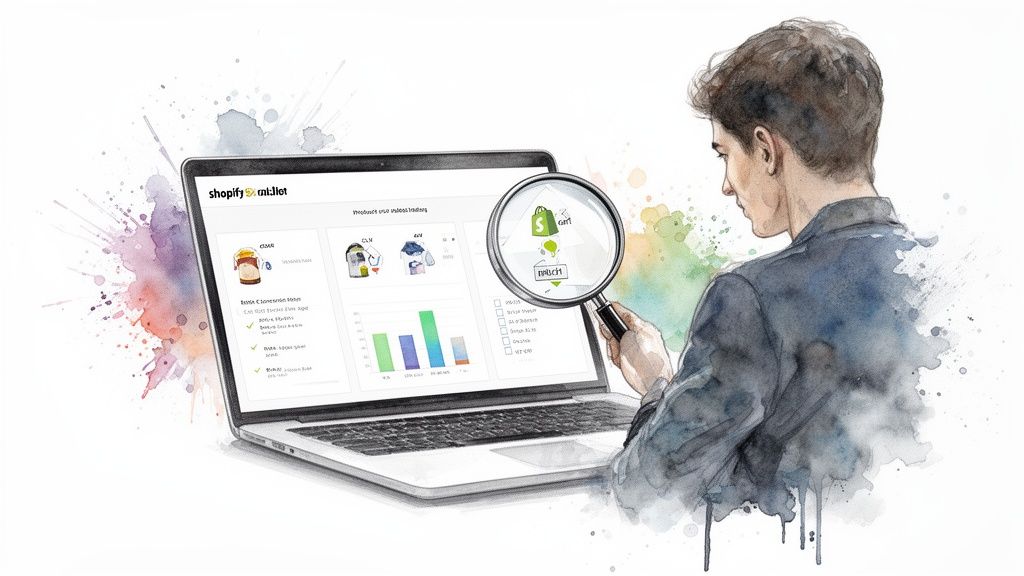
This screenshot shows exactly what I mean. A modern slide-out cart doesn't interrupt the shopping flow by sending people to a separate page. It becomes part of the experience, giving you the perfect canvas for value-added incentives.
The Power of the Slide-Out Cart
The key to this whole approach is ditching the traditional cart page and adopting a slide-out cart, often called a cart drawer. This simple change has a profound psychological effect. It keeps the customer in a shopping mindset, right on the product page where they're still open to discovering new items.
A tool like Monster Cart is built specifically for this. It replaces Shopify’s default cart with a fully customizable drawer that becomes the heart of your rewards and upsell strategy. Instead of annoying, screen-blocking pop-ups that customers have been trained to ignore, your offers appear right where the customer is already looking.
Launching High-Impact In-Cart Campaigns
With this foundation in place, you can launch campaigns that organically increase your AOV by making customers feel like they're earning rewards, not just spending money. Each tactic here focuses on adding value and improving the experience, which is how you build long-term customer relationships and boost lifetime value.
Here are a few high-impact campaigns you can roll out almost immediately:
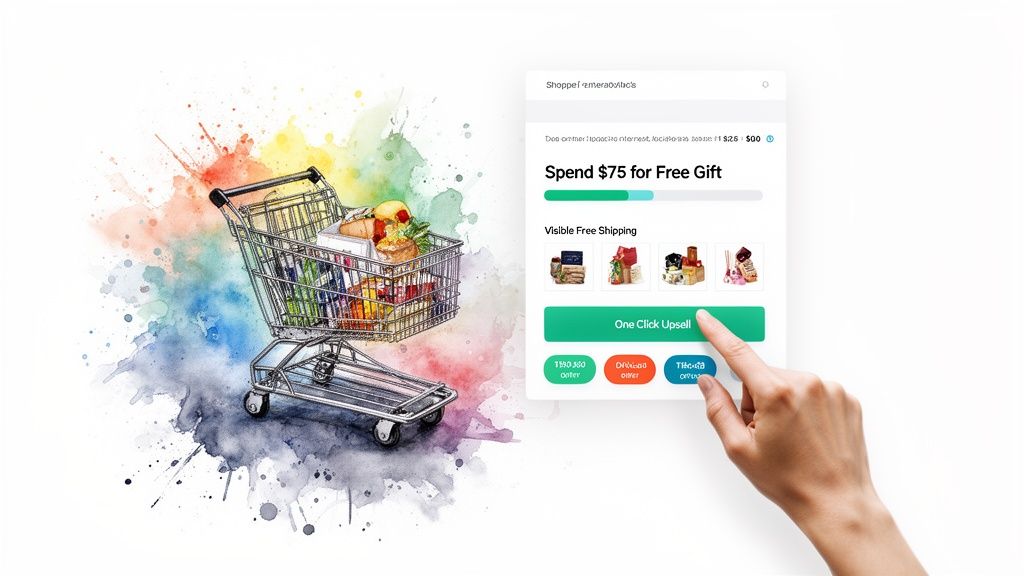
The Tiered Free Gift: This is one of the most powerful AOV boosters out there. Instead of a generic discount, you set a spending threshold to unlock a desirable free product. For example, "Spend $75 and get our bestselling lip balm for free!"
A Dynamic Free Shipping Bar: Shipping costs are a notorious conversion killer. A progress bar that visually shows how close a customer is to free shipping (e.g., "You're only $12 away from free shipping!") gamifies the experience and gives them a clear reason to add one more thing.
"Buy More, Save More" Tiers: This encourages bulk purchases with escalating rewards. You could structure an offer like, "Buy 2, get 10% off; Buy 3, get 20% off." The cart automatically applies the right reward as items are added, showing the customer the direct value of buying more.
By framing incentives as rewards to be earned rather than discounts to be claimed, you shift the customer's mindset from bargain-hunting to achieving a goal. This simple psychological switch protects your brand's perceived value and improves profitability.
Adding One-Click Upsells and Cross-Sells
Beyond threshold-based rewards, the slide-out cart is the perfect spot for relevant, one-click add-ons that don't disrupt the path to purchase. Because the customer hasn't fully committed to checkout yet, they're still in a buying mode. This is your chance to present helpful suggestions that increase the cart's total value.
One incredibly effective strategy is offering "Frequently Bought Together" bundles directly within the cart. That guide dives deep into the specific tactics for implementing product bundles to maximize your AOV.
Additionally, consider other valuable one-click offers:
Shipping Protection: Offer peace of mind with optional, low-cost shipping insurance.
Gift Wrapping: A perfect seasonal or evergreen upsell for gift-givers.
Priority Processing: Let customers pay a small fee to have their order jump to the front of the line.
These small, convenient additions can add up in a big way over time, directly boosting your bottom line with minimal effort. To see how these in-cart optimizations fit into the bigger picture, it's worth exploring all the ways you can improve your ecommerce conversion rate.
Ultimately, these tactics work because they're rooted in value and convenience. You're not just asking customers to spend more; you're giving them clear, compelling reasons to do so. This approach proves that a smart growth strategy can thrive without sacrificing your margins on endless discounts.
Turn One-Time Buyers into Brand Advocates
Getting that first sale feels incredible, but the real, sustainable growth comes from the second, third, and tenth sale from that same person. We all know the stats—acquiring a new customer can cost five times more than keeping an existing one. This part is all about shifting your mindset from one-time transactions to building genuine, long-term relationships that send your Customer Lifetime Value (CLV) through the roof.
The journey doesn’t end when they hit "complete purchase." In fact, that's where the real opportunity begins. A thoughtful post-purchase experience and a few strategic rewards can turn a casual buyer into a passionate advocate for your brand. Instead of immediately chasing the next shiny new customer, you can use simple touchpoints like the order confirmation page or follow-up emails to make them feel truly seen and appreciated.
From Transaction to Relationship
Think of the time immediately after a purchase as the "post-purchase honeymoon." The customer is excited about what's coming in the mail, and your brand is top of mind. This is your golden window to build a connection that goes way beyond the sale itself.
Don't let your order confirmation page be a digital dead end. Use that valuable real estate to thank them, show off your brand's personality, and maybe even offer a small, non-promotional piece of content—like a quick guide on how to get the most out of their new product. Little touches like these reinforce their buying decision and lay the groundwork for a lasting relationship.
The Power of Thoughtful In-Cart Rewards
Your growth strategy needs to reward loyalty in a way people can actually feel. Imagine a returning customer adding an item to their cart and a message instantly appears: "Welcome back! Here's a free gift, just for you." That kind of personal recognition is incredibly powerful and makes a customer feel valued, not just processed.
This is where a smart cart solution like Monster Cart can be a game-changer for your retention efforts. You can set up specific rules that automatically spot and reward returning customers right inside the cart. It's a seamless way to deliver a delightful surprise that costs you far less than a hefty discount but delivers a much bigger emotional punch and boosts lifetime value.
The goal is to make your customers feel like insiders. When they feel recognized for their loyalty, they aren't just buying a product; they're becoming part of your brand's community.
This approach subtly encourages repeat business by creating positive reinforcement with every purchase. Instead of training customers to wait for the next big sale, you're teaching them that loyalty comes with its own exclusive perks. For a deeper dive, our guide on how to increase customer lifetime value is packed with more actionable steps.
Turning Customer Data into Loyalty Campaigns
Your customer data is a goldmine for building retention. By segmenting your audience, you can create hyper-targeted email and SMS campaigns that speak directly to their experience with your brand, making them far more effective.
Here are a few simple but powerful segments you can start with today:
First-Time Buyers: Send them a warm welcome series. Reinforce your brand story, offer tips on using their new purchase, and maybe include a special incentive for their second order to kickstart that loyalty loop.
Repeat Customers: These are your VIPs, so treat them like it. Give them early access to new product launches, exclusive content, or members-only perks. Make them feel like they're part of an inner circle.
Lapsed Customers: If someone hasn't bought anything in a while, a friendly "we miss you" campaign with a compelling offer can be a great way to win them back without sounding desperate.
The key to all of this is personalization. A generic email blast just won't cut it anymore. Use their purchase history to make relevant recommendations and show that you actually understand what they like. By fostering this sense of community and exclusivity, you're not just selling products—you're building a loyal following that will drive your growth for years to come.
Measure and Optimize Your Growth Initiatives
Launching your in-cart rewards is a huge first step, but a strategy is only as good as the results you can measure. Real, sustainable growth comes from obsessively tracking what works, ditching what doesn’t, and constantly making your offers better. This is how you stop guessing and start making data-backed decisions that actually grow your bottom line.
You don't need some ridiculously complex analytics suite to pull this off. By zeroing in on a few critical key performance indicators (KPIs), you can build a dead-simple dashboard that gives you a crystal-clear picture of how your growth engine is performing. This is how raw numbers become real, actionable insights.

Building Your KPI Dashboard
Your entire goal here is to track the metrics that actually matter. We're talking about numbers that directly impact your profitability—forget about vanity metrics like social media likes.
Inside your Shopify Analytics, you can set up a custom view that keeps an eye on these three essentials:
Average Order Value (AOV): This is your north star metric for any in-cart campaign. When you see your AOV consistently climbing, it’s proof that your free gifts, shipping thresholds, and upsells are doing their job and getting customers to spend more.
Conversion Rate: While you're pushing for a higher AOV, you have to make sure you're not accidentally making it harder to check out. A stable—or even better, an increasing—conversion rate confirms that your offers are genuinely improving the shopping experience, not gumming it up.
Customer Lifetime Value (CLV): This one is all about the long game. Rewarding customers with something of real value, like a great free gift, builds way more loyalty than another 10% off coupon. Tracking CLV over several months will prove that your strategy is creating happy, repeat customers.
Watching these three together gives you the complete story. It ensures you’re not just juicing your AOV today at the expense of conversions or long-term brand loyalty.
The Fundamentals of A/B Testing Your Offers
Once your campaigns are humming along, the real fun begins: optimization through A/B testing. This is where you find out which rewards truly resonate with your audience and drive the best results. Instead of just assuming what your customers want, you let their actions give you the definitive answer.
A/B testing removes ego and assumptions from your strategy. You might be convinced that a 15% discount is a killer offer, but the data could easily prove that a well-chosen free gift drives a much higher AOV and protects your precious profit margins. Let the numbers guide you.
The idea is straightforward. You create two versions of an offer—let's call them Variant A and Variant B—and show them to different segments of your shoppers to see which one performs better. For example, you might pit a free gift against a percentage discount to see which one delivers a higher average order value.
A Simple Testing Plan to Get Started
You don’t need to be a data scientist to run tests that make a real impact. Just follow this simple framework to start making smarter, more profitable decisions.
Start with a clear, testable statement that outlines what you're changing, what you expect to happen, and your reasoning behind it. For instance:
Hypothesis: "Offering a free best-selling lip balm at a $75 cart threshold (Variant B) will increase AOV more than offering a 10% discount coupon at the same threshold (Variant A). We believe the perceived value of the physical gift will be a stronger motivator than the small monetary discount."
Next, you'll want to implement both variants. A tool like Monster Cart makes this dead simple, letting you set up different reward campaigns and track their performance side-by-side. You'll need to let the test run long enough to get statistically significant data—that usually means at least a week or until you have a few hundred transactions for each version.
Once the test is done, pop open the results and compare how each variant performed against your primary KPI. Did the free gift actually lead to a higher AOV? Just as important, check your secondary metrics. Maybe the discount converted slightly better, but did it come at the cost of a much lower profit margin?
Finally, based on what the data tells you, confidently roll out the winning variant to 100% of your audience. Just like that, you've made a strategic, data-backed improvement to your growth engine.
To help you structure this, here’s a simple framework you can use for any test you run.
A/B Testing Framework for In-Cart Offers
This table provides a practical template for structuring your A/B tests. Use it to keep your hypotheses clear and your metrics focused.
Test Element | Hypothesis Example | Primary Metric to Track | Secondary Metric |
|---|---|---|---|
Reward Type | A free gift will outperform a 15% discount. | Average Order Value (AOV) | Conversion Rate |
Spend Threshold | A $100 threshold will have a higher AOV lift than a $75 threshold. | Average Order Value (AOV) | Cart Abandonment Rate |
Offer Copy | Using "You've Unlocked!" will convert better than "Free Gift Added." | Reward Redemption Rate | Conversion Rate |
Product Upsell | Suggesting a complementary item will beat a generic bestseller. | Upsell Take Rate | Average Order Value (AOV) |
By following this disciplined process, you’re no longer just launching promotions; you’re building a systematic way to improve them.
This continuous loop of measuring, testing, and optimizing is the secret sauce of a truly sophisticated ecommerce growth strategy. It guarantees you're always adapting and improving, turning your shopping cart into an increasingly powerful and profitable asset for your brand.
Common Questions About Ecommerce Growth
Once you start digging into an ecommerce growth strategy, a lot of practical questions pop up. As a Shopify merchant, you're always on the hunt for clear, actionable answers you can put to work without a massive budget or a dedicated marketing team.
Let's cut through the noise and tackle some of the most common hurdles I see brands face when they're trying to scale profitably. The goal here is straightforward guidance that helps you build a sustainable growth engine—one that’s all about long-term customer relationships and healthy margins, not just short-sighted, discount-heavy tactics.
How Can I Increase My Average Order Value Without Using Hefty Discounts?
This is the golden question, isn't it? Every merchant gets tired of sacrificing margins just to make a sale. The key is to completely shift your mindset: stop subtracting from the price with deep discounts and start adding real, tangible value to the order.
Instead of offering a blanket 15% off, which just trains customers to wait for the next sale, you can introduce rewards that actually make the shopping experience better. The best place to do this is right inside the cart, where purchase intent is at its absolute peak. It’s the perfect moment to present a compelling offer.
Tiered Free Gifts: Set up a system where shoppers unlock a desirable free product once their cart hits a specific value. Think: "Spend $75 and get a free travel-size moisturizer." It feels like a genuine reward, not a cheap discount.
Dynamic Free Shipping Bar: We all know shipping costs are a top reason for abandoned carts. A visual progress bar that shows people how close they are to free shipping turns the experience into a mini-game and gives them a clear reason to add one more item.
Strategic Discounts: This isn't about site-wide sales. It's about "Buy More, Save More" offers like "Buy 2, Get 10% Off" that encourage volume and increase the total order value.
These methods work because they give customers a compelling reason to increase their order size to hit a rewarding milestone. It’s a strategy built on enhancing the shopping journey and boosting lifetime value, which is exactly what tools like Monster Cart are designed to do seamlessly.
What Is the Best Way to Start Building a Customer Retention Strategy?
Building loyalty starts the second a customer completes their first purchase. That post-purchase experience is your single most underrated opportunity to make a lasting impression and lock in a second order. Your relationship doesn't end at checkout; it’s just getting started.
A simple but ridiculously effective tactic is to slip a small, unexpected gift or a personalized, handwritten note into their package. In the digital world, use your order confirmation emails to do more than just confirm—thank them and provide real value, like a quick-start guide for their new product.
The most powerful retention strategies make customers feel seen and appreciated. It's not about complex loyalty programs; it's about creating small moments of delight that reinforce their decision to shop with you.
From there, segment your email list. Separate your first-time buyers from your repeat customers. Send a targeted "welcome" campaign to new shoppers with a special offer for their second purchase. For your most loyal fans, reward them with early access to new products or exclusive content. The foundation of turning one-time buyers into brand advocates is making every customer feel recognized.
How Do I Know If My Ecommerce Growth Strategy Is Working?
You can't improve what you don't measure. Period. To know if your strategy is actually moving the needle, you have to consistently track a handful of key performance indicators (KPIs) that directly reflect your store's financial health.
Focus on these core metrics and keep an eye on them weekly in a simple dashboard:
Average Order Value (AOV): Is it trending up? This is the clearest sign that your in-cart offers are successfully encouraging bigger spends.
Conversion Rate: Are people still checking out at the same—or a higher—rate? This ensures your offers aren't adding friction to the buying process.
Customer Lifetime Value (CLV): This is the long-term measure of success. An increasing CLV proves your retention efforts are building a loyal customer base that comes back.
Cart Abandonment Rate: A decrease here shows you're successfully smoothing out the path to purchase and removing roadblocks.
If you see positive movement in these areas after putting new tactics in place, your ecommerce growth strategy is on the right track. From there, you can use A/B testing to refine specific offers and confirm which ones deliver the absolute best results for your bottom line.
Ready to turn your shopping cart into a powerful revenue engine? Monster Cart gives you all the tools you need to boost AOV with high-converting, in-cart rewards like free gifts, shipping bars, and one-click upsells—without the need for margin-killing discounts. Join thousands of top Shopify brands and see why it's the ultimate solution for building a smarter, more profitable growth strategy. Discover what Monster Cart can do for your store today.
Join 7000+ brands using our apps