How to Increase Average Order Value Without Hurting Your Margins
Dec 23, 2025
|
Published
If you want to sustainably increase your average order value, you have to stop thinking about deep, margin-killing discounts. The most effective way brands do this is by creating value-add incentives that make shoppers want to spend more, fostering a relationship that goes beyond a single transaction.
Think about attainable reward tiers, like free shipping, a free gift with purchase, or a small discount on a future order. These simple motivators encourage customers to add just one more item to their cart, boosting your revenue right away while building loyalty and increasing customer lifetime value.
Growing Revenue Beyond Discounts
It’s an easy trap to fall into: thinking that big, flashy discounts are the only way to bump up your Average Order Value (AOV). But this is a classic short-term play. It absolutely kills your profit margins and, worse, trains your customers to just sit back and wait for the next sale.
The real goal here isn’t just a temporary sales spike. It's about sustainably growing your customer lifetime value (LTV) by creating a shopping experience that’s genuinely better than your competitors'.
A much smarter approach is to reframe the entire conversation around profitable, sustainable growth. Stop asking, "How can I get this customer to spend more right now?" Instead, start asking, "How can I add more value to this customer's order and their long-term experience?" The answer almost always involves rewarding them for spending more, not just giving things away for less.
Shifting Focus from Discounts to Value
This isn't just some abstract theory—it's a model that top-performing brands use every single day. They’ve mastered the art of making customers feel good about adding more to their cart. It all comes down to intelligent strategies that feel helpful and rewarding, not pushy.
Here are the core ideas in action:
Enhance the Customer Experience: A smooth, rewarding shopping journey is everything. When customers feel like you're looking out for them, they're far more likely to stick around, browse more products, and ultimately spend more.
Build a Loyal Customer Base: One-off sales are fine, but repeat business is where you build a real brand. Offering rewards instead of constant discounts creates a positive feedback loop that keeps your best customers coming back, significantly boosting LTV.
Prioritize Margin-Friendly Alternatives: Tactics like free gifts, exclusive content, or hitting a free shipping threshold are your best friends. They protect your profits while still giving shoppers a compelling reason to increase their cart size.
Shifting your strategy from constant sales to value-based rewards is the key to unlocking sustainable AOV growth. A customer who adds a $15 item to get a free gift is far more profitable than one who buys the same item only because it's 30% off.
To really nail this, you need to understand how AOV initiatives fit into the bigger picture. Improving your overall conversion rates goes hand-in-hand with this effort. There's a great, practical guide on how to improve ecommerce conversion rates that can help build a strong foundation.
Ultimately, a rising AOV should be the natural side effect of a fantastic shopping experience. When you focus on adding genuine value—through smart in-cart rewards, strategic product bundles, and personalized recommendations—you’ll drive bigger orders and build a healthier, more profitable business. Tools like Monster Cart are built for exactly this, helping you turn your cart into a rewards engine that boosts AOV without gutting your brand or your margins.
Turn Your Cart into an AOV Engine
Think of your shopping cart as more than just a checkout page. It's your last, and best, chance to increase a customer's order value right before they pull the trigger. At this moment, their intent to buy is at its absolute peak. By shifting your cart from a simple order summary to a dynamic rewards hub, you can nudge customers to add just one more thing.
The psychology at play here is surprisingly powerful. You’re not hitting them with a hard sell; you're helping them achieve something. They aren't just buying products—they're unlocking perks they've earned. This simple reframe makes the whole transaction feel more rewarding and encourages a higher spend without any added pressure.
How to Set Smart Reward Thresholds
One of the biggest mistakes merchants make is pulling their reward thresholds out of thin air. An effective threshold isn't a guess; it's a calculated move based on your store's actual data. If your current AOV is $75, dangling a free gift at $150 feels like a stretch and can actually lead to people abandoning their carts.
A much smarter move? Set that threshold at $100. This feels like an achievable goal. The trick is to dig into your analytics, find your modal order value (the order total that shows up most often), and set your first reward tier about 20-30% higher than that number. You're creating a small, motivating gap that a huge chunk of your customers can easily bridge with one more small item.
Pro Tip: Avoid using deep discounts as your main reward. It's a race to the bottom that erodes your margins and cheapens your brand. Stick to value-adds like free shipping or a free gift that protect your profitability and foster genuine customer loyalty.
A well-designed rewards system is all about sustainable growth. You create a great experience, which builds loyalty, and that loyalty is what ultimately drives up your AOV.
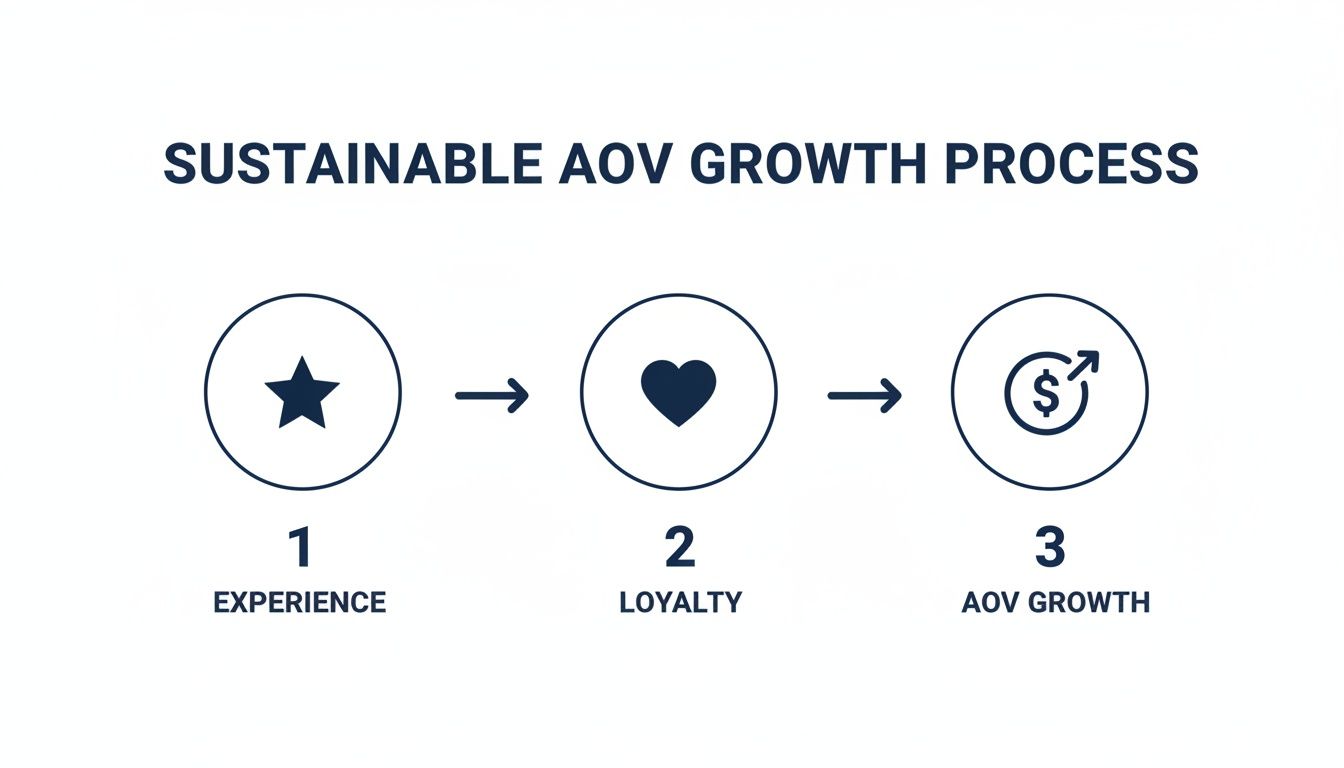
As you can see, it all starts with delivering an exceptional experience. That's the foundation for building the kind of loyalty that pays off in the long run.
Choosing Rewards That Actually Work
The best rewards aren't the most expensive ones. They're the ones that make your customers feel smart and appreciated, boosting the value of their entire purchase without costing you a fortune.
Forget about hefty discounts. Instead, try these margin-friendly rewards that customers consistently respond to:
Exclusive Gift with Purchase (GWP): Offer a popular, low-cost product that complements what they’re already buying. For instance, a skincare brand could toss in a mini version of a best-selling serum for orders over $100.
Credit for a Future Order: Instead of a 10% discount now, offer a $10 credit on their next purchase. This not only bumps up the current AOV but is a killer tactic for driving repeat business and boosting lifetime value.
Early Access to New Products: For your regulars, the chance to get their hands on a new product before anyone else can be a massive motivator.
Free Shipping: It’s a classic for a reason. Study after study confirms that unexpected shipping costs are one of the top reasons people bail on their carts.
The Power of Visual Progress
Just saying "Free shipping on orders over $100" is weak. You have to make that goal feel tangible and visible right in the cart. This is where a visual progress bar and some clear, dynamic messaging can work wonders.
A simple message like, "You're just $15.20 away from your free gift!" creates an incredibly powerful psychological nudge. The customer sees exactly how close they are, and it almost always triggers the thought, "I might as well add one more small thing." It gamifies the experience and makes hitting that goal feel fun.
This kind of dynamic in-cart experience is a core part of effective shopping cart optimization, a discipline where tiny UX tweaks can lead to some serious revenue gains.
While this might sound like it requires a developer on standby, that’s no longer the case. Modern tools built for Shopify, like Monster Cart, make it incredibly easy to launch and manage these in-cart campaigns yourself. You can set up tiered rewards, progress bars, and product recommendations inside a sleek, customizable slide-out cart. It completely replaces the default cart with a high-performing AOV engine that gets customers to happily spend more.
Strategic Bundling and Product Recommendations
Once you've got your cart working as a rewards engine, it's time to get smarter with your product suggestions. This is all about showing customers the right products at the right time, making it feel like helpful guidance, not a pushy sales pitch. Think of bundling and recommendations less as a way to squeeze more money out of a sale and more as a way to elevate the entire shopping experience.
When you get this right, you’re actually solving a problem for your customer. You're not just selling them a single item; you're offering them a complete solution, a curated look, or just a really good deal. This shift in mindset is crucial. It’s how you boost AOV while also building brand loyalty and getting shoppers to explore more of what you offer.

Different Types of Bundles for Every Goal
Not all bundles are created equal. The most successful brands use a mix of different strategies to appeal to different shoppers and their buying moods. Figuring out which type of bundle works best for your products is the first step to making them truly irresistible.
Here are the three main types that work time and time again:
‘Pure’ Bundles: These are your classic, pre-packaged kits sold as a single item. A great example is a skincare brand offering a "Morning Glow Kit" with a cleanser, serum, and moisturizer. It’s the perfect, no-guesswork option for new customers.
‘Mix and Match’ Bundles: This approach gives the power to the customer, letting them build their own bundle from a curated selection. You've probably seen this as "Pick any 3 T-shirts for $60." It offers a sense of control and ensures people get exactly what they want, which is a huge conversion driver.
‘Add-On’ Bundles: This is a more subtle cross-sell where you offer a complementary item at a small discount when someone buys a primary product. Think of offering a discounted screen protector right on the product page for a new phone.
The secret to a great bundle is that it must solve a real customer problem. A bundle shouldn’t feel like a random assortment of products; it should feel like a perfectly curated solution designed just for them.
Product bundling is one of the most reliable ways to get that AOV up. In fact, e-commerce benchmarks show that smart bundling and "frequently bought together" sections can lift order sizes by 10-30%. To put that in perspective, global AOV trends hit a record $144 in 2024. That growth is being driven by merchants on their own sites, who are seeing a 2-3x higher AOV than Amazon's average of just $35, where single-item checkouts are king. You can find more of these e-commerce benchmarks over at SpeedCommerce.
I've put together a quick table to break down the most common bundling strategies and where they shine.
Table: Effective Product Bundle Strategies
Bundle Type | Description | Best For | AOV Impact |
|---|---|---|---|
Pure Bundle | A pre-set collection of products sold as one unit (SKU). | Introducing new customers to a full routine or solution. | Moderate to High |
Mix & Match | Allows customers to choose several items from a selection to create their own bundle at a fixed price. | Apparel, consumables, or products where personal preference is high. | High |
Add-on Discount | Offering a discount on a complementary item when a primary product is purchased. | Accessories, refills, or items that enhance the main product. | Low to Moderate |
BMSM (Buy More, Save More) | Tiered discounts that increase as the customer adds more items to their cart (e.g., Buy 2 get 10% off, Buy 3 get 20% off). | Products that customers often buy in multiples, like socks, candles, or snacks. | High |
Choosing the right strategy really depends on your catalog and what your customers are already doing. The key is to make the offer feel intuitive and valuable.
Using Data to Create Irresistible Offers
The best bundles aren't just guesses; they're built on data. Before you start creating offers, dive into your past order history. What are people already buying together, without any prompting from you? Those natural pairings are your roadmap for creating bundles that you know will work.
For instance, if you sell coffee and see that tons of customers buying your French Roast also grab a specific pour-over filter, you've found a winner. Package them as a "Perfect Brew Kit," knock a little off the total price, and you've just made your customer feel like a genius for finding a great deal.
Another killer technique is to pair a bestseller with a lesser-known but highly complementary product. This is a great way to drive product discovery. It not only bumps up the immediate order value but also introduces customers to more of your catalog, potentially creating their new favorite thing and bringing them back for more. If you're looking for other ways to reward shoppers, check out our guide on creating a compelling free gift with purchase program.
Ultimately, you want the bundle to be a no-brainer. Tools like Monster Cart can make this seamless by showing these bundles and "frequently bought together" recommendations right inside the slide-out cart. As someone adds an item, you can present them with a smart, contextual add-on. This makes the upsell feel like a natural part of the shopping flow instead of an annoying pop-up, respecting the customer journey while maximizing every order.
Mastering Upsells at Key Moments
Strategic bundling is great for helping customers find a complete solution, but mastering the upsell is about making the right offer at just the right time. This isn't about being pushy; it's about being genuinely helpful.
When you suggest the perfect add-on when a customer is most receptive, it feels less like a sales tactic and more like a thoughtful recommendation from a friend. Timing is everything. A poorly placed, irrelevant offer just adds friction and might even make someone abandon their cart. Get it right, though, and you build trust, improve their experience, and directly increase your average order value.
Upselling vs. Cross-Selling: What’s the Difference?
First, let's get the language straight. People often use these terms interchangeably, but they’re two distinct strategies. Knowing the difference is crucial for using them effectively.
Upselling: This is all about encouraging a customer to buy a better, bigger, or more premium version of the product they're already looking at. Think of it as steering them from the 8-ounce shampoo to the 16-ounce bottle.
Cross-selling: Here, you’re suggesting complementary products that go well with what’s already in their cart. The classic example? Offering a phone case and screen protector after someone adds a new smartphone to their cart.
Both aim to increase the final sale price, but they get there in different ways. Upselling upgrades a single item; cross-selling adds more items to the order.
The Three Best Places for Your Offers
The impact of an upsell or cross-sell hinges on where you present it. You have to meet the customer at a point in their journey where the offer makes sense. Interrupt them at the wrong moment, and you risk doing more harm than good.
From my experience, these are the three most effective moments to make your move:
On the Product Page: This is your first shot. While a customer is actively checking out a product, you can show them upgrades like a larger size or a premium model. This is also a great spot for "Frequently Bought Together" bundles just below the main product details.
In the Cart: Once an item is in the cart, their intent to buy is strong. This is the perfect time for low-cost, highly relevant cross-sells. A small, easy add-on feels like a helpful last-minute reminder, not a hard sell.
Post-Purchase: This is a surprisingly powerful and completely risk-free opportunity. The main transaction is done, so there's zero chance of messing up the original conversion. A one-click post-purchase offer for a related item feels like an exclusive deal and captures that impulse buy from a happy customer.
My advice? Stick to a "less is more" strategy. Don't overwhelm shoppers with a dozen options. Hand-pick one or two highly relevant, easy-to-add items. The offer should feel like a natural extension of their purchase, not a blatant money grab.
Making Offers That Feel Genuinely Helpful
The secret to successful upselling isn't about slashing prices with complex discounts that confuse people and kill your margins. It's about framing your offers as genuine value-adds that make their main purchase even better.
When done right, implementing upsells and cross-sells can increase AOV by 10-30%. This isn't just theory; it’s a strategy that has helped fuel e-commerce growth, with the global AOV hitting $144 in 2024. Post-purchase offers, something as simple as an "Add this for 15% off," have been shown to boost AOV by an extra 10-15%—a much cheaper win than acquiring a brand-new customer.
To really nail this, you need to go beyond generic suggestions. The best offers are personalized, using customer data and smart logic to show them things they’ll actually want. Apps like Monster Cart are built for this, letting you create targeted in-cart and post-purchase upsells triggered by specific cart contents or values. For more advanced tactics, check out our guide covering upsell hacks for your Shopify store.
This kind of targeted approach turns a generic pitch into a curated recommendation, making the customer feel understood. It's that focus on enhancing the original purchase that ultimately lifts not just your AOV, but your long-term customer loyalty, too.
How to Measure and Optimize Your AOV Strategy
Launching a new free shipping threshold or a gift-with-purchase offer is really just the starting line. The real work begins when you start measuring what’s working, what isn’t, and how to fine-tune your approach for maximum profit. Just launching something and hoping for the best is a recipe for wasted effort and, frankly, lost revenue.
An effective AOV program is never "set it and forget it." It's a living, breathing part of your business that needs constant attention. By adopting an iterative cycle—test, measure, refine, repeat—you can build a robust system that not only lifts your average order value but also supports the overall health of your entire business.
Setting Up Simple A/B Tests
Guesswork has absolutely no place in a serious AOV strategy. The only way to know for sure if a new offer is making a real difference is to test it against a control group or another variation. This is where A/B testing comes in, and it doesn't need to be complicated.
Start with a simple, clear hypothesis. For instance: “Offering a free gift for orders over $100 will generate a higher AOV and conversion rate than offering a 15% discount on a future purchase.”
Here’s how you could structure that test:
Variant A (Control): Your current cart experience, with no special AOV-boosting offer.
Variant B (Test): A cart that includes a tiered reward, like a free gift when customers spend $100.
Variant C (Test): An alternative offer, maybe a $15 credit towards a future purchase for orders over $100.
Let the test run long enough to gather statistically significant data, and then dive into the results. To really get this right, you need to understand the fundamentals of optimization techniques like A/B and multivariate testing. It’s what allows you to make decisions based on cold, hard data instead of just a gut feeling.
Key Metrics to Track Beyond AOV
While bumping up your average order value is the headline goal, it can quickly become a vanity metric if it comes at the expense of other critical business numbers. A successful AOV strategy should lift all boats, not sink some to raise one.
When you’re looking at your A/B test results, you need a holistic view. Track these metrics together:
Conversion Rate: Did your offer actually convince more people to complete their purchase, or did it create friction and cause them to bail? A great AOV offer should ideally maintain or even improve your conversion rate.
Cart Abandonment Rate: Keep a close eye on this one. If you set a free shipping threshold way too high, for example, you might see a sudden spike in abandoned carts from shoppers who feel the goal is out of reach.
Profit Margin: A higher AOV is completely meaningless if it’s shredding your profitability. You must calculate the margin on the average order for each variant. That free gift might cost you $5, but if it increases the average order profit by $10, it’s a clear win.
Customer Lifetime Value (LTV): This is the long game, the ultimate metric. Does your AOV strategy encourage repeat business? An offer like a credit for a future purchase is specifically designed to boost LTV by creating a loyal customer base that spends more over time.
A strategy that spikes short-term AOV but hurts your conversion rate or long-term LTV is a failure. The goal is sustainable, profitable growth, not just a bigger number on a dashboard for one month.
Analyzing Results to Make Smart Decisions
Once your test is complete, it's time to turn that raw data into action.
Let's walk through a common scenario. Imagine you tested a new free shipping threshold set at $120. The data comes in, and your AOV did indeed increase by a respectable 15%. Great, right? But wait. Your cart abandonment rate also jumped by 20%, and your overall conversion rate dipped slightly.
This data is telling you a very clear story: your threshold is too high. It’s working for some customers, but it's scaring away an even larger group.
The next logical step isn't to scrap the idea, but to iterate. Run another test with a lower, more achievable threshold, maybe around $100. This iterative process—testing, analyzing, and adjusting—is how you find the sweet spot that maximizes AOV without cannibalizing your other key metrics.
This continuous optimization loop is precisely what tools like Monster Cart are built to support. With its built-in analytics, you can easily track the performance of your in-cart offers, seeing exactly how they impact AOV, conversion rates, and total revenue. It gives you the power to quickly pivot your strategy, test new rewards, and make data-backed decisions that build a healthier, more profitable business.
Frequently Asked Questions About AOV
Let’s dig into some of the most common questions we hear from Shopify merchants trying to boost their average order value. My goal here is to give you straightforward, practical answers you can run with.
What Is a Good Average Order Value to Aim For?
Honestly, there’s no magic number. A "good" AOV is completely relative to your industry, what you sell, and your typical customer. Chasing some universal benchmark is a recipe for frustration.
A much smarter approach is to focus on improving your own baseline. Aim for a 15-20% increase from where you are right now. To give you some context, the average across all of Shopify might be around $90, but that number is all over the map. A beauty brand might see an AOV closer to $71, while a furniture store could easily hit $260+.
The real goal is to make sure your AOV comfortably covers your customer acquisition costs and leaves you with a healthy profit. Forget arbitrary numbers and focus on consistent, incremental growth.
Will Offering Free Gifts or Shipping Hurt My Profit Margins?
That’s a totally fair question, but the short answer is no—not if you do it right. The trick is to see these rewards not as giveaways, but as calculated investments to get customers to spend more.
It all comes down to setting the right threshold. You need to make sure the bump in their cart value more than pays for the cost of the reward. For example, say your average product margin is 50%. If you offer a free gift that costs you $5, you just need the customer to add $10 more to their cart than they were originally planning. Anything above that is pure profit.
The real win isn't just on that one order; it's the lift in AOV across your entire business. By setting your reward threshold smartly (usually 20-30% above your current AOV), you nudge everyone to build bigger carts. This boosts your overall profit, making rewards a margin-friendly powerhouse.
How Can I Add These AOV Features Without a Developer?
This is where a lot of merchants get stuck, but you don't need to hire a developer or learn to code. The answer lies in finding the right Shopify app designed specifically for this.
The key is to choose a tool that won't bog down your site and plays nicely with your theme. For example, an app like Monster Cart is built to be incredibly lightweight and easy to use. It gives you an intuitive drag-and-drop interface to create all those powerful in-cart campaigns—like tiered rewards, progress bars, and product recommendations—without touching a single line of code.
These modern apps run the heavy lifting on their own servers, so your store stays fast. This lets you roll out sophisticated AOV strategies in minutes, giving you full creative control without any of the technical headaches. You get to focus on strategy and your customers, not on code.
Ready to turn your cart into an AOV-boosting machine? With Monster Cart, you can create a fully branded, rewards-driven cart that encourages customers to happily spend more—no deep discounts or annoying pop-ups needed. Start boosting your AOV today.
Join 7000+ brands using our apps