Ecommerce Planning and Merchandising to Boost AOV
Dec 30, 2025
|
Published
Great planning and merchandising isn't about two separate strategies; it's about one cohesive approach that links your big-picture business goals to the real-time decisions a customer makes in their shopping cart.
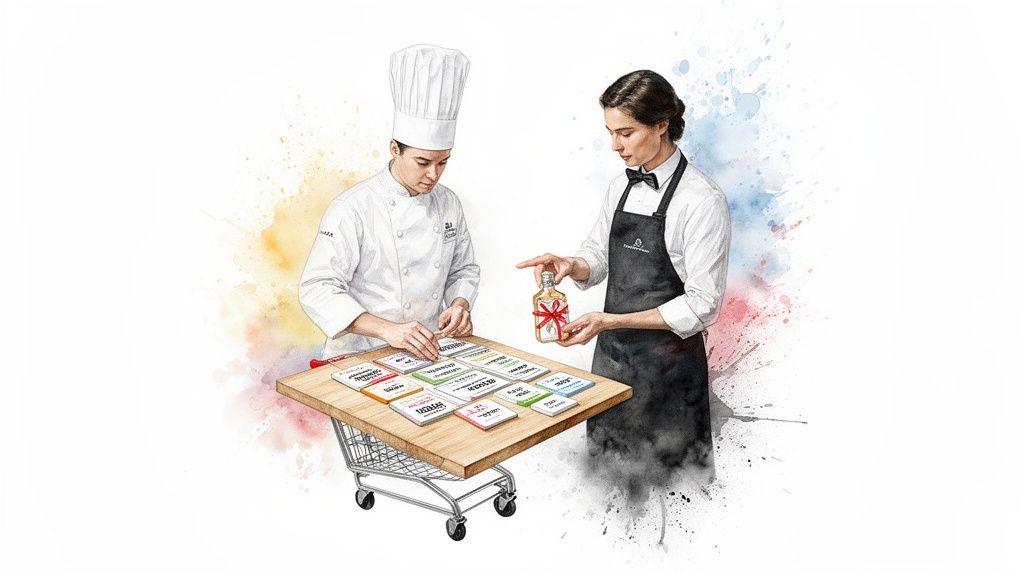
Think of it like running a successful restaurant. The strategic planning is the head chef designing a brilliant, profitable menu. The smart merchandising is the server who knows exactly when to suggest the perfect wine pairing to elevate the meal. When these two work in harmony, you don't just sell more—you create a better experience that boosts Average Order Value (AOV), encourages repeat business, and builds incredible lifetime value.
The Hidden Engine of Ecommerce Growth
If you're a Shopify merchant, you know the feeling. You fight to bring customers to your site, only to watch them get to the very last step and then... poof. They're gone. This isn't just a feeling; it's one of the biggest challenges in e-commerce today.
The numbers don't lie. Back in 2006, the average cart abandonment rate was around 59.8%. Fast forward to today, and that global average has ballooned to a staggering 70.19%. This trend translates to an estimated £2.96 trillion in lost sales every single year. The good news? A huge chunk of that is recoverable with the right strategy. You can dig into more of this data on worldwide shopping cart abandonment rates on Statista.com.
Beyond Discounts and Toward Lifetime Value
What’s the knee-jerk reaction to this problem? Discounts. Big, splashy, margin-killing discounts. While they might give you a short-term sales bump, they also teach your customers to just wait for the next sale. This erodes your brand's value and trains customers away from paying full price, damaging long-term lifetime value.
A more sustainable path to growth lies in boosting AOV without hefty discounts. This means encouraging customers to spend a little more, not by slashing prices, but by offering them genuinely compelling rewards in return. It’s about nurturing a healthier, long-term relationship focused on value, not just the lowest price.
The goal is to make customers feel rewarded for their loyalty, not just for making a transaction. By shifting focus from one-time discounts to lifetime value, you build a more resilient and profitable business.
This is where strategic incentives come in—ones that delight your customers without destroying your bottom line. Think about things like:
Free Gifts: Tossing in a desirable, low-cost item once a cart hits a certain threshold.
Free Shipping: Still one of the most powerful motivators for completing a purchase and increasing cart size.
Tiered Rewards: Creating exciting milestones that unlock better and better rewards as customers add more to their cart.
Turning Your Cart Into a Revenue Engine
This is where your cart stops being a static checkout page and becomes a dynamic sales tool. When you connect your high-level strategy to the in-cart experience, you can actively guide customers toward a higher AOV and build that coveted lifetime value.
A tool like Monster Cart is built specifically for this purpose. It transforms the standard, passive cart into an interactive rewards system, visually showing shoppers how close they are to unlocking their next perk. It's a proactive approach that doesn't just process transactions—it builds bigger, more profitable ones, turning casual browsers into loyal, high-value customers.
Building Your Strategic Planning Framework
Smart planning and merchandising don't just happen when a customer is about to check out. It all starts much earlier, with a solid strategic framework that acts as the blueprint for your entire sales process. Without this foundation, your merchandising efforts are just shots in the dark, not calculated moves designed to boost your average order value (AOV) and customer lifetime value.
Think of this framework as having four core pillars: assortment planning, pricing, promotions, and inventory management. When these are all working together, they create a system that naturally guides customers toward spending more, without you having to constantly slash prices and kill your margins.
Curate Your Product Assortment for Upsells
The first pillar is assortment planning. This isn't just about what you sell; it's the art of curating a product catalog where items naturally go together. Stop thinking about selling individual products and start thinking about building complete solutions or experiences for your customers.
A well-planned assortment just organically creates opportunities to upsell and cross-sell. For example, if you sell high-quality leather handbags, your catalog should also feature matching wallets, leather care kits, and maybe some stylish bag charms. Each one of these is a logical next step for the customer, making it an easy "yes" to add to their cart.
Your product catalog shouldn't be a random collection of items. It should be a guided journey where each product logically leads to the next, making it effortless for customers to discover more and increase their order value.
This is what sets the stage for powerful in-cart merchandising. When a customer adds that handbag, a smart cart tool like Monster Cart can instantly pop up a recommendation for the perfectly matched wallet, turning a single-item purchase into a multi-item order right then and there.
Shift from Discounts to Value-Based Rewards
Next up is your pricing and promotions strategy. The real goal here is to break the vicious cycle of constant sales that just trains customers to wait for a discount. Instead, build a calendar of value-based rewards that protects your margins while still feeling like a great deal for the shopper. You’re encouraging a higher AOV by rewarding customers for spending more, not by simply cutting prices.
Focus on incentives that actually add value. Things like:
Free Gifts with Purchase (GWP): Offer a desirable, high-margin sample or a smaller complementary product once a customer’s cart hits a certain value.
Free Shipping Thresholds: This is still one of the most powerful motivators in the book. A progress bar in the cart showing "You're only $15 away from free shipping!" works wonders.
Tiered Rewards: Create a bit of a game with escalating offers. A customer might unlock a free sample at $50, a deluxe sample at $75, and free shipping at $100.
This strategy completely changes the conversation from "how cheap can I get this?" to "what else can I get with my order?" It reframes spending as a way to get more value, which is absolutely essential for building long-term customer relationships and lifetime value.
Align Promotions with Business Goals
Your promotional strategy is what connects your value-based rewards to your actual business goals, whether that’s capitalizing on seasonal trends, launching a new product, or moving through inventory. This makes sure your promotions have a purpose and aren't just random acts of marketing.
For instance, during the summer, a skincare brand might run a promotion offering a free travel-sized sunscreen on all orders over $75. It’s relevant, it’s timely, and it encourages customers to stock up on seasonal essentials. It links a specific reward to a specific moment, which makes the offer feel way more compelling than a generic sale.
Use Inventory Management as a Merchandising Tool
Finally, smart inventory management feeds directly back into your promotional strategy. Instead of seeing a pile of excess stock as a problem you have to solve with a clearance sale, look at it as a merchandising opportunity. That slow-moving but high-quality body lotion? It can become a very attractive free gift for orders over $60.
This tactic hits two critical goals at once:
It profitably moves excess inventory without devaluing the product by slapping a huge discount on it.
It increases the perceived value of the customer's order, making them feel like they got a special bonus.
By integrating these four pillars, you create a powerful planning framework that informs every decision you make. For a deeper dive into building a robust and future-proof plan, check out these top strategic planning best practices for ecommerce. With this foundation in place, your in-cart merchandising tactics will be targeted, effective, and a whole lot more profitable.
Putting Your Plan Into Action: Turning the Cart Into a Sales Engine
Alright, you’ve done the heavy lifting with your strategic framework. Now it's time to connect that high-level planning to where the action really happens: the shopping cart. This is where your strategy meets the customer, and it's arguably the most valuable piece of digital real estate you own. It's no longer just a static list of items; it's a dynamic sales tool, and we're going to put it to work.
The goal here is simple but powerful. We want to transform the cart from a passive checkout page into an interactive, personal shopper that actively guides customers toward a higher average order value (AOV). The key is to do this not by constantly slashing prices, but by creating a value-driven experience that rewards customers for spending more. This builds loyalty and boosts their lifetime value in a way discounts just can't match.
The map below shows how your core planning pillars—assortment, pricing, promotion, and inventory—all feed directly into the in-cart merchandising tactics we're about to cover.
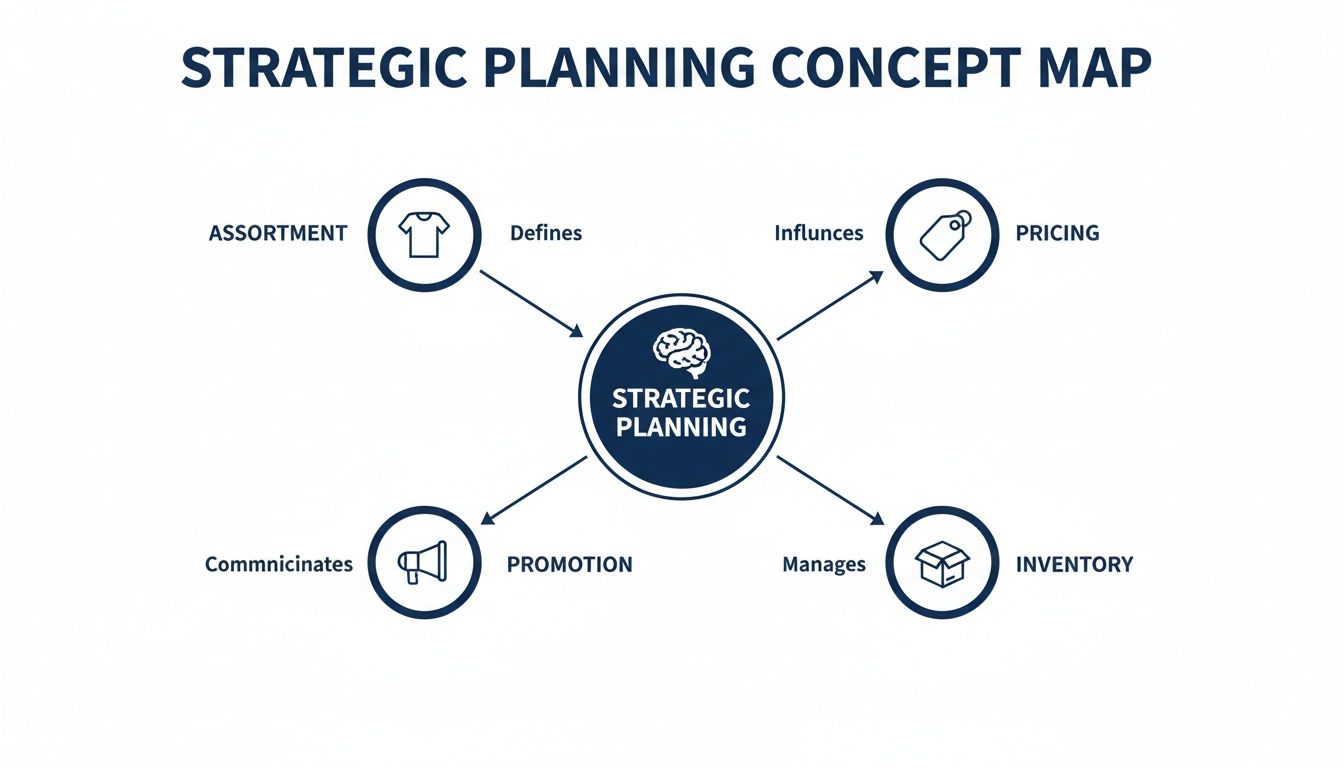
Each of these elements has to work in harmony to create the compelling offers you’ll present at this crucial final stage of the customer journey. Let’s dive into how to bring these concepts to life.
Drive Action with Progress-to-Reward Bars
One of the most effective and visually satisfying tactics is the Progress-to-Reward bar. It’s a simple visual that shows customers exactly how close they are to unlocking a valuable incentive, like free shipping or a complimentary gift. This small addition gamifies the shopping experience and taps into a powerful psychological need for completion.
Think about it: a customer is just $10 away from free shipping. When they see a progress bar that’s nearly full, it creates an almost irresistible urge to find one more small item to add. That little nudge is often all it takes to see a meaningful lift in your AOV without offering a single discount.
This tactic also directly tackles a massive conversion killer. The average cart abandonment rate hovers around a staggering 70.2%, and the number one reason—cited by 47% of shoppers—is unexpected extra costs like shipping and fees. By embedding a free shipping threshold right in the cart drawer, you turn a potential negative surprise into a positive incentive. You can get a deeper look into these checkout hurdles and why online shoppers abandon their carts at Baymard.com.
Excite Customers with Spend-to-Unlock Milestones
Once you’ve mastered free shipping, you can level up with Spend-to-Unlock milestones. This is where you create tiered rewards that get progressively better as the customer's cart value increases. It’s a fantastic way to encourage a higher spend without defaulting to margin-crushing discounts.
Here’s a simple tiered system you could set up:
Spend $50, Get a Free Sample: This is a great way to introduce customers to another product using a low-cost, high-margin item.
Spend $75, Get a Deluxe Gift: A more substantial reward that feels exclusive and genuinely valuable.
Spend $100, Get Free Shipping and the Deluxe Gift: This is the ultimate incentive, combining multiple benefits to seal the deal.
This layered approach makes shopping feel more like a game. Customers aren't just buying products; they're actively working toward exciting new rewards. A tool like Monster Cart is built for this, offering a fully customizable slide cart that visually tracks this progress in real-time. As shoppers add items, they see the reward bar fill up, creating a compelling reason to keep exploring.
Increase Order Value with Smart Recommendations
Your strategic assortment planning truly comes alive with smart in-cart recommendations. The Frequently Bought Together (FBT) feature is a classic for a reason—it just works. When a customer adds an item, your cart can instantly suggest complementary products that make their original purchase even better.
By presenting relevant upsells and cross-sells directly within a non-intrusive slide cart, you make the decision to add more items feel like a helpful suggestion rather than a pushy sales tactic. This preserves the customer experience while maximizing order value.
This is worlds away from the disruptive pop-ups that interrupt the shopping flow and annoy customers. Instead, a tool like Monster Cart integrates these recommendations seamlessly right inside the cart drawer. If someone buys a new coffee maker, the cart can suggest artisanal beans and a milk frother. This not only boosts AOV but also genuinely improves the customer's experience by ensuring they have everything they need. It’s a true win-win that builds both immediate revenue and long-term satisfaction.
Discount-Heavy vs Value-Driven Merchandising
It's tempting to rely on discounts to drive sales, but a value-driven approach creates far more sustainable growth. This table breaks down the difference.
Metric | Discount-Heavy Strategy | Value-Driven Strategy (e.g., Monster Cart) |
|---|---|---|
Customer Motivation | Transactional; buys for the lowest price. | Emotional; buys for the added value and experience. |
Brand Perception | Can be perceived as cheap or desperate. | Perceived as premium and customer-focused. |
Profit Margins | Consistently eroded by markdowns. | Protected; AOV is increased through added value, not cuts. |
Customer Loyalty | Low; customers will leave for a better deal. | High; customers feel rewarded and appreciated. |
Long-Term Growth | Unsustainable; trains customers to wait for sales. | Sustainable; builds brand equity and customer lifetime value. |
Ultimately, while discounts have their place, relying on them as your primary strategy is a race to the bottom. Shifting your focus to value-driven incentives like free gifts, free shipping, and tiered rewards builds a healthier, more profitable business in the long run.
Mastering Mobile-First Merchandising
You can have the most brilliant planning and merchandising strategy in the world, but if it falls flat on a smartphone, it’s going to fail. That’s the reality of modern ecommerce. The vast majority of your traffic is scrolling on a small screen, where attention spans are short and any hint of friction sends them running.
Think about it. Clunky pop-ups that take over the screen, slow-loading elements, and confusing checkout steps feel ten times worse on a phone. This isn't just an inconvenience; it's a major roadblock that leads directly to abandoned carts.
The data tells the story loud and clear. Mobile shopping is responsible for a staggering 79.52% of global cart abandonments, dwarfing desktop's 67.94%. This gap is especially painful for Shopify merchants, where it’s common to see over 85% of all traffic coming from mobile. You can dig deeper into how mobile friction impacts cart abandonment rates on DynamicYield.com. A mobile-first approach isn't just a good idea anymore; it's essential for survival.
Designing a Frictionless Mobile Cart
A true mobile-first merchandising strategy is all about speed and simplicity. It means ditching the disruptive, full-screen pop-ups for a clean, native-feeling experience that helps the customer without getting in their way. This is where a modern slide-out cart truly shines.
Instead of a jarring interruption, a slide-out cart elegantly appears as a seamless layer, keeping the customer grounded in their shopping session. Tools like Monster Cart are built from the ground up for this mobile world. The cart drawer gives you a fast, intuitive space where rewards and upsells feel like a helpful part of the experience, not an aggressive sales pitch.
A successful mobile merchandising strategy is invisible. It removes friction, anticipates needs, and makes it incredibly easy for customers to add value to their order with minimal effort, boosting AOV and building long-term loyalty.
Maximizing AOV with One-Click Simplicity
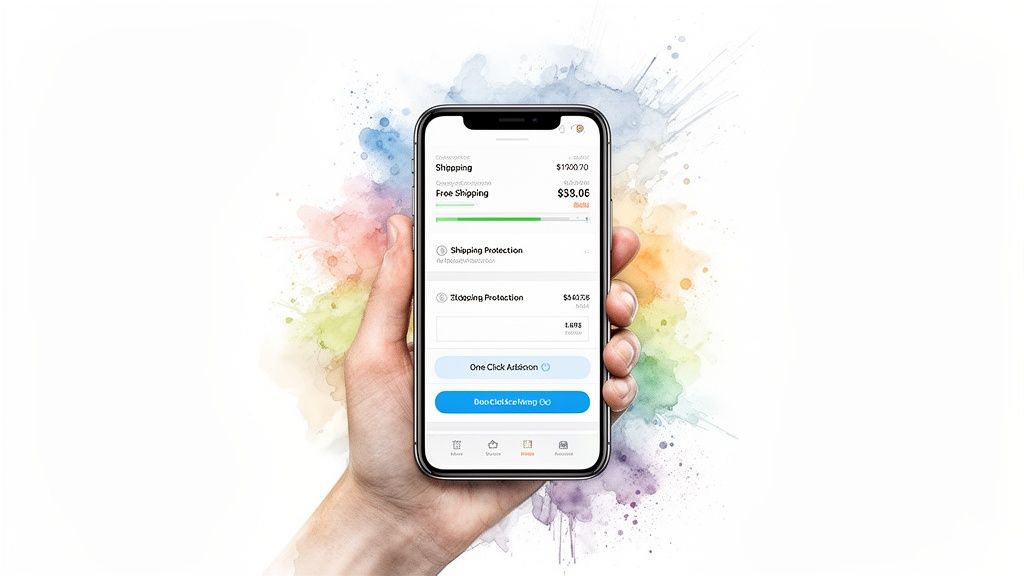
On a small screen, every single tap matters. Any upsell that forces a user to navigate to a new page or fill out a complicated form is dead on arrival. This is precisely why low-friction, one-click offers are so incredibly effective on mobile.
Consider these simple but high-impact additions you can offer right in the cart:
Shipping Protection: A single checkbox adds peace of mind.
Gift Wrapping: An easy tap to add a special touch.
Priority Processing: A small upgrade for anyone in a hurry.
These options are powerful because they require virtually no effort from the customer. When presented cleanly within a slide-out cart, they become impulse-friendly additions that can seriously bump up the final order value. This approach respects the mobile shopper's mindset, making it easy for them to say "yes" to valuable extras without breaking their stride on the way to checkout. At the end of the day, your merchandising plan has to be built for the device your customers actually live on.
Measuring the Success of Your Strategy
A well-designed planning and merchandising strategy should do more than just give you a temporary sales bump. When you shift from constant, aggressive discounts to offering genuine, value-driven rewards, you're making a long-term investment in your brand's health. But how do you know if it's actually working? You need to track the right Key Performance Indicators (KPIs) to get the full story.
Think of these metrics as your direct feedback loop. They tell you what's clicking with your customers and where you might need to adjust your approach. A clear view of this data is what turns good planning into a powerful, self-improving growth engine for your store.
Key Metrics That Matter Most
Forget vanity metrics. A few core KPIs will reveal the true impact of your in-cart merchandising. These numbers give you a window into customer behavior, real profitability, and the overall health of your business.
Let’s break down the essential ones:
Average Order Value (AOV): This is your most direct measure of success. If your AOV is climbing, it’s a clear sign that your tiered rewards, free gifts, and smart upsells are successfully nudging customers to add more to their carts before they check out.
Cart Abandonment Rate: A drop here is a huge win. It means your in-cart experience is smoother and more engaging. When you transform a pain point like shipping costs into a positive incentive (e.g., "You're $10 away from free shipping!"), you give shoppers a compelling reason to finish their purchase.
Conversion Rate: This classic metric tells you what percentage of your visitors turn into buyers. Smart, well-timed offers in the cart can be the final nudge a hesitant browser needs to become a paying customer.
Moving Beyond the First Sale to Lifetime Value
While immediate gains in AOV are fantastic, the real goal is to build a loyal customer base that keeps coming back. This is where focusing on Customer Lifetime Value (LTV) becomes absolutely critical. LTV isn't about a single transaction; it measures the total revenue you can expect from a customer over the entire course of their relationship with you.
A value-driven rewards strategy is fundamentally about building relationships. By consistently offering perks like free gifts instead of just another 10% off, you make customers feel valued. That feeling encourages repeat purchases and can dramatically increase their lifetime value.
When you reward customers for spending more, you’re not just making a bigger sale today. You're teaching them that your brand consistently offers more. This fosters a sense of loyalty that makes them less likely to be lured away by a competitor's discount and more likely to stick with you for the long haul.
The Power of A/B Testing and Optimization
Your first attempt at a merchandising strategy won't be your last—and it shouldn't be. The name of the game is continuous improvement, and that’s where A/B testing comes in. A smart cart tool with built-in analytics, like Monster Cart, lets you create a powerful feedback loop to constantly fine-tune your offers.
Don’t just guess what works. Test it. For instance, you could run experiments to see what really moves the needle on AOV:
Does a free gift unlocked at $75 perform better than free shipping at the same spend?
Is a tiered reward system with multiple milestones more effective than a single, high-value offer?
What’s the sweet spot for a one-click upsell like shipping protection? Is it $0.98 or $1.98?
By analyzing the data from these simple tests, you can make informed decisions that directly boost your bottom line. This cycle of planning, executing in the cart, measuring the results, and then refining your strategy is the core of modern ecommerce merchandising. It ensures your offers are always optimized to maximize both AOV and, more importantly, customer lifetime value.
Putting It All Together: Your Action Plan for a Higher AOV
All the strategy talk is great, but it’s worthless if you can’t put it into action. This is where your planning and merchandising finally meet—and where you start seeing real results. The whole point is to move past theory and launch a campaign that genuinely drives up your AOV, protects your profit margins, and builds the kind of customer relationships that lead to better lifetime value.
Instead of just slapping another discount code on your site, think about creating an experience. When you offer a compelling free gift, unlock free shipping, or present tiered rewards, you transform a simple transaction into something more rewarding for the customer.
A Practical Step-by-Step Guide
Getting this up and running is probably easier than you think. With a modern tool like Monster Cart, you can launch your first campaign in just a few steps and turn your slide-out cart into a serious revenue driver.
Here’s a simple, actionable plan you can follow right now:
Set a Clear Goal: Before touching a single setting, define what winning looks like. A great start is something specific and measurable, like, "Increase AOV by $15 within the next 30 days."
Plan a Tiered Offer: Think in levels. A multi-step reward system builds excitement and gives customers a reason to keep adding to their cart. For example, you could offer a free product sample at $50, then add free shipping when they hit $100.
Configure the Rewards: Jump into your cart tool and build out those milestones. Take the time to customize the progress bar and messaging in your slide-out cart so it feels like a seamless part of your brand, not a generic add-on.
Add a One-Click Upsell: Introduce a simple, low-effort offer right in the cart. A popular and surprisingly effective option is adding shipping protection for a small fee. It gives customers peace of mind and nudges that order value up just a little bit more.
A smart in-cart merchandising strategy isn't about being pushy. It's about presenting a better offer. When you make it easy and rewarding for customers to get more value, you naturally increase AOV and build stronger, more profitable relationships.
To really get the most out of your efforts, your action plan should align with well-established e-commerce best practices that always put the customer experience first.
Once you’re ready, launch your campaign. Then, keep a close eye on the results using your tool’s analytics. This creates a powerful feedback loop, letting you tweak your offers and continuously improve performance over time.
Frequently Asked Questions
Putting a modern planning and merchandising strategy into action naturally raises a few questions. Let's dig into some of the most common ones we hear from merchants moving away from constant discounts and toward value-based rewards.
How Do I Choose the Right Rewards for My Customers?
This is the big one. The best rewards feel like a genuine treat to your customer but don't blow up your budget. A great place to start is right in your own inventory. Look for high-margin or low-cost items that pair well with your bestsellers.
Think product samples, exclusive accessories, or even a popular item you’re a little heavy on. The idea is to offer something that makes their main purchase even better, not just some random freebie. This not only nudges up your AOV but also introduces them to new products, planting a seed for their next visit.
Don't just give away anything; give away something strategic. A smart reward should help your inventory goals, protect your margins, and make your customer feel like they’ve unlocked an exclusive perk.
Will In-Cart Merchandising Annoy My Customers?
It’s a fair question—we’ve all been frustrated by an aggressive pop-up that just won’t go away. The key difference here is how the message is delivered. Good in-cart merchandising isn't a disruptive interruption; it's a helpful guide that’s part of the shopping experience itself.
Tools like Monster Cart use a slide-out cart that feels like a natural part of your store. It visually shows customers how close they are to unlocking something cool, like free shipping or a gift. It turns the journey into a fun little game instead of a pushy sales pitch, making the whole process more engaging.
How Long Does It Take to See Results?
You’ll likely see an immediate lift in metrics like Average Order Value (AOV) as soon as you launch your first campaign. Things like free shipping thresholds and "spend more to get a free gift" are powerful motivators that get shoppers to add just one more item to their cart right then and there.
But the real magic happens over the long haul. The biggest win is the impact on customer lifetime value (LTV) and brand loyalty. When customers learn that you consistently offer real value beyond just a coupon code, they come back. That builds a much stronger, more profitable relationship that pays off for years.
Ready to turn your cart from a simple checkout page into your best salesperson? Monster Cart gives you everything you need to build a value-driven rewards system that grows AOV and loyalty without constantly slashing prices.
Start your free trial and see the difference today at monsterapps.shop
Join 7000+ brands using our apps