What Is AOV in Ecommerce and How to Boost It Without Discounts
Jan 1, 2026
|
Published
Average Order Value (AOV) is one of those core ecommerce metrics that tells you, in simple terms, the average dollar amount each customer spends per order. It's the financial pulse of your store, calculated by a simple division: total revenue divided by the total number of orders.
Understanding Average Order Value and Why It Matters

Think of your online store like a local coffee shop. Some folks pop in for a quick $3 espresso. Others might grab a latte, a croissant, and a bag of whole beans to take home, ringing up a $30 tab. Your AOV averages all these transactions together to give you one powerful, clean number that represents a typical sale.
This metric is so important because it helps you shift your mindset. Instead of just chasing new customers—which gets expensive fast—you start thinking about how to get more value from the traffic you already have. Honestly, increasing your AOV is one of the most cost-effective ways to grow your revenue without resorting to hefty discounts that eat into your profits.
The Simple Formula for AOV
Calculating your AOV is refreshingly simple. You just need two numbers for a specific time frame (like a month or a quarter): your total revenue and the total count of orders.
Average Order Value (AOV) = Total Revenue / Number of Orders
So, if your store pulled in $10,000 in revenue from 200 separate orders last month, your AOV is $50. That’s it. This figure becomes your benchmark, a starting point to see if the changes you're making are actually working.
Beyond the Metric: The Real Impact
A healthy AOV isn't just a number to impress your team; it's the engine for your store’s growth. When you successfully encourage a customer to add just one more small item to their cart, you're directly improving your profit margins and getting a better return on what you spent to acquire that customer in the first place.
This is where smart strategy beats brute force. Instead of slashing prices with big, profit-killing discounts, experienced merchants focus on adding value through rewards. These are the kinds of nudges that work:
Free Shipping Thresholds: "Spend just $10 more to get free shipping!" It's a classic for a reason.
Tiered Rewards: Offering a free gift or an exclusive sample once a customer's cart hits a certain value.
Smart Bundles: Packaging related products together—like a shampoo and conditioner set—to make shopping easier and increase the cart total.
By focusing on rewards over discounts, you train customers to spend more to get more value, not just to pay less. This simple shift is fundamental to building higher customer lifetime value (LTV).
At the end of the day, a solid AOV strategy is really about creating a better shopping experience. When your upsells and rewards are genuinely helpful, you’re not just pumping up a metric. You're making the customer's journey more satisfying, which is what builds loyalty and brings them back again and again. This is precisely where tools like Monster Cart come in, turning the checkout into a seamless opportunity to delight customers and grow your bottom line.
For a quick reference, here’s a breakdown of what makes AOV tick.
AOV Core Concepts at a Glance
Component | Simple Explanation | Why It Matters for Your Store |
|---|---|---|
Total Revenue | All the money your store made from sales in a given period. | The top-line number that fuels your business operations and growth. |
Number of Orders | The total count of individual transactions placed by customers. | Shows you the volume of sales, helping you understand demand and fulfillment needs. |
Average Order Value | The average amount spent per transaction (Revenue / Orders). | This is your efficiency metric. A higher AOV means you're earning more from each customer you acquire. |
This table helps put the pieces together, showing how a simple calculation can unlock powerful insights into your store's performance.
How to Calculate Your Store's Average Order Value
Finding your store's AOV is surprisingly simple. You just need two numbers that you can pull directly from your ecommerce platform's analytics dashboard, and a little basic math. This gives you the critical baseline for tracking improvements.
If you’re on Shopify, you can find these metrics in your Reports section under Sales. Just pick a time frame—say, the last 30 days—and you’ll have your total revenue and the total number of orders ready to go.
The Step-by-Step Calculation
Let's make this real with an example. Picture a direct-to-consumer skincare brand that wants to figure out its AOV for last month.
Find Total Revenue: They look at their Shopify dashboard and see they brought in $15,000 in total sales.
Find Number of Orders: In that same time frame, they processed a total of 300 orders.
Divide Revenue by Orders: They simply divide $15,000 by 300.
The result is an Average Order Value of $50. This is their starting line. It means the typical customer spends about $50 at checkout. With this number in hand, they can start setting smart goals, like offering a free gift on orders over $65 to gently nudge that average higher.
Your store-wide AOV is just the first layer. The real magic happens when you start digging deeper and segmenting this metric to find your best growth opportunities.
For example, you might discover that customers who find you through an Instagram ad have an AOV of $45, but customers from your email newsletter have a much higher AOV of $70. That kind of insight is gold. It shows you exactly which channels attract your most valuable customers and where your marketing dollars are working hardest.
Regularly calculating and segmenting your AOV transforms a simple number into a deep understanding of customer behavior. This is how you shift from just chasing sales to building a smarter growth engine, one focused on increasing customer lifetime value with well-timed rewards. This is also where an interactive cart, like one powered by Monster Cart, becomes a game-changer for presenting those targeted, value-driven offers right at the moment of purchase.
What Is a Good AOV? Ecommerce Benchmarks Explained
So, you’ve run the numbers and calculated your store’s average order value. The first thing you’re probably wondering is, "Is that any good?"
The honest answer? There’s no single magic number. What counts as a “good” AOV is completely relative—it depends on your industry, what you sell, your profit margins, and your overall business goals. But that doesn’t mean you’re flying blind. Understanding the e-commerce benchmarks is what gives you crucial context.
Think of these benchmarks less as a finish line and more as a map of the surrounding terrain. They show you where you stand compared to similar stores and help you set realistic, achievable goals. This is about finding opportunities to gently nudge your AOV upward with value-driven rewards, not about resorting to deep, profit-slashing discounts.

This simple formula is your starting point. It’s the key to tracking your performance and seeing how you measure up against the wider industry.
How Your Store Stacks Up
When you start digging into the data, you’ll see why a Shopify owner selling furniture might have a wildly different AOV than someone selling coffee. Q1 2025 benchmarks from Decile tell a compelling story. Home Goods led the pack with a massive $266 AOV, which makes sense when you think about shoppers bundling décor, bedding, and kitchenware.
Other industries showed different patterns:
Fashion & Apparel: $191
Health & Beauty: $151
Supplements: $70
Food & Beverage: $69
Even the device a customer uses matters. The average AOV on a desktop was $155, while on mobile it was $112. It seems shoppers are still more comfortable making those bigger buys on a larger screen.
Here's the big takeaway: your own branded Shopify site gives you a massive advantage. Unlike a crowded marketplace, you control the entire customer journey, giving you the power to drive those higher-value orders.
This control is your secret weapon. It means you can build a shopping experience that’s designed to add value, not just slash prices.
Moving Beyond Averages to Action
Use these benchmarks to set an internal goal for yourself. You don't have to shoot for the moon; aiming to increase your AOV by a realistic 10-15% is a fantastic start. And the best part? You don't need a sitewide sale to get there.
Instead, focus on tactics that build value for the customer and your business.
Tiered Rewards: "Spend $75 and get a free gift!" Set the threshold just a little higher than your current AOV to encourage a small add-on.
Free Shipping Minimums: This is a classic for a reason. Set a free shipping goal that feels achievable and makes adding one more item a no-brainer.
Strategic Bundles: Group complementary products together. Instead of just selling a camera, sell a "Vlogger Starter Kit" with a camera, tripod, and microphone. You're solving a bigger problem for the customer in a single, convenient purchase.
These strategies do more than just boost a single sale; they shift the entire dynamic. You’re building a healthier, more rewarding customer relationship, which is a direct line to a higher customer lifetime value (LTV).
Tools like Monster Cart are built specifically for this. They let you add these kinds of rewards and upsells directly into the cart, turning what was once a simple checkout page into a powerful engine for growing your revenue.
Proven Ways to Increase AOV Without Deep Discounts

It's always tempting to launch a big site-wide sale to get numbers up, but boosting your AOV doesn't have to mean gutting your margins. The best, most sustainable strategies are all about adding real value to the shopping experience. You want customers to spend more because they want to, not just because they're chasing a 24-hour flash discount.
When you make this shift from discounting to rewarding, you start building a much healthier, long-term relationship with your customers. The goal is to make their journey more satisfying and help them find more products they'll genuinely love. That’s how you turn a one-time buyer into a loyal fan, which is the real secret to sustainable growth and increasing lifetime value.
Set an Irresistible Free Shipping Threshold
Let’s start with a classic for a reason: the free shipping threshold. It’s one of the most effective tools in the ecommerce playbook. Think about it—with the average cart abandonment rate sitting around a staggering 70%, unexpected shipping fees are one of the top culprits.
By offering free shipping for orders over a certain amount, you flip a major pain point into a powerful incentive. The key is to set that threshold strategically. A good rule of thumb is to place it about 30% higher than your current AOV. If your AOV is $50, a $65 free shipping minimum is the perfect nudge for a shopper to add one more small item to their cart. It's a win for them and a nice little revenue bump for you.
Create Smart Product Bundles
Bundling is the art of making shopping easier while selling more. Instead of hoping a customer will hunt down three or four complementary items on their own, you do the legwork for them by packaging related products together. This not only drives up the order value but also creates a better experience by offering a complete, ready-to-go solution.
Some simple ideas:
Skincare: A "Morning Routine Kit" with a cleanser, vitamin C serum, and moisturizer.
Home Goods: A "Cozy Night In" bundle with a plush blanket, a scented candle, and a ceramic mug.
Apparel: A "Workout Essentials" set with high-waisted leggings, a matching sports bra, and a pair of performance socks.
Bundles just work. They increase the perceived value of the purchase and cut down on decision fatigue for your customers.
Offer Tiered Rewards and Free Gifts
This is where you can get really creative. Gamifying the shopping cart with tiered rewards is a fantastic way to encourage higher spending. Instead of a flat discount, you offer increasingly better rewards as customers hit certain spending goals. A free gift with purchase, for example, often feels more special and valuable than a small percentage off.
For more ideas on this, check out our deep dive on running a successful free gift with purchase campaign.
This is where a tool like Monster Cart really shines. It can transform your basic Shopify cart into an interactive progress bar. As a customer adds items, they can literally watch a bar fill up, showing them how close they are to unlocking a free travel-size product or an exclusive sample. This visual feedback makes adding one more item feel like hitting a new level in a game, not just spending more money.
By rewarding customers for spending more, you're not just increasing the value of a single transaction. You are building positive associations with your brand, which directly contributes to a higher customer lifetime value (LTV).
The post-pandemic landscape has solidified AOV as a critical growth engine. Projections show a global AOV hitting the $150-$180 range by the end of 2025, driven largely by these value-add strategies. You can see this in high-AOV sectors like electronics ($348) and luxury goods ($380-$436), which have mastered this model. And while mobile commerce is set to dominate, its lower AOV of $112 compared to desktop's $155 underscores the need for frictionless, in-cart optimization.
Implement Strategic Cross-Sells
While an upsell suggests a more expensive version of a product, a cross-sell is about recommending complementary items that make the original purchase even better. When you get it right, it doesn't feel like a sales pitch at all—it feels like genuinely helpful advice. For a deeper look at optimizing these recommendations, a guide on AI in ecommerce pricing can offer powerful insights into identifying the perfect product pairings.
Picture a customer buying a new digital camera. A smart cross-sell isn't another camera; it's a memory card, a protective case, or a lens cleaning kit. These are things they'll probably need anyway. By presenting these options at the perfect moment—like in a non-intrusive slide-out cart—you make the whole process more convenient for them and boost your AOV at the same time.
The Power of In-Cart Upsells and Rewards
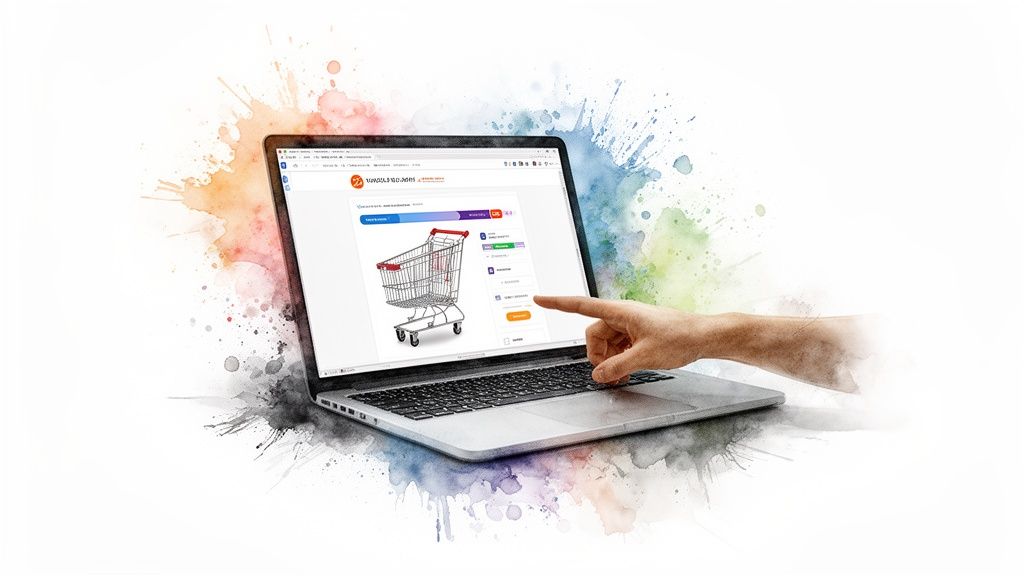
The single best moment to bump up your average order value is when a customer is already committed to buying—right there, inside their shopping cart. For years, merchants relied on aggressive, full-screen pop-ups to flash last-minute deals. The problem? That approach often backfires, creating a clunky, frustrating experience that sends shoppers running for the "close tab" button.
There's a much smarter, more elegant way. Imagine integrating rewards and offers directly into a seamless, slide-out cart. This move transforms your standard Shopify cart from a static summary into an interactive rewards engine. You're not interrupting the customer's journey; you're making it better.
The Psychology of In-Cart Progress
The real magic of an interactive cart is all about psychology. When a customer sees a visual progress bar inching closer to unlocking free shipping or a surprise gift, it gamifies the whole experience. It creates a satisfying little loop that encourages them to hit that next spending goal.
This method completely sidesteps the hard sell. You’re reframing the conversation. It's no longer about "spending more money"—it's about earning a valuable reward. That subtle shift is everything when it comes to building a positive brand impression and boosting customer lifetime value. You're aiming to delight customers, not pressure them.
By turning the cart into a game of unlocking perks, you make increasing the order value a fun, voluntary action. It feels less like an upsell and more like a personalized reward they've earned.
Making Upsells Feel Like Helpful Advice
A well-designed cart drawer can also present "Frequently Bought Together" items and one-click add-ons in a natural, helpful way. Say a customer is buying a new pair of leather boots. A quiet in-cart suggestion for a leather care kit feels like thoughtful advice, not a pushy sales tactic. That's the crucial difference between a disruptive pop-up and a genuinely useful, integrated offer.
Shopify apps like the one from Monster Upsells are built for this. They can replace the standard cart with a fully branded, interactive drawer that lets you build out sophisticated reward tiers, like:
Free Shipping Thresholds: A progress bar clearly shows customers exactly how close they are to getting free delivery.
Tiered Free Gifts: "Spend $50, get a free sample. Spend $75, get a deluxe mini!" This creates multiple incentives to keep shopping.
"Buy More, Save More" Tiers: Offer progressive rewards or discounts that naturally encourage customers to add just one more item to their cart.
When you get it right, these in-cart strategies elevate the entire shopping experience. By focusing on rewards over pure discounts, you not only increase your AOV but also build the kind of brand loyalty that drives real, long-term growth. This is how you make your cart work harder for your business.
Connecting AOV to Long-Term Business Growth
When it comes down to it, tracking your Average Order Value isn't just about watching a number go up or down—it’s a vital sign for your business's overall health and a reflection of how happy your customers are. The sharpest brands have figured this out. They're ditching the profit-killing race to the bottom with constant discounts and are instead focusing on adding real value to every purchase.
Think about it: strategies like tiered free gifts, shipping incentives, and slick in-cart offers do more than just nudge a single sale higher. They create a genuinely better shopping experience.
This shift is where sustainable growth really comes from. By encouraging customers to build bigger carts in a way that feels rewarding, you're not just making a quick buck. You're building the kind of brand loyalty that turns one-time shoppers into repeat customers, which is the holy grail of e-commerce. To see the full picture, you have to look at how AOV feeds into even bigger metrics, like the customer lifetime value (CLTV) calculation.
A higher AOV is a direct stepping stone to a greater LTV. Each rewarding transaction strengthens the customer relationship, turning one-time buyers into repeat fans who drive predictable revenue.
This isn't just a theory; the global trends back it up. The worldwide AOV climbed to $144.57 in November 2024, which is a nearly 9% jump in just one year. That tells you that smart, value-focused upselling is working on a massive scale.
For Shopify store owners, this is where in-cart reward tools can be a game-changer. They provide a proven playbook for boosting your AOV without resorting to those annoying pop-ups everyone hates. If you're ready to master these techniques, our complete revenue optimization course is the perfect next step.
AOV FAQs: Your Questions Answered
Let's tackle some of the most common questions that pop up when store owners start digging into their Average Order Value.
Does a Higher AOV Automatically Mean More Profit?
Not always, and this is a critical distinction to make. It’s easy to boost AOV by slashing prices with a huge "spend more, save more" discount, but you might just be selling more while making less on each order. Your revenue goes up, but your profit margin gets crushed.
The trick is to increase AOV smartly. Think about strategies that add genuine value for the customer. Offering a cool free gift that feels premium but doesn't cost you much is a classic win. The same goes for bundling complementary products or upselling customers to a better, higher-margin version of an item. That's how you lift your AOV and your profits at the same time.
How Often Should I Be Checking My AOV?
For a general health check, looking at your AOV on a monthly basis is a solid routine. It helps you spot broader trends and see how you’re doing over time.
However, when you’re actively trying to move the needle—say, you just launched a new free shipping threshold or a tiered gift promotion—you should be watching it much more closely. Checking it daily or even in real-time during a campaign is the only way to know if your new strategy is actually working. Comparing this data month-over-month and year-over-year will give you the full story of your progress.
The best AOV strategies aren't just about a single transaction; they're about building customer lifetime value. When you consistently create rewarding shopping experiences instead of just offering one-off deals, you build the kind of loyalty that pays off for years.
Can a Business With a Low AOV Still Be Healthy?
Absolutely. AOV is completely relative to what you sell. If your catalog is full of low-cost items like stickers, phone cases, or candy, your AOV is naturally going to be lower than a store selling high-end electronics or custom furniture. Don't sweat it.
In cases like these, a healthy business is defined by other metrics, like high purchase frequency and a strong customer lifetime value (LTV). If your customers have a low AOV but they come back to buy from you again and again, you're doing great. The real goal isn't to hit some random, high AOV number; it's to consistently improve your own AOV relative to your past performance and your specific industry.
Ready to turn your Shopify cart into a powerful revenue engine? Monster Cart helps you implement seamless in-cart rewards, upsells, and free gift offers that boost AOV without annoying pop-ups. Discover how Monster Cart can elevate your store.
Join 7000+ brands using our apps