What Is Average Order Value and How to Increase It
Dec 22, 2025
|
Published
Average Order Value (AOV) is a simple but powerful metric. In a nutshell, it's the average amount of money each customer spends when they place an order on your site. Think of it like the average check size at a restaurant—it gives you a quick read on how much people are typically willing to spend in a single visit.
The math is straightforward: just divide your total revenue by the total number of orders.
Understanding Your Average Order Value
At its heart, Average Order Value is a key health indicator for any ecommerce business. It provides a clean, immediate snapshot of your customers' spending habits. If your AOV is climbing, it’s a good sign that customers are finding more value each time they buy. If it's flat or dropping, that could be a signal that it's time to rethink your sales strategy.
While it’s easy to get caught up in the chase for new customers, focusing on AOV is often a much more profitable and sustainable way to grow. Getting a shopper who's already on your site to add one more item to their cart is far less expensive than finding and converting a brand-new buyer from scratch.
AOV as a Growth Lever
Boosting your AOV is all about getting more out of the traffic you already have. Instead of just throwing hefty discounts at people, which can chip away at your profit margins, the best strategies add real value to the shopping experience. This not only increases the immediate order value but also builds a foundation for higher customer lifetime value.
Think about rewards that do more than just lower the price:
Free gifts: Offer a desirable, relevant product once a customer’s cart hits a certain threshold.
Free shipping: This is a classic for a reason. It's often the final nudge someone needs to meet a minimum spend.
Tiered rewards: Turn shopping into a game where customers unlock bigger and better perks as their cart value increases.
This shifts the dynamic from a simple transaction to building a more meaningful relationship with your customers. It's a trend we're seeing across the board. The worldwide AOV recently hit around $144, marking the fourth year in a row of growth as smart merchants focus on delivering more value with every order. You can learn more about these e-commerce benchmarks and AOV trends.
The goal is to make customers want to spend more by offering compelling incentives, not just cheaper prices. This builds brand loyalty and improves customer lifetime value, creating a much stronger foundation for your business.
Tools like Monster Cart are built specifically for this. By embedding an in-cart rewards system, you can visually show customers how close they are to unlocking great perks. When they can see a progress bar inching toward a free gift or free shipping, they’re naturally motivated to add a little more to their cart. This drives up your AOV and makes the whole checkout process feel more engaging and rewarding.
To break it down, here are the core components of AOV.
AOV at a Glance
Component | Description |
|---|---|
Metric Name | Average Order Value (AOV) |
Calculation | Total Revenue / Total Number of Orders |
What It Measures | The average dollar amount a customer spends per transaction. |
Primary Goal | To increase the value of each customer purchase. |
Understanding these pieces helps you see AOV not just as a number, but as a direct reflection of customer behavior that you can actively influence.
How to Calculate Your Average Order Value
Figuring out your store's average order value is surprisingly simple, yet it's one of the most powerful things you can do to understand your customers' spending habits. You only need two numbers to get started, and you can pull them for any period you want—a month, a quarter, or even a full year.
The formula is incredibly straightforward:
Total Revenue ÷ Number of Orders = Average Order Value
Total Revenue: This is all the money you made from sales during your chosen time frame. Just make sure you're looking at your net revenue, which means you've already subtracted any returns.
Number of Orders: This is simply the total count of individual transactions placed during that same period.
When you do the math, you're left with a single, powerful number that tells you how much the average customer spends each time they check out. It’s a foundational metric for tracking the health of your business.
AOV Calculation in Action
Let's see what this looks like in the real world. Here are a few examples from different types of ecommerce stores, all looking at a one-month period.
Example 1: A Small Shopify Store: A new shop selling handcrafted candles brought in $4,500 from 100 separate orders.
$4,500 (Total Revenue) ÷ 100 (Number of Orders) = $45 AOV
Example 2: A Mid-Sized Apparel Brand: A growing clothing brand generated $75,000 in revenue from 938 orders.
$75,000 (Total Revenue) ÷ 938 (Number of Orders) = $79.96 AOV
Example 3: A Large Electronics Retailer: A major store selling tech gadgets pulled in $500,000 from 2,500 orders.
$500,000 (Total Revenue) ÷ 2,500 (Number of Orders) = $200 AOV
As you can see, the AOV for each business is totally different and makes sense for their industry and price points. That's why tracking your own AOV over time is often far more insightful than trying to stack it up against some generic industry benchmark.
Go Beyond a Single Number with Segmentation
Your overall AOV is a great starting point, but the real magic happens when you start segmenting. Calculating a single, store-wide AOV is a bit like looking at your entire customer base as one person—it completely misses the crucial details.
By segmenting your data, you can move from a general understanding to specific, actionable strategies. You'll discover which channels bring in your highest-spending customers and where you should focus your efforts.
Start by calculating AOV for these key groups:
New vs. Returning Customers: Are your loyal customers spending more per order than first-timers? Knowing this helps you dial in your retention and loyalty programs.
Traffic Source: What's the AOV for customers who came from Instagram ads versus organic search or an email campaign? This tells you which marketing channels are delivering the most value.
Device Type: Do people shopping on a desktop spend more than those on their phones? The answer could change how you design your site and present offers on different devices.
When you segment, your AOV transforms from a simple score into a powerful diagnostic tool. This deeper look allows you to craft smarter, more targeted strategies to boost order sizes. Instead of just throwing hefty discounts at everyone, you can offer value-driven rewards—like a free gift for a high-value customer segment. This is where tools like Monster Cart come in, helping you execute these strategies right inside the cart and guide specific shoppers toward bigger, more profitable orders that build long-term value.
Why AOV Is a Critical Metric for Your Business
So, you know how to calculate your average order value. That's step one. The real magic happens when you understand what that number is telling you about your business. AOV isn't just another metric to track on a dashboard; it’s a direct pulse on how well your marketing is working, how engaged your customers are, and whether your products are hitting the mark.
When you start focusing on lifting your AOV, your whole strategy shifts. You move away from the expensive, never-ending chase for new customers and start getting more value from the traffic you already have. It’s a smarter way to grow, and it has an immediate impact on your bottom line. Every extra dollar you add to that average order is pure profit, earned without spending more on ads.
This is especially important now, with advertising costs constantly on the rise. A higher AOV gives you more wiggle room, making it easier to absorb those increasing ad spends and ensuring every sale is a profitable one.
How AOV Connects to Profitability
AOV doesn't operate in a silo. It has a powerful relationship with two other key e-commerce metrics: Customer Acquisition Cost (CAC) and Customer Lifetime Value (LTV). Think of a healthy AOV as the bridge that turns an expensive new customer into a profitable, long-term fan.
Here’s a practical way to look at it:
Higher AOV offsets CAC: Let’s say it costs you $40 to bring in a new customer. If their first purchase is only $45, you’ve barely broken even. But if you can nudge that first order up to $75 with a compelling reward, you've instantly made that ad spend far more profitable.
Higher AOV builds LTV: A customer who spends more on their first purchase is often showing a higher level of trust in your brand. That great first experience is the perfect foundation for repeat business, which is exactly how you build a high lifetime value.
A healthy AOV is your first line of defense against shrinking margins. It ensures that you aren't just making sales, but are building a sustainable and profitable business model with every transaction.
Shifting from Discounts to Adding Value
Boosting AOV isn't about manipulating customers or constantly running deep discount promotions. The best strategies are all about adding real, tangible value to their shopping experience. It's about encouraging them to build a bigger cart because they want to unlock something great, not just because you’ve slashed prices.
Instead of a generic 10% off coupon, what if you offered a free, high-value gift on orders over a certain amount? This feels like a reward, not just a cheap deal, and it protects your brand's premium feel. In the United States, for example, the average order value recently hit $153—proof that customers are willing to spend when they see a compelling reason to do so.
This "value-first" approach is what separates a one-time sales spike from sustainable growth. This is where an in-cart rewards system, like the one built into Monster Cart, really shines. By showing a shopper a progress bar that says they’re just ‘$10 away from a free gift,’ you turn shopping into a fun challenge. It motivates them to add that one extra item to their cart, naturally increasing your AOV while making them feel like they've won, leading to better customer lifetime value.
While AOV is a powerhouse metric, it's just one piece of the puzzle. To see the full picture of your store's potential, it's worth exploring a range of conversion growth strategies.
Smart Strategies to Increase AOV Without Sacrificing Margins
Alright, you know your Average Order Value. Now what? The real work begins: figuring out how to nudge that number upward.
The most common reflex is to slash prices with site-wide discounts. While it might give you a short-term bump, it's a dangerous game that can seriously eat into your profits and, worse, devalue your brand over the long haul.
A much smarter—and more sustainable—approach is to give customers compelling reasons to spend more by adding value, not just cutting prices. You want to shift their thinking from, "How can I get this cheaper?" to "What else can I get to make this purchase even better?" It's all about building a bigger, more valuable cart because the customer feels they’re getting a fantastic deal, a special reward, or a more complete solution. This mindset protects your margins and actually strengthens your relationship with the customer.
When you focus on rewards like free gifts, free shipping, and exclusive perks, you encourage higher spending while building the kind of loyalty that turns one-time buyers into repeat customers. This is essential for boosting customer lifetime value (LTV) and building a truly resilient business.
Create Irresistible Product Bundles
One of the easiest wins for increasing AOV is bundling products. Instead of just hoping a customer stumbles upon three related items on their own, you can package them together as a single, convenient solution—often at a slightly better price than if they bought each piece separately. This instantly increases the perceived value and makes the buying decision a no-brainer.
Here are a few ways to think about it:
"Complete the Look" Bundles: If you sell apparel, package a shirt, pants, and an accessory together as a ready-made outfit.
"Starter Kit" Bundles: For a skincare brand, this could be a simple three-step routine: cleanser, moisturizer, and serum.
Bulk Bundles: Offer a small discount for buying multiples of a consumable item, like a three-pack of coffee or a six-pack of protein bars.
The trick is to create bundles that solve a real problem for your customer. By making it incredibly easy for them to get everything they need in one click, you naturally guide them toward a higher cart value.
Leverage Tiered Rewards and Free Gifts
Let’s be honest, people love feeling like they’re earning something special. Tiered rewards are brilliant because they "gamify" the shopping experience, creating a powerful psychological nudge to reach that next spending level. It’s not just a discount; it feels like a prize.
A tiered system turns the checkout process into a mini-game. When you show customers they are just a few dollars away from unlocking a great reward, you tap into their natural desire to complete a goal. This is so much more engaging than just another coupon code.
For example, you could set up your rewards in tiers:
Spend $50: Unlock Free Shipping
Spend $75: Get a Free Best-Selling Mini Product
Spend $100: Receive a 15% Discount on Your Next Order
This multi-level structure encourages shoppers to add just one more thing to their cart to hit that next enticing tier. Suddenly, their focus shifts from the total cost to the cool reward they’re about to unlock. This approach also helps improve customer lifetime value by creating a more positive, memorable shopping experience.
Set a Strategic Free Shipping Threshold
Shipping costs are the ultimate conversion killer. In fact, unexpected shipping fees are the #1 reason shoppers abandon their carts. You can flip this pain point on its head and use it as a powerful tool to boost your AOV.
The secret is to set your free shipping threshold strategically. A good rule of thumb is to place it about 30% higher than your current AOV. So, if your AOV is $60, setting the free shipping mark at $75 or $80 creates a really achievable goal. It’s just enough to prompt many shoppers to add one more low-cost item to their cart to avoid the shipping fee. This simple move can significantly lift your overall AOV without using hefty discounts that erode your margins. To make sure customers are guided smoothly towards these higher-value purchases, it's worth exploring effective strategies for optimizing sales funnels.
Implement Smart In-Cart Upsells and Cross-Sells
The shopping cart is your last, best chance to increase order value. Forget disruptive pop-ups; the most effective recommendations are integrated directly and seamlessly into the cart experience itself. This is where smart upsells and cross-sells shine.
Cross-Sells: These are complementary products that make the main purchase better. If someone is buying a camera, suggest a memory card or a camera bag. Simple.
Upsells: This is where you offer a premium version of a product or an add-on like an extended warranty. It works best when the extra value is crystal clear.
Tools like Monster Cart are built for exactly this. They can replace your standard, static cart with an interactive slide-out cart drawer that weaves these strategies into the shopping flow. As customers add items, a dynamic progress bar shows them exactly how close they are to unlocking their next reward.
Here’s a look at how Monster Cart’s slide-out cart visually guides customers toward a bigger spend with clear, motivating reward tiers.
This kind of in-cart experience makes the path to unlocking rewards obvious and intuitive. It transforms the cart from a simple checkout form into a powerful revenue engine. By gamifying the process, you naturally increase your average order value while making the entire journey more enjoyable for your customer, encouraging them to return and boosting lifetime value.
Using In-Cart Rewards to Drive Customer Spending
Most people think of the shopping cart as the last stop before checkout. In reality, it’s one of the most powerful sales tools you have. When you optimize the in-cart experience, you can turn a simple transaction into a golden opportunity to boost your AOV and make your customers happier. This all boils down to the psychology behind rewards and the human desire to complete a goal.
We are all naturally wired to finish something we’ve started. This idea is called goal proximity, and it’s the secret sauce behind why progress bars are so motivating. When a customer sees they're just “$10 away from free shipping” or “one item away from a free gift,” you give them a powerful, immediate reason to add more to their cart. Suddenly, the cart isn't just a static summary—it’s an interactive engine for growth.
Turning the Cart into a Value-Driven Experience
The trick is to boost your AOV without throwing away your profit margins on huge discounts that can cheapen your brand. The smarter play is to focus on adding real value that makes customers want to spend more. This approach doesn't just bump up the immediate sale; it also builds a stronger, more loyal customer base for the long haul.
Instead of a generic coupon code, think about a tiered reward system that makes shopping feel like a game. This reframes every purchase as a step toward unlocking something awesome, making the whole experience more engaging and less about just spending money. This positive experience is key to increasing customer lifetime value.
This flowchart lays out some of the most effective strategies for lifting your AOV.
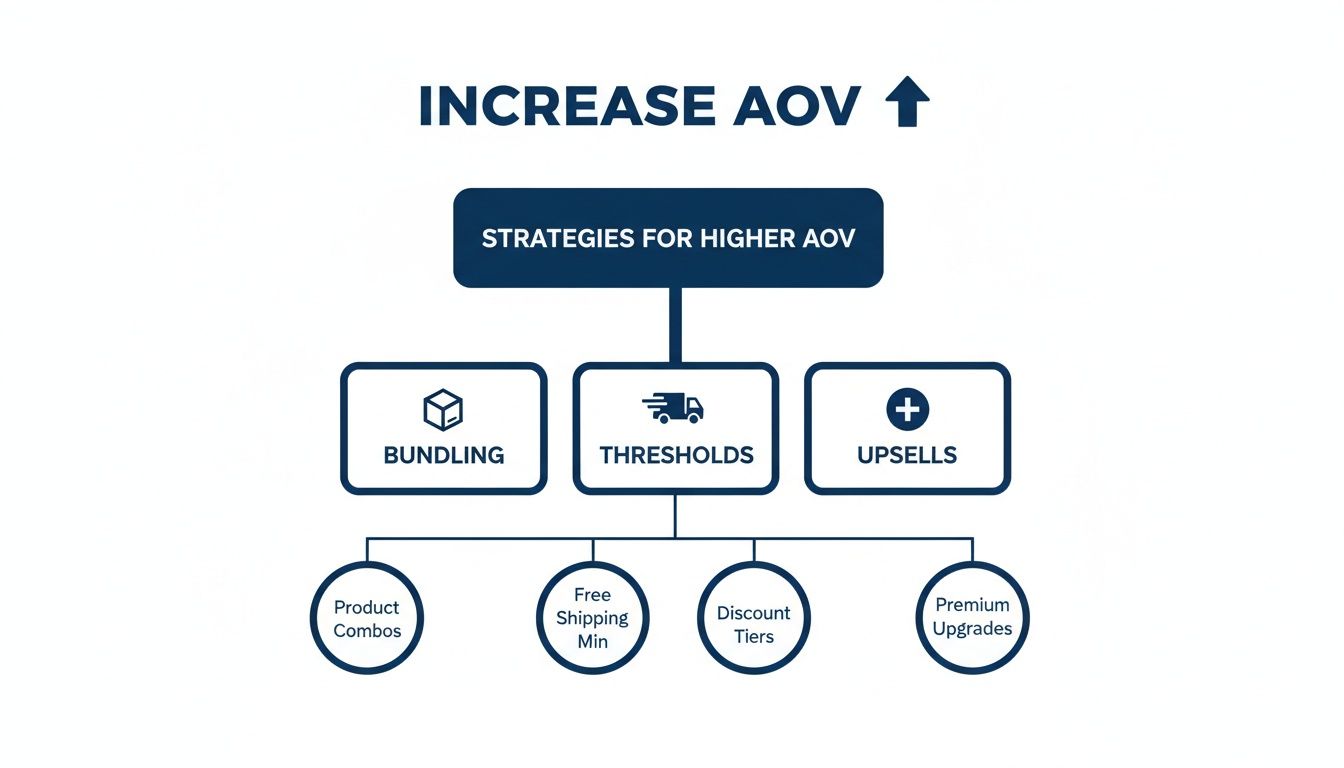
As you can see, tactics like product bundling, free shipping thresholds, and smart upsells all work together to systematically raise the value of each order.
Building an Effective Tiered Reward System
A well-designed tiered system acts like a guide, gently nudging customers up a value ladder where each rung offers a better reward. Shoppers are encouraged to add just a little more to their cart to unlock that next perk. It’s a proven way to increase your average order value without resorting to hefty discounts.
Here’s what a great tiered reward structure might look like:
Tier 1: Spend $50, Unlock Free Shipping. This is the classic for a reason. It removes one of the biggest hesitations for online shoppers and is often the easiest reward to reach.
Tier 2: Spend $75, Get a Free Gift. A free product feels like a genuine bonus. Pick a popular, low-cost item that pairs well with your other products to deliver real, tangible value.
Tier 3: Spend $100, Receive a 10% Discount. By saving a discount for the highest tier, you reserve your best offers for your best customers, protecting your margins on smaller purchases.
When you frame these perks as rewards to be earned rather than just discounts to be claimed, you completely shift the customer's mindset. They feel like they’re winning, which strengthens their connection to your brand and motivates them to hit those higher spending goals.
This is where an interactive cart becomes a game-changer. A tool like Monster Cart can replace the standard Shopify cart with a dynamic slide-out drawer featuring a real-time progress bar. As a customer adds items, the bar fills up, showing them exactly how close they are to unlocking the next reward.
This instant in-cart feedback closes the gap between seeing an offer and acting on it. It takes out all the guesswork and provides a clear, motivating path for the customer. Instead of just hoping a shopper sees a banner about free shipping, you put the incentive right in front of them at the most critical moment of their journey. This seamless integration turns your cart into your most effective salesperson, constantly working to increase your AOV while giving your customers a far better experience.
How to Measure and Test Your AOV Strategies
A brilliant strategy is only as good as its results. To truly know if your efforts to boost average order value are paying off, you need to track their impact. Launching a new offer without knowing your starting point is like driving without a map—you’re moving, but you have no idea if you're heading in the right direction.
Your first move is always to establish your baseline AOV. Before you roll out a new product bundle, a tiered rewards program, or a free shipping threshold, you have to know where you stand today. Dig into your analytics—whether it's Shopify Analytics or Google Analytics—and get a clear picture of your AOV over the last 30 or 90 days. This number is your benchmark.
Making Data-Driven Decisions
With your baseline set, you can start tracking how your new strategies are performing. Let's say you implement a "free gift at $75" offer. Monitor your AOV for the next month. Did it go up? What happened to your conversion rate? Answering these questions helps you draw a straight line from your actions to the results.
It’s also crucial to segment your data. A site-wide AOV lift is great, but knowing which customers are responding best is where the real magic happens. Take a look at how AOV changes for:
New vs. returning customers: Are those loyalty rewards actually encouraging bigger carts from your repeat buyers?
Traffic sources: Do customers from your email list respond better to free gifts than visitors from social media ads?
Getting this granular helps you fine-tune your approach, making sure every tweak you make drives both profit and a higher customer lifetime value.
Don’t just guess what your customers want—test it. Data takes the guesswork out of the equation and lets you build strategies based on what people actually do, not just what you think they’ll do.
A Simple Framework for A/B Testing
The most powerful way to dial in your strategy is through A/B testing. It’s a straightforward concept: you compare two different offers to see which one performs better. This gives you clear, data-backed proof of what truly motivates your shoppers to spend more.
For example, you could test a “free shipping at $75” threshold against a “free gift at $75” offer. By showing each version to a different slice of your audience, you can see definitively which incentive drives a higher AOV.
This is where a tool like Monster Cart becomes incredibly useful, as it lets you easily set up and launch different in-cart reward structures to see what works. By continuously testing and refining, you ensure your AOV strategies are always hitting the mark.
Your AOV Questions, Answered
Let's dig into a few common questions that pop up when merchants start tracking their Average Order Value. Getting these fundamentals right is key before you start trying to improve it.
What’s the Difference Between Order Value and Average Order Value?
Think of it this way: order value is the receipt for a single purchase. If someone buys a $40 shirt and a $15 hat, that specific order's value is $55.
Average order value (AOV) is what you get when you average out all those individual receipts over a certain time. It gives you the bigger picture of your customers' typical spending habits.
So, What's a "Good" AOV Then?
This is one of the most common questions, and the honest answer is: it depends. There’s no universal magic number.
A store selling luxury watches might have an AOV in the thousands, while a shop selling stickers could be perfectly happy with an AOV of $25. The best benchmark is your own past performance. The real goal is consistent, steady growth. An upward trend shows that your efforts to encourage bigger carts are paying off.
Chasing a higher AOV doesn't mean you have to slash prices. Instead of deep discounts that hurt your margins, think about adding value. A free gift or complimentary shipping for orders over a certain amount can nudge customers to spend more, all while making them feel like they're getting a great deal.
Should I Include Shipping and Taxes in My AOV Calculation?
Generally, no. It’s standard practice to calculate AOV based on the net revenue from the products themselves.
By excluding extra costs like shipping fees and taxes, you get a much cleaner, more accurate picture of how much customers are willing to spend on your actual products in a single checkout.
How Can Monster Cart Help Me Raise My AOV?
The secret to a higher AOV is making it fun and rewarding for customers to add just one more item to their cart. This is exactly where Monster Cart shines.
It turns your basic shopping cart into an interactive experience. As customers add items, a visual progress bar shows them exactly how close they are to unlocking cool perks, like a free gift or free shipping. It gamifies the path to a bigger cart, naturally encouraging them to spend a little more to hit that next reward—all without you having to offer a single hefty discount. This not only boosts AOV but creates a more engaging customer experience that can lead to higher lifetime value.
Ready to turn your shopping cart into your best salesperson? See how Monster Cart can help you increase AOV and delight your customers at https://monsterapps.shop.
Join 7000+ brands using our apps