10 Smart Cross Selling Examples to Boost AOV Without Deep Discounts in 2026
Feb 2, 2026
|
Published
Boosting Average Order Value (AOV) is a top priority for every Shopify merchant, but the old playbook of slashing prices with hefty discount codes is a race to the bottom. It erodes margins, devalues your brand, and attracts one-off bargain hunters, not loyal customers. The real goal isn't just a bigger one-time sale; it's about increasing customer lifetime value (LTV) by creating a rewarding and engaging shopping experience.
This is where strategic cross-selling comes in. Instead of just pushing more products, modern cross-selling focuses on adding genuine value through rewards. Think free gifts, exclusive bundles, and free shipping thresholds that make customers feel smart for spending more. When done right, these tactics feel less like a sales pitch and more like a curated journey toward a better deal. Fundamentally, all these strategies are about how you can use web design to boost your conversion rates and turn casual browsers into loyal customers.
In this guide, we'll break down 10 powerful cross selling examples that move beyond discounts. We’ll show you how to implement them effectively, turning your shopping cart from a simple checkout tool into a powerful AOV-boosting engine. With tools like Monster Cart that build this reward-centric experience directly into a seamless cart drawer, you can boost AOV and foster the long-term loyalty that builds a truly valuable brand.
1. Free Gift with Purchase (GWP) Tiered Rewards
This cross-selling strategy incentivizes customers to increase their cart value by offering tiered rewards. Instead of eroding margins with discounts, you reward higher spending with desirable free products. This creates a gamified shopping experience where a visual progress bar shows customers how close they are to unlocking the next free gift, motivating them to add more items. This is a cornerstone of boosting AOV while focusing on lifetime value.
Major retailers like Sephora and Ulta Beauty have mastered this, offering increasingly valuable gift sets at spend levels like $50, $75, and $100. This approach shifts the focus from price reduction to value addition, enhancing the customer experience and protecting your brand's perceived value. It's one of the most effective cross selling examples for boosting Average Order Value (AOV) without sacrificing profit.
Strategic Breakdown & Implementation
Why It Works: Tiered GWPs tap into the psychological principles of goal-setting and reward. Customers feel they are earning something valuable, not just spending more. This fosters a positive brand interaction and encourages exploration of your product catalog to reach the next tier, enhancing lifetime value.
Best For: Brands in beauty, wellness, food and beverage, and accessories where complementary sample-sized or full-sized products make compelling gifts.
Key Metric: Average Order Value (AOV). We’ve seen Monster Cart users achieve AOV increases of 25-35% with optimized GWP campaigns.
Pro Tip: Set your first gift tier just above your current AOV (e.g., 15-20% higher) to create an attainable stretch goal for the majority of your customers, maximizing participation and lift.
2. Frequently Bought Together (FBT) In-Cart Recommendations
This classic cross-selling tactic surfaces highly relevant, complementary products directly within the cart experience. By leveraging purchase pattern data, it shows customers what other shoppers frequently buy alongside the items they've already added. This proactive approach simplifies the shopping journey and boosts order value by anticipating customer needs, leading to higher satisfaction and better lifetime value.
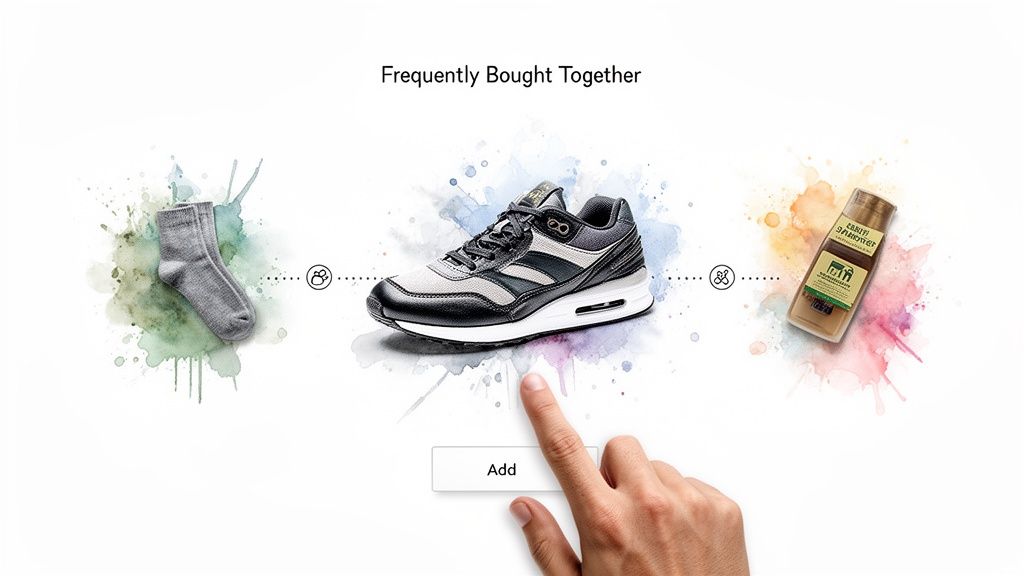
Amazon famously generates a significant portion of its revenue from this model, but the strategy is highly effective for stores of all sizes. For instance, a skincare brand might pair a popular serum with its matching cleanser and application tool. This not only increases the basket size but also introduces customers to more of your product line, making it one of the most powerful cross selling examples for driving organic product discovery and AOV.
Strategic Breakdown & Implementation
Why It Works: FBT taps into social proof and convenience. Customers see these suggestions as trusted recommendations from other buyers, reducing decision fatigue. Presenting these bundles in the cart streamlines the purchase process and increases the perceived value of the order.
Best For: Virtually any industry, but especially effective in fashion (shoes → socks), electronics (camera → memory card), beauty (foundation → brush), and home goods (coffee maker → filters).
Key Metric: Items Per Order (IPO) and Average Order Value (AOV). Properly configured FBT rules can increase items per order by 15-20%.
Pro Tip: Instead of a simple suggestion, frame it as a smart bundle. Offer a small "bundle and save" discount of 10-15% on the recommended items to significantly increase uptake. This positions the offer as a value-add reward, not just an upsell. To dive deeper into setup and best practices, learn more about creating effective frequently bought together bundles.
3. One-Click Add-Ons (Shipping Protection & Warranties)
This strategy introduces low-cost, high-margin services like shipping protection or extended warranties directly in the cart, offering customers peace of mind with a single click. Instead of pushing another physical product, you're selling a service that protects the customer's primary purchase. It’s an effortless way to increase cart value without disrupting the buying journey, as it feels like a helpful suggestion rather than a sales pitch.
Electronics giant Best Buy excels at this by offering Geek Squad protection plans at checkout, often boosting AOV by $50 or more. Similarly, many Shopify stores now use apps like Monster Cart to offer shipping protection for a few dollars, seeing adoption rates as high as 45%. These types of cross selling examples add pure profit to the order and enhance the customer's sense of security, building the kind of trust that increases lifetime value.
Strategic Breakdown & Implementation
Why It Works: This method leverages the customer's desire to protect their new investment. The low cost of the add-on feels like a small price to pay for security against loss, theft, or damage, making it an easy and logical addition right before payment.
Best For: Brands selling high-value items (electronics, jewelry, high-end apparel) or products prone to shipping damage. It’s also effective for any store looking to add a near-100% margin revenue stream.
Key Metric: Adoption Rate & Average Order Value (AOV). A well-placed in-cart offer for protection can increase AOV while simultaneously generating a new, high-margin revenue source.
Pro Tip: Frame the offer around peace of mind, not fear. Use copy like "Protect your order against theft, loss, and damage for just $2.99" to position it as a valuable service. Test making the option pre-selected in your cart to see if it boosts your adoption rate.
4. Progressive 'Buy More, Save More' Discount Tiers
This cross-selling strategy encourages customers to increase their cart value by offering progressively larger discounts as rewards for spending more. Instead of a single site-wide sale, this creates a clear incentive path for shoppers to add more items to unlock better savings. It gamifies the experience by showing customers what they stand to gain with a slightly larger purchase, a smart way to boost AOV without deep, across-the-board discounting.
Brands like Dollar Shave Club have popularized this with "Subscribe and Save" models, where bundling more products unlocks steeper discounts. Similarly, many apparel and beauty brands offer tiered savings like 15% off $100 or 20% off $200. This is one of the classic cross selling examples because it directly links a higher spend to a tangible reward, effectively boosting order value while still feeling like a great deal for the customer.
Strategic Breakdown & Implementation
Why It Works: This method leverages the principle of incremental commitment. Once a customer has decided to buy, the motivation to spend a little more to save a lot more is powerful. It shifts the focus from the total cost to the total value and savings achieved.
Best For: Consumable goods, apparel, accessories, and any brand with a wide catalog where customers are likely to purchase multiple items at once. It's ideal for moving inventory and encouraging product discovery.
Key Metric: Average Order Value (AOV). With a well-structured tier system, Monster Cart users often see AOV lifts of 30% or more by motivating shoppers to reach that next savings threshold.
Pro Tip: Combine your final discount tier with a free shipping threshold. The stacked incentives (e.g., 25% off + free shipping) create a powerful psychological trigger that makes it almost irresistible for customers to maximize their cart value.
5. Free Shipping Threshold Milestones
This classic cross-selling technique incentivizes customers to increase their order value to qualify for free shipping. Instead of viewing shipping as a necessary cost, customers perceive "unlocking" free shipping as a tangible reward, often adding more products to their cart to meet the minimum spend. This not only boosts conversion rates but also significantly improves profitability, as the value of the added items typically far exceeds the shipping expense.
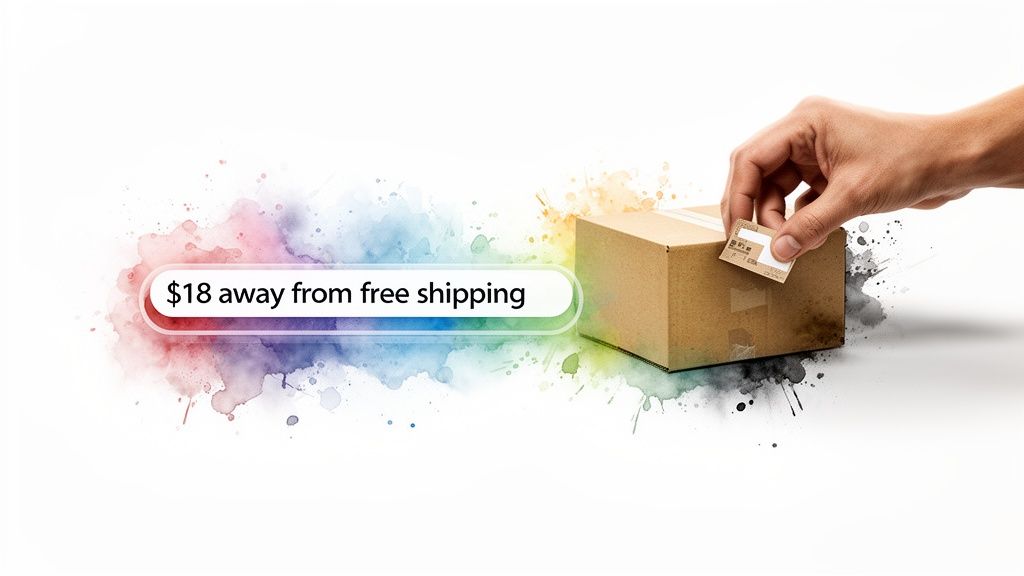
Retail giants like Target, with its well-known $35 threshold, have perfected this strategy to drive consistent AOV lift. This method serves as one of the most powerful cross selling examples because it directly addresses a major point of friction in the checkout process: shipping fees. It transforms a potential cart-abandonment trigger into a compelling reason to purchase more, enhancing the customer experience and increasing revenue without resorting to product discounts that devalue your brand.
Strategic Breakdown & Implementation
Why It Works: Free shipping is one of the most powerful psychological motivators in e-commerce. A progress bar or a clear message like "You're only $18 away from free shipping!" creates a sense of urgency and a clear, achievable goal, gamifying the shopping experience.
Best For: Virtually all e-commerce stores, especially those in apparel, home goods, and consumer electronics where shipping costs can be a significant deterrent. It is universally effective across industries.
Key Metric: Average Order Value (AOV) and Conversion Rate. A well-placed free shipping bar, like those powered by Monster Cart, can lift AOV by 15-25% by making the path to the reward clear and frictionless.
Pro Tip: Set your free shipping threshold approximately 1.3x your current AOV. This makes it an attainable goal for most shoppers. Combine this with in-cart product recommendations to suggest the perfect items to help customers reach the threshold faster.
6. Personalized Product Recommendations Based on Behavior
This sophisticated cross-selling strategy uses AI and machine learning to analyze individual customer behavior, such as browsing history, past purchases, and items added to the cart. It then dynamically suggests highly relevant products, creating a one-to-one personalized shopping journey. Instead of generic suggestions, customers see items they are statistically more likely to buy, a value-add that significantly boosts relevance and conversion rates.
This is the engine behind giants like Amazon, whose recommendation algorithm reportedly generates up to 35% of its revenue. It moves beyond simple "you might also like" widgets by truly understanding user intent. For Shopify stores, this tactic transforms the shopping experience from a simple transaction into a guided discovery, making it one of the most powerful cross selling examples for increasing both AOV and customer lifetime value.
Strategic Breakdown & Implementation
Why It Works: Personalization taps into the core human desire to be understood. When recommendations are accurate, it builds trust and makes customers feel valued. This data-driven approach ensures offers are relevant, reducing decision fatigue and increasing the likelihood of an impulse add-to-cart.
Best For: Stores with a diverse product catalog, repeat customers, and significant traffic data. It excels in fashion, electronics, beauty, and subscription box industries where tastes and needs vary widely.
Key Metric: Conversion Rate (CVR) and Average Order Value (AOV). A well-tuned recommendation engine can directly lift sales by presenting the right product at the right moment.
Pro Tip: Start by implementing recommendations based on simple triggers, like "Frequently Bought Together" on product pages or "Based on Your Viewing History" in the cart. Tools like Monster Cart can then leverage this data to present these personalized suggestions within a non-intrusive in-cart drawer, capturing the customer's attention when their purchase intent is highest.
7. Bundle Offers and Mixed-Product Packages
This cross-selling strategy involves creating curated product packages that combine complementary items at a single, often slightly discounted, price. By bundling a bestseller with a lesser-known but related product, you introduce customers to more of your catalog, simplify their purchasing decision, and increase the perceived value of their order. This method is excellent for moving inventory and boosting AOV without relying on sitewide sales.
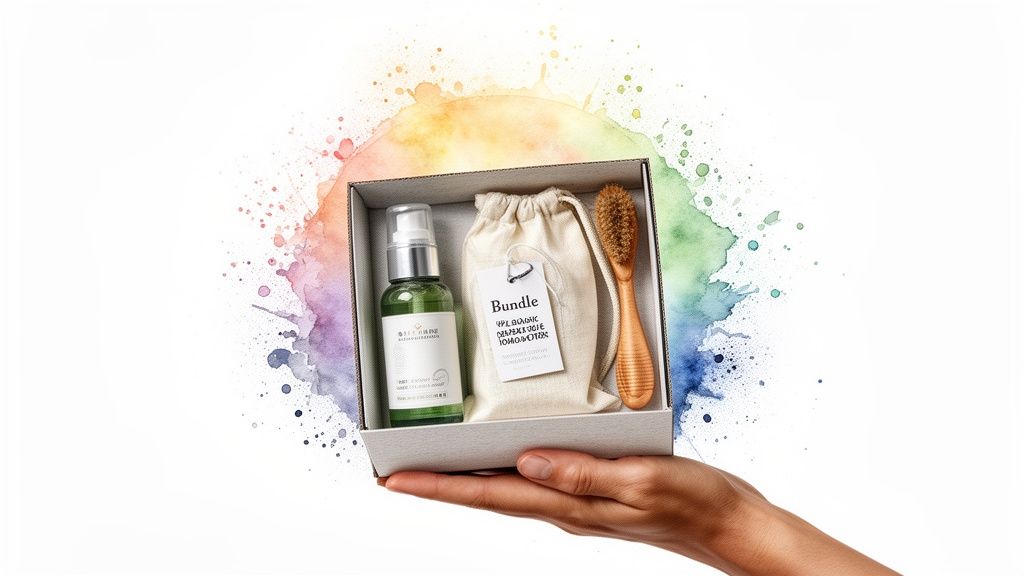
Brands like Glossier have built entire categories around "Sets & Bundles," demonstrating how effective this can be. Similarly, GoPro often packages its cameras with essential accessories at a compelling price point. These curated collections are powerful cross selling examples because they solve a customer's need more completely while lifting the total cart value, often more effectively than a simple one-off discount. You can learn more about how to strategically create a product bundle for your own store.
Strategic Breakdown & Implementation
Why It Works: Bundles tap into the desire for convenience and value. Customers feel they are getting a "deal" and a complete solution, which reduces decision fatigue. It's a guided shopping experience that increases AOV while feeling helpful rather than pushy.
Best For: Any brand with a catalog of complementary products, especially in beauty (skincare routines), electronics (starter kits), home goods (cleaning sets), and food (tasting collections).
Key Metric: Average Order Value (AOV). By presenting a bundle as an in-cart offer, stores using Monster Cart can guide customers to a higher spend threshold effortlessly, often seeing a 15-30% increase in AOV from bundle takers.
Pro Tip: Apply the 80/20 rule to your bundles. Pair one of your top-selling products (the 80%) with a complementary, but perhaps slower-moving, item (the 20%) to introduce new products to your most engaged customers and balance inventory.
8. Smart Post-Purchase Upsell and Cross-Sell Offers
This powerful strategy presents a customer with a highly relevant offer after they have completed their initial purchase, typically on the thank-you page or via a follow-up email. Because the primary transaction is already secure, these offers feel less like a sales pitch and more like a helpful suggestion. This frictionless experience captures impulse buys and introduces customers to complementary products they may not have considered, improving their experience and setting the stage for future purchases.
Brands like Warby Parker excel at this, offering lens cleaning kits right after a customer buys a new pair of glasses. This approach leverages the customer's high-intent moment to add incremental value and revenue. It's one of the most effective cross selling examples because it capitalizes on existing trust and purchase momentum without jeopardizing the original conversion. You can learn more about the strategic difference between cross-selling and upselling to refine your approach.
Strategic Breakdown & Implementation
Why It Works: Post-purchase offers eliminate decision fatigue during checkout. The customer has already committed, making them more receptive to a low-friction, one-click add-on that enhances their recent purchase. This builds on the initial sale rather than complicating it.
Best For: Any ecommerce store, particularly those selling products that have clear accessories or complementary items, such as fashion (shoe care for shoes), electronics (cases for phones), or beauty (serums for moisturizers).
Key Metric: Customer Lifetime Value (LTV). By successfully introducing customers to more of your product ecosystem, you increase their long-term value and encourage repeat purchases.
Pro Tip: Use a time-sensitive incentive like "Add this to your order in the next 15 minutes and get free shipping!" This creates urgency and frames the offer as an exclusive, immediate opportunity, driving higher take rates without complex discounts.
9. Loyalty-Based Rewards and Repeat Purchase Incentives
This powerful cross-selling strategy focuses on customer lifetime value by rewarding repeat business. Instead of one-time offers, loyalty programs create a continuous incentive loop, encouraging customers to return and consolidate their spending with your brand. By offering points, exclusive access, or tiered benefits, you transform transactional purchases into a long-term relationship.
Icons like Sephora, with its VIB program driving over 80% of sales, and Starbucks Rewards, prove that loyalty is a massive revenue driver. This model turns subsequent purchases into opportunities for value-added cross-sells, where customers redeem points for new products they might not have tried otherwise. It’s one of the most sustainable cross selling examples for fostering brand affinity and increasing customer lifetime value (LTV).
Strategic Breakdown & Implementation
Why It Works: Loyalty programs leverage the psychological principle of reciprocity and goal gradient theory. Customers feel valued and are motivated to reach the next status tier or reward, making them more receptive to adding items to their cart to earn points faster.
Best For: Brands in high-repeat-purchase categories like consumables, beauty, fashion, and food and beverage. It excels for businesses aiming to build a strong community and reduce customer acquisition costs.
Key Metric: Customer Lifetime Value (LTV). Integrating loyalty point reminders within an in-cart offer engine like Monster Cart can directly tie rewards to immediate AOV-boosting actions.
Pro Tip: Remind customers of their current point balance directly in the cart or slide-out cart. Displaying a message like, "You're only 25 points away from a $10 reward! Add one more item to earn it," creates powerful, immediate urgency to increase cart size.
10. Contextual Cart Recovery with Dynamic Discounts
While not a traditional in-cart cross-sell, this strategy uses the abandoned cart itself as a final, powerful opportunity to add value and recover a sale. It monitors abandonment behavior and triggers personalized recovery campaigns with context-sensitive offers. Instead of generic "You left something behind" emails, this method uses customer data, cart value, and history to craft targeted incentives, turning a lost sale into a high-value conversion.
This is more than just recovering revenue; it's a retention play. Fashion retailers often recover millions annually by segmenting offers: a first-time shopper might get a small discount, while a loyal VIP receives an exclusive free gift with their next purchase. This sophisticated approach makes the recovery feel like a personalized service rather than a desperate plea, reinforcing brand loyalty. It’s a crucial tool that functions as one of the most profitable cross selling examples by re-engaging customers at a critical moment.
Strategic Breakdown & Implementation
Why It Works: Personalization and context are key. An offer tailored to the customer's value (e.g., high-AOV cart gets a better incentive) and their relationship with the brand feels more genuine and compelling. It respects the customer journey and provides a relevant reason to complete their purchase, protecting margins by avoiding blanket discounts.
Best For: All ecommerce stores, especially high-consideration product niches like fashion, electronics, and home goods where customers often comparison shop before buying.
Key Metric: Cart Abandonment Recovery Rate. A well-segmented campaign can lift recovery rates from the average of 10% to over 25-30% for targeted segments.
Pro Tip: Segment your recovery offers. For first-time visitors, a 10% discount can be effective. For repeat customers, offer a more valuable incentive like a free gift or early access to a new product. This rewards loyalty and focuses discounts on new customer acquisition.
Top 10 Cross-Sell Strategies Comparison
Strategy | Complexity (🔄) | Resources & Efficiency (⚡) | Expected Outcomes (📊⭐) | Ideal Use Cases (💡) | Key Advantages |
|---|---|---|---|---|---|
Free Gift with Purchase (GWP) Tiered Rewards | Medium‑High 🔄 — tier logic + cart UX | Moderate — gift SKUs, cart UI, inventory sync ⚡ | AOV +25–35%; improves satisfaction ⭐📊 | Brands wanting AOV lift without discounting; seasonal promos 💡 | Preserves brand value; motivational progression; inventory clearance |
Frequently Bought Together (FBT) In‑Cart Recommendations | Medium 🔄 — recommendation rules + UI | Moderate — purchase data, recommendation engine, realtime sync ⚡ | AOV +15–30%; higher conversion via personalization ⭐📊 | Catalogs with complementary SKUs and historical data 💡 | Personalized suggestions; low friction one‑click adds |
One‑Click Add‑Ons (Shipping Protection & Warranties) | Low‑Medium 🔄 — simple UI, compliance check | Low — UI toggles, messaging, legal/compliance for insurance ⚡ | Adoption 20–40%; high‑margin incremental revenue ⭐📊 | High‑value or fragile items; sellers seeking margin boost 💡 | Very low friction; high conversion; reduces post‑purchase anxiety |
Progressive "Buy More, Save More" Discount Tiers | Medium‑High 🔄 — pricing logic + tier visuals | Moderate — cart calculations, margin modeling, exclusions ⚡ | AOV +20–40% but potential margin erosion if aggressive ⭐📊 | Volume‑driven brands and repeat customers 💡 | Encourages larger baskets without blunt markdowns |
Free Shipping Threshold Milestones | Low 🔄 — straightforward threshold + progress bar | Low — shipping logic, UI progress indicator ⚡ | AOV +15–25%; reduces cart abandonment ⭐📊 | Broad‑appeal stores and low price‑point retailers 💡 | Familiar, simple, trusted incentive that boosts conversion |
Personalized Product Recommendations Based on Behavior | High 🔄 — ML models + data pipelines | High — data infrastructure, ML, privacy/compliance ⚡ | AOV +10–20%; higher relevance and conversion ⭐📊 | Large catalogs, returning customers, data‑rich brands 💡 | Most relevant suggestions; improves CX and customer insights |
Bundle Offers and Mixed‑Product Packages | Medium 🔄 — bundle configs + inventory ties | Moderate — bundle setup, pricing, inventory allocation ⚡ | AOV +20–35%; moves slow‑turn stock ⭐📊 | Brands with complementary SKUs and inventory to clear 💡 | Simplifies choice; perceived value; strategic inventory clearing |
Smart Post‑Purchase Upsell and Cross‑Sell Offers | Medium 🔄 — post‑checkout flows & timing | Moderate — automation (email/SMS), offer windows ⚡ | High incremental revenue from committed buyers; good conversion ⭐📊 | Merchants wanting low‑friction add‑ons after purchase 💡 | Captures buyers already committed; lower resistance than pre‑checkout upsells |
Loyalty‑Based Rewards and Repeat Purchase Incentives | High 🔄 — program design + ongoing management | High — CRM, points engine, fulfillment, continuous refresh ⚡ | Repeat frequency +20–40%; LTV ↑ multiple‑fold ⭐📊 | Brands focused on long‑term retention and CLV growth 💡 | Builds emotional loyalty; collects zero‑party data; drives repeat business |
Contextual Cart Recovery with Dynamic Discounts | High 🔄 — segmentation + automation complexity | High — abandonment detection, dynamic incentives, omnichannel ⚡ | Recovers ~10–25% abandoned carts; strong ROI when targeted ⭐📊 | Stores with high abandonment rates and diverse segments 💡 | Protects margins with targeted incentives; personalized recovery rather than blanket discounts |
Turn Your Cart Into Your Best Salesperson
Throughout this guide, we've explored a diverse range of powerful cross selling examples, moving far beyond simple "you might also like" widgets. From tiered Free Gift with Purchase rewards to strategic one-click add-ons, the common thread is a fundamental shift in perspective. The most effective cross-selling strategies aren't about aggressively pushing more products; they are about intelligently presenting more value through rewards.
Your goal is to transform the customer's mindset from one of cost to one of achievement. Instead of seeing a hefty discount, they see a valuable reward they've earned. This reframing is crucial for building a brand that thrives on customer loyalty and high lifetime value rather than just promotional sales cycles.
Key Takeaways for Sustainable Growth
The strategic patterns we analyzed reveal a clear path to increasing your Average Order Value (AOV) without resorting to margin-killing discounts. Let's recap the core principles:
Reward, Don't Discount: The most successful cross selling examples make the customer feel like a winner. Unlocking a coveted free gift, earning complimentary shipping, or gaining access to an exclusive bundle feels like an accomplishment, not just a simple saving. This builds positive brand association and encourages higher spending.
Reduce Friction, Increase AOV: Every click and every new page loaded is a potential exit point. By integrating offers directly within the cart drawer, you create a seamless, interactive experience. Customers can see their progress toward rewards in real-time and add items with a single click, eliminating the friction that kills conversion.
Focus on Lifetime Value (LTV): A one-time sale is good, but a loyal, repeat customer is invaluable. Cross-selling strategies that offer genuine value, like personalized recommendations and loyalty-based incentives, foster a deeper connection. This turns transactional shoppers into brand advocates, dramatically increasing their long-term value.
Putting These Examples into Action
The true power of these strategies lies in their implementation. A static, uninspired cart is a missed opportunity. To bring these dynamic offers to life, you need an engine capable of turning your standard Shopify cart into an interactive rewards system. This is where tools like Monster Cart move you from theory to tangible results.
By leveraging a tool designed for in-cart optimization, you can deploy tiered gifts, progress bars, and one-click add-ons without disruptive pop-ups. You're not just selling products anymore; you're creating a gamified shopping journey that expertly guides customers toward a higher AOV and a more memorable brand experience. Ultimately, the right cross-selling strategy, powered by the right technology, turns every single cart into your most effective and persuasive salesperson.
Ready to implement these powerful cross selling examples and transform your Shopify cart into a revenue-generating machine? With Monster Cart, you can build all of the tiered gifts, progress bars, and one-click offers discussed in this article without any code. Start turning more visitors into higher-value customers today by installing Monster Cart from the Shopify App Store.
Join 7000+ brands using our apps