How to Create a Rewards Program That Drives Sales Without Discounts
Feb 5, 2026
|
Published
Creating a rewards program is about more than just giving stuff away. It’s a strategic plan to define clear goals, design rewards that people actually want (like free gifts or shipping tiers), and then wrap it all in an engaging in-cart experience.
The real key here is to shift your focus. Stop relying on margin-eroding discounts and start building systems that genuinely boost your average order value (AOV) and customer lifetime value. It's about encouraging customers to spend more per transaction by offering value, not just cutting prices.
Rethinking Rewards Beyond Just Discounts

Let's be real: constantly running sales can feel like a race to the bottom. You end up training your customers to just wait for the next 20% off coupon, which cheapens your brand and kills your margins. A modern rewards program offers a much smarter way to grow, moving the goal from one-off sales to long-term customer relationships and higher lifetime value.
The idea is to build a system that encourages shoppers to spend more with each order without just slashing prices across the board. This is where the magic of 'in-cart rewards' comes in.
The Power of In-Cart Rewards
In-cart rewards are incentives customers unlock right inside their shopping cart as they add items. Instead of dealing with disruptive pop-ups or confusing points systems that require a separate login, this approach creates a seamless, interactive, and frankly, fun experience.
Imagine this: a customer adds a $50 product to their cart. A sleek progress bar instantly appears, showing them they're just "$25 away from a free gift!" This simple, gamified nudge is way more effective at boosting AOV than a hefty 20% discount. It transforms the cart from a boring checkout tool into a dynamic growth engine.
This strategy helps you nail several key goals at once:
Boost Average Order Value (AOV) by motivating customers to add one more item to unlock perks like free shipping or a gift.
Improve the Customer Experience by making shopping more engaging, avoiding the friction of pop-ups.
Protect Your Profit Margins by offering value through products (a free gift) or services (free shipping) instead of just cutting prices.
Build Real Loyalty that goes beyond transactional discounts, creating a stronger bond with your brand and boosting lifetime value.
The core idea is to stop conditioning customers to expect discounts and start delighting them with added value. When done right, a rewards program isn't an expense; it's a strategic investment in customer relationships and sustainable growth.
Let's do a quick side-by-side. It’s pretty clear why a strategic rewards program is better for your brand's long-term health and profitability.
Traditional Discounts vs Modern Rewards Programs
Metric | Traditional Discounts | Modern Rewards Program |
|---|---|---|
Customer Behavior | Trains shoppers to wait for sales. | Encourages higher spending per order. |
Brand Perception | Can devalue products and cheapen the brand. | Builds a premium, customer-centric image. |
Profit Margins | Directly erodes margins on every sale. | Protects margins by adding value, not cutting price. |
Customer Loyalty | Creates transactional, price-focused shoppers. | Fosters genuine, long-term brand affinity & lifetime value. |
AOV Impact | Often has a neutral or even negative impact. | Directly and reliably increases AOV. |
A rewards program is purpose-built to foster a healthier, more valuable customer relationship without resorting to hefty price cuts.
A Proven Growth Engine
Thinking about how to create a rewards program might feel like a huge undertaking, but the data shows it's one of the most reliable investments a merchant can make. This isn't just about making customers happy; it's about driving tangible financial results.
Recent industry reports show just how effective these programs are. For instance, 83% of program owners report a positive ROI, pulling in an impressive average of 5.2x return on their investment.
Consumers are actively looking for these perks, too. Nearly 70% join loyalty programs specifically for the rewards. Once they're in, 84% of members shop more frequently with the brands they are loyal to, often spending 12-18% more per purchase. You can read the full research on beauty brand loyalty to see just how powerful this is in a competitive space.
This data paints a clear picture of a powerful feedback loop. Customers get more value, and in return, they spend more, more often. For Shopify merchants, this is where tools like Monster Cart become essential, giving you the power to build these engaging, in-cart experiences that drive both loyalty and revenue.
Defining Your Program Goals and Strategy
Before you start picking out free gifts, you need a plan. A rewards program without a clear goal is like a ship without a rudder—it might look nice, but it’s not going anywhere useful. The point isn’t just to give stuff away; it's to nudge your customers toward specific behaviors that actually grow your business.
Your first move is to define what success looks like in real, concrete numbers. Vague goals like "increase loyalty" just won't cut it. You need to set measurable targets that tie directly back to your brand's financial health. This simple step is what turns your program from a potential cost into a strategic, profit-driving investment.
Set Specific and Measurable Goals
Start by digging into your current business metrics. Where are the biggest opportunities hiding? A well-designed in-cart rewards program can directly move the needle on your key performance indicators (KPIs), but you have to be intentional about which ones you're targeting.
Here are a few common goals that work perfectly with in-cart rewards:
Increase Average Order Value (AOV): Get specific. A good goal is something like, "Boost AOV by 15% within the next quarter." This puts your focus squarely on getting customers to add just one more item to their cart to unlock rewards like free shipping or a gift.
Improve Conversion Rates: Frame it as, "Lift site-wide conversion rate from 2.5% to 3%." An engaging in-cart offer gives shoppers a powerful reason to complete their purchase instead of abandoning their cart.
Boost Repeat Purchase Rate: Think in terms of, "Increase our 60-day repeat purchase rate by 20%." This goal is all about turning those one-time buyers into loyal, returning fans and increasing their lifetime value.
The most effective programs are built on a foundation of data, not guesswork. Dive into your Shopify analytics to find your baseline AOV, conversion rate, and customer purchase frequency. These numbers will be your starting point for setting realistic yet ambitious goals.
Once you have your main goal locked in, your strategy becomes much clearer. If you're chasing a higher AOV, spend-based free gifts are a no-brainer. If you're focused on retention, you might offer exclusive perks to repeat buyers. For a deeper dive into the strategic side of things, check out this guide on how to create a referral program that drives growth—many of the same core principles apply.
Understand Your Margins and Customer Lifetime Value
This is the part where so many merchants trip up. They get excited and launch rewards that are so generous they actually lose money on each order. A sustainable, profitable program has to be built with a rock-solid understanding of your profit margins. Before you offer that "free" gift or free shipping, you have to know exactly what it's costing you.
Calculate the Cost of Goods Sold (COGS) for any item you're considering giving away. If you're offering a free tote bag (COGS: $5) on orders over $75, you need to be sure the lift in AOV from that offer more than covers the $5 cost plus any extra shipping. The whole idea is to incentivize a larger purchase that generates more profit, not just more revenue.
This is why thinking in terms of Customer Lifetime Value (LTV) is so important. A small investment in a reward today can create a customer who comes back again and again. Instead of obsessing over the profit on a single transaction, think about the total profit that customer might bring in over the next year.
For instance, giving a customer a $10 gift on their second purchase might feel like a hit to your margin right now. But if that little gesture encourages them to place five more orders over the next year, your return on that initial investment is massive. An LTV-first mindset helps you see rewards not as an expense, but as a down payment on future loyalty. It’s the perfect way to build a profitable program without relying on those hefty, margin-killing discounts. This is where a tool like Monster Cart really shines, letting you build out tiered, in-cart offers that protect your margins while driving the exact behaviors you’ve set as your goals.
Designing Rewards That Customers Actually Want
Alright, let's get to the fun part: figuring out the actual rewards that will stop your customers in their tracks. A great in-cart program isn't about some convoluted points system that takes forever to pay off. It’s all about immediate, tangible value that makes a shopper think, “I need to get that right now.”
The goal is to design offers that feel like an exciting discovery, not a math problem. This is where you transform a boring, passive checkout into an active, engaging experience. Your cart stops being just a list of items and becomes a dynamic little game that guides customers toward awesome perks. It’s a small shift in presentation that makes a massive difference.
Beyond Discounts: The Four Core In-Cart Rewards
If you want to boost AOV without just giving away your margin, you need a smarter toolkit. Hefty discounts are a blunt instrument; strategic, value-added rewards like free gifts and shipping are surgical. They target specific behaviors and genuinely grow your bottom line while enhancing the customer's lifetime value.
Here are the four most powerful types of in-cart rewards that we see working for brands every single day:
Spend-to-Unlock Milestones: This is your classic "Spend $X, Get Y" model. It’s a powerhouse because it gives the shopper a clear, achievable goal. The secret is picking the right threshold and a reward they actually care about.
Tiered Free Gifts: This approach really gamifies the checkout. A customer might unlock a small gift at $50, a better one at $100, and a premium item at $150. Each tier feels like leveling up.
Free Shipping Thresholds: Never, ever underestimate the power of free shipping. High shipping costs are still the #1 reason people abandon their carts. A dynamic bar showing them exactly how close they are is an incredible motivator.
Progressive 'Buy More, Save More' Offers: This is a much smarter way to handle discounts. Instead of a flat 10% off, you can tier the savings: "Buy 2, Get 10% Off; Buy 3, Get 20% Off." It directly encourages larger orders without devaluing your products.
A well-crafted in-cart reward does more than just bump up the order total. It makes the customer feel smart, like they’ve successfully unlocked a special perk. That positive feeling is what builds real brand affinity and drives long-term customer value.
The psychology here is simple but incredibly effective. When a customer sees they’re only “$15 away from a free gift,” the fear of missing out (FOMO) kicks in. Adding another item feels less like spending more money and more like claiming a prize they've earned.
Making Rewards Interactive and Engaging
The real magic happens when you present these rewards dynamically, right inside the cart. A static banner at the top of your site is easy to ignore. An interactive progress bar inside a slide-out cart is impossible to miss.
This is exactly how an app like Monster Cart completely transforms the shopping experience. It replaces the standard Shopify cart with an intelligent rewards engine designed to boost AOV.
As a customer adds items, the Monster Cart interface visually tracks their progress. The message might change from “Add $23 more for a free travel-size moisturizer” to “You've unlocked the moisturizer! Add just $42 more to get a full-size serum!” This turns the cart into a mini-game, nudging customers to hit that next milestone without being pushy.
This is fundamentally different from a traditional loyalty program. You’re not asking anyone to sign up or track points. You're giving them instant value right where it counts—at the moment of purchase. For a deeper look at this strategy, check out our complete guide on how to run a Shopify free gift with purchase campaign.
The Long-Term Value of Smart Rewards
Focusing on these kinds of value-added rewards is a strategic play. You're not just closing a sale; you're creating a memorable experience that makes people want to come back. This is how you boost customer lifetime value. The data on this is overwhelming.
Members in top-tier programs generate 12-18% more incremental revenue per year than non-members, and the most loyal customers often spend 15-25% more annually. Just look at Starbucks—their Rewards program powers an incredible 53% of U.S. store spend. Adidas adiClub members buy 50% more often and have double the lifetime value. You can learn more about these powerful loyalty program statistics to see the full picture.
By designing rewards your customers actually want—like a coveted free product or the simple joy of free shipping—you create a powerful incentive loop. They spend more to get the reward, have a great experience, and are far more likely to shop with you again. That’s how you build a sustainable, profitable business.
Building Your In-Cart Rewards System
Okay, you’ve got your strategy mapped out and a list of rewards that will get customers excited. Now it’s time for the fun part: bringing it all to life. This isn't about getting tangled up in code. It's about configuring a smart, seamless experience that makes unlocking rewards feel like an intuitive part of shopping.
The real magic happens when you build this experience directly inside the shopping cart. A fully branded slide-cart that replaces Shopify’s clunky default is a game-changer, keeping shoppers on the page and focused on the purchase. This is exactly where a tool like Monster Cart shines, transforming your cart from a simple checkout step into a powerful rewards engine designed to boost AOV and LTV.
Setting Up a Tiered Gift With Purchase Campaign
A tiered gift-with-purchase (GWP) offer is one of the most reliable ways to bump up your AOV. Instead of one flat spend goal, you create a series of milestones, each unlocking a better and better gift. It gamifies the whole experience, making customers feel like they're leveling up with every item they add.
Here’s how you’d put this into action with a solid in-cart rewards app like Monster Cart:
Define Your Tiers: First, set your spend thresholds. A beauty brand, for example, could create a ladder of rewards like this:
Spend $50: Unlock a free sample-size cleanser.
Spend $100: Unlock a free full-size lip balm.
Spend $150: Unlock a free travel skincare kit.
Configure the Rewards: Inside the app, you’ll build out each tier. You just need to specify the spend amount required and choose the exact product that should be automatically added to the cart when the customer hits that magic number.
Craft Your Messaging: This is where you seal the deal. Use dynamic messaging that updates in real-time as the customer shops. When their cart total hits $35, the cart should display, "You're only $15 away from a free cleanser!" The moment they reach $50, it should instantly pivot to, "You've unlocked the cleanser! Now spend $50 more to get a free lip balm!"
This interactive feedback loop is what makes an in-cart system so effective. It’s constantly showing customers what’s next, giving them a compelling reason to add just one more item to their cart.
This visual flow shows how different in-cart rewards can work in harmony, guiding the customer toward a bigger spend.
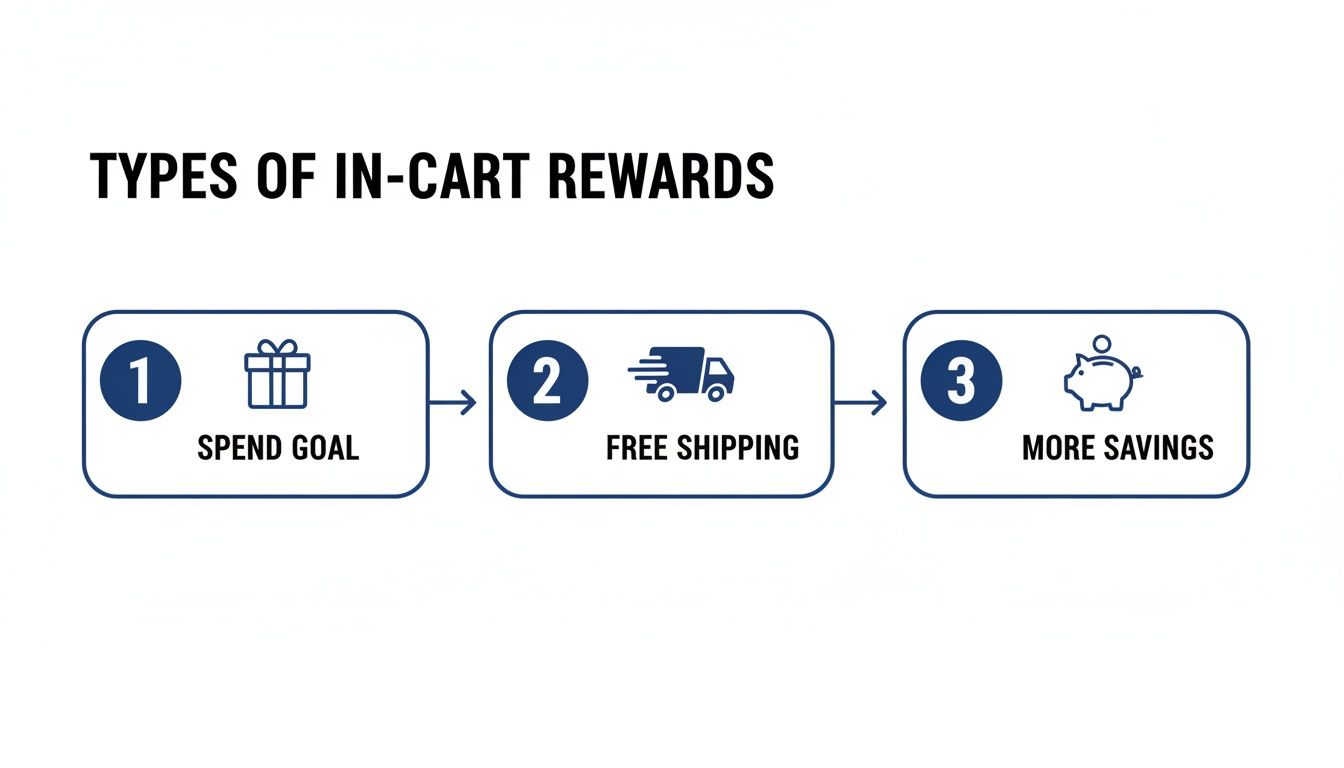
Each step—from an initial freebie to unlocking free shipping and finally bigger savings—acts as a milestone. This keeps the shopper engaged and motivated to keep adding to their order.
Configuring a Dynamic Free Shipping Bar
Let's be honest: high shipping costs are one of the biggest conversion killers. A dynamic free shipping bar tackles this problem head-on by turning a negative into a positive, clearly showing customers how close they are to ditching that fee.
Setting this up is refreshingly simple with a tool like Monster Cart:
Set Your Threshold: Figure out the order value that makes sense for free shipping (e.g., $75).
Customize the Bar: Make it your own. Match the progress bar to your brand’s colors and fonts so it feels like a natural part of your site.
Write Compelling Copy: Use motivating, real-time messages like, "Add just $12 more to unlock FREE shipping!" And when they get there, celebrate it: "Congratulations! You've earned free shipping!"
This one visual tool provides constant encouragement and removes a major point of friction at checkout.
Creating a 'Buy More, Save More' Structure
This is the smarter cousin of the site-wide discount. Instead of offering a flat percentage off to everyone, you reward customers for buying more items, which directly drives up your units per transaction (UPT).
For a clothing brand, the tiers might look something like this:
Buy 2 items, get 10% off
Buy 3 items, get 15% off
Buy 4+ items, get 20% off
With an app like Monster Cart, the system automatically counts the items in the cart and applies the right discount. The cart display clearly communicates the offer, showing customers the savings they've just unlocked and dangling the next tier in front of them.
By building these incentives directly into the cart, you’re not just offering rewards; you’re guiding the customer’s shopping behavior. You’re helping them discover more value, which in turn boosts your AOV and, more importantly, strengthens their long-term value to your brand.
Layering in Other Revenue Drivers
A truly powerful in-cart system doesn’t just stop with one offer. The best Shopify upsell apps allow you to stack multiple revenue drivers inside the same slide-cart.
The features available in a robust tool like Monster Cart give you a full arsenal for maximizing order value without ever feeling pushy.
Monster Cart In-Cart Upsell Features
Here's a quick look at some of the features within Monster Cart that you can use to build out a complete, high-converting rewards and upsell system.
Feature | Primary Goal | Example Implementation |
|---|---|---|
Tiered Rewards | Boost AOV with gamified incentives | "Spend $50 for a free sample, $100 for a full-size gift." |
Free Shipping Bar | Reduce cart abandonment | "You're $12 away from FREE shipping!" |
In-Cart Upsells | Increase units per transaction | "Frequently bought together" product recommendations. |
Product Add-Ons | Increase margin with low-cost items | One-click upsells like gift wrap or shipping protection. |
Bundle Offers | Sell more of specific products | "Buy 2, get 10% off. Buy 3, get 15% off." |
These features all work together to create a cohesive and valuable experience for the shopper.
By layering in complementary offers, you turn your cart from a simple checkout page into a sophisticated conversion tool. Each feature works in concert to increase the order value in a way that feels helpful, perfectly aligning with the goal of a rewards program that benefits both you and your shoppers.
Launching and Promoting Your New Rewards Program
A brilliant rewards program that nobody knows about is just a missed opportunity. Once you've designed your incentives and built out the logic, the real work begins: getting the word out and building genuine excitement. This isn’t just about flipping a switch; it's about crafting a narrative that shows customers how much more value they get by shopping with you.
Your promotional messaging is everything. Ditch the dry announcements like, "We have a new points system." Instead, frame it entirely around the benefits. Focus on the value they can unlock, using energetic language that sparks curiosity and makes them want to see what perks are waiting for them.
Crafting a Compelling Launch Message
The trick is to stop talking about the features of your program and start highlighting the feeling of being rewarded. Your customers don't care about the backend mechanics; they care about what’s in it for them. This simple shift in focus separates a forgettable launch from one that gets people talking and, more importantly, spending.
Here’s how you can reframe your messaging to be more customer-centric:
Instead of: "Our new rewards program is live."
Try: "Unlock free gifts and exclusive perks with every order!"
Instead of: "Spend $75 to get a free item."
Try: "Your next favorite product is on us when you spend $75!"
This benefit-driven language creates a sense of achievement and makes the rewards feel earned and special. It’s a small change in wording that can dramatically improve how your program is received right out of the gate.
Building Your Promotional Playbook
A successful launch needs a multi-channel attack to make sure you're reaching customers everywhere they hang out. You don't need a massive budget, just a coordinated push across your key marketing platforms.
Your promotional playbook should cover a few key areas:
Targeted Email Campaigns: Send a dedicated announcement to your entire email list. Use a punchy subject line like, "A New Way to Get Rewarded is Here!" and make it visual—show them exactly what they can earn.
Engaging Social Media Content: Create eye-catching posts, stories, and maybe even a short Reel or TikTok that demonstrates how the program works. A quick screen recording of the Monster Cart slide-out dynamically updating as items are added can be incredibly effective.
Prominent On-Site Banners: Get a clean, attractive banner on your homepage and a persistent header bar across your site. This ensures every single visitor knows about the new perks available.
The whole point here is to build a program that boosts your Average Order Value (AOV) without just throwing away margin on discounts. Your promotions should reflect this by emphasizing added value—like free gifts and shipping—over simple price cuts. This strategy protects your margins and strengthens your brand in the long run.
Your Pre-Launch Checklist
Before you push the big red button, run through a final checklist. A little prep work now can save you from major headaches later and ensure your customers have a flawless first experience with the new program.
Test Every Reward Tier: Seriously, go through the entire customer journey yourself. Does the free gift at $50 add to the cart correctly? Does the free shipping bar update in real-time? Find the bugs before your customers do.
Review All Messaging: Double-check every headline, email, and social post. Is the value proposition crystal clear? Is the tone consistent across all channels?
Prep Your Support Team: Give your customer service team a heads-up and a simple FAQ about how the program works. They're on the front lines, so make sure they can confidently answer any questions that come their way.
Set Up Tracking: Make sure your analytics are ready to measure the program's impact on AOV, conversion rate, and customer lifetime value from day one. You can't improve what you don't measure.
Follow this playbook, and you’ll launch a rewards program that not only delights your customers but also becomes a reliable engine for sustainable growth.
Measuring Success and Optimizing for Growth

Here’s the thing: launching your rewards program is just the start. The most effective programs aren't "set it and forget it" campaigns; they're living, breathing parts of your marketing strategy that you constantly monitor and refine.
Treating your program this way lets you make smart, data-driven improvements that actually boost your bottom line. It’s how you move beyond just giving away free stuff and start building a system that drives sustainable growth without killing your margins with hefty discounts.
Defining Your Key Performance Indicators
To figure out if your program is actually working, you have to track the right numbers. Your Key Performance Indicators (KPIs) tell the real story of how customer behavior is changing.
Focus on these three core areas:
Average Order Value (AOV): Is the program actually getting customers to add more to their carts? A rising AOV is the clearest sign that your spend-based rewards are hitting the mark.
Conversion Rate: A slick in-cart experience should make checkout easier, not harder. If your conversion rate is climbing, it means your offers are compelling enough to get shoppers across the finish line.
Customer Lifetime Value (LTV): This is the ultimate metric. A great program turns one-time buyers into loyal, repeat customers, dramatically increasing the total revenue each person brings to your brand.
Using Analytics to A/B Test and Improve
Once the data starts rolling in, you can quickly see what’s resonating with your customers and what’s falling flat. Your analytics dashboard is your best friend for uncovering these opportunities.
Don't be afraid to experiment. The most profitable rewards programs are the result of continuous testing and learning. What works today might not work next quarter, so stay curious and let the data guide your decisions.
Let's say you notice your "free gift at $100" offer isn't really moving the needle on AOV. This is the perfect chance to run an A/B test. You could try offering a different gift at the same $100 threshold, or maybe test lowering the spend requirement to $85. It's amazing how often small tweaks can lead to significant gains.
The best tools, like Monster Cart, have built-in analytics that make it easy to see which offers are performing best. By keeping a close eye on these results, you can confidently fine-tune your strategy. After all, a primary goal of any rewards program is to build lasting customer relationships and boost lifetime value. For a deeper dive into strategies that go beyond loyalty programs, read this guide on how to improve customer retention.
Got Questions? We've Got Answers
You're ready to build a rewards program that actually drives growth, but a few questions are probably rattling around in your head. That’s normal. Let's tackle some of the most common concerns merchants have before they dive in.
How Do I Know if My Program Will Actually Be Profitable?
This isn't about guesswork; it's about doing some simple, smart math upfront. Before you launch any reward, you need to calculate its total cost. That means factoring in the Cost of Goods Sold (COGS) for any free gifts and adding any extra shipping expenses you might incur.
The real key is setting spend thresholds that ensure the bump in a customer's cart value generates more profit than the reward costs you. Stop thinking about one-time sales and start focusing on Customer Lifetime Value (LTV). A small, calculated investment now can easily pay for itself by creating a much more valuable long-term relationship without resorting to hefty discounts.
Will Customers Actually Bother to Participate?
They will if you make it dead simple and instantly gratifying. The best programs are the ones that don't feel like a program at all. Instead of making customers jump through hoops signing up for accounts and tracking points, in-cart rewards give them that hit of satisfaction right away.
When a shopper can literally see a progress bar telling them they’re just $10 away from free shipping or a surprise gift, participation becomes a completely natural part of the checkout flow. Using an app like Monster Cart makes this a breeze by building those rewards directly into the slide-out cart, which gets rid of all the friction and makes engagement feel automatic.
The most successful rewards programs don't feel like programs. They feel like a smarter, more valuable way to shop, nudging customers to spend more without you having to rely on those margin-killing discounts.
What Kind of Rewards Work Best to Boost AOV?
While every audience has its quirks, some rewards are just consistently better at getting customers to add more to their cart. My advice? Focus on adding real, tangible value instead of just slashing prices.
Free Shipping: This one is a universal powerhouse. High shipping costs are one of the biggest reasons people ditch their carts, so giving them a clear path to unlock it for free is incredibly effective.
Tiered Free Gifts: This approach gamifies the whole experience. You can offer increasingly better gifts at different spending levels, which taps into that "challenge accepted" mindset and encourages customers to add just one more item to reach the next tier.
These strategies are brilliant because they protect your margins while giving customers a genuinely compelling reason to bump up their order size—which is exactly what we're aiming for. It's all about increasing AOV and lifetime value in a sustainable way.
Ready to turn your Shopify cart into a powerful rewards engine? Monster Cart gives you all the tools to build a high-converting in-cart experience that boosts AOV and customer loyalty without leaning on constant discounts. Start your free trial today.
Join 7000+ brands using our apps