How to reduce shopping cart abandonment: Proven tactics for higher conversions
Feb 25, 2026
|
Published
To get a real handle on cart abandonment, you have to stop thinking about what happens after a shopper leaves. The real win is addressing why they leave in the first place, and that means transforming your standard Shopify cart into an experience that builds value with things like free shipping or a surprise gift.
It's about making the checkout feel like a rewarding finish line, not just another transaction. This approach not only recovers sales but boosts Average Order Value (AOV) and customer lifetime value (LTV) without constantly slashing your prices.
The Hidden Revenue in Your Abandoned Carts
Every single abandoned cart on your store is more than just a lost sale—it's a massive opportunity hiding in plain sight. Think of it as a river of revenue just waiting to be diverted back to your bank account.
When shoppers add items to their cart, they’re telling you they want to buy. Their intent is sky-high. Yet, something consistently gets in the way right before they pull the trigger.
This isn't a small problem; it's huge. The global average shopping cart abandonment rate hovers at a staggering 70.19%. Let that sink in. For every 100 potential customers who add something to their cart, more than 70 of them walk away empty-handed.
The culprits are almost always the usual suspects. Unexpected shipping costs kill 1 in 4 carts on the spot, and other surprise fees like taxes will scare off another 55% of would-be buyers. You can see the full breakdown of this behavior in recent consumer behavior research on Contentsquare.com.
Top Cart Abandonment Reasons and Their In-Cart Solutions
To tackle this head-on, it helps to see the direct line between a common problem and a proactive, in-cart solution. This table breaks down the biggest conversion killers and shows how you can solve them before the shopper even thinks about leaving.
Abandonment Reason (Global Data) | Impact on Shoppers | Proactive In--Cart Solution |
|---|---|---|
Extra Costs (Shipping, Taxes) | The #1 killer. Shoppers feel ambushed by last-minute fees, which breaks trust and kills the sale. | Offer a free shipping progress bar directly in the cart. This turns a negative surprise into a positive, achievable goal. |
Forced Account Creation | Creates unnecessary friction. Shoppers want a quick, easy checkout, not another password to remember. | Implement a streamlined guest checkout option and offer social logins to make the process as smooth as possible. |
Complex Checkout Process | Too many steps or fields create frustration. If it feels like work, they'll leave. | Use an express checkout drawer or slide-out cart that keeps the customer on the product page and simplifies the path to purchase. |
Couldn't Find a Coupon Code | Shoppers leave to hunt for a discount code, get distracted, and often don't return. | Offer a small, automatic in-cart reward like a free gift or a tiered discount that applies instantly, keeping them on-site. |
Website Errors or Slowness | Glitches, crashes, or slow load times create distrust and signal an unprofessional store. | Optimize your site speed and ensure your checkout is mobile-responsive and bug-free across all devices. |
Each of these proactive solutions is designed to remove a specific point of friction, keeping the customer's momentum moving forward toward a completed purchase.
Shift Your Strategy from Reactive to Proactive
For years, the standard playbook for abandonment has been purely reactive. You wait for someone to leave, and then you chase them with a series of abandoned cart emails, usually loaded with hefty discounts.
While that can claw back some sales, it's a flawed model. It trains your customers to abandon their carts on purpose, knowing a 15% off coupon is on its way. This slowly erodes your profit margins and devalues your brand over time, hurting long-term lifetime value.
A much smarter, more profitable strategy is to prevent abandonment before it even happens. This requires a fundamental shift in how you see the shopping cart itself.
Instead of seeing the cart as a simple container for products, reframe it as a dynamic rewards engine—a tool to build excitement, communicate value, and make completing the purchase an easy, compelling decision.
Build Value, Not Just a Shopping List
Imagine this scenario: a customer adds a product to their cart. Instead of just seeing a subtotal and a "Checkout" button, they see a progress bar that shows they’re only $15 away from unlocking free shipping. So, they add one more small item. Boom, the bar fills up, and a message appears: "You've unlocked a free gift!"
This interactive experience completely changes the dynamic. The cart goes from being a boring list to a rewarding journey.
This proactive approach nails several key goals at once:
It tackles the #1 reason for abandonment: It completely eliminates the sticker shock of shipping costs by turning free shipping into a clear, achievable goal.
It boosts Average Order Value (AOV): Shoppers are naturally nudged to add more to their cart to unlock the next reward, increasing the value of each and every sale. If you want to dive deeper into this metric, check out our guide on what is Average Order Value.
It focuses on long-term value: By offering rewards like a free gift, you can introduce customers to new products and create a memorable experience that builds real loyalty—something a one-time discount can never do. This is a crucial step towards increasing customer lifetime value.
This is the entire philosophy behind a tool like Monster Cart. It's all about transforming the cart into an interactive layer that boosts conversions and AOV without constantly resorting to margin-killing discounts.
Finding the Leaks in Your Checkout Funnel
Before you can plug the holes draining your revenue, you have to find them first. Treating cart abandonment without a proper diagnosis is like trying to fix a car by randomly swapping out parts—it's expensive, inefficient, and almost never works.
You need to become a bit of a detective. Following the data trail is the only way to pinpoint exactly where your customers are hitting a wall and bailing on their purchase.
Guessing that “high shipping costs” are the problem isn’t enough. You need to know where in the journey that friction becomes a dealbreaker. Is it on the product page? In the cart itself? Or during the final payment step? Each of these drop-off points tells a completely different story about your customer experience.
Go Beyond Basic Analytics
Your Shopify dashboard gives you a high-level view, but to truly understand why shoppers are leaving, you have to dig much deeper. This means blending the "what" (quantitative data) with the "why" (qualitative insights).
Start with the tools you probably already have. Google Analytics is a great starting point for mapping out your checkout funnel. You can set up a goal that tracks users from the moment they add an item to their cart all the way to the thank-you page. This will give you a stark visual of your biggest drop-off points.
For instance, you might see that 90% of users who add to cart make it to the checkout page, but only 40% actually complete the purchase. Right away, that tells you the leak isn't about getting people to the checkout; it's something happening during the checkout process itself.
Pinpoint Friction with Visual Data
Numbers tell part of the story, but visual data brings it to life. This is where tools like heatmaps and session recordings become absolutely essential.
Heatmaps show you precisely where users are clicking, how far they're scrolling, and what they're hovering over. A heatmap might reveal that users are frantically clicking on a trust badge, hoping for more information that isn't there, or that they completely ignore the link to your shipping policy.
Session Recordings are like having a screen recording of a user's visit. You can watch them struggle with a confusing form field, hesitate the second shipping options appear, or rage-click a button that’s broken on their phone.
These tools let you see your store through your customer's eyes, uncovering friction points you would have never spotted on your own.
A classic finding from session recordings is watching shoppers add items to their cart just to see the final shipping cost. If that number comes as a shock, you can literally see them slam on the brakes and abandon the session. This is a clear signal that your shipping costs need to be communicated much earlier and more clearly.
Mine Your Shopify-Specific Data
While analytics tools are powerful, don't overlook the goldmine of data sitting right inside your Shopify ecosystem. This is where you'll find the specific, actionable insights that generic advice always misses.
Payment Gateway Reports: Dive into your Shopify Payments or third-party gateway reports. A high number of failed transactions could point to a technical glitch, a confusing payment interface, or a sign that you aren't offering the payment options your audience actually uses.
Customer Support Tickets: Your support team is on the front lines. Sift through support emails and chats for recurring themes. Are customers constantly asking about your return policy? Are they confused about a promo code? These complaints are direct, unfiltered feedback on friction in your funnel.
On-Site Search Queries: Look at what people are searching for on your site. If terms like "free shipping," "returns," or "coupon code" pop up over and over, it’s a strong indicator that this information is either unclear or not being presented at the right moment.
By combining these different data sources, you move from guessing to knowing. This data-driven approach doesn’t just help you fix problems; it highlights the need for solutions that provide granular, real-time cart performance tracking. When you can see how users interact with incentives in the cart itself, like with an app such as Monster Cart, you gain the power to optimize the experience before they even consider leaving.
Turn Your Cart Into a Rewards Engine
Once you’ve figured out where shoppers are dropping off, the goal isn't just to patch the leaks—it's to completely rethink the experience. A standard shopping cart is just a passive list of items, a boring but necessary step before checkout. But what if it could be an active, engaging tool that actually convinces customers to finish their purchase and even spend a little more?
This means shifting your mindset from reactive recovery to proactive motivation. Instead of chasing down shoppers with discount codes after they leave, you build tangible value right into the cart itself. This makes the decision to buy an exciting and rewarding one, tackling the root causes of abandonment—cost and perceived value—head-on.
This visual flow breaks down the simple but powerful process of turning checkout insights into fixes that actually boost conversions.
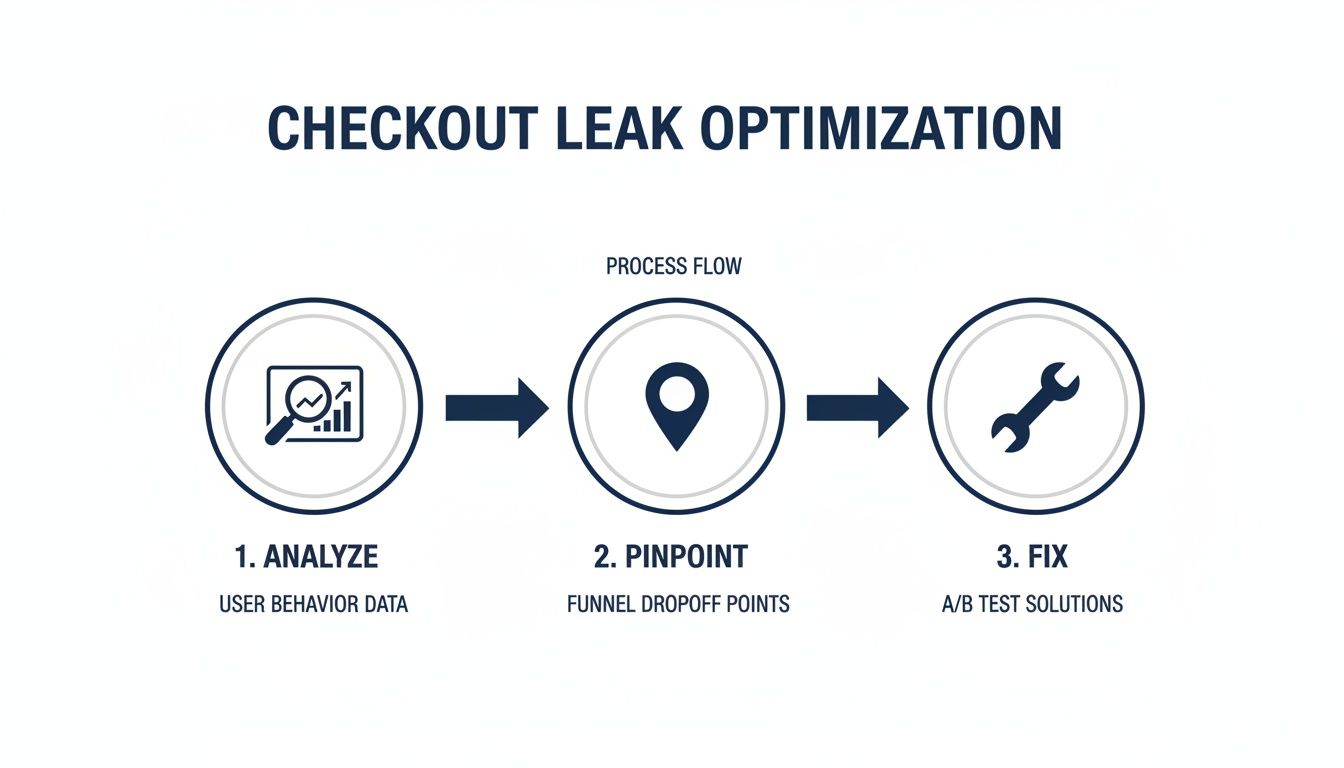
When you analyze your data, pinpoint the exact friction points, and implement targeted fixes like in-cart rewards, you create a direct path to higher revenue. It’s a straightforward formula for boosting AOV and LTV.
Beyond the Coupon Code
For years, the go-to strategy for online merchants has been the site-wide discount. While a 10% off coupon can feel like a quick win, it often does more harm than good in the long run. It eats into your profit margins, cheapens your products in the eyes of customers, and worst of all, it trains people to always wait for a sale.
A rewards engine, on the other hand, is all about increasing the total value of the cart—for both the customer and for your business. It’s a strategy built around lifetime value (LTV), not just a single, discounted transaction. Instead of just slashing prices, you create compelling incentives like free gifts or free shipping that motivate shoppers to hit specific spending goals.
This proactive approach turns the cart into a mini-game. The prize? A real, tangible reward that feels way more valuable than a small percentage off. This gamified experience keeps shoppers engaged and focused on what they can gain, not just what they have to pay.
Building a Tiered Rewards System
One of the most effective ways to turn your cart into a rewards engine is with a tiered system. This structure gives customers a clear, visual path to unlock progressively better rewards as they spend more. It’s a powerful psychological hook that plays on our natural desire to reach the next level.
Here’s what a typical tiered rewards system might look like in action:
Tier 1: Spend $50 → Unlock Free Shipping. This directly tackles the #1 reason for cart abandonment—unexpected costs.
Tier 2: Spend $75 → Unlock a Free Gift. This adds a layer of excitement and is a brilliant way to introduce customers to another one of your products. You can get the full playbook in our guide on how to run a successful free gift campaign.
Tier 3: Spend $100 → Unlock an Exclusive 15% Discount on a Future Order. This incentive is all about building long-term loyalty and securing that next sale, boosting LTV.
The key to making this work is a dynamic, visual slide-cart that updates in real-time. As a customer adds items, a progress bar fills up, showing them exactly how close they are to the next reward. This creates a powerful feedback loop that makes adding one more item feel like an accomplishment. Apps like Monster Cart are built specifically for this, turning the standard cart into an interactive and motivating experience that naturally increases AOV.
Gamify Spending with 'Buy More, Save More'
Another powerful incentive is the "Buy More, Save More" model. This isn't just a simple bulk discount. Instead, it’s a visible, escalating offer that encourages higher cart values by showing the customer exactly what they stand to gain with each addition.
Imagine a shopper adds two of your core products to their cart. The cart instantly updates with a message: "Add 1 more and save 10% on all three!" When they do, a new message appears: "Add 2 more and save 20%!"
This approach is incredibly effective because it frames the offer in terms of a reward, not just a cost reduction. The customer feels like they are achieving a better deal through their own actions, which is far more compelling than a passive coupon code.
This strategy is especially powerful for products that people often buy in multiples, like cosmetics, supplements, or apparel. It naturally boosts your Average Order Value (AOV) without devaluing your brand.
Strategic Upsells Without the Annoying Pop-Ups
The final piece of a high-converting rewards engine is the strategic upsell. And no, we’re not talking about those aggressive, full-screen pop-ups that interrupt the shopping flow and drive people away. We’re talking about relevant, one-click add-ons presented seamlessly within the cart drawer itself.
These are typically low-cost, high-value items that perfectly complement the main purchase. Think:
Shipping Protection: For a small fee, customers can insure their order against loss or damage.
Priority Processing: Offers a way for eager customers to jump to the front of the line.
Relevant Add-Ons: Suggest a small, complementary product, like shoe cleaner for a new pair of sneakers.
Because these offers appear directly in the cart, they feel like helpful suggestions rather than pushy sales tactics. They add incremental revenue to each order and actually improve the customer experience by providing useful options. Well-executed customer loyalty reward programs can transform your abandoned carts into a powerful engine for repeat business, and these in-cart upsells are a perfect component of that system.
At the end of the day, a cart that functions as a rewards engine is one of your best defenses against abandonment. The data is clear: high extra costs are the top cart killer, with 55% of shoppers bailing due to surprise shipping, taxes, and fees. A system that offers free shipping thresholds, visible rewards, and other engaging incentives directly fights this problem, turning a point of friction into a moment of delight. This is the core principle behind the Monster Cart app.
Your Checkout Optimization Checklist
Even the best in-cart rewards on the planet won't rescue a sale if your final checkout is a clunky, frustrating mess. Think of it this way: your interactive cart gets the customer excited and builds value, but the checkout page is where they need to feel secure and confident. A slow or confusing checkout is like hitting a brick wall right before the finish line—it kills all that positive momentum and plants seeds of doubt.
This is where you bridge the gap between a high-value cart and a completed purchase. A seamless journey from cart to confirmation is non-negotiable, especially when you realize just how many sales are lost to a poorly designed process.
Remove Friction at Every Step
Friction is the absolute enemy of conversion. Every unnecessary field, every unexpected question, and every moment of hesitation adds another layer of friction that can push a shopper to give up. Your goal is to make the process so smooth that buying feels like the easiest, most natural next step.
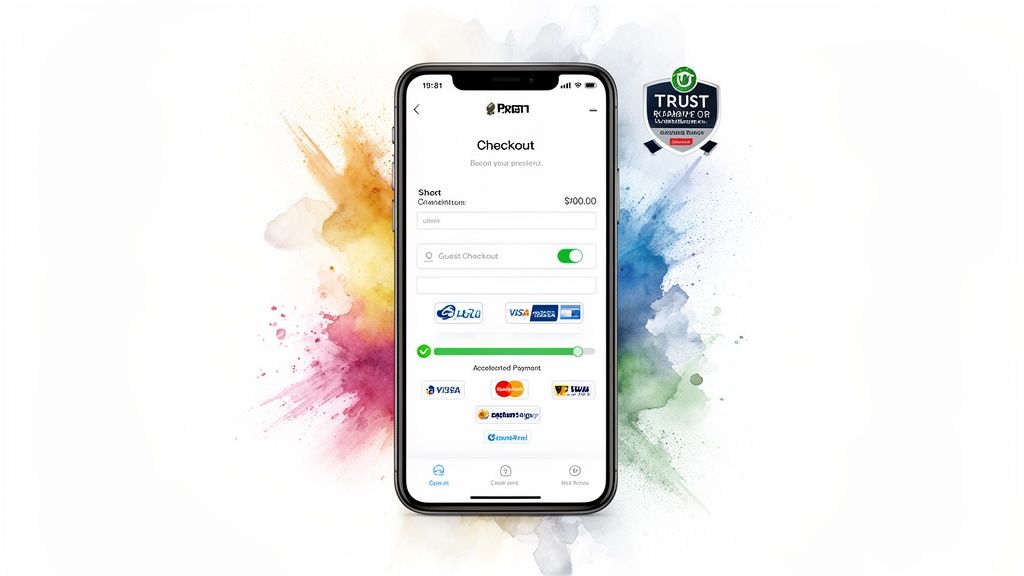
Start with the low-hanging fruit: offer a guest checkout option. Forcing shoppers to create an account is one of the most common and easily avoidable mistakes I see merchants make. While building your customer list is a great goal, demanding it at the point of sale is a massive barrier.
A shopper who is ready to give you their money shouldn't have to stop and create yet another password they'll forget. Offering a guest checkout respects their time and can single-handedly save a huge percentage of would-be abandoned carts.
After adding a guest option, audit your checkout forms with a critical eye. Do you really need their phone number? Is a separate billing and shipping address section necessary if most customers use the same one? Every single field you can eliminate makes the process faster and less intimidating, especially on mobile where typing is a pain.
Build Unshakeable Trust and Security
As customers start entering their most sensitive information, their trust in your brand is put to the test. This is not the time to be subtle. Prominently displaying trust signals is essential for reassuring shoppers that their data is safe with you.
These visual cues are instant credibility boosters:
Security Badges: Logos from well-known providers like Norton, McAfee, or the built-in Shopify Secure create a strong sense of safety.
Payment Logos: Showing familiar logos like Visa, Mastercard, PayPal, and Apple Pay proves you partner with trusted financial institutions.
SSL Certificate: While standard on Shopify, making sure your URL has the "https" and padlock icon visible reinforces that their connection is secure.
This is all about managing customer anxiety. The more secure your checkout feels, the more confident they'll be in hitting that "Complete Purchase" button.
Accelerate the Path to Purchase
In an on-demand world, speed is everything. This is where accelerated payment options, often called express checkouts, become an absolute game-changer for your conversion rate.
Integrations like Shop Pay, Apple Pay, and Google Pay let customers complete their purchase in seconds using pre-saved information. This completely bypasses the tedious manual entry of shipping and credit card details, a major source of both frustration and typos. For returning customers, these options make re-ordering absurdly simple, a key factor in boosting lifetime value.
The data backs this up. A complicated checkout is responsible for a staggering 22% of global cart abandonment. Offering a guest checkout can slash this, but you can crush it even further by optimizing the entire flow. Dive into these checkout abandonment statistics from Baymard Institute to see the full impact.
I've put together a quick table to highlight the most common friction points and the best ways to solve them. Focusing on these areas will give you the biggest bang for your buck.
High-Impact Checkout Optimizations
Friction Point | Why It Causes Abandonment | Solution | Potential Impact |
|---|---|---|---|
Forced Account Creation | Creates a huge, unexpected barrier right before payment. Shoppers hate creating new accounts and passwords. | Offer a prominent guest checkout option. | Very High |
Long, Complicated Forms | Overwhelms users, especially on mobile. Each field is another chance for them to quit. | Remove all non-essential fields (e.g., optional phone number, company name). Use auto-fill. | High |
No Express Payment Options | Makes checkout slow and tedious. Manually entering card and address details is a major pain point. | Integrate one-click payment methods like Shop Pay, Apple Pay, and Google Pay. | Very High |
Hidden Costs (Shipping, Taxes) | Surprise fees at the final step are the #1 reason for abandonment. It breaks trust and feels deceptive. | Use an in-cart rewards system (like Monster Cart) to display shipping estimates and tax info upfront. | Highest |
Lack of Trust Signals | Shoppers are wary of entering payment info on sites that don't look secure or legitimate. | Prominently display security badges, payment logos, and customer reviews. | Medium |
As you can see, the fixes are often straightforward, but their collective impact on your conversion rate can be massive.
Manage Expectations with Visual Cues
A long checkout can feel endless if there's no end in sight. A progress bar or a simple step indicator is a powerful tool for managing customer expectations and motivating them to finish.
By showing shoppers exactly where they are in the process (e.g., "Step 1 of 3: Shipping"), you give them a clear sense of momentum and control. This little bit of visual feedback reduces anxiety and makes the remaining steps feel much more manageable. It’s a small UX detail that makes a huge difference.
When you pair these checkout optimizations with a powerful in-cart rewards engine like Monster Cart, you create a truly unstoppable conversion funnel. The cart builds excitement and AOV, while the checkout provides a fast, secure, and frictionless path to sealing the deal.
Building a Smart Recovery and Retention Strategy
Even with a perfectly optimized cart and checkout, some shoppers will inevitably get distracted or hesitate. Life happens. This is where a smart recovery and retention strategy comes into play, turning what looks like a lost sale into a golden opportunity for re-engagement.
But let's be clear: the old-school approach of just blasting a generic "You left something behind!" email with a hefty discount is broken. It's a race to the bottom that trains customers to expect a handout and absolutely erodes your margins and lifetime value.
A modern strategy continues the value-driven conversation you started in the cart. It's all about focusing on rewards over discounts and long-term loyalty over a single, cheap sale. An abandoned cart isn't a failure; it’s a high-intent signal from a shopper who is one small nudge away from becoming a customer. Your job is to make that nudge helpful, not just promotional.
Crafting High-Impact Recovery Flows
The most effective abandoned cart flows—whether email or SMS—don't just remind shoppers of the products they left. They remind them of the value they were so close to unlocking. This is where the in-cart rewards you’ve set up become your most powerful recovery tool.
Instead of leading with "Here's 15% off," imagine an email with the subject line: "You're so close to your free gift!" This approach is far more compelling because it focuses on what they stand to gain, not just what they have to spend.
Your recovery sequence should be a strategic series of gentle nudges:
The First Nudge (30-60 minutes after abandonment): This is a simple, helpful reminder. It should be light in tone and focused on convenience. Mention the specific items in their cart and make it incredibly easy for them to return and complete their purchase with a single click.
The Value Reminder (24 hours later): If they haven't returned, this is your chance to re-emphasize the value. Remind them of the free shipping or the free gift they were just dollars away from unlocking. Highlighting a key product benefit or a stellar customer review can also reignite their interest.
The Last Call (48-72 hours later): This is the final, light-touch follow-up. You can introduce a sense of urgency (e.g., "Your cart is about to expire") or, if it aligns with your brand strategy, use it for a small, strategic offer as a last resort.
The key is to make your follow-up messages feel like an extension of the positive, rewarding experience you built in the cart. When a shopper sees your brand in their inbox, they should recall the excitement of unlocking a reward, not just a list of products.
This value-first approach makes your recovery messages far more effective and builds a healthier customer relationship from the very first interaction.
Linking Recovery to Lifetime Value
The ultimate goal isn't just to recover one sale; it's to cultivate a loyal, repeat customer. This is where thinking about customer lifetime value (LTV) becomes absolutely essential. Every decision, from the in-cart rewards you offer to the tone of your abandoned cart emails, should be made with LTV in mind.
Hefty, immediate discounts are the enemy of high LTV. They attract one-time bargain hunters and devalue your brand. Conversely, a strategy built on rewards like a free gift with purchase does the opposite.
It increases perceived value: The shopper gets a bonus item that feels special, creating a more memorable and positive experience.
It introduces new products: That free gift might just be the customer's next favorite product, leading directly to a future purchase.
It fosters genuine loyalty: Customers who have a great experience are far more likely to return and buy again, even without a discount.
The positive in-cart experience you deliver with a tool like Monster Cart lays the perfect foundation for this. Because the initial interaction was rewarding and non-disruptive, customers are significantly more receptive to your follow-up messages. They see your brand as a helpful guide, not just another retailer trying to make a sale. To better understand how these pieces fit together, explore our guide on how to increase customer lifetime value.
Building a Cohesive Retention Engine
Your recovery flow shouldn't operate in a vacuum. It's the first step in your broader customer retention strategy. By successfully recovering a cart with a value-driven approach, you've created the perfect entry point for a new customer into your brand ecosystem.
From here, you can nurture that relationship through post-purchase flows, loyalty programs, and personalized communication. The positive experience they had—from the exciting in-cart rewards to the helpful abandoned cart reminder—makes them far more likely to become a long-term advocate for your brand.
This holistic approach is the key to sustainable growth. For a holistic approach to understanding and implementing strategies against cart abandonment, explore this proven playbook for ecommerce success.
Ultimately, every abandoned cart is a conversation starter. How you choose to continue that conversation determines whether you get a one-time, low-margin sale or a high-value customer for life.
Your Questions, Answered
After digging into the core strategies for tackling cart abandonment, a few key questions always pop up. I've heard these from hundreds of Shopify merchants, so let's get you some quick, no-fluff answers.
What Is a Good Shopping Cart Abandonment Rate to Aim For?
Everyone wants to know the magic number, but the truth is, it doesn't exist. While the global average hovers around a scary 70%, a "good" rate is completely relative to your industry and what you sell.
Instead of chasing a universal benchmark, focus on your baseline. A 5-10% reduction from where you are right now is a massive win that directly translates to more revenue. The best move is to implement proactive strategies, like in-cart rewards and a frictionless checkout, and then obsess over your own analytics to track the lift. Progress over perfection, always.
Are Abandoned Cart Pop-ups Still Effective?
Honestly, exit-intent pop-ups are starting to feel a bit dated. They can work in a pinch, but they're a reactive, last-ditch effort that often interrupts the shopper and can make your brand feel a little desperate.
The modern approach is all about preventing abandonment in the first place. Think about an interactive slide-cart that builds in rewards and excitement as someone shops, like the experience Monster Cart creates. It adds value and makes the cart a more exciting place to be, so shoppers are far less likely to even think about leaving. It's a brand-building tactic focused on AOV and LTV versus a potentially brand-damaging one.
How Soon Should I Send an Abandoned Cart Email?
Timing is everything, and a single email just won't cut it. You need a sequence. Here’s a cadence that consistently gets results:
First Email (30-60 Minutes): This is a gentle nudge while the purchase is still fresh in their mind. Keep it simple and helpful, not salesy.
Second Email (24 Hours): Now you can reiterate the value. Remind them of that free gift they were close to unlocking or the free shipping threshold they almost hit.
Third Email (48-72 Hours): This is your final, friendly follow-up. A little light urgency like, "Your items are waiting!" can work wonders.
The key is to make these messages feel helpful. You're reminding them of the value they left behind, not just pushing them to buy.
Can Offering Free Gifts Be More Profitable Than Discounts?
Absolutely, and frankly, it's not even close. This is a core concept for building a truly valuable brand. A straight discount is a direct cut to your profit margin on every single order. A free gift with purchase (GWP), on the other hand, has a high perceived value for the customer but a much lower actual cost to you.
But the real magic is how GWPs boost your AOV. They give shoppers a tangible reason to add one more item to their cart to unlock the reward. This increases the total sale value, improves overall profitability, helps you move specific inventory, and introduces customers to new products—building lifetime value in a way a simple percentage-off sale never could.
Join 7000+ brands using our apps