7 Product Bundling Pricing Examples to Boost AOV in 2026
Feb 11, 2026
|
Published
Are you leaving money on the table? Traditional bundling often relies on steep discounts that erode margins and train customers to wait for sales. But what if you could increase Average Order Value (AOV) and protect your profits? The secret lies in shifting your mindset from discounting to rewarding. This guide explores seven strategic product bundling pricing examples that do just that.
We'll break down how to use free gifts, shipping thresholds, and tiered rewards to create irresistible offers that boost customer lifetime value (LTV). You will learn not just what to offer, but the specific psychology and pricing formulas behind each high-performing bundle strategy. This isn't just a list; it's a comprehensive playbook for Shopify store owners looking to boost AOV by rewarding customers, not just discounting products.
This listicle provides a deep dive into several platforms and strategic libraries to help you find the best bundling approach for your store. Each option includes:
A strategic breakdown: The shopper psychology and merchant rationale.
Pricing formulas: Real calculation samples to model your own offers.
Actionable implementation tips: Specific advice for creating compelling in-cart experiences, with a focus on tools like Monster Cart that prioritize lifetime value.
Performance expectations: What kind of AOV lift you can realistically expect.
Forget generic success stories. Here you’ll find replicable methods and direct links to see these strategies in action. Our goal is to equip you with the product bundling pricing examples and tactical insights needed to stop giving away profit and start building more valuable, long-term customer relationships.
1. Monster Cart
Monster Cart distinguishes itself as a premier solution for Shopify merchants aiming to master sophisticated bundling and upselling strategies directly within the customer's shopping cart. It transforms the standard, static cart into a dynamic, interactive rewards engine, making it a standout platform for implementing effective product bundling pricing examples. Instead of relying on disruptive pop-ups, it uses a sleek, fully brandable slide-cart drawer to present offers that enhance the shopping experience while powerfully boosting Average Order Value (AOV) and encouraging long-term loyalty.
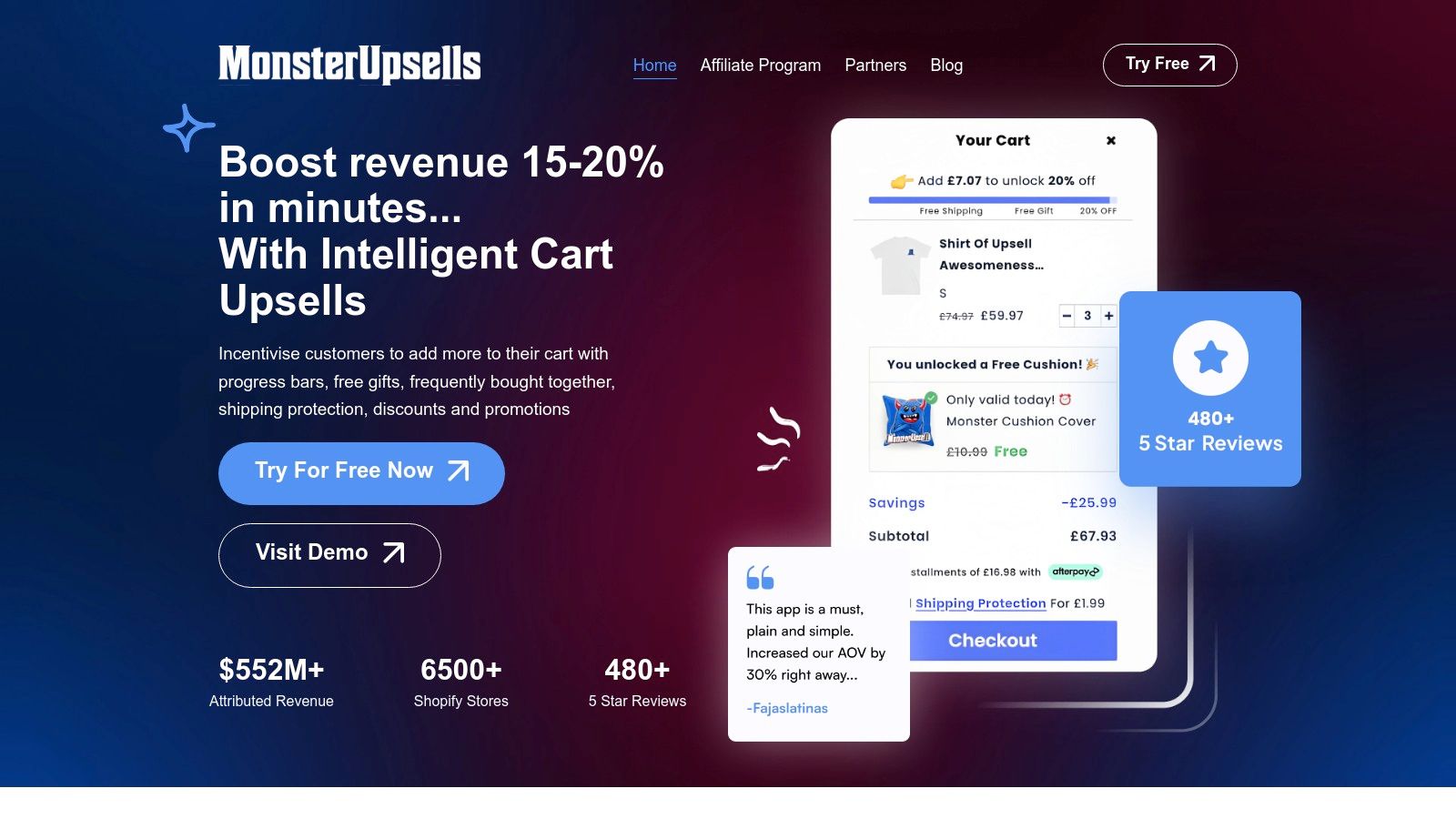
This approach gamifies the shopping experience. As customers add items, visual progress bars and milestones show them how close they are to unlocking valuable rewards like free shipping, a free gift, or tiered incentives. This real-time feedback loop encourages shoppers to add more to their cart to reach the next threshold, moving beyond simple discount-heavy tactics to build long-term value and customer loyalty.
Key Features & Strategic Advantages
Monster Cart's strength lies in its ability to stack multiple revenue-driving offers within a single, non-intrusive interface. Merchants can simultaneously deploy various bundling and upsell techniques without overwhelming the customer.
Tiered Rewards & Gamification: Create "spend-to-unlock" campaigns that visually reward customers for increasing their cart value. This is ideal for tiered offers (Buy 2, Get a Free Gift; Spend $100, Unlock Free Shipping) or Gift-With-Purchase (GWP) thresholds. The visual progress bar makes achieving the next reward feel like a compelling game.
In-Cart Cross-Sells: Display "Frequently Bought Together" recommendations directly in the cart, making it effortless for shoppers to add complementary items. This is a classic bundling technique executed with modern precision, capturing impulse buys just before checkout.
One-Click Add-Ons: Seamlessly offer high-margin extras like shipping protection, product warranties, or priority processing. These low-friction offers can significantly increase AOV with minimal effort.
Personalized Product Recommendations: Leverage customer data to suggest relevant products inside the cart, turning a simple checkout step into a personalized shopping experience.
Why It Stands Out
What sets Monster Cart apart is its focus on value-driven AOV growth rather than aggressive discounting. By emphasizing rewards like free gifts, free shipping, and exclusive access, it helps merchants protect their margins and cultivate customer lifetime value. It shifts the customer mindset from "How much can I save?" to "What more can I get?". For a deeper dive into creating these compelling offers, you can learn more about how to make a bundle and apply those principles within the cart.
The platform is trusted by over 6,500 Shopify stores and is backed by powerful social proof, with countless five-star reviews citing AOV lifts between 10-30% and substantial revenue gains. The app's built-in analytics allow for A/B testing, so you can measure the direct impact of each bundling strategy and optimize for performance.
Pricing and Access
Monster Cart offers a free trial, allowing merchants to test its capabilities. The pricing model is transparent and scales with a store's order volume, ensuring it remains accessible for growing businesses.
Orders per Month | Monthly Price |
|---|---|
0–50 | $12.99 |
51–200 | $21.99 |
201–500 | $36.99 |
501–1000 | $56.99 |
1001–2000 | $91.99 |
2001–3000 | $116.99 |
3001+ | $134.99 |
While some users note a brief setup period to fully configure their campaigns, the customer support team is widely praised for its responsiveness and expertise in helping merchants get up and running quickly.
Website: https://monsterapps.shop
2. Shopify Bundles (official Shopify app)
For merchants just dipping their toes into the world of product bundling pricing examples, Shopify’s own native app, Shopify Bundles, is an excellent, risk-free starting point. It’s a free, no-code tool that allows you to create straightforward "fixed" bundles and multipacks directly within the familiar Shopify Admin. This simplicity is its core strength, enabling store owners to quickly test bundling concepts without the complexity or cost of third-party solutions.
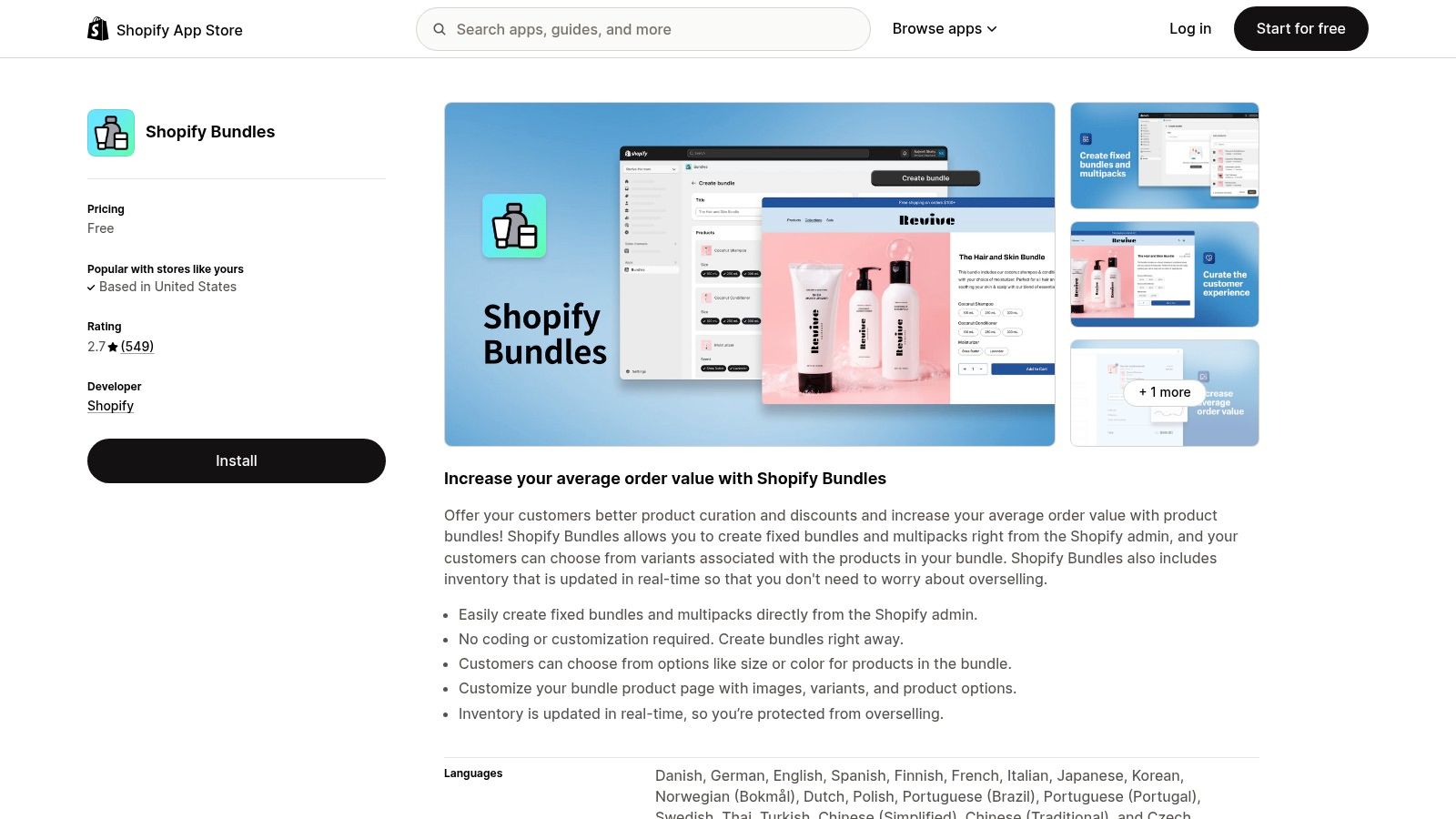
This app is ideal for prototyping basic "buy together" offers. It handles real-time inventory syncing flawlessly, meaning if a single item within a bundle sells out, the entire bundle becomes unavailable, preventing overselling. Many official and third-party bundling solutions, like the official Shopify Bundles app, rely on seamlessly integrating with Shopify to function effectively, and this native tool ensures perfect harmony from the start.
Strategic Breakdown
Pricing Formula: Fixed Bundle Price = (Product A Price + Product B Price) x (1 - Discount %)
Margin/Calculation Sample: A $40 skincare serum and a $25 moisturizer (total cost $15) are bundled for $55, a 15% discount. The bundle price is $65 x (1 - 0.15) = $55.25 (rounded to $55). The margin is ($55 - $15) / $55 = 72.7%, a slight dip from individual sales but offset by a higher AOV.
Best-Fit Merchant: New Shopify stores, brands with a small catalog, or merchants wanting to test the appeal of a specific product combination before investing in advanced tools.
Shopper Psychology Rationale: It leverages the principle of Simplicity. The offer is clear and easy to understand: buy these specific items together and save money or get a curated kit. There’s no complex decision-making, which reduces friction and encourages a quick purchase.
Key Takeaway: Shopify Bundles is a powerful prototyping tool. Use it to gather data on which product combinations resonate most with your audience. Think of it as your bundle testing ground before scaling up your strategy with a more feature-rich tool like Monster Cart that focuses on rewards and lifetime value.
Implementation Tips & Performance
For Monster Cart users, a great approach is to promote your Shopify-created bundle as an in-cart upsell. When a customer adds a hero product (like the serum from our example), trigger a cart notification.
Trigger: Customer adds
Skincare Serumto the cart.Cart Visuals/Copy: Display a banner in the cart: “Complete Your Routine! Add our Hydrating Moisturizer and save 15% on the set. Get the complete Skincare Duo for just $55.”
This tactic turns a simple bundle into a dynamic offer, boosting AOV without devaluing your core products with site-wide discounts. The performance expectation for this basic bundle type is a modest but reliable 5-10% lift in AOV, primarily driven by customers who were already considering both products.
3. Bundler – Product Bundles (Shopify App Store)
For Shopify merchants ready to move beyond simple fixed bundles and explore more dynamic offers, Bundler – Product Bundles is a top-tier choice. It’s a versatile and highly-rated app known for its generous free plan and powerful mix-and-match capabilities. This makes it an ideal platform for implementing sophisticated product bundling pricing examples, such as tiered discounts and volume breaks, without a significant upfront investment.
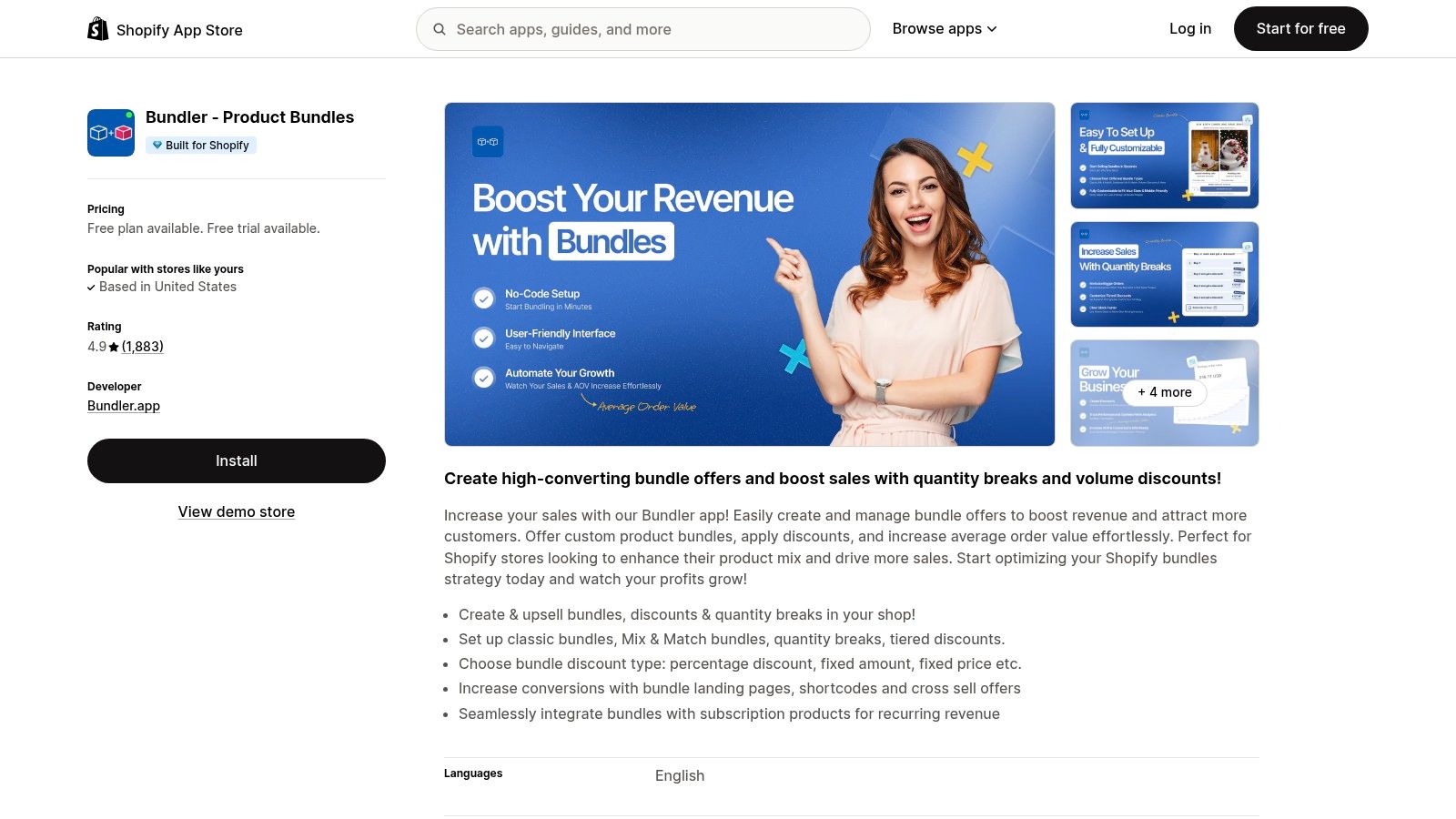
Bundler excels at empowering customers with choice, a key differentiator from static bundles. It allows you to create offers like "Buy any 3 items from our Summer Collection and get 15% off," encouraging shoppers to build their own perfect package. This app provides the tools to create offers that feel less like a hard sell and more like a personalized reward, aligning with modern strategies that build lifetime value.
Strategic Breakdown
Pricing Formula: Tiered Mix-and-Match = (Sum of Chosen Products) x (1 - Tiered Discount %)
Margin/Calculation Sample: A customer builds a bundle from a collection of $15 t-shirts (cost $5 each). Tier 1: Buy 2 get 10% off. Tier 2: Buy 3 get 15% off. A customer buys 3 shirts for a total retail price of $45. The bundle price is $45 x (1 - 0.15) = $38.25. The margin is ($38.25 - $15) / $38.25 = 60.8%, which is lower than a single shirt sale but results in a 200% increase in items per transaction.
Best-Fit Merchant: Brands with a diverse catalog of complementary products (e.g., apparel, cosmetics, food items), or stores wanting to clear specific inventory by including it in an attractive mix-and-match offer.
Shopper Psychology Rationale: This model taps into the IKEA Effect and Gamification. Customers feel a sense of ownership and smartness by "building" their own deal. The tiered structure creates a mini-game, incentivizing them to add one more item to reach the next reward level, which directly increases Average Order Value.
Key Takeaway: Use Bundler's mix-and-match feature to give customers control. This not only boosts AOV but also provides valuable data on which products are most frequently paired, informing future fixed-bundle strategies and even product development.
Implementation Tips & Performance
A powerful way to leverage a mix-and-match bundle is by presenting it as a cart-based upsell, a specialty of Monster Cart. This avoids cluttering product pages and presents the offer when the customer has high purchase intent.
Trigger: Customer has 2 items from the
Summer Collectionin their cart.Cart Visuals/Copy: Display a progress bar or banner in the cart: “You’re so close! Add one more item from our Summer Collection to unlock 15% off your entire set. Build your perfect bundle now!”
This strategy turns a standard shopping trip into an interactive experience, promoting discovery and higher spend. The expected performance for a well-executed mix-and-match bundle is a significant 15-25% lift in AOV, as it effectively encourages customers to buy more than they initially intended. For a deeper dive into similar strategies, you can explore more about how frequently bought together offers work to enhance the customer journey.
4. BOLD Bundles – Product Bundles (Shopify App Store)
For Shopify merchants ready to graduate from simple fixed bundles to more dynamic offers, BOLD Bundles is a well-established and trusted solution. Developed by Bold Commerce, this app expands the bundling toolkit to include popular promotional models like "Buy One, Get One" (BOGO), volume discounts, and mix-and-match bundles. It's a versatile workhorse for stores needing proven, reliable bundling mechanics that go beyond basic product pairing.
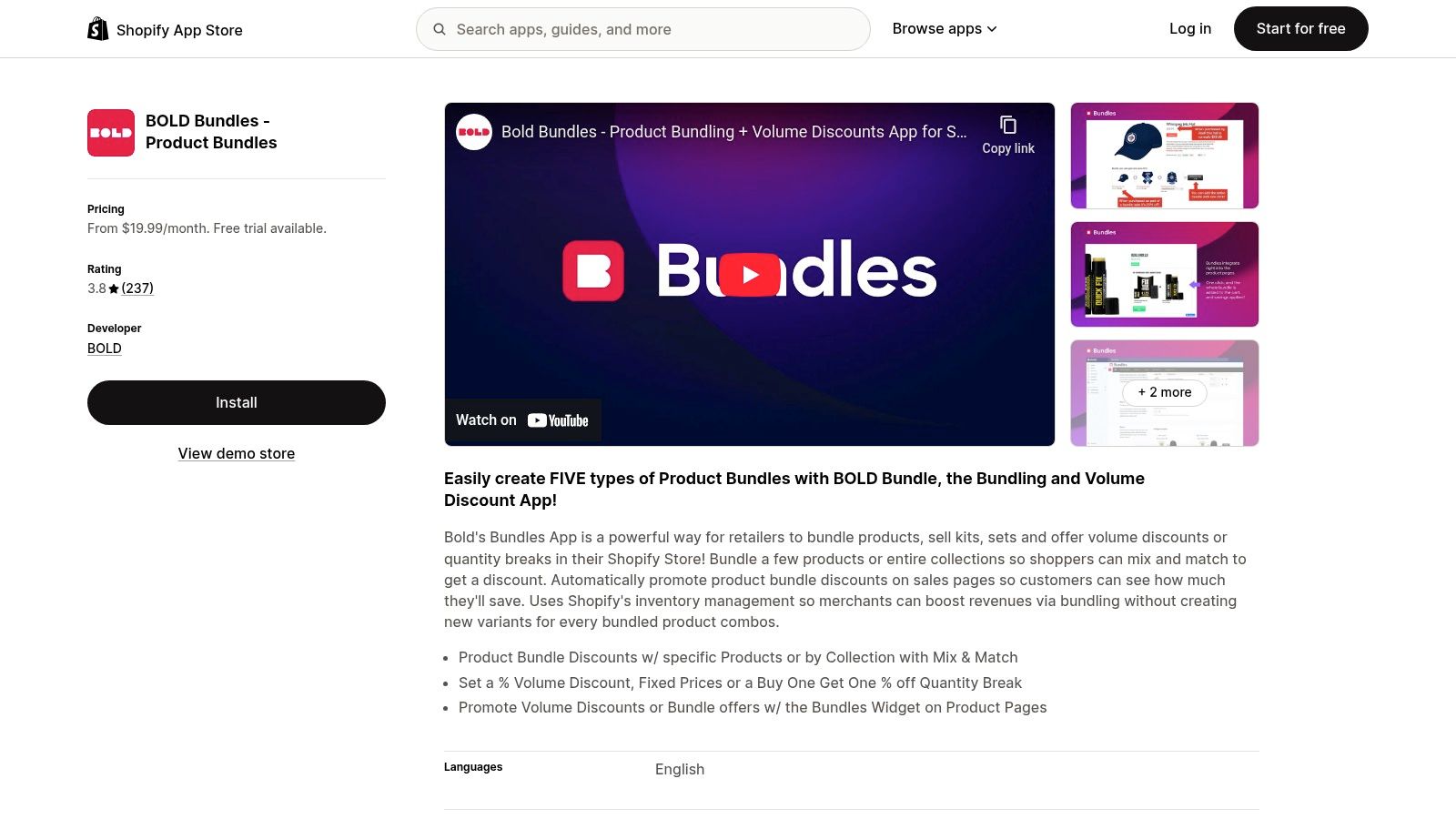
BOLD Bundles is particularly effective for implementing quantity-based incentives, a powerful product bundling pricing example that encourages customers to stock up. It allows merchants to display savings directly on the product page, clearly communicating the value of buying more. The app uses Shopify's native inventory system, ensuring that component stock levels are always accurate and preventing overselling issues.
Strategic Breakdown
Pricing Formula: Volume Discount Price = (Product A Price x Quantity) - ((Product A Price x Quantity) x Tiered Discount %)
Margin/Calculation Sample: A brand sells a $15 face mask with a $4 cost. They offer a "Buy 3, Get 15% off" deal. Total retail price is $45, but the bundle price is $45 - ($45 x 0.15) = $38.25. The total cost is $16 (4 masks x $4). The margin is ($38.25 - $16) / $38.25 = 58.2%, which is lower than a single unit sale (73.3%) but results in a significantly higher transaction value and moves more inventory.
Best-Fit Merchant: Stores with consumable products (e.g., coffee, cosmetics, supplements), apparel brands selling basics (socks, t-shirts), or any merchant who wants to encourage bulk purchases and increase inventory turnover.
Shopper Psychology Rationale: This strategy taps into the Value Seeking principle and the concept of Stockpiling. Customers feel smart for unlocking a better per-unit price by buying in bulk. It’s a practical, logical incentive that frames a larger purchase as a savvy financial decision rather than an indulgence.
Key Takeaway: BOLD Bundles excels at creating clear, quantity-based offers. Use it to shift focus from one-off sales to increasing the lifetime value of a customer by encouraging them to commit to a larger initial purchase of products they’ll use repeatedly.
Implementation Tips & Performance
While BOLD Bundles is great for on-page promotions, pairing it with Monster Cart creates a powerful, full-funnel strategy. Use Monster Cart to echo and amplify the bulk offer when a customer adds just a single item to their cart, catching those who missed the on-page prompt.
Trigger: Customer adds a single
Face Maskto the cart.Cart Visuals/Copy: Activate a cart notification bar: "Don't Run Out! Add 2 more Face Masks to your cart and get 15% off your entire supply. Stock up and save today."
This approach reinforces the value proposition at a critical decision point. It’s an effective way to transform a single-item purchase into a multi-item haul, directly boosting AOV. Expect this kind of targeted, in-cart bulk upsell to increase AOV by 15-20% for eligible products, as it persuades shoppers to maximize the value of their order.
5. Amplify | Bundles & Upsell by PickyStory (Shopify App Store)
For brands ready to graduate from basic bundles to a sophisticated, visually-driven upsell strategy, Amplify by PickyStory offers a powerful suite of tools. This premium platform excels at creating aesthetically pleasing "shop the look" bundles, curated kits, and tiered discounts that feel like an organic part of the shopping experience. It moves beyond simple fixed bundles into AI-driven recommendations and robust analytics, designed for merchants who see bundling as a core merchandising strategy.
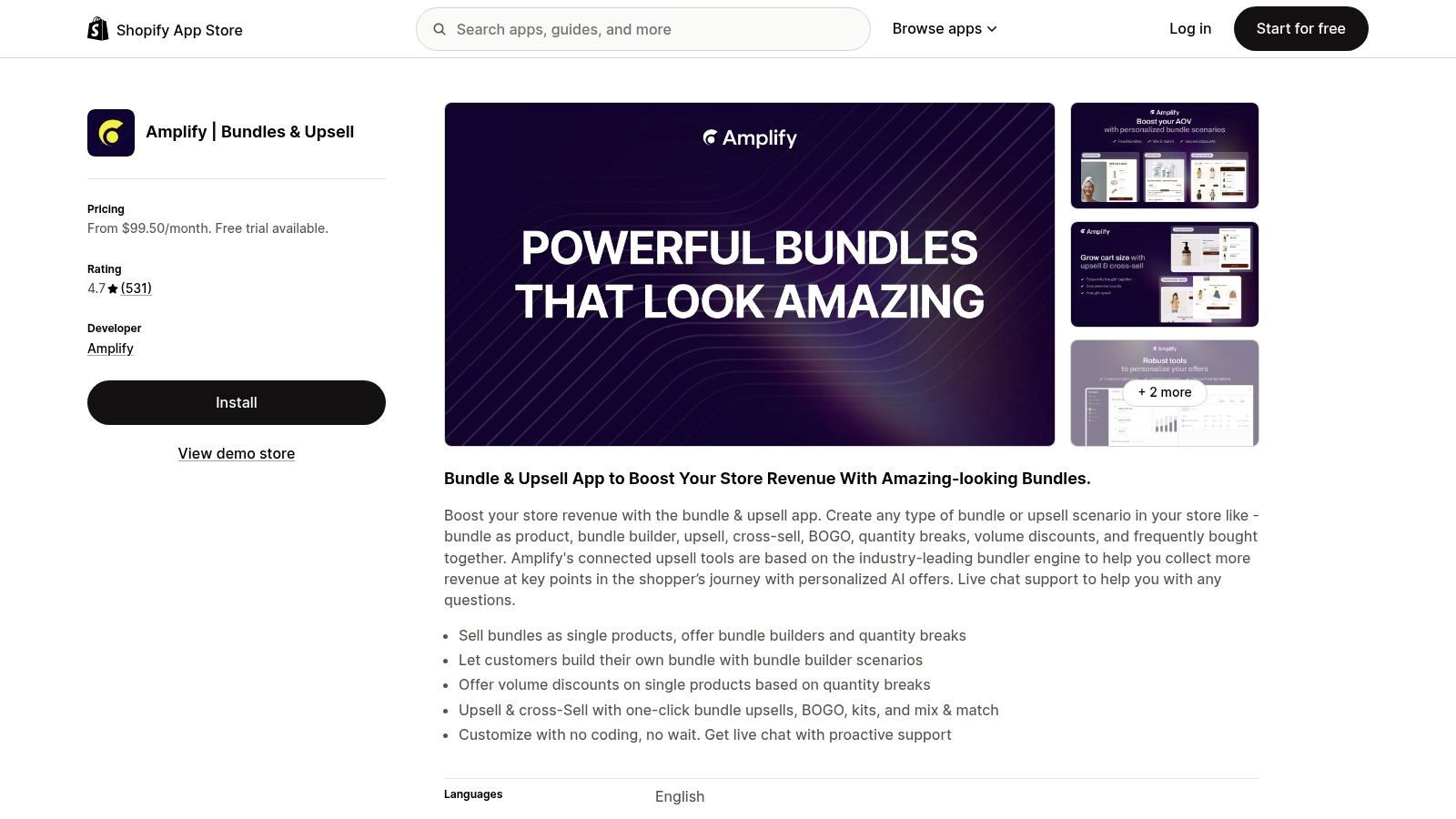
The platform's strength lies in its combination of visual appeal and intelligent selling. Amplify allows for unlimited bundles and upsells across its plans, making it highly scalable. While its entry pricing is higher than basic apps, its focus on AI recommendations and deep analytics provides the data needed to create highly effective, data-backed product bundling pricing examples that resonate with specific customer segments.
Strategic Breakdown
Pricing Formula: Tiered Discount Bundle Price = (Product A Price + Product B Price + Product C Price) - (Tiered % or $ Off)
Margin/Calculation Sample: A fashion store sells a $100 jacket, a $60 shirt, and a $40 pair of pants. The bundle offers "Buy 2 items, get 10% off; Buy all 3, get 20% off." A customer buying all three gets a bundle price of ($100 + $60 + $40) x (1 - 0.20) = $160. If the total COGS is $80, the margin is ($160 - $80) / $160 = 50%, a calculated trade-off for a significantly higher AOV.
Best-Fit Merchant: Established fashion, beauty, or home decor brands with a strong visual identity. Stores focused on creating curated experiences and those needing advanced analytics to optimize offers.
Shopper Psychology Rationale: This leverages Gamification and the Goal Gradient Effect. By presenting a tiered offer ("buy more, get rewarded"), it creates a mini-challenge for the shopper. Each item added brings them closer to a better reward, making it compelling to complete the "set" and unlock the maximum value.
Key Takeaway: Use Amplify for visually compelling, multi-product bundles that tell a story. Its strength is in creating a cohesive look or solution, encouraging customers to buy an entire curated collection. This is key for boosting AOV and lifetime value without relying on hefty discounts.
Implementation Tips & Performance
Amplify's sophisticated offers are perfect for integration into a smart cart experience like Monster Cart. You can use its visual bundles to create powerful post-purchase upsells that feel less like a sales pitch and more like a helpful recommendation.
Trigger: Customer purchases the
Jacketfrom the "shop the look" example.Cart Visuals/Copy: In the post-purchase or thank you page, trigger a Monster Cart offer: "Complete the Look! You’ve got the jacket, now get the rest of the outfit. Add the matching Shirt and Pants and get 20% off the full set. Claim Your Full Outfit Discount."
This strategy captures the initial sale and then leverages the customer's high-intent moment to significantly increase the order's lifetime value. The performance expectation for this type of advanced, tiered bundling is a 15-25% lift in AOV, as it effectively transforms single-item purchasers into multi-item brand enthusiasts.
6. Rebuy (Personalization platform with cart/checkout bundling)
For Shopify Plus merchants and enterprise-level brands, Rebuy elevates product bundling from a simple tactic to a core part of a data-driven personalization strategy. It’s an advanced merchandising suite that injects dynamic, AI-powered bundles and upsells across the entire customer journey, from product pages and the cart to checkout and post-purchase interactions. Rebuy moves beyond fixed kits, using customer behavior to recommend the most relevant product combinations in real-time.
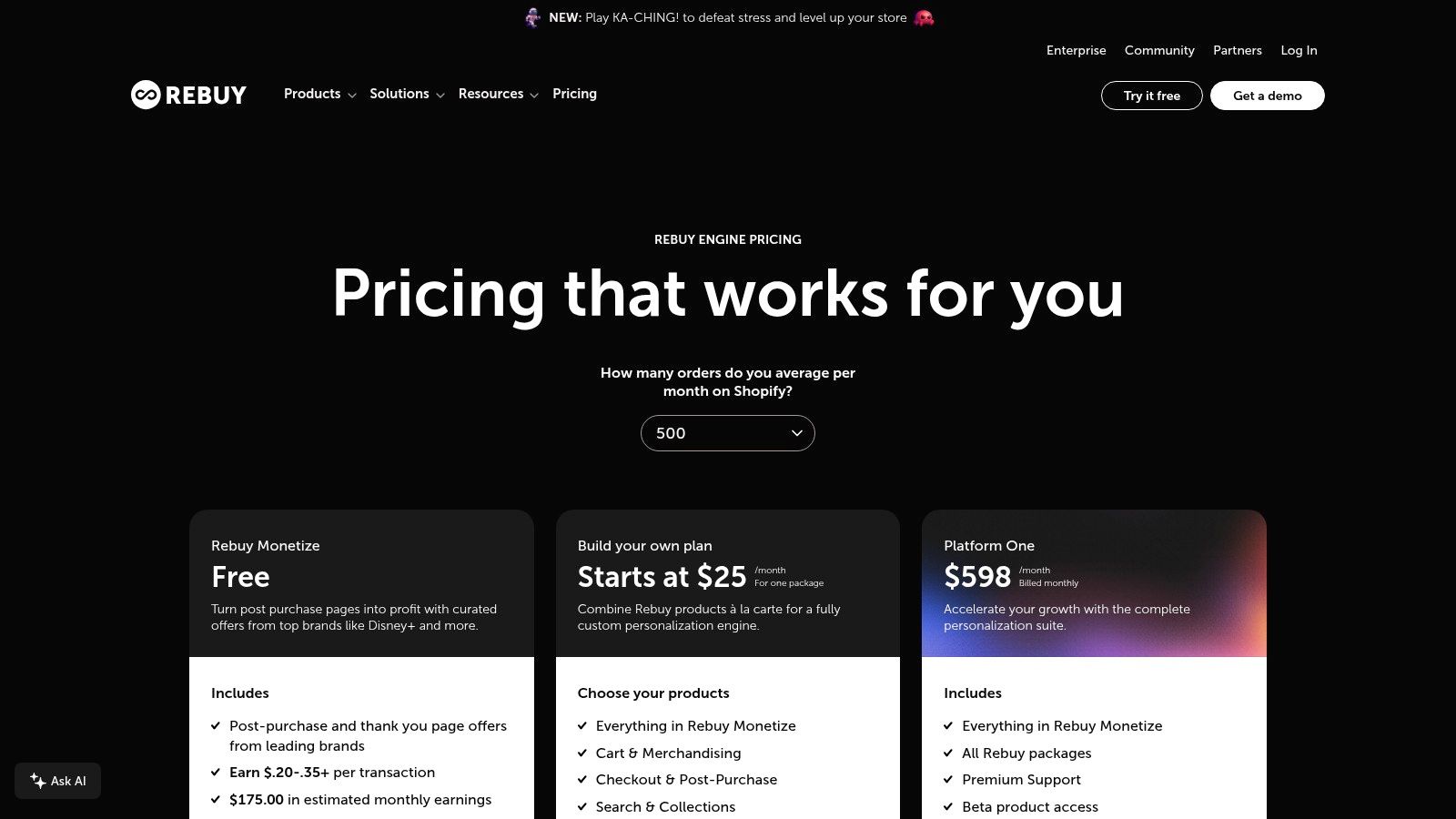
This platform is designed for optimization, offering robust A/B testing and omnichannel placements that a basic app cannot. Its power lies in its ability to adapt offers based on cart contents, past purchase history, and real-time browsing data. While implementation is more involved than a simple app, its potential for a significant AOV and conversion lift is unmatched for merchants ready to scale their merchandising efforts. You can learn more about its pricing and modules at the official Rebuy website.
Strategic Breakdown
Pricing Formula: Dynamic Bundle Discount = Varies based on AI rules, A/B test performance, and shopper segmentation. Can be a fixed price, % off, or tiered discount.
Margin/Calculation Sample: A customer adds a $150 premium coffee machine (cost $70) to their cart. Rebuy’s AI identifies them as a high-LTV shopper and offers a bundle with a $30 bag of espresso beans (cost $8) and a $25 milk frother (cost $10) for a total of $190, a 7.3% discount. The margin is ($190 - $88) / $190 = 53.7%. While the percentage margin is lower, the total profit dollars ($102 vs. $80) are significantly higher.
Best-Fit Merchant: Shopify Plus brands, high-volume stores, and data-driven teams with a large catalog seeking to maximize AOV through personalization and A/B testing.
Shopper Psychology Rationale: Rebuy taps into Personalization and Authority. The AI-driven recommendations feel like a bespoke suggestion from a knowledgeable expert (“Customers who bought this also loved…”). This builds trust and makes the upsell feel like a helpful service rather than a generic sales push, dramatically increasing uptake.
Key Takeaway: Rebuy is an optimization engine, not just a bundling tool. Use its A/B testing to discover which bundle offers (e.g., percentage discount vs. free gift) drive the highest profit and lifetime value, not just the highest AOV.
Implementation Tips & Performance
While Rebuy manages on-site personalization, you can leverage its logic to inform your Monster Cart strategy for cart recovery and win-back campaigns. If Rebuy identifies a highly effective bundle, use that same winning offer in your cart-level messaging.
Trigger: Customer adds a primary product to the cart that is part of a high-converting Rebuy-tested bundle.
Cart Visuals/Copy: Use Monster Cart to display a prominent banner mirroring Rebuy’s data: “Your Perfect Pairing is Here! Based on your cart, we recommend adding the Espresso Beans & Milk Frother. Complete the set and get it all for $190.”
This creates a consistent, data-backed offer that reinforces the value proposition from the PDP to the cart. For a sophisticated platform like Rebuy, performance expectations are high; successful implementations can see a 15-25% increase in AOV, fueled by hyper-relevant, AI-powered product bundling pricing examples that convert at a higher rate than static offers.
7. Simon‑Kucher: How and when to use bundle pricing (examples library)
While not an app or a direct tool, Simon‑Kucher's strategic article on bundle pricing is an indispensable resource for merchants aiming to master the theory behind the practice. As a leading global pricing consultancy, their insights provide a high-level strategic framework that moves beyond simple discounts into value-based selling. This resource is perfect for ecommerce leaders who want to understand why certain bundles work, using real-world examples from giants like Comcast and TurboTax to inform their own digital strategies.
This educational content helps merchants frame their offers, whether it's a "good-better-best" tiered bundle or a complete "all-in-one" solution. It complements practical tools by providing the strategic "why" behind the "how," ensuring your bundles aren't just discounted products but compelling value propositions. Understanding these core principles is key to crafting offers that feel less like a sale and more like a smart purchase, a concept essential for sustainable growth and increasing lifetime value.
Strategic Breakdown
Pricing Formula: Abstract/Conceptual (e.g., Value of Full Solution > Sum of Individual Product Values). The focus is on communicating the enhanced value, not just the math.
Margin/Calculation Sample: A brand sells a camera ($500), lens ($300), and case ($50) separately (total cost $450). Instead of a simple discount, they create a "Pro Photography Kit" for $800. The perceived value comes from the curation and convenience, not just the $50 saving. The margin is ($800 - $450) / $800 = 43.75%, preserving profitability while boosting AOV.
Best-Fit Merchant: Strategically-minded store owners, marketing managers, and brands looking to build a sophisticated, long-term pricing strategy that goes beyond simple percent-off discounts.
Shopper Psychology Rationale: This approach leverages the concept of Value Perception and Decision Simplification. By curating a "complete solution," you remove the cognitive load of choosing individual components. The shopper trusts the expert (the brand) to have assembled the perfect package, making the higher-priced bundle feel like the smartest, most convenient choice.
Key Takeaway: Use Simon‑Kucher's insights to architect your bundle's narrative. Before you build the offer in a tool like Monster Cart, define the value story. Is it a starter kit? A professional upgrade? A complete solution? A clear story justifies the price and drives conversions, ultimately leading to higher lifetime value.
Implementation Tips & Performance
After absorbing the strategy, use Monster Cart to execute a "good-better-best" tiered offer. For instance, when a customer adds a basic product, use the in-cart upsell to present more advanced bundles.
Trigger: Customer adds
Standard Yoga Matto the cart.Cart Visuals/Copy: Present tiered in-cart choices:
Good: "Just the Mat - $25"
Better: "Starter Kit: Add Blocks & Strap for $45 (Save $5)!"
Best: "Pro Kit: Get the Mat, Blocks, Strap, and a Free Water Bottle for $60 (Best Value)!"
This strategy directly applies the "buy more, get rewarded" principle detailed in many pricing guides, turning a single-item purchase into a high-value transaction. By framing the upsell around clear value tiers and a non-discount reward like a free gift with purchase, you can expect a 15-25% increase in AOV from engaged customers, as you're appealing directly to their desire for a comprehensive and smart solution.
Product Bundle Pricing: 7 Examples Compared
Product | Implementation complexity 🔄 | Resources & cost ⚡ | Expected outcomes 📊⭐ | Ideal use cases 💡 | Key advantages |
|---|---|---|---|---|---|
Monster Cart | Moderate — Shopify-native but requires initial setup/optimization 🔄 | Monthly, volume-based pricing (free trial available); can be meaningful at high volume ⚡ | High potential — vendor-reported AOV lifts (≈10–30%) and notable attributed revenue; strong upsell rates 📊⭐ | Shopify stores seeking in-cart rewards, milestone/gift campaigns and seamless upsells 💡 | Native branded cart drawer, stacked in-cart revenue drivers, built-in analytics |
Shopify Bundles (official) | Very low — no-code, native Admin setup 🔄 | Free; native tool reduces app stack ⚡ | Modest — good for simple fixed bundles and safe inventory handling 📊⭐ | Quick prototypes, simple fixed bundles/multipacks, stores wanting minimal setup 💡 | Free, real-time inventory sync, native theme compatibility |
Bundler – Product Bundles | Low — straightforward install; some theme styling may be needed 🔄 | Free plan available; affordable paid tiers ⚡ | Good for testing varied bundle tactics; high user satisfaction reported 📊⭐ | Stores experimenting with mix-and-match, BOGO, volume discounts on a budget 💡 | Versatile discount rules, cost-effective, strong ratings |
BOLD Bundles | Medium — proven app but some features gated by higher tiers 🔄 | Paid plans; clear tiering with premium features on higher tiers ⚡ | Reliable promotion mechanics for BOGO and bulk; predictable outcomes for common promos 📊⭐ | Merchants needing established bundle mechanics and quantity-break support 💡 | Broad promo support, established vendor, good documentation |
Amplify (PickyStory) | Medium–high — visual merchandising setup and customization 🔄 | Premium pricing; scales with store revenue; trial available ⚡ | Strong visual impact and merchandising-driven lifts; advanced analytics help optimization 📊⭐ | Fashion, beauty, curated brands wanting shop-the-look and unlimited upsells 💡 | AI recommendations, rich visual merchandising, scalable bundles/upsells |
Rebuy | High — enterprise implementation with modular setup and testing 🔄 | High cost; modular pricing; sales contact required ⚡ | Potentially high — deep personalization and omnichannel A/B testing can materially lift AOV 📊⭐ | Enterprise brands needing full-funnel personalization (PDP → post-purchase → email/SMS) 💡 | Omnichannel placements, A/B testing, dedicated success support |
Simon‑Kucher: How and when to use bundle pricing | Very low to access; applying recommendations may require consultancy 🔄 | Low to read; consulting/implementation costs if engaged ⚡ | Strategic clarity — improves pricing positioning and bundle architecture (educational) 📊⭐ | Marketers planning pricing strategy, product packaging and positioning 💡 | Authoritative strategic guidance, cross-industry examples and risk framing |
Build Your High-Converting Bundle Strategy Today
Throughout this deep dive into product bundling pricing examples, a powerful, recurring theme has emerged: the most successful bundling strategies are not built on deep discounts. Instead, they are engineered to create undeniable value, enhance the customer experience, and strategically increase perceived worth. We've moved beyond simple "buy one, get one" offers and explored sophisticated models that leverage shopper psychology to drive higher average order values and foster long-term loyalty.
From the straightforward logic of pure bundles to the personalized empowerment of "Build Your Own Box" models, the goal remains the same. You want to guide customers toward a more valuable purchase in a way that feels like a discovery, not a sales pitch. This approach shifts the focus from a one-time transaction to a more meaningful customer relationship. It’s about making your shoppers feel smart and rewarded for engaging more deeply with your brand.
Key Takeaways for Your Bundling Blueprint
As you prepare to implement these strategies, keep these core principles at the forefront of your planning. They are the foundation of any high-performing bundling offer.
Value Over Discounts: The most effective bundles often feature a reward, like a free gift or free shipping, rather in place of a steep price reduction. This preserves your brand's premium perception and protects your profit margins, fostering better customer lifetime value.
Simplicity is Key: Shoppers should understand the offer and its benefits within seconds. A complicated bundle with confusing rules will be ignored. Clarity and convenience are non-negotiable for high conversion rates.
In-Cart Experience Matters: The most effective place to present a bundle offer is within the shopping cart itself. It's a low-friction environment where the customer has already shown high purchase intent. This is where a tool like Monster Cart excels, creating a seamless and value-added experience at the most crucial moment.
Your Actionable Next Steps
Feeling inspired? It’s time to turn these examples into a tangible strategy for your store. Here’s a simple, three-step plan to get started:
Analyze Your Data: Begin by identifying your "hero" products (your bestsellers) and your "sidekick" products (items that are frequently bought together or complement your heroes). Use your Shopify analytics to find these natural pairings. This data is the starting point for your first bundle test.
Choose Your Model: Select one of the product bundling pricing examples from this article that best aligns with your brand and customer behavior. A "Free Gift with Purchase" bundle is often the easiest and most effective starting point for merchants new to this strategy.
Implement and Test: Use a tool that allows for seamless, in-cart implementation. Pay close attention to your key metrics: Average Order Value (AOV), Conversion Rate (CVR), and Units Per Transaction (UPT). Don't be afraid to tweak the offer threshold, the reward, or the call-to-action copy based on performance.
Selecting the Right Bundling Tool
We've reviewed several powerful tools, from Shopify's native app to comprehensive platforms like Rebuy. When making your choice, consider these factors:
Ease of Use: How quickly can you set up and launch a new bundling offer? Your tool should empower you to be agile, not slow you down with a complex interface.
Customization: Can you style the offer to perfectly match your brand's look and feel? A cohesive visual experience is crucial for building trust.
Placement and Triggers: Does the tool specialize in in-cart offers? As we've emphasized, this is the optimal placement. A tool like Monster Cart, designed specifically for the cart, can transform this final step of the journey into an interactive and rewarding experience that boosts lifetime value.
By focusing on a value-driven, in-cart bundling strategy, you are not just selling more products; you are building a smarter, more profitable ecommerce engine. To integrate product bundling effectively into a wider growth plan, explore proven and impactful new year DTC Marketing Strategies that can help scale your brand. Remember, every order is an opportunity to delight your customer and increase their lifetime value.
Ready to turn your Shopify cart into your most powerful sales tool? Monster Cart makes it simple to implement the dynamic, in-cart product bundling pricing examples we've covered. Transform your cart with goal-based rewards, progress bars, and one-click upsells to boost your AOV without relying on discounts.
Join 7000+ brands using our apps