Product Recommendation Shopify Guide to Grow Your AOV
Jan 27, 2026
|
Published
It’s a common trap to think that steep discounts are the only way to get your Shopify store’s Average Order Value (AOV) moving in the right direction. But a much smarter strategy is to use smart product recommendations that genuinely add value to the shopping experience, encouraging customers to spend more without torching your profit margins. This is about enhancing the customer's journey and lifetime value, not just hacking away at prices.
Moving Beyond Discounts to Increase Shopify AOV
Relying on storewide discounts to juice your sales numbers is a short-term fix with some serious long-term costs. You’re basically training your customers to wait for a sale, which devalues your brand and shrinks your margins with every order. The real opportunity is in shifting your mindset from slashing prices to adding genuine value through intelligent, in-cart product recommendations and rewards like a free gift or free shipping.
This means ditching the disruptive, annoying pop-ups and instead weaving helpful suggestions directly into the natural flow of shopping. The goal is to make the experience feel rewarding and seamless, not salesy, fostering a relationship that prioritizes lifetime value.
The Psychology of the Shopping Cart
The shopping cart is so much more than a temporary holding area for products. It's a critical decision-making point where a ton of buyer psychology comes into play. One of the biggest revenue leaks in all of ecommerce is cart abandonment, which hovers at an average rate of 70.22%.
Think about that. The most significant drop-off happens after a customer adds an item but before they even get to the checkout page. That means a huge chunk of potential buyers are gone before your cart recovery emails even have a chance to fire. This is why you need to use psychological triggers and incentives—powered by rewards, not just discounts—right there inside the cart experience itself.
Here’s a great example of an in-cart experience built to increase AOV by offering rewards and upsells without ever feeling pushy or disruptive.
This visual shows exactly how things like progress bars and clear reward tiers can motivate a customer to add just one more thing to their order to unlock a cool perk like a free gift or free shipping. This is the core principle of an app like Monster Cart, which is designed to lead with value.
Building Value Over Slashing Prices
Instead of pushing a generic 20% off coupon, imagine offering a free gift once a customer’s cart hits a certain value. The product recommendations you show them can be the perfect items to help them reach that goal. This completely reframes the upsell from a pushy sales pitch into a helpful tip for getting more out of their purchase.
By focusing on rewards and value-added suggestions, you transition from a transactional relationship to a more loyal, long-term one. The focus shifts from a single sale to increasing customer lifetime value.
To really encourage repeat purchases and higher spending without constantly leaning on discounts, you should also look into strategies for launching effective points programs. This approach builds incredible loyalty and gives you a much more sustainable path for growth. Apps like Monster Cart are built for this, transforming the standard, boring cart into an interactive rewards engine that makes shopping way more engaging—and profitable.
Matching Your Recommendation Strategy to the Customer Journey
Effective product recommendations aren't just about what you show, but when you show it. Timing is everything. A great recommendation should feel like a genuinely helpful piece of advice that makes shopping easier, not a random, pushy sales pitch that just gets in the way.
When you align your offers with where the customer is in their buying journey, you can organically lift your Average Order Value (AOV) without resorting to margin-killing tactics.
The big idea here is to shift away from hefty discounts and focus on building value through rewards. Instead of slashing prices, think about offering a free gift, unlocking free shipping, or even a small discount for hitting a certain spend threshold. This approach encourages shoppers to add just one more thing to their cart to unlock a real benefit, which protects your margins and builds a much healthier, long-term customer relationship focused on lifetime value.
Product Page vs. In-Cart Recommendations
On a product detail page (PDP), the customer is still very much in discovery mode. They're comparing options, reading reviews, and trying to decide if the main item is right for them. This is the perfect place for "Frequently Bought Together" bundles or "Complete the Look" suggestions. If someone is looking at a new tent, showing them a high-quality sleeping bag and a lantern as a bundle just makes sense.
But once an item is in the cart, the customer’s mindset shifts from browsing to buying. This is the prime moment for smart, complementary cross-sells. If they've just added a bottle of shampoo, suggesting the matching conditioner inside the cart drawer is a natural next step. It feels like a helpful reminder, not an aggressive upsell, and it keeps the checkout process moving smoothly. Leading with a tool like Monster Cart at this stage is highly effective.
This visual flow shows how you can level up your AOV strategy—moving from a reliance on discounts to using smart recommendations that ultimately foster real loyalty.
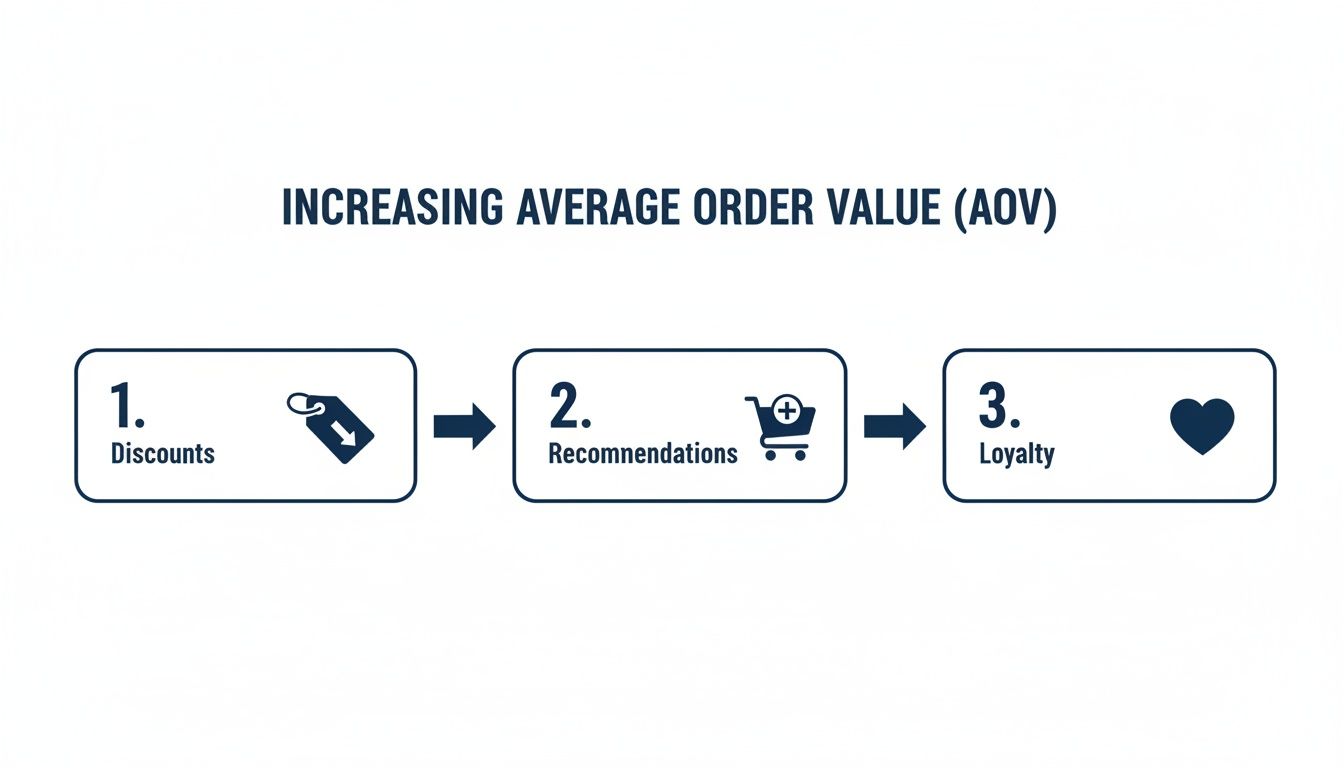
The key takeaway? While discounts might give you a temporary lift, a truly sustainable growth strategy is built on intelligent recommendations that lead to happier, more loyal customers with a higher lifetime value.
To make this clearer, let's break down where to place recommendations and what to expect from each.
Product Recommendation Placement and Impact
This table compares the most common spots for Shopify product recommendations, their main goal, and the ideal strategy for each.
Placement | Primary Goal | Best Strategy Example | Potential Impact |
|---|---|---|---|
Product Detail Page (PDP) | Increase cart size before checkout | "Frequently Bought Together" bundles or "Shop the Look" showcases. | Medium-High AOV Lift; can increase time-on-page but may distract from the primary product. |
In-Cart Drawer / Slide-Out Cart | Immediate AOV boost at the point of decision | Low-cost, complementary cross-sells or "spend-to-unlock" rewards like a free gift. | Highest AOV Lift; frictionless experience with a high conversion rate. |
Dedicated Cart Page | Last-chance upsell before payment | "You Might Also Like" suggestions based on the entire cart's contents. | Medium AOV Lift; less intrusive but can add friction by requiring another page load. |
Post-Purchase / Thank You Page | Drive a second, immediate purchase | A one-time offer on a related product to encourage a quick follow-up sale. | Increases LTV; doesn't impact the initial AOV but builds loyalty and repeat business. |
As you can see, the in-cart drawer is often the sweet spot for driving the highest immediate AOV lift because it catches the customer when their intent to purchase is at its peak.
Implementing Smart In-Cart Rules
This is where a modern product recommendation Shopify strategy really comes to life, especially with in-cart tools like Monster Cart that operate inside a slick slide-out cart. You can set up precise rules that trigger incredibly relevant offers at the perfect moment.
Here are a few real-world scenarios you can set up in minutes:
Spend-to-Unlock: A customer has $42 in their cart, and your free shipping threshold is $50. Your recommendation engine should be smart enough to show them complementary items priced between $8 and $15. This makes hitting that goal feel easy and achievable, not like a huge leap.
Item-Based Triggers: If a customer adds a specific floral dress to their cart, you can configure a rule to automatically recommend the matching sun hat or sandals. It's a perfect, context-aware cross-sell.
Exclusion Rules: To keep your offers from feeling spammy, you can prevent certain items from being recommended. For example, you’d never want to suggest another pair of jeans to someone who just added one. Smart rules prevent these awkward moments.
By configuring these smart rules, your recommendations become a dynamic, helpful part of the shopping experience. They guide the customer toward a better purchase and a higher cart value, creating a win-win that drives revenue without sacrificing the customer experience or your profit margins.
Designing Recommendations That Convert, Not Annoy
Let’s be honest: the most effective product recommendations are the ones that don’t feel like a sales pitch. They should feel like a natural, helpful part of your store. A jarring, off-brand widget can instantly shatter a customer's trust and make your upsell feel like a cheap gimmick.
The goal is to seamlessly weave these suggestions into your store’s design.
This all starts with making the recommendation widget look like it truly belongs. You have to match your brand’s theme perfectly—same fonts, same colors, same button styles. A recommendation that looks native is one that customers are far more likely to trust and, ultimately, click.
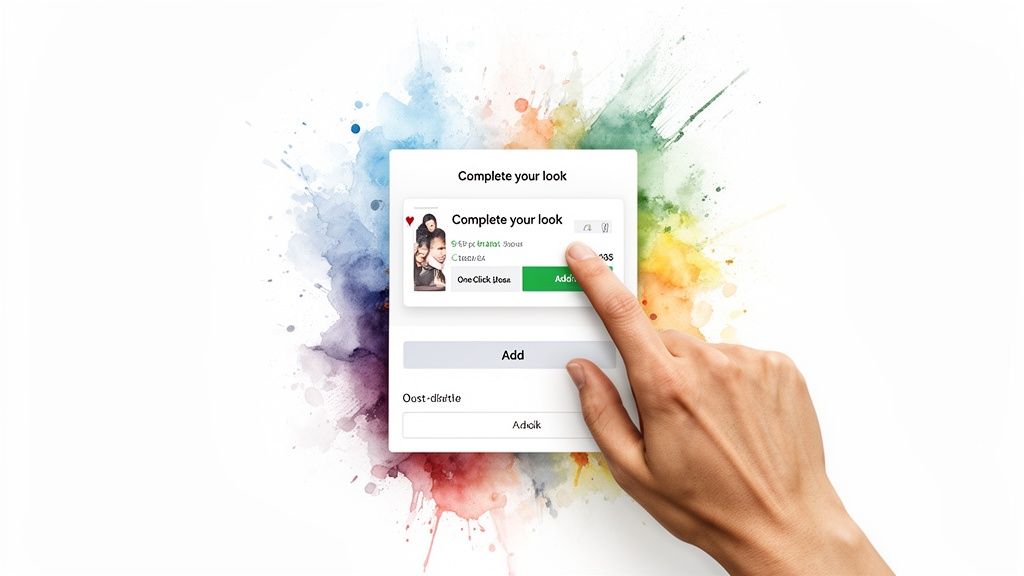
The image above is a perfect example. The prompt to "Complete Your Look" adds real value instead of just pushing another product. It’s a subtle but powerful shift.
Crafting Copy That Connects
The words you use are just as important as the design. Generic prompts like "You might also like" are tired, lazy, and completely uninspired. You can do so much better. The trick is to use clear, benefit-driven copy that quickly explains why the recommendation is relevant to them.
Here are a few powerful examples to get you started:
"Complete your look" for apparel and accessories.
"Frequently paired with" for products that just make sense together.
"Unlock free shipping with this item" to tie the upsell to a tangible reward.
This simple change in language turns a sales pitch into helpful advice. It reframes the offer around the customer's benefit, encouraging them to add more to their cart without being conditioned to expect discounts. This helps build a healthier customer relationship focused on lifetime value, not just one-off transactions. To make your recommendations truly effective, you need to apply broader strategies to improve ecommerce conversion rate.
The Power of a Frictionless Experience
Great design and copy are critical, but the user experience (UX) is where the conversion actually happens. A clunky, slow process will kill even the most compelling offer. If there's one thing to get right, it's the one-click add-to-cart button. Customers have to be able to accept a recommendation instantly, without being redirected to another page or forced to start over.
This is where a modern slide-out cart experience, powered by a tool like Monster Cart, becomes a total game-changer.
Instead of disruptive full-screen pop-ups or annoying page reloads, the offer appears cleanly within the cart drawer. The customer never leaves the page they're on, keeping them locked in the buying flow and moving forward.
A seamless slide-out cart makes accepting an offer feel completely effortless. By removing that friction, you make it incredibly easy for customers to say "yes" to your recommendations, which directly boosts AOV and makes the whole shopping experience better.
This approach respects the customer's time and attention. By presenting relevant, beautifully designed offers in a non-intrusive way, you create a system that consistently converts without annoying your shoppers. It’s a smarter way to grow—one that’s focused on adding value instead of just pushing products. For more on this, you might find our guide on frequently bought together strategies useful.
Using Gamified Rewards to Power Your Recommendations
The best product recommendation strategies do more than just show a grid of related items. They connect those suggestions to a real, tangible reward that customers actually want. Instead of a generic upsell, you frame your recommendations as the key to unlocking something valuable like a free gift, free shipping, or even a tiered discount.
This simple shift changes the entire dynamic. It’s no longer a sales tactic; it’s a helpful tip that empowers the customer to get more out of their purchase. The magic happens when the products you recommend are the direct path to hitting a goal.
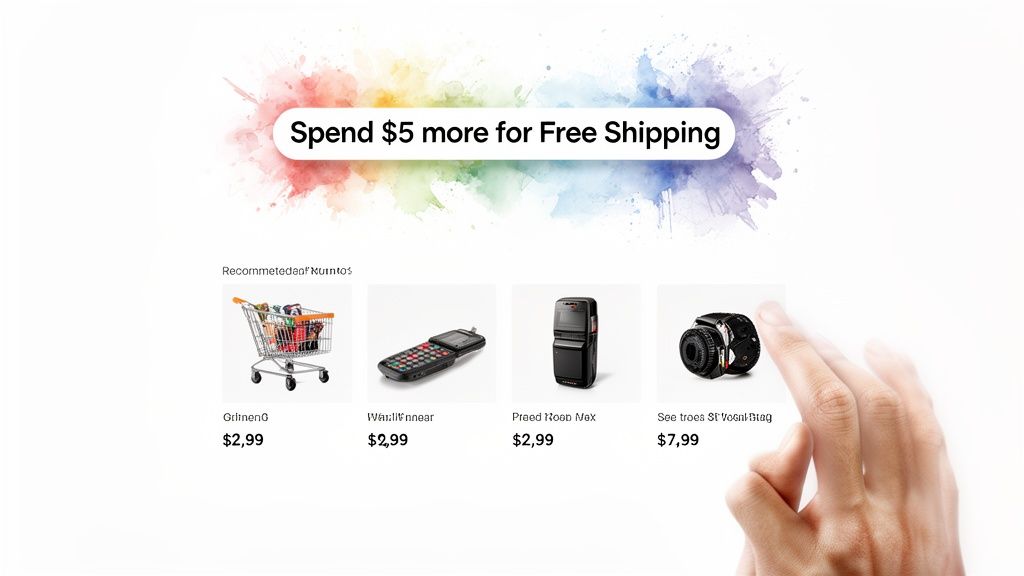
This gamified approach makes shopping more engaging. It moves the focus away from aggressive selling and toward helping your customers "win."
Build Motivation with Progress Bars
One of the most powerful tools in your arsenal here is the in-cart progress bar. A simple visual cue like, "You're only $10 away from Free Shipping!" creates a clear goal and a sense of momentum that’s hard for a shopper to ignore.
This taps into a psychological trigger known as the goal-proximity effect. When people see they’re close to achieving something, they're far more motivated to take that final step to get there.
And that’s where your recommendations come into play. If a customer has $45 in their cart and your free shipping threshold is $50, your recommendation engine should be smart enough to feature relevant products in the $5-$15 price range. Suddenly, it’s not a random suggestion—it's the perfect solution to their immediate goal.
This is a core feature of apps like Monster Cart, which bake these dynamic progress bars right into the slide-out cart, keeping the whole experience smooth and interactive.
Types of Gamified Rewards to Offer
Your first instinct might be to offer a discount, but you have better options. The real goal is to boost AOV and build loyalty, not just clear out inventory. Focusing on value-added rewards protects your margins and fosters a much healthier customer relationship geared towards high lifetime value.
Consider these powerful alternatives:
Free Shipping Thresholds: This is the undisputed champion, and for good reason—it just works. Unexpected shipping costs are one of the biggest reasons people abandon their carts.
Free Gift with Purchase: Offering a cool, low-cost item once a customer hits a spend goal can feel more special than a small discount. It’s also a killer way to introduce customers to other products in your catalog. You can dive deeper into this with our guide on setting up a Shopify free gift with purchase campaign.
Tiered Rewards: Why stop at one reward? You can create multiple levels, like "Spend $50 for a free sticker, spend $100 for a free tote bag." This gives customers multiple goals to aim for and encourages even bigger orders.
By making the path to a reward clear and actionable, you turn the shopping cart into an engaging experience. The customer feels smart for maximizing their order's value, and you benefit from a higher AOV.
Addressing the Root of Cart Abandonment
This strategy is especially good at tackling the real reasons people abandon their carts, particularly with key demographics. For example, millennials aged 25-34 abandon an average of 4.8 shopping carts every 30 days. The reason isn't a lack of interest; it’s sticker shock.
Unexpected costs are the primary trigger, with 48% of abandoned carts being ditched because of hidden fees and shipping charges. A transparent, reward-based incentive like a free shipping threshold directly removes that psychological barrier stopping this critical group from clicking "buy." You can find more data on how shoppers behave by reading these insights on cart abandonment.
Ultimately, a gamified approach powered by smart recommendations turns your cart into your most valuable conversion tool. It proactively solves customer pain points, increases order value, and builds the kind of positive experience that fosters true lifetime value.
Measuring and Optimizing Your Recommendation Strategy
A great product recommendation strategy is never "set it and forget it"—it’s a living part of your store that needs data to thrive. If you really want to maximize profitability, you have to track the right metrics, make informed adjustments, and constantly refine your approach with an eye on long-term growth.
This means looking beyond a single number. While a rising Average Order Value (AOV) is a fantastic sign, it doesn’t tell you the whole story. The smartest merchants focus on metrics that reveal the health of their customer relationships, prioritizing lifetime value over short-term gains.
So, instead of leaning on hefty discounts to move the needle, think about how your recommendations can unlock rewards like free shipping or a free gift. This approach naturally boosts AOV while building genuine loyalty.
Key Metrics to Track
To get a complete picture of your success, you need to monitor a few key performance indicators. Dashboards inside apps like Monster Cart make this dead simple, giving you a clear, at-a-glance view of what’s actually working.
Attach Rate: This tells you what percentage of total orders include at least one recommended item. A high attach rate is a great indicator that your offers are relevant and compelling.
Recommendation Revenue: This is the total revenue generated directly from customers accepting your in-cart offers. It’s the clearest, most direct measure of your strategy's ROI.
Revenue Per Session (RPS): This shows how much revenue you’re generating from each visitor. An increasing RPS means your overall on-site experience, including recommendations, is becoming more effective.
The goal is to create a system where customers want to add more to their cart because they see the value. This focus on rewards over discounts is what separates a good strategy from a great one, driving sustainable growth and higher customer lifetime value.
A Simple Framework for A/B Testing
Continuous optimization is the secret to long-term success with your product recommendation Shopify strategy. You don't need some complex, enterprise-level setup to start A/B testing; you just need a clear goal and a systematic approach.
The key is to test one variable at a time. For instance, you could test two different free gift offers at the same spend threshold to see which one has a higher take-rate. It's that straightforward.
Here are a few elements worth testing:
Reward Thresholds: Does a $50 free shipping threshold convert better than a $60 one? Let the data decide.
Offer Copy: Test a benefit-driven call-to-action like "Unlock Your Free Gift" against a simpler "Add to Cart."
Product Rules: For a specific product category, try recommending complementary items versus a "frequently bought together" bundle to see which performs better.
By regularly testing and refining your offers, you can fine-tune your strategy for maximum impact. And if you need a refresher on the fundamentals, check out our guide on how to calculate Average Order Value to ensure you're tracking your core metric correctly.
Your Questions on Shopify Product Recommendations Answered
Rolling out a new product recommendation strategy always brings up a few questions. Getting straight answers is the key to building a system that actually boosts your AOV without annoying customers or bogging down your store.
Let's tackle some of the most common ones I hear from merchants.
Will Product Recommendations Slow Down My Shopify Store?
The honest answer? They can, if you use a clunky, outdated app. A poorly built tool can absolutely drag your site speed down, which is why it's so important to choose a modern solution built for performance.
Look for apps that load asynchronously—a fancy way of saying they don't block the rest of your page from loading. A well-designed slide-out cart, like the one from Monster Cart, often ends up making the user experience feel faster. By replacing the default cart page, it creates a smoother, quicker flow for the customer and cuts out extra page loads.
Are Manual or AI-Powered Recommendations Better?
This isn't an either/or fight; the smartest stores use a mix of both.
Manual recommendations give you complete control. They're perfect for curating specific product bundles or pushing high-margin items that you know are a perfect match for what's in the cart. This is where your own expertise as a merchant shines.
On the other hand, AI-powered recommendations are incredible for personalizing suggestions at scale, using a customer's unique browsing history to show them things they're likely to love. The winning strategy is a hybrid: set manual, strategic rules for your bestsellers and hero products, then let an algorithm handle tailored suggestions for the rest of your catalog.
The most effective setup combines your direct product knowledge with the personalization power of AI. This ensures your recommendations are both strategic and individually relevant, maximizing their impact on AOV and lifetime value.
How Do I Recommend Products Without Being Pushy?
The secret is to make every single recommendation feel like a genuine benefit to the customer. Ditch the generic "You might also like..." and use language that communicates clear value, like "Complete the Set" or "Frequently Paired With."
But the single most powerful way to do this is by tying the recommendation to a reward they can unlock.
A prompt that says, "Add this item to get a Free Gift" or "Spend $7 more for Free Shipping" feels like a helpful insider tip, not a hard sell. This simple shift in focus from "buy more stuff" to "get more value" completely changes the dynamic. It encourages bigger orders while building a positive customer relationship that lasts, focusing on lifetime value.
Ready to turn your Shopify cart into a powerful AOV-boosting engine? Monster Cart helps you build a seamless in-cart reward and upsell experience that customers love. Ditch the annoying pop-ups and start increasing your revenue with a smarter, frictionless slide-out cart.
Learn more and see how it works at https://monsterapps.shop.
Join 7000+ brands using our apps