A Shopify Merchant's Guide to Shipping Protection and AOV
Feb 10, 2026
|
Published
For way too long, merchants have been stuck in a margin-killing race to the bottom with discounts. But there’s a much smarter, more sustainable way to lift your Average Order Value (AOV): shipping protection. It’s about giving customers real peace of mind against lost, stolen, or damaged packages, transforming a potential headache into a premium, high-margin service that builds long-term customer relationships.
Move Beyond Discounts with Shipping Protection
Let's be real—the endless cycle of discounts trains your customers to just wait for the next sale. It’s a short-term trick that can seriously erode your profit margins and brand value. Instead of playing that game, the smartest merchants focus on boosting AOV and lifetime value by genuinely improving the customer experience with valuable rewards and services.
This is where shipping protection comes in. Think of it as more than just an insurance policy; it's a powerful trust signal. When a customer sees you’ve got their back if something goes wrong during delivery—from porch pirates to a crushed box—they feel much more confident hitting that "buy now" button. That confidence almost always translates into higher conversion rates and a willingness to spend more.
A Smarter Path to Higher AOV
Instead of slashing your prices, you're adding a low-cost, high-value service that customers are genuinely happy to pay for. It’s a small addition that can give your AOV a serious lift without sacrificing a single dollar of product revenue, building a far more sustainable growth model focused on lifetime value.
And let's face it, the modern logistics landscape is wild. Packages travel across oceans and continents, making protection more critical than ever. Recent shipping reports have logged a staggering number of incidents over the past decade, with machinery failure, collisions, and fires leading the charge. The risks in transit are very, very real.
By reframing shipping protection as a premium service, you create a brand new revenue stream. It becomes a testament to your brand’s commitment to a secure and positive customer experience, from checkout all the way to their doorstep.
Building Trust and Lifetime Value
But real protection goes beyond a simple checkbox in the cart. It starts with the physical integrity of the package itself. Getting proactive with measures like using tamper evident packaging is a huge step. It not only protects the product but also builds consumer trust and cuts down on the very issues shipping protection is designed to solve in the first place.
Ultimately, this strategy shifts your focus from one-off sales to building long-term relationships. You can even layer shipping protection with other rewards, like a free shipping bar or a free gift with purchase. By using a slick in-cart tool like Monster Cart, you can present shipping protection as part of a frictionless rewards system, giving you a powerful alternative to the endless discount cycle.
Seamlessly Integrate Protection Into Your Cart
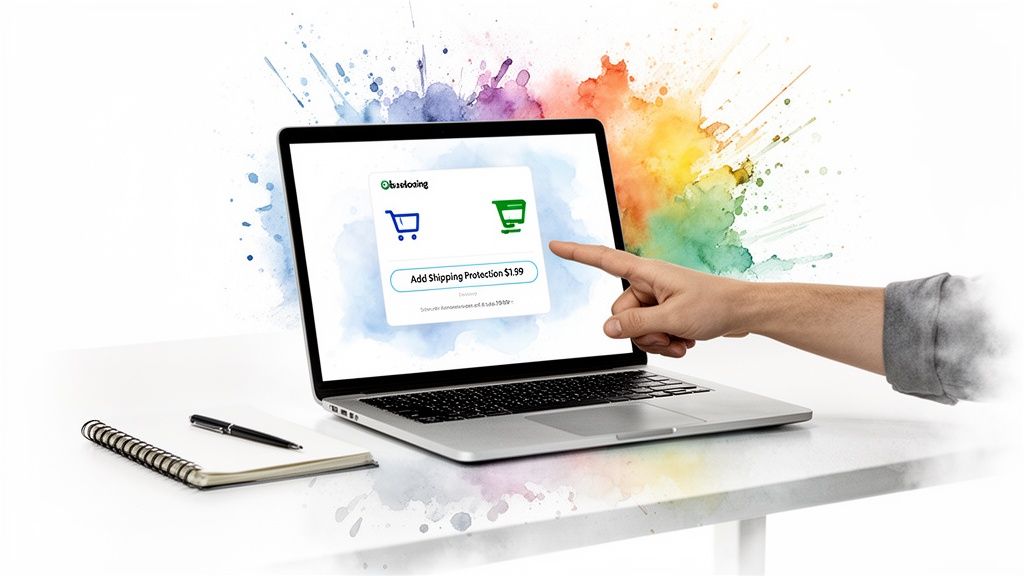
The best shipping protection offer is the one your customer barely has to think about. It should feel like a natural part of the checkout flow, not some jarring interruption that breaks their focus. Your goal is to present it as a helpful, low-friction add-on, and a slide-cart or cart drawer is your best friend for this.
Unlike an aggressive pop-up, a well-designed cart drawer keeps the customer in the buying mindset. It creates a branded, persistent space where you can introduce value-adds like shipping protection without killing the mood. This approach respects the customer's journey and turns the cart itself into a strategic engine for boosting AOV and lifetime value.
Designing the In-Cart Offer
The key is making the offer look like it belongs there. It needs to match your store’s branding perfectly—same fonts, same colors, same button styles. An offer that feels tacked on or looks like a third-party ad can erode trust at the most critical moment of the sale.
This is where a tool like Monster Cart really shines. It replaces Shopify’s default cart with a fully customizable, on-brand experience. With its one-click add-on feature, you can build a shipping protection offer that appears right inside the cart drawer, making it an effortless choice for the customer.
Here’s what a clean, well-integrated offer looks like.
Notice how the option is clear and concise. It’s a suggestion, not a demand, allowing the customer to opt-in with a single click.
The most effective in-cart offers are presented as a small, pre-ticked checkbox or a simple 'Add' button. The goal is to minimize cognitive load, making it an easy 'yes' for the customer who wants that extra peace of mind.
Crafting Microcopy That Sells
Those few words you use to describe the offer? They’re incredibly important. Your microcopy needs to communicate value instantly. Forget vague jargon and focus on the direct benefit to the customer.
Here are a few copy examples that work well:
Action-Oriented: "Protect your order against loss, theft, or damage for just $1.99."
Benefit-Driven: "Add Peace of Mind for $0.98 - Full replacement for lost or damaged items."
Simple & Direct: "✓ Yes, secure my entire order."
Remember, this is about more than just boosting AOV on a single order. It's about building a better customer relationship. Offering a valuable service like shipping protection shows you care about their experience after they click "buy." That builds trust, which is the real foundation of customer lifetime value. For more ideas on enhancing your cart, you can explore some of the best Shopify upsell apps that prioritize a smooth customer journey.
A great experience gives shoppers the confidence to come back, knowing their orders are in safe hands from click to delivery.
Find Your Optimal Pricing Strategy
Moving beyond a one-size-fits-all price is where you turn a simple shipping protection offer into a serious, high-margin revenue stream. The right strategy makes adding protection an easy ‘yes’ for the customer, not a moment of hesitation. Let's break down the most common models to find the perfect fit for your store.
Your goal here is to find the pricing model that lines up perfectly with your product catalog, your average order value, and the customers you sell to. You want the offer to feel like an affordable, logical add-on, not another significant expense.
The Fixed-Fee Model
This is the simplest approach and, honestly, often the most effective. You just charge a single, flat rate on every single order, no matter how big or small. Think $0.98 or $1.99—a price point so low it feels like a total no-brainer to click 'yes'.
Best For: Stores with a fairly consistent and lower AOV (say, under $100).
Why It Works: Simplicity is its superpower. Customers don’t have to do any mental math, which removes all friction and makes it an incredibly easy conversion.
This strategy is a volume game. That tiny fee might feel like pocket change to the customer, but it adds up significantly over thousands of orders, creating a substantial new revenue stream.
The Percentage-Based Model
With this model, the cost of shipping protection is just a small percentage of the total cart value, usually somewhere between 1% and 2%. This approach is smart because it scales the cost of protection directly with the value of the order.
Best For: Businesses with a wide range of product prices and a higher AOV.
Why It Works: It keeps the protection fee proportional to the risk. Someone buying a $500 item is almost always more willing to pay $7.50 for peace of mind than a customer who's only spending $20.
Remember, the real goal is to boost AOV without resorting to margin-killing discounts. By adding a small, value-driven fee, you're increasing the total cart value and strengthening your margins. That’s a far more sustainable way to grow.
The Tiered Model
A tiered model is the perfect middle ground, blending the predictability of a fixed fee with the scalability of a percentage. You simply set different flat fees based on specific order value brackets.
Example Tiers:
Orders $0 - $100: $1.99 protection fee
Orders $100.01 - $300: $3.99 protection fee
Orders $300.01+: $5.99 protection fee
This model strikes a great balance, making sure the fee is reasonable for small orders while capturing more revenue on larger, higher-risk purchases. Pricing it just right is critical to seeing that lift; to learn more, check out our guide on how to calculate average order value.
Comparing Shipping Protection Pricing Models
Choosing the right pricing model isn't just about picking one and forgetting it. It's about understanding the psychology behind each approach and aligning it with your store's specific goals. The table below breaks down the most common strategies to help you decide which one makes the most sense for your business.
Pricing Model | How It Works | Best For | Potential Drawback |
|---|---|---|---|
Fixed-Fee | A single, flat rate on every order (e.g., $1.99). | Stores with a lower, consistent AOV (under $100). | Might feel disproportionately high on very small orders. |
Percentage-Based | A small percentage of the cart total (e.g., 1.5%). | Stores with a wide price range and higher AOV. | Can feel expensive on very large orders, potentially hurting opt-ins. |
Tiered Model | Different flat fees based on order value brackets. | Stores that want a balanced approach for all order sizes. | Requires a bit more setup and analysis to define the right tiers. |
Ultimately, each model has its place. A store selling affordable accessories will likely see the best results with a simple fixed fee, while a furniture store will benefit more from a percentage or tiered structure. The key is to start with the model that best fits your business today.
No matter which model you land on, tools like Monster Cart make implementing it dead simple. You can easily configure and test different pricing structures right inside the cart drawer, helping you dial in the sweet spot that maximizes both customer opt-ins and your bottom line.
Crafting Offer Copy That Actually Converts
The words you use in your cart have a direct, measurable impact on whether a customer opts in for shipping protection. If your language is vague or confusing, you can bet your take rate will plummet. The goal here is to be clear, concise, and persuasive, so the value is obvious in a split second.
This isn’t just about a quick upsell; it’s a critical customer touchpoint. When you get the copy right, you set clear expectations from the start, which means fewer support tickets down the road. It's about being transparent about what the protection covers, which reduces future headaches and actually strengthens the relationship with your customer.
Focus on the Benefit, Not Just the Feature
Let's be honest: customers don't buy "shipping protection." They buy what it does for them. They're buying peace of mind. Your copy needs to reflect that. While some people respond to straightforward, logical terms, others are looking for emotional assurance. This is a perfect opportunity to A/B test and find out what really clicks with your audience.
Try pitting these two angles against each other:
The Emotional Angle: Frame the offer around the feeling of security. Think phrases like "Add Peace of Mind" or "Secure Your Delivery." This approach taps into the customer's desire to avoid the stress and frustration of a lost package.
The Logical Angle: Be direct and specific about the service. Use copy like "Insure Against Theft & Damage" or "1-Click Order Protection." This speaks to shoppers who appreciate functional, no-nonsense language.
The most effective copy often finds a way to blend both. A great headline might be "Add Peace of Mind," with a sub-line that clarifies: "Full replacement for lost, stolen, or damaged items." This gives you the best of both worlds.
Real-World Examples That Work
Your call-to-action (CTA) and the benefit description are the two most important pieces of the puzzle. Keep them short, punchy, and focused on making the customer's decision feel like a no-brainer.
This infographic breaks down a few popular pricing structures, and your choice here will definitely influence your copy.
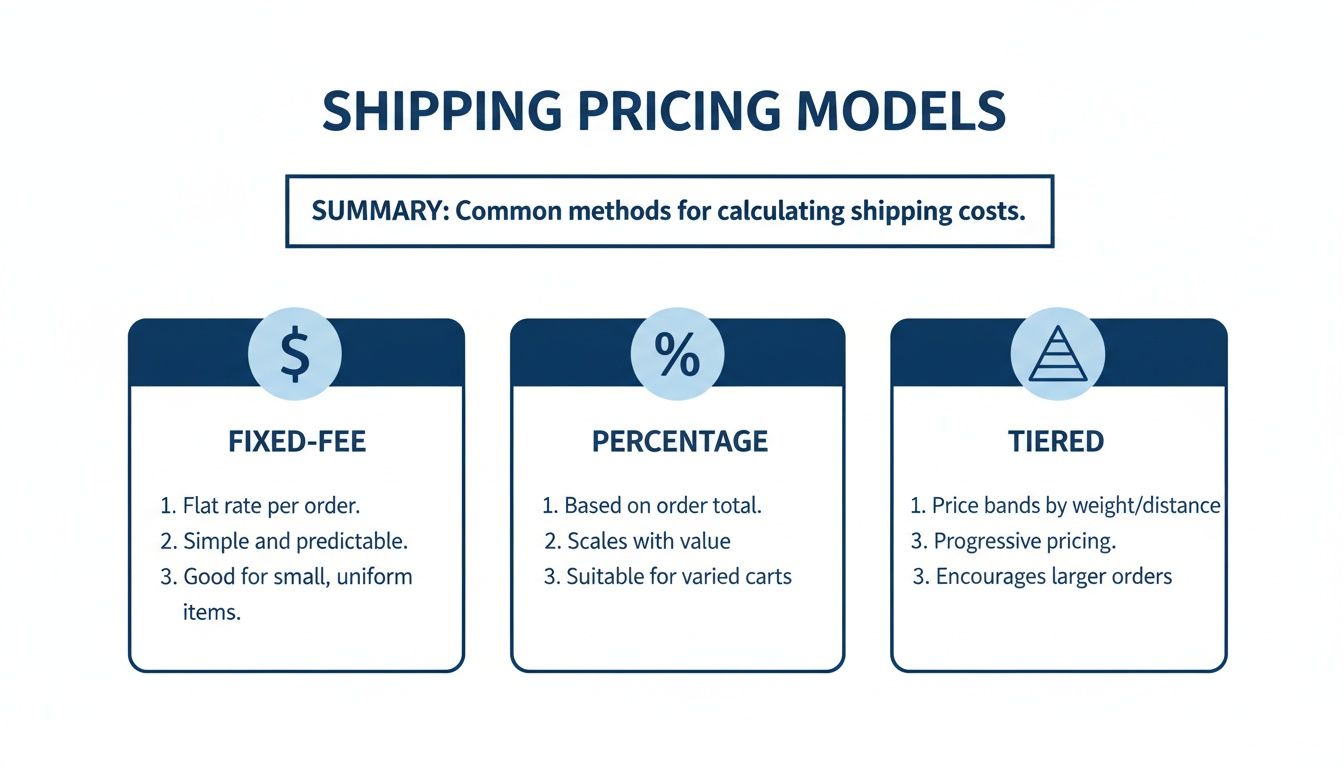
Whether you land on a fixed-fee or a tiered model, the copy has to make the value proposition crystal clear.
Here are a few copy formulas you can adapt and test:
Headline: Protect Your Order
Description: Add for $1.99 to get a free replacement if your order is lost, damaged, or stolen.
Headline: Insure Your Shipment
Description: For just 1.5% of your order total, we'll guarantee a secure delivery.
No matter which copy you choose, a tool like Monster Cart makes it incredibly simple to test and implement. By presenting this offer cleanly inside the cart drawer, you can stack it with other rewards like a free gift or a free shipping bar. This creates a powerful system that boosts AOV and lifetime value without ever resorting to those margin-killing discounts.
Measure Your Success and Optimize for Growth
Getting a shipping protection offer live is a huge first step, but the real work starts the moment it’s active. To actually understand its impact, you need to look past just the take rate. The goal is to see how this one small addition ripples across your most important business metrics, turning a simple feature into a predictable growth engine.
This is about more than just adding a new revenue stream; it's about making smarter, data-driven decisions for your store. By tracking the right KPIs, you can dial in your pricing, tweak your copy, and fine-tune the offer to get the best possible results. This is what separates a decent idea from a great long-term strategy.
The Key Metrics to Watch
To get the full story on your shipping protection's performance, you'll want to keep an eye on these core metrics. Together, they paint a complete picture of how the offer is affecting revenue, conversions, and even customer loyalty.
Take Rate: This is the most direct measure of success. It’s simply the percentage of customers who add shipping protection to their order. If your take rate is low, it might be a sign that your pricing is off, the copy isn't compelling, or the offer just isn't visible enough.
Average Order Value (AOV) Lift: Is the protection offer actually encouraging customers to complete their purchase? The best way to know is to track the AOV for orders with protection versus those without. A positive lift here proves the strategy is working as a true value-add, not just another fee.
Cart Conversion Rate: A common (and valid) fear is that adding another choice in the cart will create friction and hurt conversions. By monitoring your overall cart conversion rate, you can make sure your offer is a seamless addition, not a distraction that causes people to abandon their purchase.
Customer Lifetime Value (LTV): This is the long game. Keep an eye on the repeat purchase behavior of customers who opt-in for protection. That extra peace of mind often builds a deeper sense of trust and loyalty, which is a direct driver of higher LTV down the road.
A/B Testing for Continuous Improvement
A "set it and forget it" offer will eventually go stale. The only way to really refine your strategy over time is through consistent A/B testing. This process lets you swap out guesswork for hard data, ensuring that every little change you make is moving you in the right direction.
The most successful merchants are never satisfied with "good enough." They are constantly testing and iterating, knowing that small, incremental improvements to their in-cart offers can lead to significant gains in AOV and customer LTV over time.
Consider running a few simple tests to get started:
Pricing: Pit a flat fee like $1.99 against a percentage-based fee of 1.5%.
Copy: Test an emotional benefit ("Add Peace of Mind") against a more functional one ("Insure Against Theft & Damage").
Default State: Compare having the protection pre-selected in the cart versus requiring customers to actively opt-in.
This data-driven approach is at the heart of apps like Monster Cart, which make it simple to build and test these kinds of offers right in the cart. To really maximize the impact of shipping protection on your bottom line, it's also smart to understand broader strategies for growth, including how to increase average order value across your entire store.
As global trade continues to expand, so do the risks—and the customer demand for security. Global marine cargo insurance premiums have shown steady growth, which points to a major opportunity for Shopify merchants to turn a logistical headache into a powerful revenue stream. You can read more about these IUMI stats and trends. By measuring and optimizing, you’re not just capturing a piece of that market; you’re building a more resilient and profitable business.
Common Questions About Shipping Protection
Even with a solid plan, you’re probably still weighing a few questions about adding shipping protection to your Shopify store. That’s a good thing. This is a smart play—one that shifts your growth strategy from margin-killing discounts to real, tangible value.
Let's walk through some of the most common concerns I hear from merchants before they jump in. Getting these details right is what makes the offer feel like a helping hand, not another hurdle at checkout.
Will It Hurt My Conversion Rate?
This is easily the number one fear merchants have, and it’s a totally valid one. The last thing you want is for a value-add to create friction.
But here’s what we’ve seen time and time again: when shipping protection is implemented correctly, it rarely harms conversion. In many cases, it actually increases it. The key is to present it as a subtle, optional add-on inside a slide cart, not a disruptive pop-up.
Using a tool like Monster Cart makes the offer feel like a helpful suggestion. For customers who are on the fence, that little bit of extra security gives them the confidence they need to complete their purchase. Of course, A/B testing is always the best way to see the real impact on your audience.
How Should I Price My Offer?
There's no single magic number here. The best price depends entirely on your store's average order value.
For most stores, a low, flat fee between $0.98 and $2.95 works wonders. It's an impulse-friendly price point that makes the decision a quick and easy "yes" for the customer. It feels like a no-brainer.
If you’re dealing with a much higher AOV, a percentage-based fee (think 1-2% of the cart total) might make more sense. My advice? Start simple. A low flat fee is easy to implement and understand. You can always test your way into a more complex pricing model once you have some baseline data.
The most powerful growth strategies are built on customer lifetime value, not just a single sale. A well-priced shipping protection offer creates a better post-purchase experience, which is the secret to earning repeat business.
What Is The Best Way To Handle Claims?
How you manage claims is a massive customer experience opportunity. Seriously. A negative situation handled well can create a customer for life.
If you’re self-insuring, your top priority is to build a clear, simple, and fast internal process. Make it painless. If a customer has a lost package, a hassle-free resolution can turn them into your biggest fan.
Partnering with a third-party service? They’ll typically handle the claims process for you, which is a huge load off your plate. Either way, create a clear policy page on your website that explains exactly how customers can file a claim and what to expect. Transparency is everything.
Can I Combine This With Other Offers?
Absolutely, and you should. This is where a modern cart solution really shines. You can and should stack shipping protection with other rewards to create a compelling, multi-layered incentive system that drives your AOV through the roof.
Imagine a customer's cart showing them all this at once:
A progress bar inching them closer to free shipping.
An offer to unlock a free gift if they spend a little more.
A simple one-click option to add shipping protection.
This creates a powerful engine for boosting order value without ever touching a discount code. You’re rewarding customers for spending more while giving them the peace of mind that their bigger order is fully protected.
Monster Cart makes it incredibly easy to build this exact kind of multi-reward system right into your slide cart. Instead of annoying pop-ups, you can seamlessly combine shipping protection with free gifts, progress bars, and more to naturally lift your AOV and build lasting customer loyalty.
See how Monster Cart can transform your Shopify store today.
Join 7000+ brands using our apps