Shopify Spend X Get Y: A Guide to Boosting AOV and Lifetime Value
Jan 16, 2026
|
Published
Tired of the endless discount cycle eating away at your profits? The Shopify spend x get y model is a smarter way to grow. It’s all about rewarding customers for spending more and adding genuine value to their order, not just slashing prices at every turn.
This guide will break down exactly how to use this strategy to sustainably grow your Average Order Value (AOV), protect your margins, and build a base of loyal customers who value your brand for more than just a sale.
Moving Beyond Discounts to Boost AOV
The constant pressure to offer discounts can feel like a race to the bottom. While a 20% off coupon might snag a quick sale, it usually attracts bargain hunters who won’t come back without another price cut.
That cycle slowly kills your profit margins and can even devalue your brand over time. You end up training customers to wait for the next sale instead of ever paying full price. This approach focuses on a one-time transaction, not on building a long-term, profitable customer relationship.
The "spend X, get Y" strategy completely flips this dynamic. Instead of focusing on what a customer saves, it shifts the focus to what they earn. This simple psychological switch turns the shopping experience from a basic transaction into a rewarding journey, encouraging a higher spend and fostering genuine loyalty.
The Psychology of Earning a Reward
So, why is "Spend $75, get a free gift" so much more powerful than a simple discount? It taps directly into some potent consumer psychology.
An offer like this feels less like a desperate plea for a sale and more like an exclusive perk. Customers feel like they’ve achieved something by hitting that spending threshold, which creates a positive, memorable feeling about your brand.
You’re essentially gamifying the shopping cart. Suddenly, a shopper isn't just buying products; they're on a mini-quest to unlock a prize. This simple shift is what encourages them to add one more item to their cart to reach the goal, directly pushing up the order value in a way that feels fun and natural.
By framing promotions as rewards instead of discounts, you move the customer's focus from price to value. They aren't just saving money; they are gaining an extra item, which often holds a higher perceived value than a simple percentage off.
Building Long-Term Value Over One-Time Sales
The real power of this strategy is its ability to build customer loyalty and increase lifetime value (LTV). While hefty discounts attract fleeting customers, reward-based offers cultivate a real relationship. You're giving them more value, which makes them far more likely to come back.
Just look at the benefits:
Increased Perceived Value: A free gift, especially one that perfectly complements their purchase, can feel way more valuable than a small discount. A customer might not remember the 15% they saved, but they will remember the bonus product they got.
Strategic Product Introduction: You can use free gifts to introduce customers to new or related products they might not have tried on their own, often leading to future full-price purchases of that item.
Improved Profit Margins: By offering a low-cost, high-perceived-value item as the reward, you can protect your margins far better than you could with a sitewide discount.
Enhanced Customer Experience: A well-executed in-cart reward system, like one powered by an app like Monster Cart, gives real-time feedback that makes shopping more interactive and enjoyable, boosting lifetime value.
This method is a core part of any healthy plan to boost your AOV. If you're new to the concept, taking a moment to understand what is AOV in ecommerce is the perfect first step for setting effective spending goals.
And remember, "spend x get y" is just one tool in your toolbox. You can explore other effective strategies to increase average order value to build a well-rounded promotional calendar. By moving away from a discount-only mindset, you're investing in a more sustainable and profitable future for your Shopify store.
How to Craft Irresistible Spend Threshold Offers
The real magic of a "spend X, get Y" offer isn't just in the technical setup; it’s in the psychology behind the deal itself. A generic or uninspired offer will fall flat, but a carefully crafted one can seriously boost your average order value (AOV) and build lasting customer loyalty.
Your goal is to create an offer that feels like a genuine win for the shopper, motivating them to happily add just one more thing to their cart. This is about boosting AOV without resorting to hefty, margin-crushing discounts.
This isn't about guesswork. It requires a clear look at your store's data to find that perfect sweet spot between what excites your customers and what keeps your business profitable.
Setting a Smart Spending Threshold
First things first, you need to determine the "X" in your offer—the spending goal. Set it too high, and you'll discourage shoppers before they even start. Set it too low, and you'll give away margin on sales you were going to get anyway.
A reliable starting point is to set the threshold 15-30% above your current Average Order Value. For example, if your AOV is currently $50, a great initial threshold to test would be around $60-$65.
This feels like an achievable stretch for the average customer, encouraging them to toss one more small item in the cart to unlock their reward.
Before you launch, run the numbers. Make sure the final cart value, even after accounting for the cost of the reward and shipping, still leaves you with a healthy profit margin. You're aiming for a bigger, more profitable sale, not just a bigger one.
The visual below breaks down how a reward-based offer stacks up against a traditional discount when it comes to driving customer value and business growth.
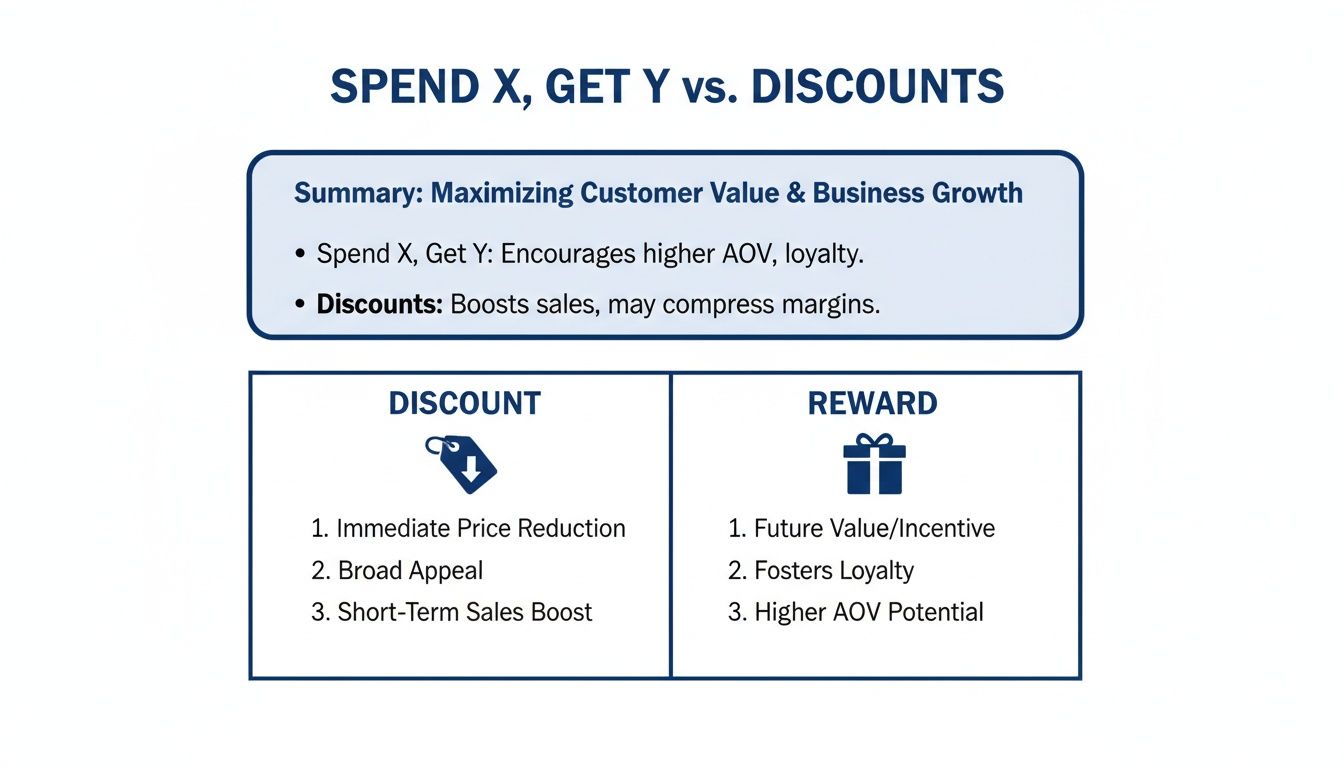
This comparison really drives home the point: discounts reduce revenue, while reward-based offers add value. That distinction is crucial for building long-term customer relationships and protecting your brand's integrity.
Choosing the Perfect Reward
Once you have your threshold, it's time to choose the "Y"—the reward. This is where you can get creative and reinforce your brand's value. Hefty discounts might attract one-time bargain hunters, but a thoughtful reward encourages repeat business and fosters genuine loyalty.
Think beyond simple price cuts and focus on what provides real, tangible value to your customers.
High-Perceived-Value Free Gifts
A free gift almost always feels more valuable than an equivalent discount. The key is to pick items with a high perceived value but a relatively low cost to you.
Skincare Brand Example: A store with a $60 AOV could offer a free travel-size moisturizer on orders over $75. The gift introduces customers to another product and feels like a luxury bonus.
Pet Supply Store Example: A shop with a $45 AOV could give away a free, durable chew toy (that you source in bulk) on carts over $50.
Future-Use Discounts
Instead of giving a discount now, reward them with a coupon for their next purchase. An offer like "Spend $100 today, get $15 off your next order" is a brilliant way to drive repeat business and boost customer lifetime value (LTV). You secure a full-margin sale today while giving them a compelling reason to come back. For more ideas on structuring these types of deals, you can explore our detailed guide on how buy more, save more promotions work.
The Power of Free Shipping
Never, ever underestimate free shipping. Unexpected shipping costs are the #1 cause of cart abandonment. Using free shipping as a reward is one of the most effective motivators you can deploy.
A "Spend $50 for Free Shipping" offer is clear, universally understood, and directly tackles a major pain point for online shoppers. It removes that final barrier to purchase and often has a much better ROI than a product discount.
When you focus on rewards that add value instead of just cutting prices, you train customers to appreciate your brand, not just your sales. This strategic approach, especially when powered by an in-cart rewards engine like Monster Cart, turns a simple promotion into a powerful tool for sustainable growth.
Offer Type Comparison: Spend X Get Y vs. Traditional Discounts
When deciding on a promotional strategy, it's helpful to compare how each approach impacts your business. While a straight discount is simple, a "Spend X, Get Y" offer often delivers better results across several key areas.
Metric | Traditional Discount (e.g., 20% Off) | Spend X Get Y (e.g., Spend $75, Get Free Gift) |
|---|---|---|
Average Order Value (AOV) | Can decrease. Shoppers may focus only on discounted items. | Almost always increases. Motivates adding items to meet a threshold. |
Profit Margin | Directly reduced. The discount cuts into the margin on every item. | Protected. You control the fixed cost of the gift. |
Customer Perception | Transactional. Can train customers to only buy during sales. | Value-added. Feels like a genuine bonus and a positive experience. |
Brand Loyalty | Weakens. Creates price-focused relationships. | Strengthens. Builds an emotional connection and encourages repeat business. |
Inventory Management | No direct impact. | Excellent. Allows you to move overstocked items or introduce new products. |
Ultimately, the choice depends on your goals. But if you're focused on building a sustainable brand with high customer lifetime value, the "Spend X, Get Y" model is a clear winner.
Choosing Between In-Cart and Post-Purchase Promotions
You've got the perfect "spend X, get Y" offer ready to go, but your next decision is just as important: where and when will your customers actually see it? The placement of your promotion can make or break its success and completely changes the customer's experience.
A poorly timed offer feels like a jarring interruption. But a seamlessly integrated one? That feels like a helpful, friendly guide leading your customer to a better deal.
The two most common spots for these offers are post-purchase and in-cart. While both are designed to increase your average order value (AOV), their methods and results couldn't be more different. One creates friction, while the other builds a smooth, rewarding journey to checkout.
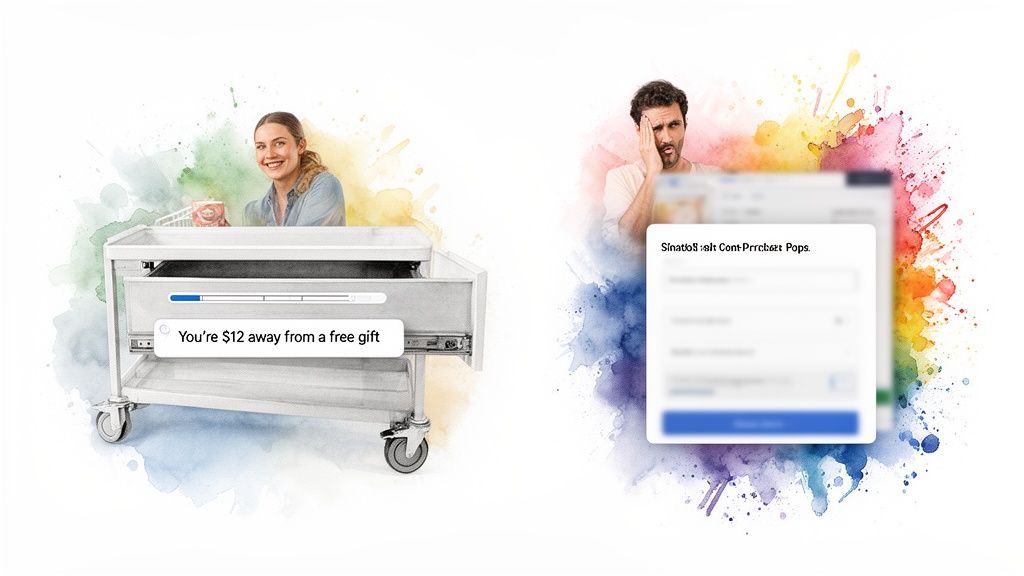
This image nails the core difference. On one side, you have a gentle, in-cart nudge. On the other, a disruptive, post-sale demand. The first guides the customer toward a goal, while the second can sour the entire experience right after they've already committed to buying.
The Problem with Post-Purchase Upsells
Let's talk about post-purchase offers. These pop up after a customer has already completed checkout. They’ve entered their credit card details, hit the "buy" button, and are mentally checking out. Then, suddenly, a new screen appears asking them to add another item or spend more money.
This approach is inherently disruptive. It completely breaks the natural flow of the purchase and forces the customer into another buying decision right when they thought they were finished. This can lead to decision fatigue or even buyer's remorse, undoing all the goodwill you just built.
Post-purchase upsells ask for a second commitment. The customer has already trusted you with their money once, and now you're immediately asking for more. This can feel aggressive and transactional, undermining efforts to build long-term customer relationships and lifetime value.
While some apps are built for this, the user experience often feels jarring. Instead of feeling rewarded, the customer might feel like you're just trying to squeeze every last dollar out of them. This is the exact opposite of the value-added experience a great Shopify spend x get y offer is supposed to create.
Embracing the Power of In-Cart Promotions
A far more effective and customer-friendly strategy is to weave the promotion directly into the shopping cart experience before they check out. This is where tools like Monster Cart really shine. By replacing the standard, static cart page with an interactive slide-out cart, you turn a simple order summary into a dynamic rewards engine.
The key benefit here is real-time feedback. As a customer adds items, an in-cart progress bar visually tracks how close they are to unlocking their reward. This simple mechanic powerfully gamifies the shopping experience.
This approach taps into a few key psychological triggers:
Goal Proximity: Seeing a message like, "You're just $12 away from a free gift!" creates a powerful urge to close that gap. The goal feels tangible and super achievable.
Reduced Friction: The entire interaction happens right inside the cart drawer. The customer never has to leave the page or get interrupted, keeping their path to checkout smooth and clear.
Loss Aversion: When a customer gets close to a reward, they're much more motivated to reach it because not doing so feels like they're losing out on a perk they've already earned.
This method transforms your promotion from an intrusive upsell into a helpful and exciting part of the shopping journey itself.
Creating a Seamless and Engaging Experience
The goal is to make unlocking rewards feel intuitive, not demanding. An in-cart system delivers the kind of instant gratification that modern shoppers have come to expect. When a customer adds an item that pushes them over the threshold, the reward should automatically pop into their cart. This confirms they've "won" and reinforces their smart shopping decision.
This seamless integration is crucial for avoiding cart abandonment. While detailed stats on spend-based rewards are still emerging, we know that unexpected costs and complex checkouts are major reasons people ditch their carts. A jarring pop-up can easily feel like a complex, unexpected step.
An in-cart system works to prevent this by keeping the entire experience fluid and transparent. There are no surprises at checkout—only a clear, rewarding path to earning more value. For merchants looking to explore different in-cart tools, our guide on the best Shopify upsell apps offers a great overview of the options out there.
Ultimately, choosing an in-cart promotion system is about respecting the customer's journey. It guides them toward a higher AOV by adding value at every step, fostering goodwill and encouraging the kind of loyalty that lasts far beyond a single transaction.
Designing a High-Converting In-Cart Reward Experience
A brilliant "spend X, get Y" offer can easily fall flat if the customer experience is clunky or confusing. The design of your in-cart promotion is just as critical as the deal itself. Success hinges on making the process of unlocking a reward feel intuitive, exciting, and completely seamless.
The goal is to turn your cart from a boring order summary into an interactive engine for boosting your Average Order Value (AOV). This takes a thoughtful approach to user experience (UX), making sure the customer always feels guided, not pressured.
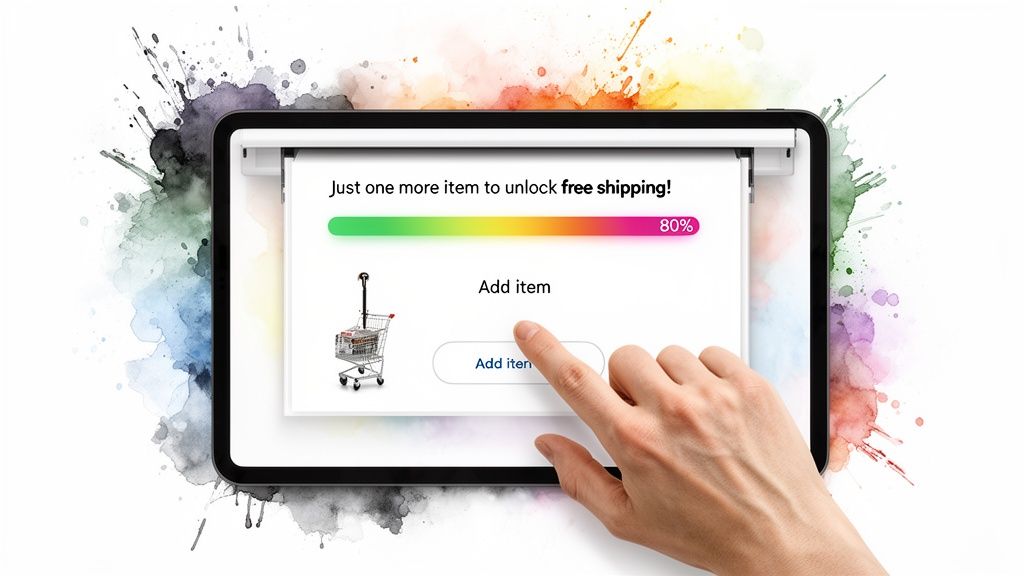
This entire interaction needs to happen without ever forcing the shopper off their current page. This is where a slide-out cart drawer, a core feature of apps like Monster Cart, becomes essential. It keeps the customer in the shopping flow, minimizing friction and the risk of them bouncing.
The Power of Visual Progress
Humans are hardwired to finish what we start. Seeing how close we are to a goal gives us a powerful psychological push to get over the finish line. In your Shopify cart, nothing does this better than a visual progress bar.
As a customer adds items, a dynamic bar should fill up in real time, showing them exactly how close they are to their reward. This simple visual cue gamifies the experience, turning a routine purchase into a fun mini-challenge. It creates a sense of momentum that makes hitting the spend threshold feel like a real accomplishment.
Crafting Compelling Microcopy
The words you use in your cart are just as important as the visuals. This is where microcopy—the small bits of text that guide users—plays a starring role. Vague or boring text won't inspire anyone to add another item to their cart.
Your copy needs to be clear, exciting, and action-oriented. Just compare these two approaches:
Boring: "Spend $50 for a free gift."
Exciting: "You're just $12.35 away from your free mystery gift!"
The second option creates a sense of urgency and curiosity. It gives the shopper a precise, manageable goal. That tiny shift in language transforms a generic promotion into a personal invitation to earn something valuable.
Your microcopy should build anticipation. Use phrases like "Almost there!" or "Unlock your reward" to encourage that final, AOV-boosting addition to the cart. Keep it concise, energetic, and focused on the benefit to the customer.
Keeping the Experience Contained and Seamless
The golden rule of in-cart design is to eliminate friction. Every click that takes a customer away from their product page increases the chance they'll get distracted and leave. This is precisely why keeping the entire reward experience inside a cart drawer is so effective.
A slide-out cart allows shoppers to:
See Real-Time Updates: When they add an item, the cart slides out, the progress bar moves, and the microcopy updates instantly.
Add Products Without Leaving: They can see product recommendations or add items directly within the cart drawer.
Stay Focused on Checkout: The primary call-to-action remains "Checkout," keeping them on a clear path to purchase.
This seamless flow is crucial for preventing cart abandonment. While tons of data focuses on recovering carts after they're abandoned, a well-designed in-cart experience aims to stop that from happening in the first place by removing common frustrations. Understanding the average cart recovery rates makes it clear why preventing abandonment is so much more powerful.
By combining visual progress, compelling microcopy, and a frictionless cart drawer, you create an environment where customers are genuinely motivated to spend more. This turns your Shopify spend x get y offer into a reliable and customer-friendly tool for growing your store.
Measuring Success and Optimizing for Lifetime Value
Launching your Shopify spend X get Y campaign is a great first step, but the real growth starts the moment you begin measuring what’s actually working. Let’s be clear: true success isn't about that one, slightly larger sale today. It’s about using these offers to build a more loyal, more profitable customer base that sticks around for the long haul.
This means you need to look past surface-level metrics like conversion rates. The focus has to shift to boosting your Average Order Value (AOV) without resorting to margin-killing discounts. When you use rewards like a free gift or free shipping, you're adding value to the experience. This encourages customers to spend more and turns a simple promotion into a core piece of your customer retention strategy.
Key Metrics to Monitor for Campaign Health
To figure out if your spend threshold offers are really doing their job, you have to track the right data. A winning campaign doesn't just convert; it profitably increases order sizes and keeps customers coming back.
Start by keeping a close eye on these essential metrics:
Average Order Value (AOV): This is your north star. Is your AOV genuinely higher during the campaign compared to periods without it? A solid lift here proves the offer is motivating people to add more to their cart.
Offer Uptake Rate: Of all the customers who qualified, what percentage actually redeemed the offer? A low uptake rate could be a red flag that your spending threshold is too high or the reward just isn't compelling enough.
Cart Abandonment Rate: Watch this number carefully. While a dozen things can cause cart abandonment, an overly aggressive or confusing offer could accidentally make it worse.
Profit Margin Per Order: This is critical. Did the bigger order value actually offset the cost of the reward? You need to make sure your bigger sales are also more profitable sales.
For a deeper look at connecting promotions to your overall growth, it's worth learning how to grow your Shopify store with data-driven decisions. This helps you see how everything fits together.
Optimizing Your Offers with A/B Testing
Think of your first "spend X, get Y" campaign as a baseline, not the final word. The secret to long-term success is to constantly optimize by A/B testing. Don't be afraid to experiment and find out what truly resonates with your audience.
The trick is to test different variables one at a time so you can get clean, clear results. For instance, you could run tests on:
The Reward ('Y'): Pit a free gift against a coupon for a future purchase. Does one drive a better AOV or more repeat business?
The Threshold ('X'): Test a $50 threshold against a $65 one. Does the higher number lift your AOV without scaring off too many customers?
The Microcopy: Try out different messaging right in the cart. Does "You're $10 from a free gift!" outperform a more generic "Spend $50, get a gift"?
An in-cart rewards app like Monster Cart makes this whole process way easier. You can quickly swap out offers and track how they perform without having to call a developer, giving you the agility to adapt based on what your customers are actually doing.
The ultimate goal is to shift your mindset from securing a single, larger sale to nurturing Customer Lifetime Value (LTV). A well-optimized 'spend X, get Y' campaign should make customers feel valued, encouraging them to return again and again.
Focusing on Lifetime Value, Not Just Discounts
The biggest trap merchants fall into is getting stuck in a discount-driven mindset. Sure, a simple 20% off coupon can give you a quick sales spike, but it often attracts bargain hunters who have zero brand loyalty. They show up for the deal and vanish the second it’s gone.
Reward-based promotions are fundamentally different. They build value.
When you offer a free gift or an exclusive product, you're not just closing a sale; you're creating a positive, memorable experience. This is the bedrock of Customer Lifetime Value (LTV). A customer who gets a delightful bonus with their order is far more likely to feel a real connection to your brand.
By tracking the repeat purchase rates of customers who engaged with your spend threshold offers, you can directly measure their impact on LTV. You'll probably find that these rewarded customers become some of your most valuable, proving that a smart in-cart strategy is an investment in a more sustainable, profitable future.
Common Questions About Spend X Get Y Offers
What is the best reward for a Spend X Get Y offer?
The golden rule here is to find a reward that has a high perceived value for the customer but a low actual cost to you. Get this right, and shoppers feel like they've scored big while your margins stay healthy.
Trial-size products, exclusive merch, or even digital downloads often hit that perfect sweet spot. But don't forget the king of all incentives: free shipping. It remains a massive motivator, with 73% of shoppers admitting they've abandoned a cart because of shipping costs.
The key is to test what resonates with your audience. An app like Monster Cart makes it dead simple to swap out gifts or free shipping offers on the fly. This lets you find the perfect reward that boosts lifetime value without just slashing prices.
High-perceived-value gifts that let customers sample new products
Free shipping thresholds to slash cart abandonment
"Next purchase" discounts that encourage repeat business
Digital bonuses like guides or e-books that cost you nothing to fulfill
Selecting Your Ideal Reward
The right gift has to make sense for your numbers—specifically your AOV and profit margins.
A beauty brand, for example, might offer a $5 serum sample on any order over $60. Or a pet supply shop could toss in a low-cost chew toy once a cart hits $50. Both feel like a genuine bonus to the customer.
Free shipping is another powerhouse. As a reward, it often delivers a 15% lift in conversion all on its own. And digital products? They can cost you next to nothing to deliver but feel like a premium add-on to the customer. These are the kinds of rewards that push up AOV without eating into your profits.
Rewards almost always outperform discounts because they add tangible value. Customers feel like they’ve earned a real bonus, not just snagged a temporary bargain.
Can I Set Up Tiered Rewards in Shopify Without an App?
Not really, and this is a critical limitation. Native Shopify discounts can handle a simple, single-tier "buy X, get Y" deal, but they fall completely flat when it comes to more advanced, multi-tier setups.
More importantly, they can’t show a customer their progress in real-time or update rewards as they add more to their cart. You lose out on that powerful psychological nudge that gets a shopper to add one more item to unlock the next reward tier.
This is exactly the gap an app like Monster Cart is built to fill. It gives you those dynamic, in-cart progress bars and gamified reward tiers that make the whole experience interactive and fun.
Shopify Native: Handles basic threshold rules, but offers no live updates in the cart.
Monster Cart: Powers a slide-out cart drawer with a progress bar that updates in real-time.
Tier Customization: Lets you create unlimited reward levels, swap gifts, and add free shipping thresholds.
How Do I Calculate The Right Spending Threshold?
This is less of an art and more of a science. The best place to start is with your store's current Average Order Value (AOV).
A good rule of thumb is to set your spending thresholds about 15–30% above your current AOV. This creates a challenge that feels achievable, not impossible. Of course, you need to make sure the extra revenue you generate more than covers the cost of the gift and any shipping, all while preserving your profit margin.
You can model a few different scenarios in your analytics dashboard to see what makes sense. Then, use a tool like Monster Cart to A/B test different tiers and see which one actually moves the needle on AOV and, over the long run, Customer Lifetime Value. After a bit of testing, you’ll land on a threshold that feels like a great deal for your customers and is perfectly sustainable for your business.
Ready to boost your AOV and delight shoppers with in-cart rewards? Try Monster Cart right now.
Join 7000+ brands using our apps