Shopify Upsells And Cross Sells To Increase AOV
Jan 29, 2026
|
Published
Forget about store-wide discounts that just chip away at your profits. The real secret to sustainable growth isn't about cutting prices—it's about mastering upsells and cross-sells. These are powerful, proven strategies that boost your average order value by offering more value to customers who are already in the mood to buy.
This approach is a game-changer. It moves you from chasing one-off sales bumps to building genuine, long-term customer relationships and increasing lifetime value.
Unlock More Revenue Without Hefty Discounts
So many Shopify merchants feel stuck in a relentless cycle of discounts, constantly slashing prices just to make a sale. While a quick 15% off might give you a short-term boost, it's a dangerous game. It slowly eats away at your margins and, even worse, trains your customers to just sit back and wait for the next big sale.
This creates a downward spiral where profitability takes a hit and your brand's perceived value starts to fade. The true power of upselling and cross-selling lies in their ability to dramatically increase website conversions by flipping the script from price reduction to value addition.
Instead of just taking money off the top, these strategies enrich the customer's purchase, making them feel like they’re getting a smarter deal or a more complete solution. This isn't about being pushy; it's about being genuinely helpful at the perfect moment, boosting both AOV and lifetime value.
The Shift to Value-Based Selling
The core idea here is to boost your Average Order Value (AOV) by offering rewards instead of markdowns. This simple shift protects your margins while building a much stronger connection with your audience. When you get it right, these offers feel less like a sales tactic and more like a personalized, helpful suggestion.
Just think about these value-driven alternatives to a generic 20% off coupon:
Free Gifts: Offer an exclusive, desirable product once a customer's cart hits a specific value.
Free Shipping: Set a clear spending goal to unlock free shipping—it's one of the most effective incentives out there.
Tiered Rewards: Build excitement by letting shoppers unlock better and better rewards as they spend more.
By focusing on what you can add to a customer's order rather than what you can subtract from the price, you completely transform the transaction. You're not just selling a product; you're creating a rewarding experience that encourages loyalty and higher spending.
This mindset is absolutely critical for long-term success. It prioritizes customer lifetime value (LTV) over a single sale. Instead of constantly chasing new customers with discounts, you start cultivating repeat business from shoppers who feel seen and valued.
The goal is to make every interaction a positive one, turning your shopping cart from a simple checkout page into a dynamic conversion engine. Tools like Monster Cart are designed around this very principle. They let you build these seamless, rewarding experiences directly into your Shopify store—without the annoying pop-ups that kill the customer journey.
This guide will show you exactly how to put these strategies to work.
Understanding Upselling vs. Cross-Selling
At their core, upsells and cross-sells are two sides of the same coin. Both are designed to increase a customer's order value by making their shopping experience better, not just by pushing more products. But they go about it in completely different ways, and knowing when to use each is what separates a genuinely helpful suggestion from annoying noise.
Think of it like ordering at your favorite cafe. When the barista asks if you want to make your small latte a large for just a buck more, that’s an upsell. You were already buying a latte; they’re just encouraging you to get a better, more premium version of it. It’s all about enhancing the original choice.
Now, what if that same barista asks if you’d like a freshly baked croissant to go with your latte? That’s a cross-sell. They’re suggesting a different but complementary item to round out your purchase. It’s about completing the experience.
This simple visual shows how both strategies lead to growth, but they take different paths to get there.
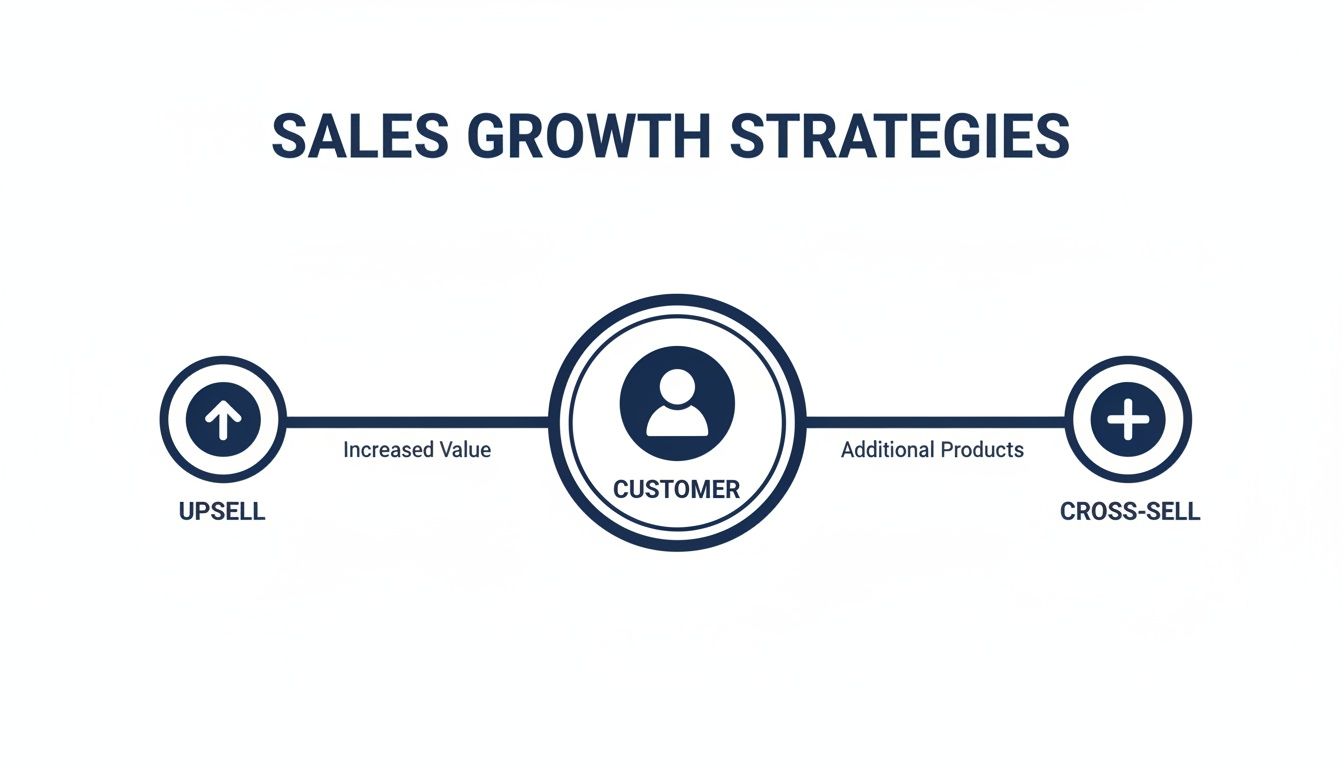
The key takeaway is that both paths lead to a higher AOV. One satisfies a desire for "more" or "better," while the other fulfills the need for a "complete set."
The Psychology Behind Each Approach
The real power of upselling and cross-selling isn't in the tech; it's in understanding your customer's mindset the moment they're ready to buy. Each tactic taps into a different psychological trigger, which is why the right offer at the right time feels so natural.
An upsell works because the customer has already decided to buy from you. They’ve done the research, picked a product, and are mentally committed. Offering a slightly better version at this stage doesn't feel like a whole new decision—it feels like a simple, low-risk upgrade. You’re just tapping into the momentum they already have.
A cross-sell, on the other hand, appeals to our desire for a complete solution. When someone buys a new camera, offering a memory card isn't pushy; it's helpful. You’re anticipating their next need and saving them the hassle of another search. This positions your brand as a thoughtful expert, not just a seller. You can learn more by exploring the difference between a cross-sell and an upsell in more detail.
Driving Lifetime Value, Not Just AOV
While both strategies are fantastic for an immediate AOV boost, their real impact is long-term. When you get this right, you shift the entire focus from a single transaction to building a lasting relationship.
By thoughtfully anticipating a customer’s needs, you do more than just increase the cart total. You demonstrate that you understand them, which builds trust and encourages them to return. This is the foundation of high customer lifetime value (LTV).
Instead of just killing your margins with another discount, you’re adding genuine value to their purchase. This could look like:
Upselling to a more durable version of a product: This shows you care about their long-term satisfaction.
Cross-selling a care kit for their new purchase: This helps them protect their investment.
Offering a bundle that saves them money: This makes them feel like a smart, savvy shopper.
Ultimately, mastering upsells and cross-sells means moving beyond simple sales tactics. It’s about creating a smarter, more intuitive shopping journey. When customers feel understood and valued, they don’t just spend more today—they come back again and again. An intelligent cart experience, like one powered by Monster Cart, can automate these helpful suggestions seamlessly, turning every purchase into a chance to build real loyalty.
Why Smart Offers Outperform Steep Discounts
Leaning on steep discounts to drive sales is a bit like running on a treadmill. You’re putting in a lot of effort, but you’re not really getting anywhere. While a quick 20% off sale might give you a temporary spike in orders, it often does more harm than good by slowly chipping away at your profit margins and devaluing your brand over time. Customers catch on fast and learn to wait for the next sale, creating a painful cycle for your bottom line.
There’s a much smarter, more sustainable way to grow. The real goal is to increase your Average Order Value (AOV) by adding value, not by subtracting from the price. Smart upsells and cross-sells built around rewards completely shift the customer’s mindset from, “How can I pay less?” to, “How can I get more?” This subtle but powerful change is the secret to building a healthier, more resilient business.
The aim is to reward customers for spending more, building a positive relationship that encourages them to come back again and again. This focus on Lifetime Value (LTV) creates a business that thrives long-term, instead of just surviving from one sale to the next.
Shifting from Discounts to Value-Added Rewards
Instead of just slashing prices, think about offers that make your customers feel smart and appreciated. These strategies protect your margins and create a far more engaging shopping experience. The idea is to give them a compelling reason to add just one more thing to their cart.
Here are a few powerful alternatives to a standard discount:
Free Gift with Purchase: Offer an exclusive or popular product once a customer’s cart hits a certain threshold. This feels like a genuine bonus, not just a markdown. Check out our detailed guide on how to set up a Shopify free gift with purchase for more ideas.
Free Shipping Thresholds: Let's be honest, shipping costs are a major reason people abandon their carts. Setting a clear spending goal to unlock free shipping is one of the most effective incentives you can possibly offer.
Progressive Rewards: Build excitement with a tiered system that gets better as customers spend more. For example, a customer might unlock a free sample at $50, a deluxe gift at $75, and free shipping at $100.
These value-added rewards transform a simple transaction into a rewarding experience. The customer feels like they’ve earned a special perk, which strengthens their connection to your brand.
The Financial Impact of Smart Offers
The financial argument for this approach is impossible to ignore. Effective upselling and cross-selling strategies aren't just minor tweaks; they are serious revenue drivers. In fact, these tactics are responsible for an estimated 30% of total sales revenue for many businesses. This highlights a critical truth in e-commerce: it's almost always more profitable to maximize the value of your existing customers than to constantly chase new ones.
By focusing on smart rewards, you’re not just making a single sale more profitable. You’re investing in a customer relationship that will pay dividends over and over again.
This strategy slashes customer acquisition costs and dramatically improves loyalty. It's no surprise that, globally, 88% of brands are already using upselling and 79% are using cross-selling, leading to significant revenue growth without having to sacrifice their margins.
Building a Rewarding In-Cart Experience
For these offers to really work their magic, they need to be presented seamlessly right at the point of highest intent—the shopping cart. Clunky pop-ups and confusing banners just break the customer's flow and can lead to frustration and abandonment. The best approach is to weave these rewards directly into the cart itself.
This is where a tool like Monster Cart really shines. It transforms your standard Shopify cart into an interactive rewards engine. As a customer adds items, a dynamic progress bar can show them exactly how close they are to unlocking their next reward, like a free gift or free shipping. This gamified experience encourages them to add more to their cart, naturally boosting your AOV.
By making the whole process intuitive and rewarding, you create a frictionless path to checkout that customers actually enjoy.
Designing A Flawless In-Cart Upsell Experience
Let's move from theory to action. The most critical moment in any customer's journey is the shopping cart—it’s where buying intent is at its peak, and where a sale is either won or lost. For years, merchants have relied on disruptive, flow-breaking pop-ups to pitch last-minute offers. But let's be honest, these often do more harm than good, leading to frustration and abandoned carts.
A much smarter approach is to weave upsells and cross sells seamlessly into the cart experience itself. Instead of interrupting the customer, you enhance their journey with helpful, relevant suggestions presented at the perfect moment. This transforms your cart from a simple checkout form into a powerful conversion engine.
The Power of the Modern Slide-Out Cart
The traditional Shopify cart page is a dead end. It’s static and pulls the customer away from their shopping flow. A modern slide-out cart, on the other hand, keeps them engaged on the product page while giving them a dynamic space to build their order. This is the ideal environment for introducing smart offers.
For anyone on Shopify, a solid foundation in Shopify website design is the first step to making these campaigns work. A well-designed site creates the perfect stage for an equally well-designed cart experience. Instead of clunky interruptions, you can present one-click add-ons, bundles, and personalized recommendations right inside the cart drawer.
This screenshot from Monster Cart shows just how clean and integrated a slide-out cart can be, presenting offers without ever getting in the way.
The key insight here is that the offers feel like a natural part of the checkout process, not a forced advertisement.
Implementing Frictionless In-Cart Offers
A seamless in-cart experience is all about making it incredibly easy for customers to say "yes." The goal is to remove friction at every turn, encouraging a higher spend without making anyone feel pressured. This approach is all about boosting AOV and lifetime value by adding genuine value.
Here are some of the most effective in-cart offers you can set up:
One-Click Add-Ons: These are low-cost, high-value items that are a no-brainer to add with a single click. Think shipping protection, product warranties, or priority processing. They are simple cross-sells that can add up significantly over time.
Frequently Bought Together Bundles: Dig into your sales data and find the products people almost always buy together. Presenting these as a pre-made bundle directly in the cart makes it dead simple for customers to complete their setup with complementary items.
Personalized Recommendations: Use what's in the cart to trigger relevant product suggestions. If a customer adds a leather handbag to their cart, an intelligent system can automatically cross-sell a matching leather care kit.
The core principle is simple: make the offer so relevant and easy to accept that it feels like a natural next step. This frictionless approach not only increases AOV but also drastically reduces cart abandonment rates.
This is precisely where an integrated tool like Monster Cart shines. It replaces the default Shopify cart with a customizable slide-out engine built for these exact strategies, letting you create a seamless experience that feels native to your brand. To see how different tools stack up, you might want to check out our guide on the best Shopify upsell apps.
Measuring the Impact of a Seamless Experience
When you shift from annoying pop-ups to integrated in-cart offers, you get real, measurable results. In the hyper-competitive world of e-commerce, mastering your upsell and cross-sell conversion rates is a game-changer for boosting AOV without just throwing discounts around. A strong conversion rate is typically over 20%, a sign that your offers are genuinely hitting the mark with shoppers.
By moving to personalized in-cart recommendations, one platform shot its rate up to 22% in just six months, while also seeing a 30% drop in cart abandonment as shoppers eagerly added well-matched products. This real-world turnaround shows how tools like Monster Cart, with its slick slide-cart upsell engine, can replicate that kind of success for Shopify brands.
Ultimately, a flawless in-cart experience is about respecting the customer's journey. By providing helpful, non-intrusive offers, you build trust, increase order value, and create a shopping environment that encourages customers to complete their purchase—and come back for more.
Advanced Strategies With Gamified Rewards
Standard upsells and cross-sells work, but if you really want to hook shoppers and drive them to spend more, it’s time to make your offers feel like a game. Gamifying the cart experience transforms a simple transaction into an interactive challenge, building serious loyalty and encouraging customers to add just one more item.
The goal is to move past static, boring offers and build a dynamic system where shoppers unlock progressively better rewards as they spend. This strategy taps into powerful psychological triggers, like the satisfaction of hitting a new milestone and seeing a goal right within reach. Instead of just seeing a price, customers see a challenge they want to conquer.
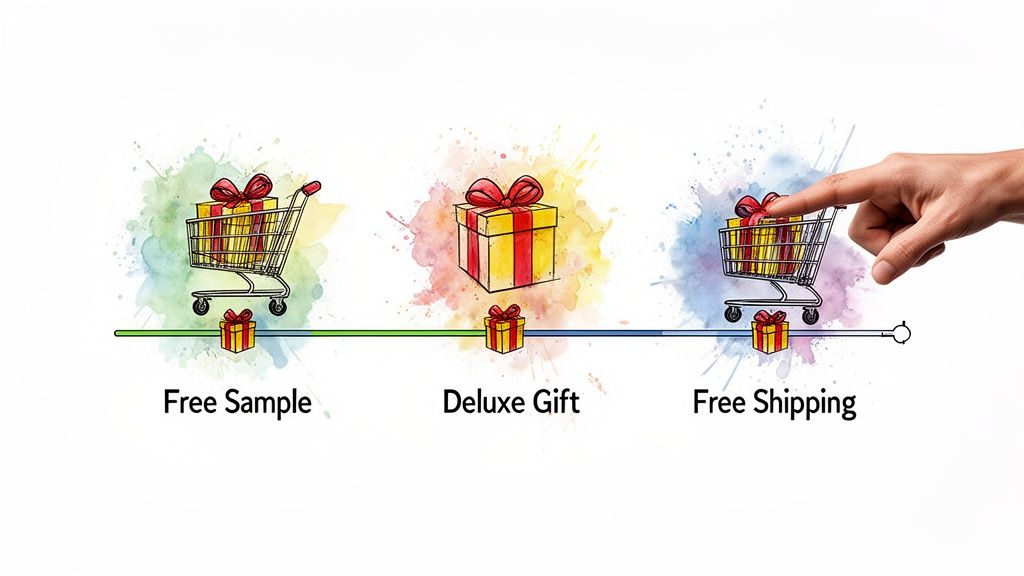
This approach is all about boosting your AOV and lifetime value without resorting to those margin-killing, store-wide discounts. You’re rewarding customers for their engagement, not just for clicking "buy."
Using Progressive Reward Tiers
Progressive rewards create a clear "spend-more-get-more" journey that customers instantly understand. The concept is simple: the more a customer adds to their cart, the cooler the rewards they unlock. This gives them a compelling, tangible reason to increase their order value right then and there.
A typical tiered system might look something like this:
Tier 1 ($50 Cart Value): Unlock a Free Sample of a new product.
Tier 2 ($75 Cart Value): Unlock a Deluxe Gift, like a travel-size bestseller.
Tier 3 ($100 Cart Value): Unlock Free Shipping on the entire order.
This multi-level approach keeps shoppers glued to the cart, constantly showing them the next awesome reward that’s just a few dollars away. It turns the checkout process into a rewarding quest rather than a boring final step.
The Power of a Dynamic Progress Bar
For progressive rewards to really hit home, they have to be visual. This is where a dynamic progress bar inside the cart becomes an absolute game-changer. As a customer adds items, the bar fills up in real-time, showing them exactly how close they are to the next prize.
This visual feedback is everything. It creates a sense of anticipation and urgency, motivating shoppers to close that small spending gap to unlock their reward. It answers the question, "What do I get if I spend just a little more?" in a clear, compelling, and immediate way.
This is a core feature in a specialized tool like Monster Cart, which can transform the standard Shopify cart into an interactive rewards engine. That progress bar makes the whole experience feel more tangible and gets shoppers thinking about what else they can add to hit that next tier.
Stacking Offers for Irresistible Value
Once you’ve got a tiered reward system running, you can take things a step further with offer stacking. This is an advanced strategy where you let customers combine multiple rewards to create a high-value package that feels too good to ignore. It’s the ultimate way to boost AOV without ever touching a discount code.
For example, a customer in a single cart could qualify for:
A free gift for spending over $75.
Free shipping for reaching the $100 threshold.
A one-click product add-on like shipping insurance.
When you present these offers together in a seamless slide-out cart, you create a deal that feels incredible. The customer feels like they are getting a massive amount of extra value, which solidifies their decision to buy. This focus on adding value instead of subtracting from the price is the secret to building a sustainable and profitable e-commerce strategy that puts long-term customer relationships first.
Measuring Success And Optimizing Your Offers
Launching your upsell and cross-sell strategy is just the start. The real growth happens when you start digging into the data to see what’s working, what’s not, and how to make your next offer even better. A great strategy is a measured one, and tracking the right numbers is the only way to move from guesswork to predictable growth.
The goal isn't just a one-time sales bump. It’s about sustainably boosting your Average Order Value (AOV) and building the kind of customer relationships that last. By focusing on the right metrics, you can make sure your offers are adding real value to the customer experience, not just giving away profit.
Key Performance Indicators to Monitor
To get a clear picture of how your offers are doing, you need to keep a close eye on a few essential Key Performance Indicators (KPIs). These numbers tell the true story.
Average Order Value (AOV): This is your north star. Is your AOV actually going up after launching your new offers? This tells you, flat out, if customers are spending more per order.
Offer Conversion Rate: What percentage of customers who see an offer actually take it? A low rate might mean your offer isn't compelling enough, or maybe you're showing it at the wrong moment.
Customer Lifetime Value (LTV): This is the long-term prize. Are customers who grab your value-add offers (like a free gift) coming back to shop more often than those who just get a discount? A rising LTV is proof that your strategy is building real loyalty.
A/B Testing Your Way to Profitability
Once you're tracking these KPIs, you can start fine-tuning your approach. A/B testing is your most powerful tool for this. It lets you test different offer variations against each other to see what truly clicks with your audience. Don't just guess what customers want—let the data tell you.
For example, you could test two different rewards at the same $100 spending threshold:
Offer A: Spend $100 and get a free gift.
Offer B: Spend $100 and get 15% off.
By comparing the AOV and conversion rates for both, you might find that the free gift actually generates a higher overall profit by protecting your margins, even if the conversion rate is a tiny bit lower. This is the kind of insight that builds a sustainable business.
This is where a tool with built-in analytics, like Monster Cart, becomes your secret weapon. It puts the data you need right at your fingertips, making it simple to run tests and dial in your strategy for maximum profitability.
Cross-selling, in particular, is a revenue powerhouse. Research shows that companies using these strategies can see revenue jump by up to 30%, and it can be up to 20 times more effective than upselling alone. And when you consider that your existing customers are 50% more likely to try new products, effective cross-sells are an absolute goldmine. Discover more insights on these cross-selling statistics.
Got Questions? We've Got Answers.
We get it. Diving into the world of upsells and cross-sells can bring up a lot of questions. Here are some of the most common ones we hear from Shopify merchants, with practical answers that put the customer experience—and your profitability—first.
Where’s The Absolute Best Place To Put An Upsell Offer?
The best spot is almost always inside the shopping cart, especially if you're using a modern slide-out cart. Why? Because it’s seamless.
Aggressive pop-ups are the digital equivalent of a pushy salesperson—they’re disruptive and a major cause of cart abandonment. By placing a relevant upgrade or add-on right in the cart, the offer feels like a natural part of the shopping flow, not a jarring interruption.
Should I Offer Rewards Or Discounts?
When in doubt, always lean toward value-add rewards. While a quick discount can sometimes clinch a sale, it’s a slippery slope. It eats into your profit margins and, worse, trains your customers to hold out for the next price drop.
A reward—like a free gift or free shipping—actually boosts the perceived value of the entire order and makes the customer feel genuinely appreciated. This focus on adding value is far more powerful for increasing customer lifetime value (LTV) and building a base of loyal, repeat buyers.
So, Upsells Or Cross-Sells? Which One Should I Use?
The smartest strategy is to use both, just at the right moments. Upsells and cross-sells solve different problems.
Think of it like this: a cross-sell is about completion. It offers a complementary item that makes the main purchase better (like batteries for a new toy). An upsell, on the other hand, is about upgrading. It offers a more premium version of the product the customer is already considering. The trick is to make sure every single offer is genuinely helpful and makes perfect sense with what's already in their cart.
How Can I Do All This Without Hiring A Developer?
Years ago, implementing a sophisticated in-cart rewards system was a complex, code-heavy nightmare. Thankfully, those days are over. Today, the solution is a dedicated Shopify app.
An integrated tool can completely replace your store's basic, default cart with a fully customizable engine built for these kinds of strategies. This lets you set up gamified reward tiers, one-click add-ons, and dynamic progress bars without having to write a single line of code.
Ready to turn your Shopify cart into your best salesperson? Monster Cart makes it incredibly simple to build the kind of seamless, high-converting upsells and cross-sells that customers actually enjoy. Start boosting your AOV today at monsterapps.shop.
Join 7000+ brands using our apps