How to Use "Buy One Get One Free Deals" to Boost AOV, Not Kill Profits
Feb 1, 2026
|
Published
Traditional buy one get one free deals are a retail classic for a reason—they can drive a quick burst of sales. But let's be honest, they often come with a hidden cost: hefty discounts that can quietly chip away at your brand's long-term health and profitability.
While the magnetic pull of "free" is undeniable, leaning too hard on these promotions can slash your profit margins and, worse, attract an army of one-time deal hunters instead of loyal, repeat customers with a high lifetime value. The key isn’t to abandon the BOGO concept entirely, but to evolve it into something much smarter: a rewards-based system designed to boost Average Order Value (AOV) and build lasting customer relationships.
The Hidden Costs of Traditional BOGO Deals
Everyone loves the word "free." It’s one of the most powerful motivators in retail, capable of triggering an emotional, gotta-have-it response that often bypasses rational thinking. But when merchants get stuck in the cycle of standard BOGO promotions, they risk falling into a dangerous discounting trap that can seriously hurt their business.
This knee-jerk reaction is explained by a behavioral quirk called the zero price effect, a phenomenon where our demand for something skyrockets the moment its cost drops to zero. In one famous experiment, researchers found that when a Hershey’s Kiss was offered for free, a whopping 69% of people chose it over a premium Lindt truffle priced at just $0.15. It's proof that the allure of 'free' can make us see value where there isn't any. You can read more about the wild psychology of free on The Hustle.
Eroding Profit Margins
The most immediate danger of a classic BOGO deal is its brutal impact on your bottom line. At its core, giving away a product for free is just a 50% discount on two items. While it might be a quick way to clear out inventory, it can absolutely decimate your profit margins, especially if you’re selling products with a higher cost of goods.
This approach often creates a short-term spike in sales volume but a major drop in overall profitability. You're moving more units but making less money on each and every transaction—a textbook unsustainable model for real growth.
Attracting the Wrong Customers
Deep, frequent discounts tend to attract a very specific kind of shopper: the deal hunter. These customers are loyal to the discount, not to your brand. They show up during a sale and vanish the moment it’s over, contributing next to nothing to your store's customer lifetime value (LTV).
The goal isn't just to make a sale today; it's to acquire a customer who will return and pay full price tomorrow. Traditional BOGO deals often work against this objective by conditioning shoppers to wait for the next promotion.
Building a sustainable, beloved brand is about fostering a community of genuine advocates who value your products for what they are, not just for the markdown.
A Smarter Path to Growth
So, how do you capture all the excitement of "free" without torching your profits? The answer is to shift your strategy from a blanket discount to a targeted, earned reward. Instead of a generic BOGO, try offering a free gift once a customer's cart reaches a specific spending threshold.
This modern approach, powered by in-cart rewards engines like Monster Cart, is a game-changer because it achieves several critical business goals at once:
It boosts Average Order Value (AOV) by encouraging customers to add just one more item to their cart to unlock their reward.
It protects your margins since you control the cost of the gift, often choosing items with a high perceived value but a low actual cost.
It introduces customers to new products, turning a simple reward into a powerful sampling program that can drive future full-price purchases and increase lifetime value.
By reframing the offer this way, you transform a potentially costly discount into a profitable incentive. We dig deep into this topic in our complete guide on how to increase Average Order Value. This method still delivers that "thrill of the hunt" for a freebie, but it does so in a way that aligns with long-term business health and real customer loyalty.
To make the difference crystal clear, let's break down how the old-school approach stacks up against a modern rewards strategy.
Traditional BOGO vs. Modern In-Cart Rewards
The table below highlights the strategic differences between a standard discount-heavy BOGO offer and a modern, AOV-focused rewards system.
Metric | Traditional BOGO Deals | In-Cart Rewards (e.g., Monster Cart) |
|---|---|---|
Primary Goal | Move inventory quickly | Increase Average Order Value (AOV) |
Profit Impact | Significantly reduces margins (often a 50% discount) | Protects margins with a fixed-cost reward |
Customer Type | Attracts one-time deal hunters | Fosters loyalty and increases Lifetime Value (LTV) |
Brand Perception | Can devalue the brand over time | Enhances brand value through generosity |
Upsell Potential | Minimal; encourages buying the cheapest items | High; motivates customers to add items to hit a goal |
Product Discovery | Limited; focused on a specific product | Excellent; introduces new products as gifts |
As you can see, shifting from a simple discount to an earned reward isn't just a minor tweak—it's a fundamental change in strategy. It moves the focus from short-term volume to long-term value, which is where sustainable growth really happens.
Designing Profitable Free Gift Rewards
Moving away from a classic BOGO and into an in-cart rewards system is where you really start turning the psychology of "free" into a powerful business asset. Instead of just slicing your margins in half with a 50% discount, you’re building a smarter, more profitable promotion that actively encourages customers to spend more. This is the blueprint for creating free gift offers that genuinely grow your Average Order Value (AOV) and Customer Lifetime Value (LTV).
The key is to ditch the discount mindset entirely. You're no longer just giving something away for the sake of a sale; you're crafting a rewarding experience that benefits both your customer and your bottom line.
Choosing the Perfect Free Gift
First things first, you need to pick a reward that feels valuable to your customers but is cost-effective for you. The goal is to find an item with a high perceived value, even if its actual cost is quite low. This isn't about being cheap—it's about being strategic.
Here are a few proven ideas for picking a winning free gift:
Travel-Sized Bestsellers: Customers already love these products. Offering a smaller version is a perfect, low-cost way to give them something they genuinely want.
New Product Samples: Use your rewards program as a discovery engine. Offering a new serum or accessory as a gift is a brilliant way to get it into customers' hands and generate organic buzz.
Complementary Accessories: Did a customer just buy a new handbag? Offer a matching cardholder as a gift. It enhances the primary purchase and feels like a thoughtful, curated bonus.
Slow-Moving Inventory: Turn that excess stock into a marketing asset. Clearing out older inventory as a free gift is far more profitable than marking it down by 50% or more.
As you design these offers, you can also weave in complementary tactics like maximizing profits with bundling strategies to pump up the perceived value even more.
Setting Smart and Profitable Cart Thresholds
Once you have your gift, the next critical step is setting the spending goal. This is where you directly influence AOV. Set the bar too high, and you'll discourage shoppers. Set it too low, and you’ll give away products without getting a meaningful lift in what they spend.
The sweet spot is usually 20-30% above your current AOV. For example, if your average order is around $60, setting a free gift threshold at $75 presents an achievable and enticing goal. A customer with $62 in their cart is highly likely to add one more small item to unlock a valuable reward.
This is where an in-cart rewards engine like Monster Cart really shines. It visualizes the journey for the customer, right there in the slide-out cart.
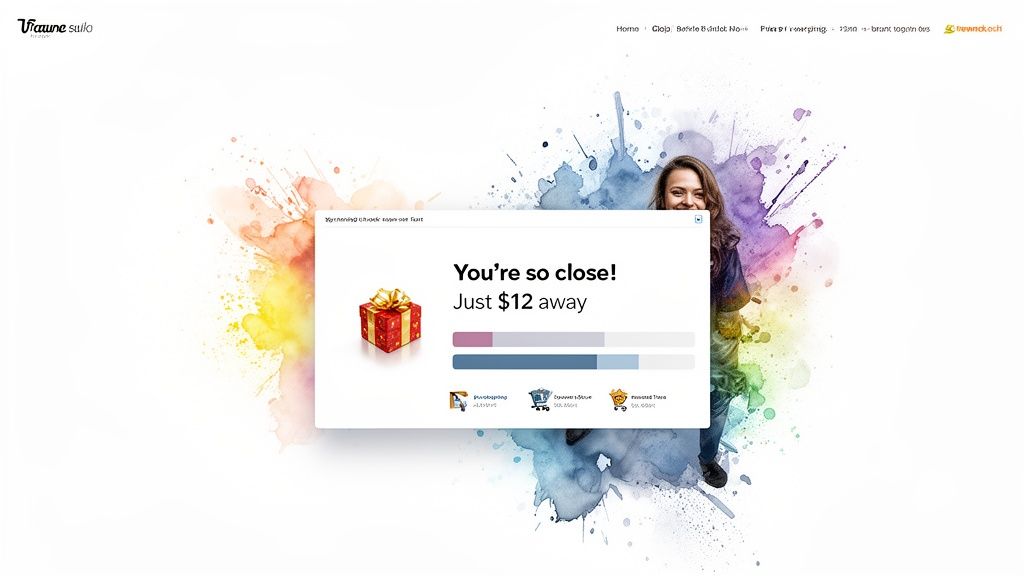
The progress bar in the image above acts as a mini-game inside the cart. This clear, real-time feedback is incredibly motivating and transforms a simple purchase into an engaging experience.
Gamifying the Experience with Tiered Rewards
Why stop at just one reward? Tiered offers are an incredibly powerful way to push AOV even higher by creating multiple goals for your most engaged shoppers. You can build a ladder of incentives where the rewards get better as the customer spends more.
A tiered system turns a single transaction into a rewarding journey. It gamifies the shopping cart, making customers feel like they are leveling up with every dollar they spend.
Here’s what a real-world tiered reward structure could look like:
Spend $75, Unlock: Free Shipping
Spend $100, Unlock: A Free Radiance Serum (Sample Size)
Spend $150, Unlock: A Full-Size Radiance Serum + Free Shipping
This structure doesn't just offer a single reward; it creates an entire incentive system inside the cart. Customers can clearly see what’s next, encouraging them to add more to their order to reach that next exciting milestone. This approach is far more dynamic and profitable than a simple buy one get one free deal. To learn more about this strategy, you can explore our detailed guide on using a free gift on Shopify to its full potential.
Alright, let’s bring this section to life. You’ve done the strategic thinking, and now it’s time for the fun part: actually building the in-cart engine that will turn those plans into profit. This is where we move from the drawing board to the real world, setting up a system that bumps up spending without getting in your customer’s way.
With a tool like Monster Cart, you can build this entire experience right inside the cart drawer. It becomes a seamless, interactive part of the shopping flow.
We’re ditching the annoying pop-ups that interrupt and irritate. The goal here is a subtle, motivating system that naturally guides customers toward your spending goals. It’s all about configuring a few key pieces that work together to create a powerful incentive loop.
The whole process is surprisingly straightforward when you have the right tools. It really boils down to three simple steps: pick a great gift, set a clear goal, and launch the campaign.
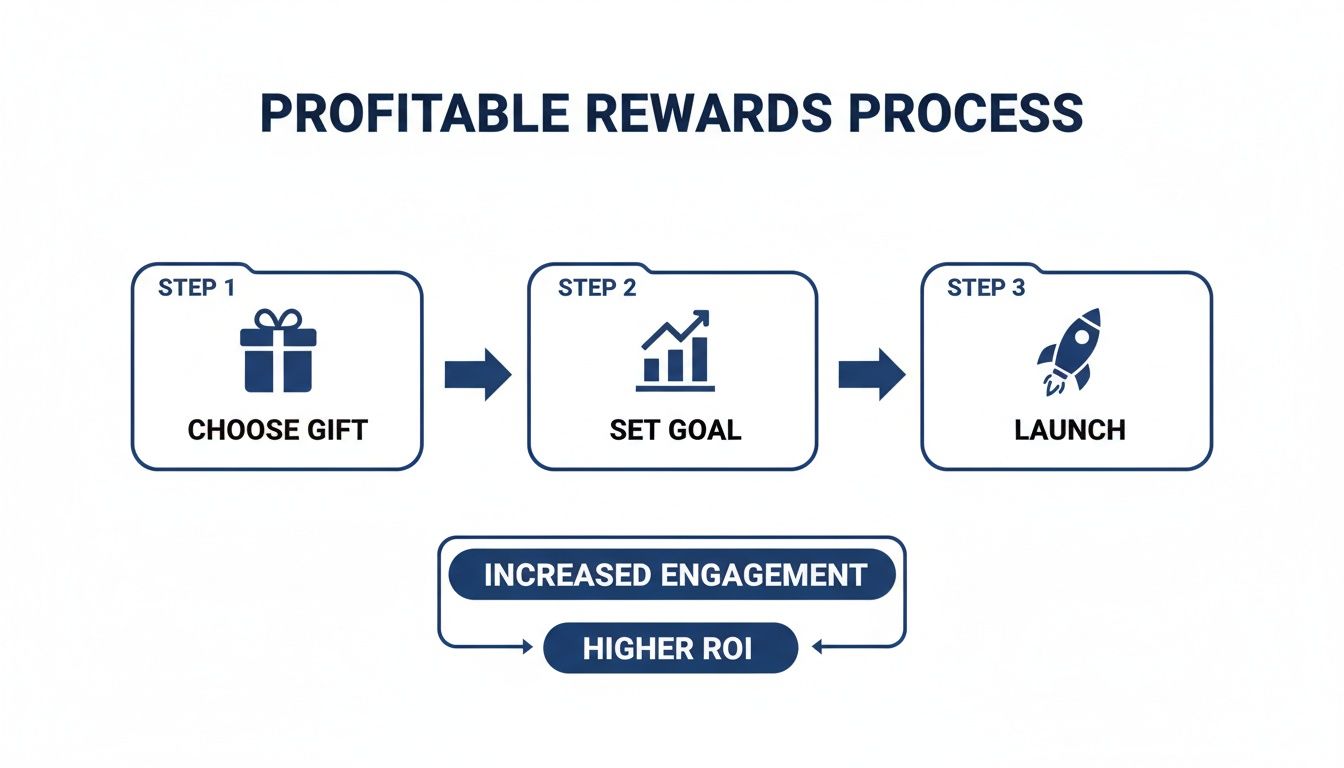
As you can see, a killer campaign isn’t about complexity. It’s about making smart choices upfront that lock in profitability and get customers excited from the jump.
Configuring Your Spending Goals and Rewards
First things first, you need to set the rules of the game inside your in-cart rewards app. This involves two main settings: the spending threshold and the reward itself. Based on our strategy earlier, you’ll want to set a spending goal that’s roughly 20-30% higher than your current AOV. This makes the reward feel challenging but totally achievable.
Next, you'll pick the free product they get. This is where your homework on choosing a high-perceived-value, low-cost item pays off. Inside an app like Monster Cart, it’s as simple as selecting the exact product variant you want to give away.
Once that's set up, the system handles the rest. The moment a customer’s cart total ticks over your threshold, the free gift automatically appears in their cart. No coupon codes, no extra clicks. This lack of friction is huge for keeping conversion rates high.
Designing an Interactive Progress Bar
The visual progress bar is the heart and soul of this in-cart experience. It’s a powerful psychological trigger that gamifies the act of shopping. As customers add items, they see the bar fill up in real time, showing them exactly how close they are to unlocking that reward.
This instant feedback builds a sense of momentum. It taps into that universal human desire to finish what we’ve started, making shoppers far more likely to toss one more item in their cart to get across the finish line.
An in-cart progress bar does more than just display information; it creates an emotional investment in the purchase. Customers are no longer just buying products—they are working towards a tangible reward.
Getting the design right is key. You can customize the colors and text to perfectly match your brand, making the entire experience feel native to your store. This level of polish is what separates a smooth, brand-enhancing upsell from a generic, third-party pop-up. If you're looking for more ways to present offers, take a look at our guide on the best upsell apps for Shopify.
Crafting Compelling Microcopy That Converts
While the progress bar shows them the way, the right words create the urgency. Your in-cart messaging—or microcopy—needs to be clear, encouraging, and action-oriented. Ditch the generic phrases and use copy that speaks directly to their progress.
Here are a few proven templates that work wonders in the cart drawer:
When they are close: "You're so close! Just $12 away from your free gift!"
Initial prompt: "Spend $75 and get a free Radiance Serum!"
When the reward is unlocked: "Congratulations! You've unlocked your free gift."
These short, punchy messages guide the customer without feeling pushy. They build excitement and turn a standard checkout into a more dynamic, rewarding interaction. This is a much smarter way to increase order value than traditional buy one get one free deals, which often just slice into your margin without actually growing the cart total.
The power of "free" is undeniable. BOGO deals account for 80% of all free offers and see a whopping 93% shopper usage. Research has shown time and again that a free item often outperforms an equivalent discount. One study found that 73% more hand lotion was sold in bonus packs compared to discounted ones, proving just how much we love a zero-price perk.
An amazing offer can completely miss the mark if the experience feels clunky or confusing. The real power of moving beyond traditional buy one get one free deals comes to life right inside the cart. This is your chance to turn a simple transaction into an engaging, rewarding journey that naturally guides customers toward a higher spend.
The goal is to make your cart the most exciting part of your store, not just a boring final step. This means getting obsessed with the small user experience (UX) and creative details that make your in-cart rewards feel special and downright irresistible.
Designing a Seamless In-Cart Journey
First things first, the cart experience has to feel native to your brand, not like a third-party app you just bolted on. A slide-out cart, like the one powered by Monster Cart, gets rid of the standard, jarring trip to a separate cart page. This keeps the customer in the shopping flow, making it dead simple for them to add more items without losing their momentum.
Your design should be a seamless extension of your store. Use your brand’s fonts, colors, and overall vibe to create a cohesive look. Most importantly, show off the free gift with a high-quality product image. Don’t just mention it in a line of text; let them see exactly what they’re so close to getting. A great visual is always more motivating than words alone.
Turning Shopping into a Game with Progress Bars
The interactive progress bar is really the heart of a high-converting cart. It gamifies the entire experience by giving shoppers a clear goal and instant feedback on how close they are. As they add items, the bar fills up, creating a powerful sense of forward motion.
This simple visual tool taps into a psychological trigger known as the goal-gradient effect—the closer we get to a goal, the more motivated we are to finish. Seeing a message like, "You're only $10 away!" is an incredibly powerful nudge to add one last thing to their order.
Your cart should not be a passive list of products. It should be an active, motivating engine that encourages customers to reach for the next reward, boosting AOV and their overall satisfaction.
This kind of subtle encouragement is so much more effective than a disruptive pop-up. It respects the customer's journey while perfectly aligning their actions with your business goals.
Stacking Offers to Maximize AOV
Why stop at just one reward? The in-cart experience is the perfect place to stack multiple offers, creating a ladder of incentives that can seriously pump up the final order value. This is where you graduate from simple discounts and start thinking about total customer value.
For example, you can combine a free gift offer with a free shipping threshold. A customer might add an item to unlock their gift, only to realize they're now just a few dollars away from getting free shipping, too. It’s a powerful, multi-layered incentive to keep adding to their cart.
Here’s what a smart offer stack could look like:
Tier 1 (Spend $75): Unlock a Free Mini-Serum
Tier 2 (Spend $100): Unlock Free Shipping
This approach rewards customers at multiple levels, making them feel genuinely valued while you systematically boost your AOV.
Using Microcopy to Motivate and Convert
The words you use in the cart are just as crucial as the visuals. Good microcopy is clear, concise, and motivating. It guides the customer through the reward journey, building a sense of excitement and a little bit of urgency.
The table below breaks down some examples of effective copy you can use at each stage of the in-cart journey.
Key Copy Elements for In-Cart Rewards
Stage | Example Copy | Psychological Trigger |
|---|---|---|
Initial State | "Spend $50 to unlock a free gift!" | Goal Setting: Gives the user a clear, immediate target. |
Mid-Progress | "You're only $12.50 away from your reward!" | Goal-Gradient Effect: Creates urgency as they get closer. |
Reward Unlocked | "Success! You've unlocked your free gift!" | Positive Reinforcement: Confirms their achievement and adds delight. |
Next Tier Nudge | "Spend $25 more to also get Free Shipping." | Upsell: Introduces a new, higher-value goal. |
Getting these small text snippets right is critical for a smooth and persuasive experience.
To truly optimize your cart, it's essential to understand the impact of discounts and promotions on cart recovery. Your copy can be the tipping point between an abandoned cart and a completed, higher-value purchase. At the end of the day, you should be focused on boosting lifetime value, not just making a single, heavily discounted sale. Tools like Monster Cart help you do exactly that by building rewards right into the shopping journey.
Measuring and Optimizing Your Reward Strategy
Launching your in-cart reward strategy is a huge first step, but the real growth happens when you start listening to your data. If you can’t measure your efforts, you can't improve them. This is where we shift from setup to a continuous cycle of data-driven optimization, making sure your offers don’t just drive sales but build a healthier, more profitable business for the long haul.
This data-first approach moves beyond surface-level metrics like how many gifts were claimed. We need to focus on the key performance indicators (KPIs) that truly matter: Average Order Value (AOV), profit margin per order, and, most importantly, Customer Lifetime Value (LTV). By tracking these, you can avoid the classic pitfall of hefty discounts that erode your margins and instead build a system that rewards customers while growing your bottom line.
Identifying the KPIs That Truly Matter
To know if your strategy is actually working, you have to track the right numbers. Seeing a lot of customers claim a free gift is exciting, but it doesn't tell the whole story.
Let's focus on the metrics that reveal the true health of your reward strategy:
Average Order Value (AOV): This is your primary metric. Is your free gift threshold successfully encouraging customers to add more to their cart? A rising AOV is the clearest sign your strategy is working as intended.
Profit Margin Per Order: This one is crucial. You absolutely must ensure the cost of the free gift isn't erasing the profit from the increased order value. Calculate your margin on orders with a free gift versus those without to confirm profitability.
Customer Lifetime Value (LTV): This is the long game. Are customers who receive a free gift returning to shop again? A smart rewards program should turn a first-time buyer into a loyal, repeat customer, significantly boosting their LTV.
Focusing on these three pillars ensures you’re not just giving things away. You are strategically investing in customer relationships and sustainable growth, a far cry from the margin-crushing impact of many traditional buy one get one free deals.
Analyzing Your Results for Smarter Decisions
With your key metrics in hand, you can start digging into the data to find out what truly resonates with your audience. Which gifts are driving the biggest AOV lift? Which spending thresholds are hitting that sweet spot between being motivating and being profitable?
Your data is a roadmap to your customers' desires. Analyzing it allows you to stop guessing and start making informed decisions that directly impact your revenue and customer loyalty.
For instance, you might discover that a free travel-sized version of your bestselling serum (low cost, high perceived value) dramatically outperforms a more expensive accessory. This insight is gold. It tells you exactly what kind of rewards motivate your customers to spend more, allowing you to refine your future offers for maximum impact. This is precisely the kind of strategic thinking that an in-cart rewards engine like Monster Cart facilitates through its analytics.
The Power of A/B Testing Your Offers
Once you have a baseline, the next step is to start testing. Continuous optimization through A/B testing is how you turn a good reward strategy into a great one. Don't just set it and forget it.
Here are a few simple but powerful A/B tests you can run:
Test Different Reward Products: Pit two different free gifts against each other at the same spending threshold. Does a new product sample perform better than a classic bestseller?
Test Spending Thresholds: Try setting your goal slightly higher or lower. Does a $75 threshold convert better than a $65 one? Analyze both the conversion rate and the final AOV to find your store’s ideal number.
Test Promotional Copy: Experiment with the microcopy in your cart. Does "You're so close!" create more urgency than "Spend $15 more to unlock..."? Small wording changes can have a surprisingly large effect on behavior.
The concept of using "free" to drive massive adoption is nothing new. Coca-Cola famously launched the coupon era by giving away vouchers for a free glass of Coke. This led to an incredible 8,500,000 free drinks redeemed between 1894 and 1913, helping propel the brand into every U.S. state. Today, BOGO-style deals make up around 80% of all 'free' promotions globally. You can discover more insights about the history of BOGO deals and their modern applications on Talon.One.
By adopting a mindset of constant measurement and refinement, you ensure your reward strategy evolves with your customers. This data-backed approach guarantees you're not just making sales—you're building a smarter, more resilient, and more profitable business, one optimized offer at a time.
Common Questions About Profitable BOGO Deals
Pivoting from old-school BOGO discounts to a modern, AOV-focused rewards strategy can feel like a big leap. I get it. Merchants often wonder if giving up the familiar buy one get one free deals is the right move for their bottom line.
Let's walk through the most common concerns. My goal is to clear up any confusion and show you exactly why this strategic shift is so powerful for long-term, sustainable growth. This isn't about killing the thrill of a great deal; it's about making that deal work a whole lot harder for your business.
Are Free Gift Offers Really More Profitable Than a 50% Off BOGO Sale?
Without a doubt, and the difference is massive. A classic BOGO deal is just a 50% discount in disguise. It sounds great, but it can absolutely wreck your revenue and profit margins, especially on your higher-cost products. You end up moving more units but making way less on each sale.
With a strategic free gift, you're back in the driver's seat. You choose a gift with a high perceived value but a low cost to your business and then set a minimum spend to unlock it. This simple move accomplishes two critical things:
You protect your profit margins by fixing the exact cost of the promotion.
You actively drive up the total cart value, giving your Average Order Value (AOV) a serious boost.
Plus, you get the added bonus of introducing customers to new products, which often leads to them coming back to buy the full-size version later on, increasing their lifetime value.
What Kind of Products Work Best as a Free Gift?
The best free gifts feel like a genuine reward, not just a cheap toss-in. You want to delight your customer while keeping your own costs in check.
Here are a few categories I've seen work incredibly well:
High Perceived Value, Low Cost: Think travel-sized versions of your bestsellers, a slick accessory that complements a main product, or even a digital download like an e-book.
New Product Samples: This is a brilliant tactic. You're basically running a highly targeted sampling campaign to get a new product into your customers' hands, generating buzz and feedback without a separate marketing budget.
Excess Inventory: Got some slow-moving stock? Turn it into a powerful marketing tool. Offering it as a free gift is always more profitable than slapping a deep clearance sticker on it.
The best gift feels like a thoughtful bonus, not a sales gimmick. It should enhance the customer's experience with your brand and make them feel valued for spending a little extra.
At the end of the day, the gift should fit your brand and be something a wide range of your customers would actually want.
How Do I Promote In-Cart Offers Without Annoying Pop-Ups?
This is where the beauty of an in-cart rewards engine really shines. Forget those disruptive, full-screen pop-ups that kill the shopping vibe and frustrate users. The promotion should feel like a natural, helpful part of the buying journey.
Start with a simple, site-wide announcement bar at the top of your store. Something like, "Free Gift with all orders over $75!" sets the expectation without ever getting in the way.
But the real magic happens right inside the cart. As soon as a customer adds an item, an interactive progress bar and clear messaging can appear in the cart drawer. This visual guide shows them exactly how close they are to unlocking their reward. It’s a subtle, gamified approach that builds excitement and encourages a higher spend without causing any friction. With a tool like Monster Cart, this entire experience is seamless.
How Do I Set the Right Spending Threshold for My Free Gift?
Figuring out the right spending goal is a bit of an art, but it should always start with science—your data. First thing's first: calculate your store's current Average Order Value (AOV). A great starting point for your free gift threshold is about 20-30% higher than that number.
For example, if your AOV is sitting at $60, setting the threshold at $75 creates an achievable, tempting goal. It encourages shoppers to just add one more small item to their cart to get their reward.
You also have to factor in the cost of the gift to make sure every single redeemed offer is profitable. And don't be afraid to test different thresholds. Analyze the results to find that sweet spot that gives you the best lift in AOV while protecting your profit margins.
Ready to transform your cart into a profit engine? With Monster Cart, you can build a fully branded, in-cart rewards experience that boosts AOV without hefty discounts. Ditch the annoying pop-ups and guide your customers to higher spending with interactive progress bars, tiered rewards, and seamless one-click upsells. Join over 7,000 Shopify brands and see why they trust Monster Cart to create a smarter, more profitable checkout journey. Learn more and get started at https://monsterapps.shop.
Join 7000+ brands using our apps