A Guide to Conversion Optimization Shopify for Higher Revenue
Jan 23, 2026
|
Published
When we talk about Shopify conversion optimization, we're not just talking about getting one more sale. We're talking about getting the most out of every single cart and turning first-time buyers into loyal fans. This playbook isn't about the old, tired strategy of throwing hefty discount codes around until your margins evaporate.
Instead, we'll dig into a much smarter approach: creating an in-cart experience so rewarding that customers want to spend more, boosting not just Average Order Value (AOV) but also their lifetime value.
Rethinking Shopify Conversion Optimization Beyond Discounts
For years, the go-to move for Shopify stores was aggressive pop-ups and endless discount codes. Sure, those tactics can give you a quick sales bump, but they're a fast track to the bottom. You end up training your customers to never pay full price, which is a dangerous game for long-term brand health.
This chips away at your Average Order Value (AOV) and, more importantly, eats into your lifetime value and profitability.
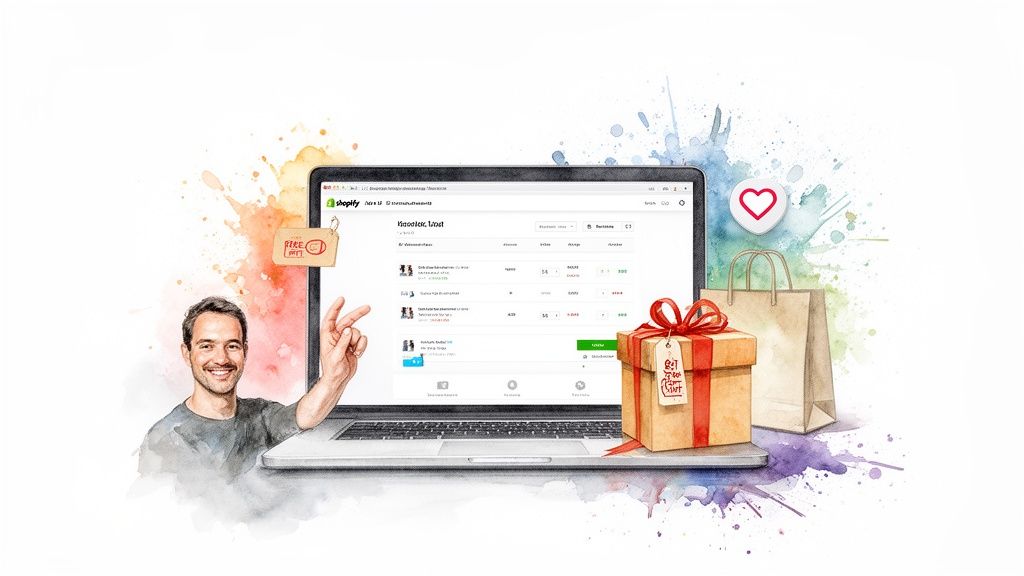
A far more powerful strategy is to stop offering hefty discounts and start rewarding. Instead of just giving away margin, you can gamify the shopping experience with perks like free shipping or a free gift, encouraging customers to add just one more item to unlock a genuinely valuable reward.
Building Value Instead of Offering Discounts
The goal here is to transform your cart from a boring checkout page into a dynamic rewards engine. These offers should feel like a natural part of shopping, not some disruptive sales pitch. Think about it from the customer’s point of view: unlocking a cool free gift feels earned and exciting, while a 10% off coupon just feels expected.
This method completely upgrades the shopping experience by:
Increasing Perceived Value: A free gift or complimentary shipping often feels way more valuable to a customer than a small percentage off.
Boosting AOV Naturally: Customers are genuinely motivated to add that one last item to their cart to hit a reward threshold.
Fostering Real Loyalty: Rewards create positive, memorable moments with your brand, which is exactly what brings people back for another purchase.
By focusing on lifetime value, you're not just optimizing for a single transaction. You're building a sustainable business where customers return because they love the experience you provide—not just because they're hunting for the lowest price.
The Power of an Interactive Cart
To really nail conversion optimization on Shopify, you need a solid foundation. An insightful guide on the dos and don'ts of building your Shopify store is a great place to start. Once that’s handled, you can really elevate the experience.
Imagine a cart that visually updates as shoppers add items, showing them their progress toward the next reward. A tool like Monster Cart makes this a reality, swapping Shopify's basic cart with a fully branded, interactive slide-cart that's designed to implement these reward-based strategies without hefty discounts.
This approach keeps the customer engaged and motivated. The simple act of adding an item to the cart becomes a fun little journey toward unlocking the next great perk.
Finding and Fixing the Hidden Revenue Leaks in Your Store
Before you can even think about advanced conversion strategies, you have to plug the holes that are sinking your sales right now. So many Shopify stores unknowingly leak revenue from dozens of tiny friction points in their sales funnel, especially in the cart and checkout. Fixing these is almost always the fastest way to see a meaningful lift in your numbers.
The gap between an average store and a top-performing one is staggering. The typical Shopify store converts at just 1.4%, but the top 10% of merchants are hitting 4.7% or higher. That’s not a small difference—it’s a massive opportunity that most stores are leaving on the table.
Identifying the Common Culprits
So, where is all this money going? The problems are usually hiding in plain sight, frustrating your customers just enough to make them bounce. For a lot of stores, the biggest offender is simply a high cart abandonment rate. If you can learn how to reduce cart abandonment, you’ll make an immediate impact on your bottom line.
These are the friction points I see time and time again:
Surprise Shipping Costs: This is the undisputed champion of conversion killers. A customer is mentally ready to pay one price, then gets ambushed with an unexpected shipping fee at the very last second. It feels like a bait-and-switch.
A Clunky Checkout Process: Too many steps, pointless form fields, or no guest checkout option—these are all roadblocks that can easily derail a motivated buyer.
A Painful Mobile Experience: Most of your traffic is probably on a phone. If your cart is slow, hard to navigate, or just plain broken on a small screen, you’re practically handing sales to your competitors.
Using Data to Uncover Friction
The good news is you don’t have to guess where your store is bleeding cash. You can use simple tools to see exactly where people are getting stuck. Heatmaps will show you where users are clicking (and, more importantly, where they aren't), while session recordings let you watch anonymized user journeys to pinpoint the exact moment they get frustrated and leave.
This isn’t about a massive, expensive store overhaul. The whole idea is that small, strategic fixes—inspired by how the top-tier stores operate—can lead to dramatic gains in revenue.
The goal is to make the path from adding an item to the cart to completing the purchase as seamless and rewarding as possible. Every obstacle you remove is a potential sale saved.
But why just fix what’s broken when you can proactively make the experience better? Take shipping costs. Instead of just getting rid of the surprise fee, you can flip it into a reward. A progress bar in the cart that shows, "You're only $15 away from free shipping!" transforms a negative into a positive, AOV-boosting incentive. This builds a better customer relationship, encouraging higher lifetime value.
This is exactly where a dynamic tool like Monster Cart comes in. It lets you build these kinds of rewarding, gamified experiences directly into your cart flow, turning would-be lost sales into bigger orders from happier customers.
How to Build an In-Cart Rewards System That Boosts AOV
Once you've plugged the obvious leaks in your checkout flow, it's time to shift from fixing problems to proactively adding value. This is where a smart in-cart rewards system comes in, transforming your shopping cart from a boring transaction summary into an interactive engine for boosting AOV and lifetime value.
The trick is to reframe the customer's mindset. You want them thinking less about "How much can I save with a discount?" and more about "What cool stuff can I earn?"
You do this by turning the shopping experience into a mini-game. Instead of just slapping a hefty discount code on their order, you create a clear, visual path to a genuinely valuable reward like a free gift or free shipping. This simple psychological shift encourages shoppers to add just one more item to their cart to hit the next milestone, boosting the perceived value of their purchase without gutting your margins.
The Psychology of Gamification in Ecommerce
It really comes down to a basic human driver: we're motivated by progress. When a customer can see exactly how close they are to unlocking a reward—like free shipping or an exclusive gift—it creates a powerful reason for them to bump up their order value. This isn't some pushy sales tactic; it's a positive incentive that makes the whole journey more engaging.
Imagine a skincare brand offering a free travel-size serum on orders over $75. As a customer adds products, a progress bar right inside the cart drawer updates in real-time, showing them they're only "$20 away from your free gift!" This creates a small, fun challenge that turns a passive shopping session into an active goal.
The best rewards systems make customers feel like they've earned a special perk, not just redeemed a coupon. This builds a much stronger emotional connection to your brand and pays dividends in long-term customer lifetime value.
But before you start layering on new features, you have to make sure your foundation is solid. A clunky user experience will kill your conversion rate, no matter how great your offers are. It's crucial to first identify, diagnose, and fix any friction points that might be causing revenue leaks.
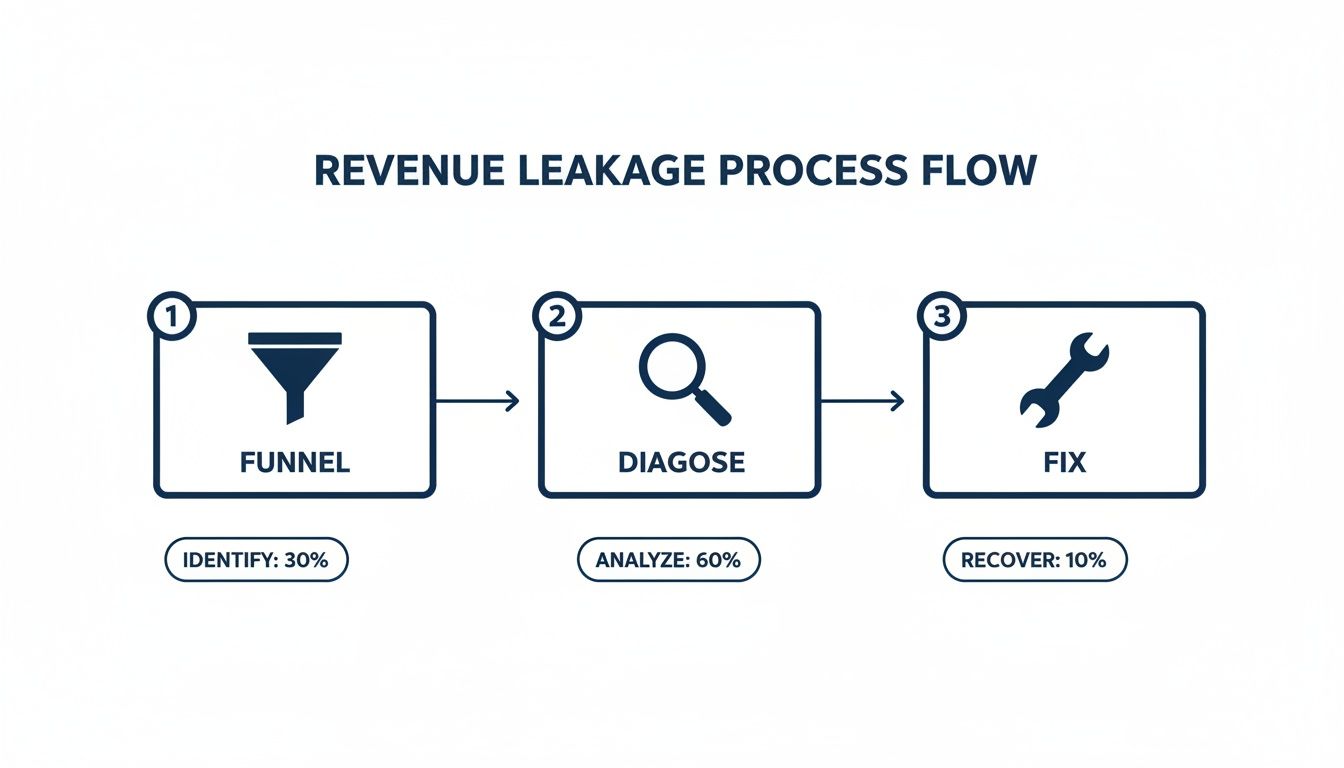
This framework is a reminder to shore up your defenses first. Find and resolve existing issues before you start building out exciting new strategies like in-cart rewards.
Designing High-Impact Reward Tiers
A truly effective rewards system should feel like a native part of your store, not some clunky third-party app that was bolted on as an afterthought. The goal is to replace Shopify's default cart with a dynamic, on-brand slide-out cart that can handle these promotions automatically and elegantly.
This is exactly what a tool like Monster Cart is designed for. It gives you the power to build sophisticated, tiered reward campaigns that customers actually enjoy interacting with.
Here’s a look at a few high-impact reward strategies you can roll out quickly.
High-Impact In-Cart Reward Strategies
These in-cart strategies are designed to boost AOV by gamifying the shopping experience. Each one targets a slightly different customer motivation, from saving money on shipping to earning an exclusive product.
Reward Strategy | Primary Goal | Best For | Example Implementation |
|---|---|---|---|
Spend-to-Unlock | Increase AOV | Stores with a clear average order value and a desire to nudge customers to spend 15-30% more. | "Spend $50 and get Free Shipping!" then "Spend $100 to unlock an exclusive Free Gift!" |
Progressive Rewards | Maximize Cart Value & LTV | Brands with a wide range of products and price points, encouraging larger, consolidated purchases. | "Unlock 10% off at $75, 15% off at $125, and 20% off at $175!" shown on a progress bar. |
Free Gift with Purchase | Boost AOV & Move Inventory | Businesses looking to introduce new products, clear out excess stock, or add significant perceived value. | "Add any two serums to your cart and get a free Jade Roller instantly!" |
By building these offers directly into the cart, you make the whole experience interactive. Customers can see their progress in real-time, which gives them a powerful motivation to hit that next spending goal before they even start the checkout process.
Here are a few proven reward models to get you started:
Spend-to-Unlock Tiers: The classic "Spend X, Get Y" model is a workhorse for a reason. You can create multiple tiers that stack, like "Spend $50 for Free Shipping" and "Spend $100 for a Free Gift," creating a ladder of incentives.
Progressive Rewards: This is a "Buy More, Save More" offer framed as a rewarding challenge. For instance, a customer might unlock a 10% discount at $75, which then bumps up to 15% at $125, all shown on a slick visual progress bar.
Free Gift with Purchase: This is a fantastic strategy for boosting AOV and strategically moving specific inventory. You can learn more about how to set up a powerful Shopify app for a free gift to get the most out of this tactic.
Making Strategic Upsells Without Annoying Your Customers
A great upsell should feel less like a sales pitch and more like a helpful recommendation from someone who knows their stuff. This is the secret sauce for any serious conversion optimization Shopify strategy. The idea is to present relevant, subtle offers right inside the cart, making it easy for customers to add more value to their order without ever feeling pressured.
This is all about shifting your mindset away from aggressive, hefty discounts and toward strategic rewards that are a win-win. The most successful brands I've seen focus on lifting their Average Order Value (AOV) by making the shopping experience better, which naturally leads to higher customer lifetime value. You’re not just trying to close a sale; you're building a smarter cart.
Making Offers Customers Actually Want
The whole game hinges on one word: relevance. A generic, poorly timed offer just feels pushy and can send a customer running for the digital door. But a thoughtful suggestion that makes perfect sense with what's already in their cart? That’s just good service.
Here are a couple of low-friction strategies that just plain work:
'Frequently Bought Together' Suggestions: This is a classic for a reason. If someone buys a new camera, suggesting a memory card and a case isn't just an upsell—it's helping them complete their purchase. The offer is logical and genuinely useful.
One-Click Service Add-ons: Small, convenient additions can give your AOV a nice bump with almost zero effort from the customer. Offering things like shipping protection, gift wrapping, or priority processing are perfect impulse buys that add clear value.
When an offer enhances the primary purchase, it stops feeling like an upsell and starts feeling like part of a premium, personalized shopping experience. This subtle shift is what separates high-converting stores from the rest.
Understanding the fine art of presenting these offers is a big deal. If you want to get into the weeds, you can learn more about the key differences between cross-selling and upselling and figure out which tactic to use when.
Integrating Upsells into the Cart Flow
The single biggest mistake stores make is forcing customers to leave the cart to add these suggested items. Any click that disrupts the path to checkout adds friction and dramatically increases the risk of abandonment. The only way to do this right is to build these offers directly into an in-cart experience, like a slide-out cart.
This is where a tool like Monster Cart really shines. It lets you build these recommendations right into the cart drawer itself. A customer can see a 'Frequently Bought Together' bundle or add shipping protection with a single click, all without ever navigating away from the cart.
Their cart total updates instantly, and they can head straight to checkout without any interruptions. This seamless flow makes the whole process feel effortless and native to your store, turning simple suggestions into a powerful and reliable revenue stream.
Closing the Mobile Conversion Gap for More Sales
Take a look at your Shopify analytics. Most of your traffic is probably coming from a phone, right? Now look at your sales data. I’m willing to bet it tells a very different story.
This gap between mobile traffic and mobile sales is one of the biggest—and most overlooked—opportunities for any Shopify store. A clunky, slow, or confusing mobile cart is a conversion killer, turning interested shoppers into abandoned carts faster than you can say "friction."
The data paints a pretty stark picture. The average mobile conversion rate on Shopify hovers at a dismal 1.2%. But here's the kicker: the top 20% of stores are hitting 3.9% on mobile. That means the best merchants are converting mobile shoppers at over three times the platform average.
That isn't a small gap. It's a massive, flashing sign pointing to a huge opportunity. For more on these benchmarks, you can discover more insights about Shopify statistics on ecommercetrix.com.
Optimizing the Mobile Cart Experience
Fixing this isn't about some massive, store-wide redesign. It’s about focusing on the small details that make a huge difference when your entire store is condensed onto a 6-inch screen. The goal is to create a totally frictionless journey from adding a product to checking out, all with a thumb.
Think about your own mobile cart right now. Is it easy to use? Fast? Or does it feel like a clunky afterthought ported over from the desktop site?
Here's where to put your focus for a much better mobile experience:
Make Buttons Easy to Tap: Tiny, hard-to-press buttons are a one-way ticket to frustration. Make sure your "Add to Cart," "Checkout," and quantity adjusters are big, clear, and have enough breathing room around them to avoid mis-taps.
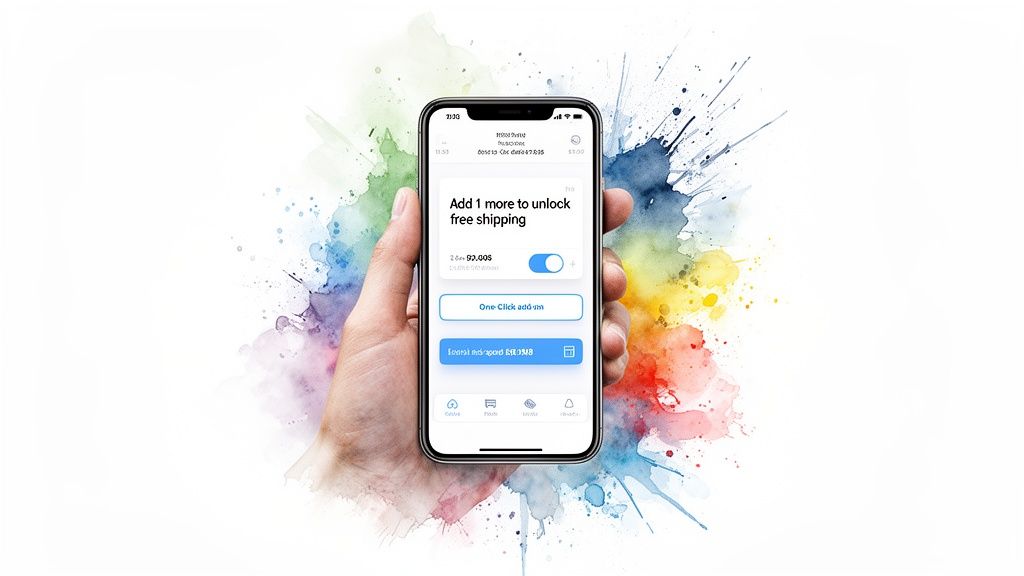
Keep Rewards Front and Center: If you're running in-cart offers like a free shipping bar or a free gift reward, that progress needs to be dead-simple to see on mobile. No one should have to pinch and zoom to figure out how close they are to a reward.
Declutter the Interface: One-click upsells are great for AOV, but they can quickly create a chaotic mess on a small screen. A mobile-first design presents these valuable offers cleanly, so they feel helpful, not overwhelming.
The best mobile carts feel like they were born on the device. They're fast, intuitive, and make it ridiculously easy for a customer to give you their money. Every piece of friction you remove is another sale you just saved.
Why a Mobile-First Slide-Cart Is Essential
Let's be real: traditional pop-ups and full-page cart redirects are poison for mobile conversion rates. They’re disruptive, often slow to load, and can feel completely broken on a phone. This is exactly where an in-cart upsell engine designed specifically for mobile becomes a total game-changer for your Shopify conversion optimization.
An app like Monster Cart was built from the ground up with a mobile-first philosophy. It ditches the standard Shopify cart page for a slick, lightning-fast slide-cart that feels like a native part of your store. This approach keeps the customer in the shopping flow, avoiding that jarring redirect to a whole new page. You can learn more about how to improve your ecommerce conversion rate with these kinds of smart upgrades.
By closing the gap between your desktop and mobile shoppers, you're not just making small tweaks. You're unlocking a significant stream of revenue from the traffic you already have. It's not about finding more customers; it's about serving the ones who are already knocking on your door.
How to Measure Your Success and Refine Your Strategy
Getting your in-cart rewards system live is a huge step, but it’s just the starting line. The real wins in conversion optimization for Shopify come from what you do next: a constant cycle of measuring, learning, and tweaking your approach. If you’re not tracking the right data, you’re flying blind.
The first move is to stop obsessing over just the final conversion rate. While it matters, that number doesn't give you the full picture. A truly effective in-cart strategy should be lifting the value of every single order, not just pushing more people across the finish line.
This means you need to shift your focus to a few key performance indicators (KPIs) that tell you the real story of how your strategy is performing.
Key Metrics to Monitor
Instead of drowning in a sea of analytics, zero in on the metrics that directly show the impact of your in-cart offers. Think of these as your North Stars for gauging success.
Average Order Value (AOV): This is your most important metric, period. Is that free shipping bar or tiered gift system actually getting customers to add more to their cart? A rising AOV is the clearest signal that your strategy is hitting the mark.
Cart Abandonment Rate: A slick, well-designed slide-cart with seamless upsells is meant to remove friction. If you see your abandonment rate dropping, it’s a good sign the shopping experience is smoother and keeping people engaged.
Customer Lifetime Value (LTV): This is the long game. Rewarding customers with valuable perks like free gifts—instead of just another hefty discount—is how you build real loyalty. Tracking LTV over time will show you if you’re creating repeat buyers who feel connected to your brand.
The goal is to build a sustainable growth engine. Focus on creating a rewarding experience that boosts lifetime value, not just a one-time transaction. Hefty discounts erode margins, but smart rewards build a loyal customer base.
Using Analytics to Refine Your Offers
To really dial things in, you need to know which offers are truly connecting with your audience. A great tool like Monster Cart has built-in analytics that show you exactly which reward tiers are performing best and which upsells are getting the most clicks.
This data is your playbook for making improvements. Are customers constantly getting close to your top reward tier but never quite hitting it? Maybe that threshold is a bit too high. Is one specific "Frequently Bought Together" bundle crushing it? It’s time to feature that bundle more prominently.
This feedback loop lets you run simple, powerful A/B tests. For one month, try a "Spend $75, Get a Free Gift" offer. The next month, switch it to a "Spend $75, Get 15% Off" discount. By comparing the impact on AOV and LTV, you’ll discover what genuinely motivates your customers, letting you build a smarter, more profitable conversion optimization Shopify strategy.
Got Questions? We've Got Answers.
Your questions about Shopify conversion optimization, answered. Here are a few of the most common things I hear from merchants who are ready to build a killer in-cart rewards program without just giving away the farm.
Can I Still Run Discounts with In-Cart Rewards?
You absolutely can, but you have to be smart about it. Forget the generic 10% off coupon that gets blasted everywhere. Instead, think in terms of a progressive discount model, like "Spend $100, get 15% off." This simple tweak completely reframes the discount. It’s no longer a handout; it's a reward for a higher spend, actively encouraging a bigger cart.
The whole point is to break the cycle of margin-killing sales that cheapen your brand. When you use rewards like a free gift, complimentary shipping, or tiered savings, you're training customers to increase their order value to unlock something special. That’s a far healthier and more sustainable way to grow your business and your customer lifetime value.
What Makes a Good Free Gift with Purchase?
The best free gifts walk a fine line: they need to be genuinely desirable to the customer but have a low cost-of-goods-sold (COGS) for you. Think travel-sized versions of your bestsellers, overstocked items you need to clear out, or slick accessories you can't buy separately.
A great gift should feel like a real bonus, not a cheap throwaway. It's your chance to introduce a shopper to another product they might love, paving the way for future purchases. It all comes down to perceived value—the customer needs to feel like they just unlocked something awesome.
A well-chosen free gift can absolutely skyrocket your AOV while costing you next to nothing. It shifts the customer's mindset from "How much can I save?" to "What cool reward can I earn?" That's a powerful and profitable change for your brand.
Will This Slow Down My Store?
That's a super valid concern. Site speed is everything when it comes to conversion optimization on Shopify, and a clunky, poorly coded app can absolutely crush your store's performance. The good news is that modern, well-built solutions are engineered to be lightweight and blazing fast.
For instance, an app like Monster Cart is built to load asynchronously. In simple terms, this means it doesn’t stop the rest of your page from loading. Your in-cart rewards and upsells appear seamlessly right where they should, without hurting your customer's experience or tanking your Core Web Vitals. Always, always choose tools that are built with performance as a priority.
Ready to turn your Shopify cart from a simple checkout page into a revenue-driving machine? With Monster Cart, you can build the interactive, high-converting rewards and upsell system your store deserves. Start boosting your AOV and delighting customers today.
Join 7000+ brands using our apps