Cross Discount Codes The Ultimate Guide to Boosting AOV
Feb 26, 2026
|
Published
In 2026, the smartest ecommerce brands are playing a different game. They're using cross discount codes not as a blunt instrument to slash prices, but as a surgical tool to build a better shopping experience. This is all about creating value-added rewards—like free shipping or an exclusive gift—that feel more special than a simple percentage off. It’s a far more sophisticated way to give shoppers the deal they expect while nudging them to spend more and boost their lifetime value.
The Future of Smart Discounts Beyond Price Slashing
Picture this: you walk into your favorite local coffee shop. The barista, who knows your usual order, says, "Hey, if you add one of our new pastries to your latte, you'll unlock a reward." It doesn't feel like a desperate sale, right? It feels like a thoughtful, personalized suggestion. That’s the feeling we’re aiming for with cross discount codes. It’s a fundamental move away from reactive price-cutting and toward proactive value-building that nurtures long-term customer relationships.
For too long, the default sales strategy has been the sitewide discount: 20% off everything. Sure, it can create a quick revenue spike, but it's a short-term fix that often poisons your long-term health. This approach guts your profit margins and, worse, trains your customers to just wait for the next sale. You end up in a race to the bottom that devalues your brand.
Smart rewards, on the other hand, completely change the conversation from, "How much can I save?" to, "What more can I get?"
Moving from Price Cuts to Value Creation
The goal here isn't just to close a sale; it's to make every single transaction more valuable. This is where you need to get laser-focused on lifting your Average Order Value (AOV) and nurturing Customer Lifetime Value (LTV). Instead of giving away hefty discounts, you can offer rewards that feel more substantial to the customer but actually cost you less.
Here are a few ways to rethink your promotional playbook:
Free Shipping Thresholds: Offer free shipping on orders over a certain dollar amount. It's one of the most powerful motivators for getting a customer to add one more item to their cart.
Gift With Purchase (GWP): A fan-favorite strategy where an exclusive free gift is unlocked once a customer's cart hits a specific spending goal.
Tiered Rewards: This creates a fun, gamified experience where customers unlock progressively better rewards as their cart total climbs.
By focusing on these value-added incentives, you turn a simple checkout into a more engaging journey. Customers feel rewarded for spending more, which builds genuine loyalty and makes them more likely to come back. That's how you boost their lifetime value.
Capitalizing on Modern Shopping Habits
This entire strategic shift lines up perfectly with how people shop today. The modern shopper is practically hardwired to hunt for a deal. In fact, the global digital coupon market is valued at a staggering $727.3 billion in 2024 and is projected to hit $1.6 trillion by 2030.
This data tells us that discount-seeking isn't just a behavior—it's an integral part of the consumer journey. Today, nine out of ten shoppers use a discount code at checkout. You can explore more on these coupon statistics to see just how ingrained this habit is.
This presents a massive opportunity. Instead of fighting this instinct with margin-killing discounts, you can lean into it with intelligent, cart-based reward systems. Tools like Monster Cart make this incredibly seamless, letting you build these dynamic offers right into the cart experience. You can transform a simple transaction into an interactive journey that guides customers toward a bigger cart and a more satisfying purchase.
Understanding How Cross Discount Codes Actually Work
Let's break down what cross discount codes really are and how they work. Forget about those simple, one-off coupon codes for a moment. At its core, a cross discount is an interactive offer designed to reward customers for spending more.
Think of it less like a coupon and more like a guided shopping journey. Instead of a blanket "10% OFF" that applies to everything, this approach creates smart, conditional rewards that encourage specific actions. It's the digital version of a great salesperson suggesting the perfect accessory to go with a new outfit, making the customer feel understood while boosting the sale.
The whole idea is to stop relying on passive, margin-killing discounts and start using active, AOV-boosting incentives. You're not just giving away profit; you're strategically investing a small amount to encourage a much bigger, more profitable cart and build a relationship that encourages repeat purchases.
The Most Effective Variations
The best part about these offers is their flexibility. You can tailor them to hit whatever goal you’re focused on, whether that’s clearing out old inventory, launching a new product, or just bumping up your average cart size.
Here are a few of the most popular and effective types you'll see:
The Classic "Buy X, Get Y" Bundle: This is a simple but incredibly powerful tactic. For example, a customer adds a high-end camera to their cart and is immediately offered a protective case at 50% off. The offer is directly relevant and adds instant value.
Tiered Spending Goals: This is all about gamifying the shopping experience. An offer like, "Spend $75 to unlock a free gift," gives customers a clear, tangible goal. It’s amazing how often people will add just one more item to their cart to hit that target.
Product-Specific Deals: This strategy is perfect for introducing customers to other products in your catalog. Think: "Buy our best-selling coffee blend, get a free bag of our new hazelnut roast." It not only boosts AOV but also gets your other products into the hands of loyal customers.
This visual perfectly illustrates the shift away from old-school price-slashing and toward smarter, reward-based incentives that build value.
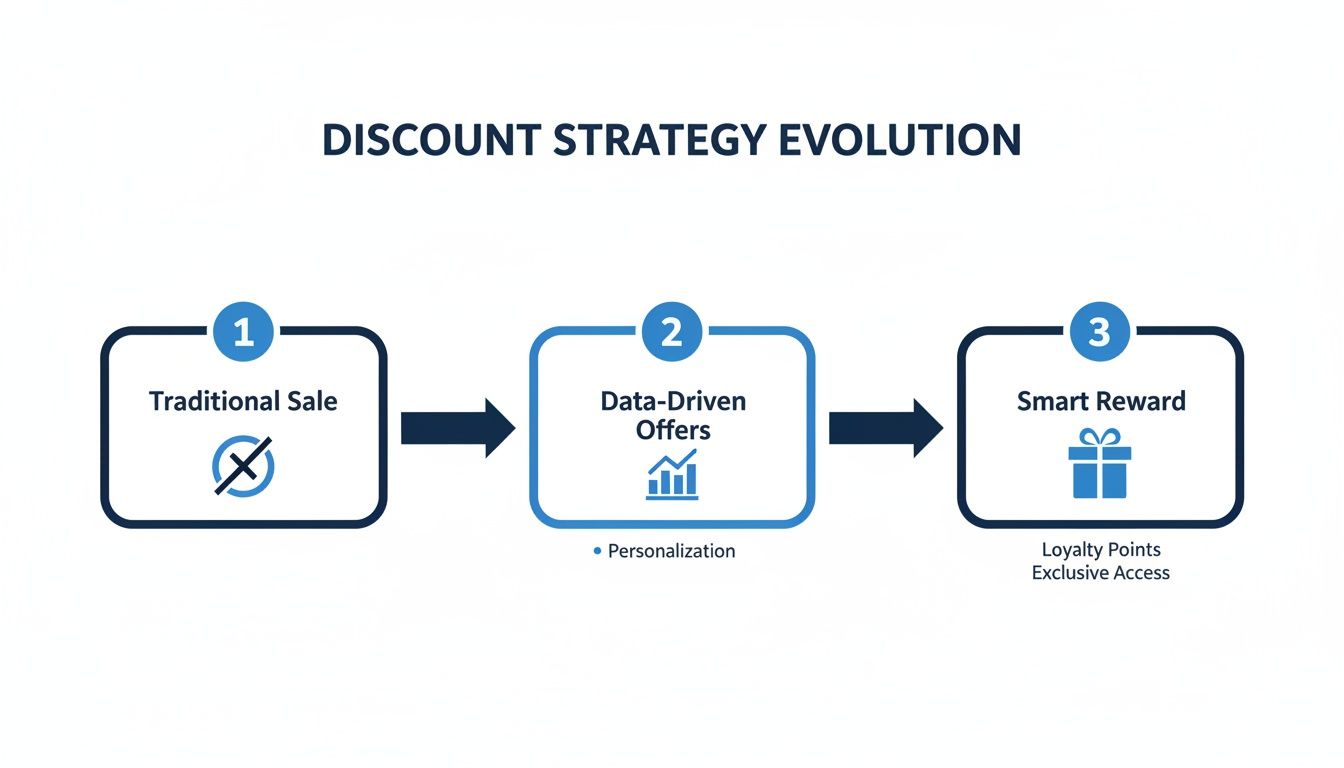
The key takeaway here is the move from devaluing a product with a discount to enhancing the entire purchase with a value-added reward.
Transforming The Checkout Experience
This strategic approach completely changes the dynamic of the checkout process. A traditional discount is a one-and-done deal. A customer plugs in a code, the price drops, and they're gone. It’s functional, sure, but it’s uninspired and does nothing to increase the order value or build a lasting customer relationship.
Cross discount codes, on the other hand, turn the cart into an engaging, interactive space. When a customer adds an item, they might see a progress bar inching toward a free shipping threshold or a quick notification that they're only $15 away from unlocking a free gift. If you want to dive deeper into this, our guide on the differences between cross-selling and upselling is a great next step.
This real-time feedback loop is incredibly motivating. It transforms the cart from a static summary of items into a dynamic rewards engine, encouraging customers to explore and add more to their order.
Ultimately, this is all about protecting your profit margins and focusing on lifetime value. Instead of giving away 20% of your revenue on every sale, you're strategically giving away a lower-cost item (like a free gift) to secure a much higher AOV. This shift in focus is what truly sets successful brands apart.
Traditional Discounts vs Strategic Cross-Sell Rewards
It's easy to see how a small change in your offer strategy can have a massive impact on your bottom line. A quick comparison makes the difference crystal clear.
Metric | Traditional Discount ('20% OFF') | Cross-Sell Reward ('Spend $75, Get a Free Gift') |
|---|---|---|
AOV | Often remains static or can even decrease. | Directly incentivizes a higher spend to hit a threshold. |
Profit Margins | Significantly eroded, especially on high-ticket items. | Protected. The fixed cost of the gift is usually much lower than a percentage discount. |
Perceived Value | Can devalue the brand, training customers to wait for sales. | High. The customer focuses on the added value of the gift, not the price cut. |
Customer LTV | Can create transactional, price-focused relationships. | Builds loyalty through a positive, rewarding experience. |
The table really tells the whole story. While a blanket discount might secure a quick sale, a strategic cross-sell reward builds a healthier, more profitable business for the long haul. It's all made possible by smarter tools like Monster Cart that seamlessly weave these offers right into the shopping flow.
Alright, let's move from theory to practice—this is where the real money is made. Cross discount codes aren't just some abstract marketing idea; they're powerful, hands-on tools for driving more revenue and making customers feel like they've hit the jackpot. The key is to stop thinking, "How can I offer a discount?" and start asking, "How can I create a rewarding experience that encourages people to spend more?"
Instead of falling back on the usual margin-killing sitewide sales, let's dig into some real strategies that actually boost your Average Order Value (AOV). These tactics are all about building value, moving inventory the smart way, and creating customer relationships that last. It’s about making every single promotion a win for you and your shopper.
Transform Slow-Movers into Strategic Rewards
We've all got them: those products that just sit on the shelf, collecting dust. These items tie up your cash and take up precious warehouse space. Instead of slapping a 50% off sticker on them and barely breaking even, you can strategically turn them into high-value free gifts.
Picture this: you have a best-selling skincare serum. You could offer a slow-moving (but still great) facial roller as a free gift on all orders over $85.
Boosts Perceived Value: The customer gets a real, tangible product. A gift with a $25 perceived value almost always feels more rewarding than a 20% discount that might only save them $17.
Protects Your Margins: The actual cost of that free gift is way less than the revenue you'd lose with a big percentage-off discount, especially on a bestseller.
Clears Inventory: You move old stock without cheapening your brand through steep markdowns. You've just turned a potential loss into a killer marketing tool.
This approach flips a liability into an asset, using a cross discount setup to make the shopping experience better while solving a nagging inventory problem.
Gamify New Product Launches
Launching something new is tough. You need to build hype and get those critical first sales in the door. Cross discount codes are perfect for this, letting you turn a product launch into a fun, unlockable event.
Instead of just dropping the new item into your store, make getting it feel like an exclusive reward. Try a campaign like, "Spend $100 and unlock our new limited-edition candle for just $5!"
This creates a powerful sense of urgency and exclusivity. Customers aren't just buying a new product; they're earning access to it. This gamified approach makes the launch more memorable and drives a higher AOV right out of the gate as people add items to their cart to hit that goal.
This strategy is especially powerful for products that complement your bestsellers, as it encourages shoppers to build a complete set. In fact, many brands use this tactic to bundle items and create what are known as frequently bought together offers, a proven way to lift cart value. For more on that, check out our guide here: https://blog.monsterapps.shop/blogposts/frequently-bought-together.
Create Irresistible Bundles and Kits
Bundling is a classic for a reason, but it gets even better when you power it with dynamic cross discounts. Instead of pre-packing kits, you let customers build their own bundles and reward them for it.
For instance, a cosmetics brand could run a "Build Your Own Beauty Box" promotion:
Step 1: Add any foundation to your cart.
Step 2: Choose any concealer and get 20% off it.
Step 3: Add a setting powder to complete the trio and unlock free shipping on your entire order.
This tiered reward system walks the customer through a curated shopping journey. It feels personal and packed with value, nudging them to buy a full routine instead of just one product. This kind of multi-layered approach to cross discounts is a core feature of advanced cart apps like Monster Cart, which can handle these complex rules without breaking a sweat.
These strategies are just the start. The goal is always to think beyond a simple discount and focus on increasing Customer Lifetime Value (LTV). To get a better handle on strategies that work across different platforms, this comprehensive cross-channel marketing guide is a fantastic resource. By consistently delivering real value through rewards like free gifts and smart bundles, you build a loyal customer base that picks your brand for the experience, not just the price.
How to Implement Your Strategy with Monster Cart
A great strategy is one thing, but connecting it to the right tech is what turns a smart idea into a profitable reality. While native Shopify features give you the basics, they just can't handle the dynamic, multi-layered cross discount codes we’ve been talking about. Trying to build complex, tiered rewards usually means shelling out for expensive custom development, which puts it out of reach for most merchants.
This is exactly where Monster Cart comes in. It’s designed to be your growth engine, replacing the standard Shopify cart with a slick, fully branded slide-out cart that’s also an interactive rewards system. It lets you build these sophisticated offers right into the shopping experience, guiding customers toward a higher spend without ever feeling pushy.
Building Your First In-Cart Reward Program
Let's walk through just how easy it is to set up a compelling offer that nudges customers to spend more. Instead of leaning on big discounts that eat into your profits, we’re going to focus on value-added rewards that drive up AOV and build loyalty for the long haul. The goal is to make your customers feel rewarded for spending more, not trained to expect a sale.
With Monster Cart, you can easily create campaigns like:
Spend to Unlock Tiers: Build a ladder of rewards that customers unlock as their cart grows. Think: "Spend $50, unlock free shipping" followed by "Spend $85, get a free gift."
Free Gift with Purchase: Set a single, clear spending goal to get a desirable freebie. This is perfect for moving specific inventory or letting customers sample a new product.
Progressive "Buy More, Save More" Rewards: Instead of a flat discount, reward bigger carts with better savings. This is a smart way to encourage bulk buys while protecting your initial margin.
The real difference-maker here is that these aren't just passive codes buried on a checkout page. They are active, visual motivators that live inside the cart. This screenshot shows exactly how Monster Cart uses a real-time progress bar to gamify the journey to the next reward.

This visual feedback loop is incredibly powerful. It shows shoppers exactly how close they are to their next perk, turning the cart into a genuinely engaging experience.
Gamifying the Path to a Higher AOV
The magic of using Monster Cart for your cross discount strategy is the gamified experience it creates. As shoppers add items, the cart gives them immediate, visual feedback. A progress bar fills up, and a message like, "You're only $12 away from your free gift!" appears.
This transforms the cart from a simple order summary into a dynamic rewards engine. It’s a gentle but persistent nudge for the customer to add just one more thing to hit that next threshold. This is miles more effective than a disruptive pop-up that breaks their shopping flow and often leads to an abandoned cart.
This approach is all about psychology. It taps into our natural desire for achievement and completion. Unlocking a reward feels like a win for the customer, creating a positive emotional connection to your brand and making the final purchase feel even more valuable.
That positive feeling is crucial for building Customer Lifetime Value (LTV). When someone feels like they got a great deal and a special reward, they're far more likely to come back. You’re not just making a single, larger sale; you’re creating a loyal, repeat customer.
Going Beyond Discounts with Strategic Upsells
Monster Cart also lets you stack even more value directly inside the cart drawer, giving you multiple chances to increase the order value without touching your margins. This is where your strategy can get really sophisticated.
You can add other revenue-driving elements that work right alongside your cross discount offers:
Frequently Bought Together: Suggest relevant, complementary products based on what's already in the cart. A customer buying a camera might see a one-click option to add a memory card.
One-Click Add-Ons: Offer services like shipping protection, extended warranties, or priority processing. These are high-margin additions that give customers peace of mind.
Personalized Recommendations: Show other products a customer might love, turning the cart into a last-minute discovery tool.
By combining a tiered reward system with these smart in-cart upsells, you create a powerful, multi-faceted AOV-boosting machine. The entire process is frictionless, all happening inside a sleek, on-brand slide-out cart that never takes the customer away from their shopping. This is how you run a modern rewards strategy that actually grows your business.
Measuring the True Success of Your Promotions
A sudden spike in sales after launching a new promotion feels great, right? But here’s the thing: a quick revenue bump doesn't automatically mean your campaign was a true success. The real impact of your cross discount codes and reward strategies is measured by how they contribute to the long-term health of your business. It's time to shift your focus away from those surface-level vanity metrics.
Instead of obsessing over conversion rates alone, smart merchants dig deeper. They look at the key performance indicators (KPIs) that reveal whether they're actually building a sustainable brand or just giving away profits for a temporary sales boost. The goal, after all, is to reward your customers and grow your business at the same time.
This data-driven approach is what separates the pros from the amateurs. It helps you figure out which offers genuinely motivate your audience to spend more and which ones are simply costing you money. By analyzing the right numbers, you can fine-tune your promotions, protect your margins, and build a business that thrives long after the initial sale is over.
Looking Beyond Conversion Rate
A high conversion rate is awesome, but it never tells the whole story. If all those new conversions are coming from low-value orders driven by steep discounts, you might actually be losing money. That's why it's so important to prioritize metrics that reflect profitability and customer loyalty.
Focus on these three essential KPIs:
Average Order Value (AOV): This is the most direct measure of your cross discount strategy's effectiveness. Are your rewards—like a free gift or a free shipping threshold—actually encouraging customers to add more to their carts? A rising AOV is a clear sign that your strategy is hitting the mark.
Customer Lifetime Value (LTV): A truly successful promotion creates happy, loyal customers who come back to shop again. When you reward shoppers with valuable extras instead of just slicing prices, you build a much stronger relationship. Tracking LTV shows you whether your offers are creating one-time bargain hunters or long-term brand fans.
Profit Margin Per Order: This is your ultimate source of truth. It's crucial to calculate the total cost of a promotion—including the cost of a free gift or shipping expenses—and measure it against the final order value. This ensures that even as you push AOV higher, you're also maintaining healthy profitability on each and every sale.
Don't just chase sales; chase profitable growth. A great rewards program should make each transaction more valuable, not just cheaper for the customer. Thinking about lifetime value transforms your promotions from a cost center into a powerful engine for sustainable growth.
A/B Testing Your Way to Profitability
You should never have to guess which offers perform best. A/B testing is the most effective way to learn what truly resonates with your audience and drives the most profitable behavior. Instead of defaulting to another 15% off coupon, try testing different value-added rewards to see what really moves the needle.
For example, you could run a simple test comparing two different offers targeting a similar AOV goal:
Offer A: "Unlock Free Shipping on all orders over $75."
Offer B: "Receive a Free Gift with any purchase over $85."
After running the test for a week or two, you can analyze the data to see which offer not only produced a higher AOV but also resulted in a better profit margin. You might be surprised to find that the perceived value of the free gift encourages a higher spend and actually costs you less than absorbing shipping fees. You can find more details on how to start this analysis in our guide on how to calculate average order value.
This kind of testing empowers you to make smarter, data-backed decisions. By continuously refining your offers, you can build a fine-tuned promotional strategy that boosts AOV, delights customers, and protects your bottom line. And with a tool like Monster Cart, setting up and tracking these kinds of in-cart reward experiments becomes completely effortless.
Common Cross Discount Mistakes and How to Avoid Them
Cross discount codes are an incredible tool, but they can get messy if you're not careful. A poorly planned promotion can do more harm than good—confusing customers, crushing your profit margins, and even making your brand feel a bit cheap. Let's walk through the most common missteps merchants make and how you can sidestep them to make sure your offers actually drive growth.
The whole point is to boost your Average Order Value (AOV) without just throwing away money on hefty discounts that devalue your products. It's all about finding that sweet spot where the customer feels like they got a great deal and you see a real lift in profit and long-term loyalty.
Setting Unrealistic Reward Thresholds
This is one of the fastest ways to kill a promotion. If you set the spending goal way too high, customers won't even bother trying. But if you set it too low, you're just giving away freebies on orders people were going to place anyway, which eats directly into your margin.
The Fix: Take a hard look at your current AOV. A great starting point for your first reward tier is about 15-20% above that average. This makes the goal feel achievable—often, all it takes is one more small item to unlock the reward.
Offering Irrelevant or Cheap Free Gifts
A free gift needs to feel like a genuine bonus, not some dusty item you're trying to clear out of the stockroom. Offering a low-quality or random gift can make your entire brand feel cheap. The gift has to match your brand's quality and actually make sense with what the customer is buying.
Think of it this way: the reward is a direct reflection of your brand. A poorly chosen gift sends the wrong message and can undo all the trust you've worked so hard to build.
The best rewards are the ones that make the customer's experience even better and boost their lifetime value. Instead of just giving something away, offer value that strengthens their bond with your brand and makes them want to come back.
Creating Confusing and Complicated Rules
"Buy any two items from Collection A, but not on Tuesdays, to get 15% off a third item from Collection B if your cart is over $97." If a customer needs a spreadsheet to figure out your deal, they're just going to leave. Complexity is the ultimate conversion killer.
Your offer should be so simple you can explain it in one sentence. Clarity builds confidence and cuts down on friction at checkout, which is exactly what you want.
Forgetting About the Customer Journey
A great cross discount strategy isn't just a single offer; it's woven into the entire shopping experience. This is where tools like Monster Cart are a game-changer. By showing customers their real-time progress toward a reward right in the slide-out cart, you turn the whole thing into a fun, gamified experience.
This visual feedback loop stops any confusion and actively encourages shoppers to add a little more to their cart. It turns a simple promotion into an interactive system that guides customers toward a higher AOV, making your cross discount codes infinitely more effective. Nailing these details ensures every offer you create is a win-win for both you and your customers.
Your Questions, Answered
Got questions about cross discounts and in-cart rewards? Good. That means you’re thinking strategically. I've pulled together the most common ones I hear from merchants to help you sidestep any hurdles.
Can I Stack Multiple Cross Discount Offers in Shopify?
Out of the box, Shopify plays by a "one discount per order" rule. But let's be real, that's not how modern shopping works. This is where a smart tool like Monster Cart steps in, letting you create a layered system of rewards.
You can set up a ladder of incentives right inside the cart. Think: free shipping unlocks at $50, but then a free gift appears as a new goal at $85. It's not about stacking codes at checkout; it's about creating a single, gamified journey where shoppers unlock new perks as their cart value grows.
Will Offering Free Gifts Hurt My Profit Margins?
Not if you're smart about it. In fact, a good gift-with-purchase strategy is almost always more profitable than a straight discount. A 15% off coupon eats into the margin of every single item in the cart. A free gift has a fixed, predictable cost.
The trick is to offer gifts with a high perceived value but a low actual cost to you. The boost you get in Average Order Value from customers spending more to hit the threshold almost always outweighs the cost of the gift. You end up with a more profitable order and a happier customer. That's a huge win for lifetime value.
How Do I Choose the Right Spending Threshold?
This is less of an art and more of a science. Start by looking at your data. Pull your current Average Order Value (AOV) from your Shopify analytics.
A great starting point for your first reward threshold is about 15-20% above your current AOV. If your store’s AOV is $80, setting your first goal at $100 is perfect. It feels like an achievable nudge, encouraging shoppers to add just one more item to their cart without feeling like a massive leap.
Ready to move beyond basic discounts and start boosting your AOV with intelligent, in-cart rewards? Monster Cart makes it easy to create engaging, gamified shopping experiences that increase sales and customer loyalty.
Join 7000+ brands using our apps