8 Brilliant Cross Selling Example Strategies to Boost AOV in 2026
Feb 8, 2026
|
Published
Tired of eroding your margins with constant discounts just to move the needle on Average Order Value (AOV)? There’s a more profitable, sustainable way. This article moves beyond generic advice to provide a tactical playbook of proven cross-selling examples designed specifically for Shopify merchants. We'll break down how to strategically offer value-driven rewards like free gifts, shipping upgrades, and exclusive products to not only increase AOV but also build long-term customer lifetime value.
The goal isn't just a bigger one-time sale; it's about increasing lifetime value and nurturing a customer base that feels rewarded, not just sold to. For more detailed strategies on how to effectively increase average order value in crowdfunding, consider exploring this guide.
Below, we will explore several real-world scenarios, each serving as a practical cross selling example. We'll dissect the strategy, offer structure, and trigger logic for each one. You'll learn how tools like Monster Cart can transform your standard shopping cart into a dynamic rewards engine, making these strategies seamless and highly effective. Get ready to implement actionable tactics that boost your bottom line immediately, all while building a healthier, more profitable business.
1. Frequently Bought Together (FBT) Bundles
The "Frequently Bought Together" (FBT) cross-sell is a classic for a reason: it works. This strategy uses historical purchase data to identify and suggest complementary products that customers often buy in the same transaction. Instead of a generic suggestion, it presents a data-backed recommendation, making the offer feel like a helpful tip rather than a sales pitch. This cross selling example is powerful because it taps directly into proven customer behavior, boosting AOV through relevance, not discounts.
For a Shopify store using Monster Cart, these bundles can be displayed natively within the slide-out cart, creating a seamless one-click add-on experience. For example, a customer adding a high-end camera body to their cart might instantly see a suggestion to add the most commonly paired lens and memory card.
Strategic Breakdown
Scenario: A customer adds a primary product to their cart, like a premium yoga mat.
Offer Structure: One-click add-on bundle. The cart drawer displays a bundle offer: "Add a matching yoga block and water bottle for just $35 more."
Trigger & Placement: Triggered when the primary item (yoga mat) is added to the cart. The FBT offer appears directly below the added item in the cart drawer.
Sample Copy: "Complete your set! Customers also bought these:"
Estimated KPI Impact:
AOV Increase: 10-25%
Conversion Rate Lift: 2-5%
Monster Cart Implementation: Use the app’s analytics to identify top product pairings. Create a "Frequently Bought Together" offer and set the yoga mat as the trigger product. Monster Cart will automatically display the bundle when the conditions are met.
Actionable Takeaways & Insights
This method excels at boosting average order value without resorting to site-wide discounts. To master the art of combining products effectively, consider implementing a winning bundle pricing strategy that enhances perceived value.
Key Insight: Focus on relevance over everything. An FBT offer succeeds when it feels like a natural and logical next step for the customer. Aim for products with at least a 40% co-purchase correlation for the strongest impact.
To dive deeper into this specific tactic, you can explore how FBT bundles can elevate your AOV and see more detailed implementation guides.
2. Tiered Spend-to-Unlock Rewards
Tiered spend-to-unlock rewards transform the shopping cart into an interactive game. This cross selling example motivates customers to increase their order value by offering escalating rewards like free gifts, exclusive discounts, or free shipping as they hit specific spending thresholds. It gamifies the path to purchase by showing customers exactly what they can earn and how close they are to unlocking the next tier. This strategy creates a powerful psychological incentive to add more items, boosting AOV without devaluing products with site-wide discounts and focusing on long-term customer value.
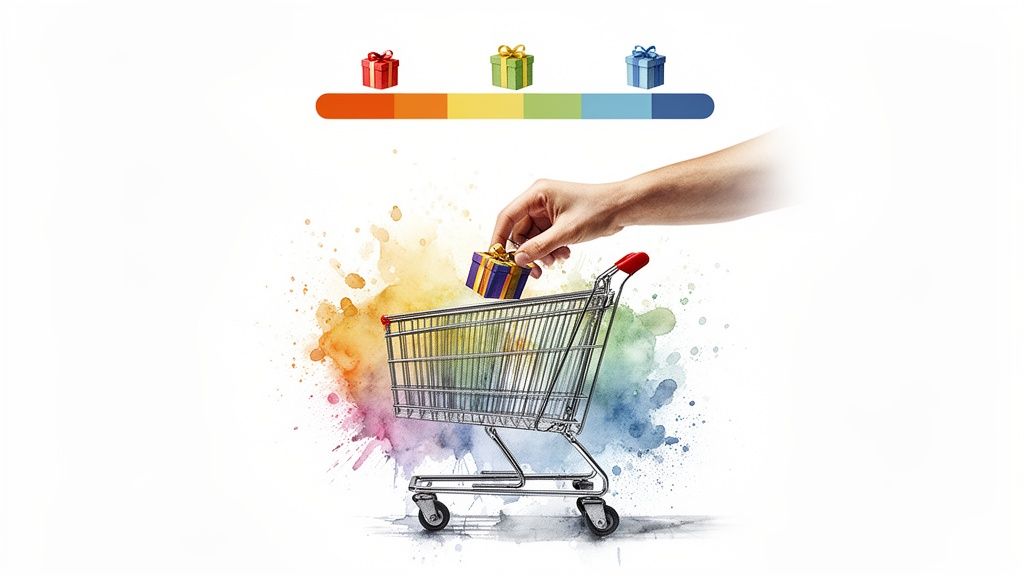
For stores using Monster Cart, this is brought to life with a dynamic, visual progress bar in the cart drawer. As a customer adds items, the bar fills up in real-time, clearly showing the distance to the next reward. For instance, a beauty brand might offer a free sample at $50, a deluxe sample at $75, and free shipping at $100, encouraging customers to bridge the spending gap.
Strategic Breakdown
Scenario: A customer has $65 worth of skincare products in their cart, and the brand's average order value is $70.
Offer Structure: Multi-tier spend goal with progress bar. The first tier is a deluxe sample at $75, and the second is free shipping at $100.
Trigger & Placement: Triggered as soon as the first item is added to the cart. The progress bar and reward information are displayed prominently at the top of the cart drawer.
Sample Copy: "You're only $10 away from a free gift!" or "Spend $25 more to unlock free shipping."
Estimated KPI Impact:
AOV Increase: 15-30%
Conversion Rate Lift: 3-7%
Monster Cart Implementation: Create a "Spend Goal" offer in Monster Cart. Set up multiple tiers (e.g., Tier 1: spend $75, get Product A; Tier 2: spend $100, get Free Shipping). The app will automatically generate the visual progress bar and apply the rewards when a customer reaches a threshold.
Actionable Takeaways & Insights
This method is exceptionally effective because it shifts the customer's focus from "how much am I spending?" to "what can I earn?" The first reward tier should be set just above your current AOV (around 10-20% higher) to make it feel achievable for most customers.
Key Insight: The visual progress bar is the most critical element. It creates a sense of momentum and a psychological need to "complete the goal." Use compelling visuals and clear messaging to highlight the value of the next unlocked reward.
Testing your reward tiers is essential for optimization. Use Monster Cart's analytics to see where customers drop off and which rewards drive the most incremental revenue. This data-driven approach ensures your tiers are motivating, not discouraging.
3. One-Click Add-Ons (Warranties, Shipping Protection, Add-to-Cart Upsells)
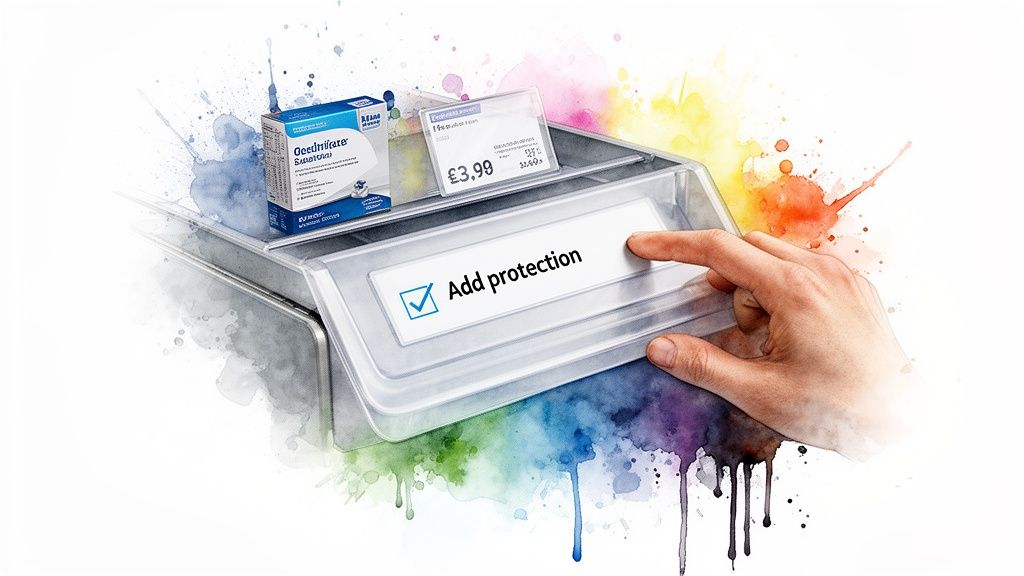
The one-click add-on is a high-margin, low-friction cross-selling example that capitalizes on a customer's purchase intent at its peak. This strategy presents small, valuable services like warranties or shipping protection as simple checkbox additions directly in the cart. Instead of asking customers to navigate to another page, it offers an impulse-friendly choice that enhances their purchase with minimal effort, boosting AOV without discounting core products.
For Shopify stores, Monster Cart can seamlessly integrate these offers into the cart drawer. For instance, a customer buying a pair of expensive sneakers could be presented with a simple, pre-checked box to "Add 1-Year Damage Protection for $4.99," making it an effortless, high-value addition to their order.
Strategic Breakdown
Scenario: A customer adds a $150 electronic gadget to their cart.
Offer Structure: A simple checkbox or one-click button add-on. The cart drawer displays an option: "✅ Add 2-Year Extended Warranty for $9.99."
Trigger & Placement: Triggered when any physical product is added to the cart. The offer appears directly above the subtotal or "Checkout" button for maximum visibility.
Sample Copy: "Protect your purchase! Add shipping protection for just $1.99."
Estimated KPI Impact:
AOV Increase: 5-15%
Profit Margin Lift: 1-3% (due to high-margin nature of add-ons)
Monster Cart Implementation: Create a new product for the "Warranty" or "Protection" service. Use Monster Cart to set up an "Add-to-Cart Upsell" offer, triggering it for specific products or entire collections. Configure it to display as a checkbox in the slide-out cart.
Actionable Takeaways & Insights
This method is incredibly effective for increasing pure profit on each order. Unlike product bundles, these service add-ons often have near-100% margins. The key is to frame the offer as peace of mind, not an upsell.
Key Insight: Test pre-checked vs. unchecked options. Data shows pre-checked boxes can increase acceptance rates by 2-3x, but be mindful of local regulations. The goal is to make it feel like a helpful default, not a trick.
These small, incremental additions are a powerful way to increase lifetime value by enhancing the post-purchase experience. They demonstrate a brand's commitment to customer satisfaction beyond the initial sale.
4. Buy More, Save More Progressive Discounts
The "Buy More, Save More" model is a powerful cross selling example that gamifies the shopping experience by rewarding customers with increasing discounts as they add more to their cart. This strategy motivates shoppers to increase their order value not just to get a single deal, but to unlock progressively better savings on their entire purchase. It shifts the focus from a last-minute upsell to a rewarding journey of building a bigger, better-value cart, all while encouraging higher spend for a higher reward.
With Monster Cart, this progression is visualized in real-time within the cart drawer, showing customers exactly how close they are to the next savings tier. This dynamic feedback loop encourages customers to add one more item to hit the next discount threshold, directly boosting average order value without resorting to deep, site-wide sales.
Strategic Breakdown
Scenario: A customer adds a few low-to-mid-priced items to their cart, like skincare serums or coffee bags.
Offer Structure: Progressive cart-wide discount. The cart dynamically shows the savings unlocked and the amount needed to reach the next tier.
Trigger & Placement: Triggered as soon as the first item is added. A dynamic progress bar or text appears at the top of the cart drawer, updating with each item added.
Sample Copy: "You're $15 away from unlocking 15% off your entire order!"
Estimated KPI Impact:
AOV Increase: 15-30%
Conversion Rate Lift: 3-7%
Monster Cart Implementation: Create a "Buy More, Save More" offer in Monster Cart. Set multiple spending thresholds (e.g., $50, $85, $150) with corresponding percentage discounts (e.g., 5%, 10%, 15%). The app will automatically track cart value and display the dynamic progress bar.
Actionable Takeaways & Insights
This approach excels at increasing AOV and customer lifetime value by rewarding loyalty and bulk purchasing. It encourages customers to explore more of your product catalog to reach the next discount tier, turning a simple transaction into a rewarding challenge.
Key Insight: Set your first discount tier just above your current average order value (around 30-40% higher). This makes the first reward feel achievable and provides a clear incentive for customers to add another item they were already considering.
To build a compelling tiered offer, you can explore the psychology behind how to structure a 'buy more, save more' campaign that maximizes both customer satisfaction and your profit margins.
5. Free Gift with Purchase (GWP) Campaigns
The Gift with Purchase (GWP) model is a powerful cross selling example that shifts the focus from price reduction to value addition. Instead of offering a hefty discount, merchants reward customers with a free, desirable item when their cart total reaches a specific threshold. This strategy increases AOV and customer satisfaction by making the shopping experience feel rewarding rather than transactional, protecting your profit margins in the process.
For Shopify stores, Monster Cart elevates the GWP strategy by turning the cart into an interactive rewards system. It visually displays the free gifts customers can unlock at different spending levels, gamifying the path to a higher cart value and encouraging them to add more items to claim their prize.

Strategic Breakdown
Scenario: A customer has added $62 worth of cosmetics to their cart, and the store offers a free limited-edition lipstick for all orders over $75.
Offer Structure: Spend-to-unlock free gift. The cart visually shows how close the customer is to unlocking the reward.
Trigger & Placement: Triggered when the cart value is approaching the GWP threshold (e.g., within $20). The offer is prominently displayed in the cart drawer as a progress bar or rewards banner.
Sample Copy: "You're only $13 away from a FREE limited-edition lipstick!"
Estimated KPI Impact:
AOV Increase: 15-30%
Conversion Rate Lift: 3-7%
Monster Cart Implementation: Create a "Gift with Purchase" campaign in the app. Set the spending threshold to $75 and select the lipstick as the reward. Monster Cart will automatically display the dynamic progress bar in the cart to all eligible shoppers.
Actionable Takeaways & Insights
This approach is highly effective for building brand loyalty and moving specific inventory without devaluing your core products. To maximize impact, choose GWP items that are aspirational yet cost-effective, such as deluxe samples or exclusive accessories. The perceived value of the gift should significantly outweigh its actual cost.
Key Insight: Frame the GWP as an exclusive reward, not a simple freebie. Use urgency and scarcity in your messaging (e.g., "While supplies last") to motivate immediate action and make the offer feel more valuable.
By turning the purchase journey into a rewarding experience, you encourage higher spending and foster a positive connection with your brand, driving long-term customer value far more effectively than a simple percentage-off discount.
6. Personalized Product Recommendations Based on Cart Contents
This advanced cross-selling approach moves beyond simple pairings to offer truly dynamic, one-to-one suggestions. It leverages behavioral data, purchase history, and even machine learning to predict what a specific customer is most likely to want next. This cross selling example feels less like a sales tactic and more like a personal shopper, creating a tailored experience that boosts both AOV and customer loyalty without relying on discounts.
For a Shopify store, this means presenting recommendations that are hyper-relevant to the items in a customer's cart. With an app like Monster Cart, these sophisticated, algorithm-driven suggestions can appear natively in the cart drawer, turning a moment of consideration into a moment of discovery and a larger purchase.
Strategic Breakdown
Scenario: A customer adds a specific brand of organic, fair-trade coffee beans and a French press to their cart.
Offer Structure: Dynamically generated one-click add-on. The cart drawer displays two or three highly relevant products, like a matching coffee grinder or a set of double-walled glass mugs from a brand they've browsed before.
Trigger & Placement: Triggered when any item is added to the cart. Personalized recommendations appear directly below the cart subtotal in the cart drawer.
Sample Copy: "You might also like:" or "Recommended for you:"
Estimated KPI Impact:
AOV Increase: 15-30%
Conversion Rate Lift: 3-7%
Monster Cart Implementation: Enable the AI Product Recommendation engine within the app. The system will analyze your product catalog and customer behavior to automatically generate and display the most relevant cross-sell offers in the cart, adapting in real time.
Actionable Takeaways & Insights
This method is a powerful way to increase lifetime value by demonstrating that you understand your customer's unique needs. It encourages higher spending by showing them products they genuinely want, rather than pushing generic best-sellers.
Key Insight: Start with clear rules before scaling to complex AI. For instance, create a rule to recommend "water filters" if any "reusable water bottle" is added. As you gather data, layer in machine learning to uncover non-obvious connections your customers are making.
By mastering this strategy, you create a smarter shopping experience. You can discover how product recommendations on Shopify can be fine-tuned to maximize their impact on your store's bottom line.
7. Subscription or Replenishment Upsells
Transforming a one-time buyer into a repeat customer is the key to sustainable growth. The subscription cross-sell shifts the focus from a single transaction to long-term customer lifetime value (LTV). This strategy offers customers a small reward or other incentive to sign up for recurring deliveries of consumable products, effectively automating future sales. This is a powerful cross selling example for brands with replenishable goods, like supplements, coffee, or skincare.
With Monster Cart, this offer can be presented directly in the cart drawer, allowing a customer to switch their one-time purchase to a "Subscribe & Save" model with a single click. For instance, a customer adding a bag of premium coffee beans to their cart could see an option to subscribe for a monthly delivery and immediately save 15% on their order.
Strategic Breakdown
Scenario: A customer adds a consumable product, like a bottle of daily vitamins, to their cart for a one-time purchase.
Offer Structure: One-click subscription toggle. The cart presents an option to convert the purchase into a recurring subscription for a reward like a discount or free gift on first renewal.
Trigger & Placement: Triggered when a subscription-eligible item is added to the cart. The offer appears directly on the product's line item in the cart drawer.
Sample Copy: "Subscribe & Save 15% on every order! Get it delivered monthly."
Estimated KPI Impact:
Customer LTV Increase: 50-200%
Retention Rate Lift: 20-40%
Monster Cart Implementation: Integrate your subscription app (e.g., Recharge, Skio) with Monster Cart. Configure the cart to display the subscription widget for eligible products, allowing customers to opt-in directly from the cart drawer before checkout.
Actionable Takeaways & Insights
This approach excels at building predictable, recurring revenue and significantly boosting LTV without devaluing your products. The key is to make the subscription process frictionless and transparent, clearly communicating the benefits and ease of management (like skipping or canceling).
Key Insight: Frame the subscription as a convenience, not just a discount. Highlight benefits like "never run out again" alongside the savings. The initial reward serves as the hook, but the convenience factor is what drives long-term retention.
8. Strategic Exclusions and Scarcity-Based Upsells
This psychology-driven approach leverages scarcity and exclusivity to motivate customers to complete their purchase or increase their order value. Instead of offering a discount, this strategy creates urgency by highlighting limited inventory or time-sensitive opportunities. This cross selling example is powerful because it taps into the fear of missing out (FOMO), encouraging immediate action without devaluing your products.
With Monster Cart, you can seamlessly integrate these psychological triggers into the slide-out cart. For instance, when a customer adds a popular dress to their cart, a subtle message like "Only 3 left in this size!" can appear directly below the item, creating a powerful incentive to check out before it's gone.
Strategic Breakdown
Scenario: A customer adds a trending, low-stock fashion item to their cart.
Offer Structure: In-cart scarcity messaging and progress bar for an exclusive offer. The cart displays "Low Stock: Only 4 remaining!" next to the item and a bar showing "You're $15 away from unlocking an exclusive tote bag."
Trigger & Placement: Triggered when a product with low inventory (e.g., <10 units) is added to the cart. Scarcity messaging appears beside the product line item, and the exclusive offer is displayed at the top of the cart drawer.
Sample Copy: "Hurry, selling fast!" or "Unlock a limited edition gift with your order."
Estimated KPI Impact:
AOV Increase: 5-15% (from customers adding items to unlock exclusives)
Conversion Rate Lift: 4-8% (due to urgency)
Monster Cart Implementation: Tag products with low inventory in Shopify. In Monster Cart, set up a tiered reward that unlocks an exclusive gift. Create a cart notification triggered by the "low-stock" tag to display your scarcity message.
Actionable Takeaways & Insights
This tactic is incredibly effective for boosting conversions without resorting to markdowns, thereby protecting your margins and brand perception. It shifts the customer's focus from "how much can I save?" to "what might I miss out on?" It's a prime example of driving value through perceived exclusivity rather than price reduction.
Key Insight: Authenticity is crucial. Only use real inventory data for scarcity claims to maintain customer trust. False scarcity can damage your brand's reputation and lead to cart abandonment if customers notice the same "low stock" warning on every visit.
This strategy pairs well with limited-edition product drops or seasonal items where scarcity is a natural and believable element of the product lifecycle.
8 Cross-Sell Strategies Compared
Strategy | 🔄 Implementation Complexity | 💡 Resource Requirements | ⭐📊 Expected Outcomes | Ideal Use Cases | ⚡ Key Advantages |
|---|---|---|---|---|---|
Frequently Bought Together (FBT) Bundles | Low–Medium; simple rules + algorithm tuning | Clean product data, purchase history, minor UI config | ⭐⭐⭐ — AOV +10–30%; moderate incremental revenue | Complementary product lines (beauty, fashion, tech accessories) | Native cart cross-sells; feels helpful; mobile-optimized |
Tiered Spend-to-Unlock Rewards | Low; UI progress bar and tier config | Design assets, tier strategy, analytics for tuning | ⭐⭐⭐⭐ — AOV +15–35%; higher engagement | Brands wanting motivation-based AOV lift across segments | Leverages goal psychology; reduces blanket discounts |
One-Click Add-Ons (Warranties, Protection) | Medium; UX + integrations for fulfillment/claims | Integration with protection providers, CS readiness, legal checks | ⭐⭐⭐ — Take rates 8–15%; high-margin add-on revenue | Physical goods where protection resonates (electronics, footwear) | Very low friction; high margins; easily measurable ROI |
Buy More, Save More Progressive Discounts | Medium; pricing rules + real-time cart calc | Margin modeling, pricing strategy, cart logic, analytics | ⭐⭐⭐ — AOV +15–25%; strong quantity-based uplift | Consumables, supplements, bulk-buy product categories | Incentivizes larger baskets; discounts apply to entire cart |
Free Gift with Purchase (GWP) Campaigns | Medium; inventory & fulfillment planning | Gift inventory, cost planning, campaign ops, UI badges | ⭐⭐⭐ — Increases AOV; perceived as reward vs discount | Beauty, luxury, and brands where gifts enhance perception | Maintains brand value; drives satisfaction and social moments |
Personalized Product Recommendations | High; ML models + data pipelines | Historical data, ML/engineering, product tagging, analytics | ⭐⭐⭐⭐ — AOV +10–20%; estimated ROI 300–500% (longer term) | Large catalogs with 500+ orders and rich customer data | Highly relevant suggestions; improves over time with data |
Subscription / Replenishment Upsells | Very High; recurring billing + ops complexity | Subscription platform integration, billing, logistics, CS | ⭐⭐⭐⭐⭐ — Can 3–5x LTV; predictable recurring revenue | Consumables with clear replenishment cycles (supplements, grooming) | Increases LTV and revenue predictability; builds loyalty |
Strategic Exclusions & Scarcity-Based Upsells | Medium; inventory hooks + time-based UI | Real-time inventory, legal review, timer UX, segmentation | ⭐⭐ — Conversion +5–15%; faster purchase decisions | Fashion, limited-edition drops, seasonal or hype products | Creates urgency without extra discounts; boosts conversions |
Your Next Move: Turning Your Cart into a Revenue Engine
The cross-selling examples we've explored prove one critical point: your Shopify cart is one of the most underutilized assets for growing your brand. From simple "Frequently Bought Together" bundles to sophisticated tiered rewards, the right offer at the right moment can dramatically increase your Average Order Value (AOV) and customer lifetime value (LTV). Each cross selling example moves beyond generic pop-ups and instead integrates value directly into the customer’s natural shopping journey.
The common thread woven through each successful strategy is a shift away from a discount-heavy mindset. Instead of simply slashing prices, you can build a more sustainable and profitable business by rewarding customers for their loyalty and engagement with free gifts, shipping upgrades, or exclusive access. This value-first approach not only protects your margins but also fosters a stronger, more positive brand perception.
Key Takeaways for Immediate Action
To transform these concepts into reality, focus on these core principles:
Context is King: The best cross-sell feels like a helpful suggestion, not a pushy sales pitch. Tailor your offers to the specific items in the customer's cart, as seen with personalized recommendations and one-click add-ons like shipping protection.
Gamify the Experience: Use progress bars for tiered spend-to-unlock rewards or "Buy More, Save More" offers. This visual feedback creates a sense of achievement and encourages customers to add just one more item to reach the next threshold.
Friction is the Enemy: The beauty of a Gift with Purchase (GWP) or a one-click add-on is its simplicity. The easier you make it for a customer to accept an offer, the higher your conversion rate will be. This is where an in-cart experience, like that offered by Monster Cart, shines, eliminating extra steps and interruptions.
A Strategic Shift from Discounts to Rewards
Ultimately, mastering the art of the cross-sell is about building smarter, more resilient customer relationships. While a 20% off coupon might secure a single sale, a thoughtful free gift or a valuable product bundle creates a memorable experience that brings customers back. Each cross selling example in this guide is a blueprint for turning a transactional checkout process into an interactive and rewarding brand touchpoint.
The goal isn't just to make a bigger sale today; it's to increase the lifetime value of every customer you acquire. By focusing on value, relevance, and a seamless user experience, you can turn your cart from a simple transaction summary into your most powerful revenue engine. This strategic pivot empowers you to grow consistently without relying on margin-eroding sales events, building a healthier business for the long term.
Ready to implement these powerful cross-selling strategies without the technical headache? Monster Cart is designed to transform your slide-out cart into an interactive rewards layer, making it easy to launch tiered gifts, one-click add-ons, and progress bars in minutes. Start turning every cart into a revenue opportunity today with Monster Cart.
Join 7000+ brands using our apps