Boost Revenue with ecommerce personalization tools for higher AOV
Mar 1, 2026
|
Published
So, what exactly are ecommerce personalization tools? At their core, they’re software platforms that help you stop treating every customer the same. They let you create unique shopping experiences for individual visitors based on their real behavior, preferences, and past interactions with your store.
What Are Ecommerce Personalization Tools and Why They Matter

Imagine having a brilliant personal shopper who knows exactly what your customers want, often even before they do. That’s the real power behind today’s ecommerce personalization tools. They’ve come a long way from just slapping a customer's first name in an email subject line. Now, they are intelligent revenue drivers for smart merchants focused on boosting lifetime value.
These tools work by analyzing customer data—like browsing history, previous purchases, and what’s currently in their cart—to serve up relevant content, spot-on product recommendations, and timely offers. The whole point is to make every visitor feel like the store was built just for them, creating a smoother and far more engaging path to checkout.
Shifting from Discounts to Value-Driven Rewards
For way too long, "personalization" was just code for aggressive pop-ups that offered a hefty discount. While that can sometimes grab a quick sale, it's a dangerous game. This race to the bottom erodes your profit margins and, worse, trains your customers to never pay full price. The key to sustainable growth is to think beyond the single transaction and focus on lifetime value (LTV).
The new gold standard is all about creating genuine value, not just cutting prices. Instead of defaulting to margin-killing discounts, top brands now use personalization to offer value-added rewards that boost Average Order Value (AOV) and build real loyalty. These offers feel earned and exclusive, not desperate.
Here are a few key examples of modern, value-driven personalization in action:
Free Shipping Thresholds: "You're only $15 away from free shipping!"
Gift With Purchase (GWP): "Spend $100 and get our best-selling serum for free."
Tiered Rewards: "Add one more item to unlock a deluxe sample."
Exclusive Access: Offering early access to new drops or sales for your best customers.
These strategies make shoppers feel appreciated while naturally encouraging them to spend more, which directly improves your bottom line without cheapening your brand. A fantastic example of advanced personalization that adds real value is virtual try on technology, which gives shoppers the confidence to click "buy" on items like apparel or cosmetics.
To give you a clearer picture, here’s a quick breakdown of how modern personalization tools benefit your business.
Key Benefits of Modern Personalization Tools
Benefit | Impact on Your Business |
|---|---|
Increased Average Order Value (AOV) | Motivates customers to add more items to their cart to unlock rewards like free shipping or gifts, instead of just using discounts. |
Improved Conversion Rates | Reduces friction and creates a more engaging journey, leading to fewer abandoned carts. |
Stronger Brand Loyalty & LTV | Makes customers feel seen and valued, fostering a long-term relationship beyond just the transaction. |
Better Profit Margins | Shifts the focus from margin-killing discounts to value-added offers with a lower, fixed cost. |
Enhanced Customer Experience | Delivers a "personal shopper" feel that makes buying from your store a genuinely pleasant experience. |
These benefits demonstrate a fundamental shift: you're moving from a transactional model to a relational one, which is the key to sustainable growth and higher lifetime value.
The global market for these solutions is booming for a reason. Valued at USD 3.4 billion in 2024, it’s set to expand at a compound annual growth rate of 13.6% through 2034. More importantly, the segment for AI-powered and real-time personalization is growing even faster, showing that merchants are hungry for smarter tools.
Ultimately, the best tools integrate these rewards seamlessly into the shopping experience, often within a dynamic cart drawer. A solution like Monster Cart, for example, turns the cart into a rewards engine, showing customers their progress toward unlocking valuable perks. This gamified approach builds excitement and transforms the path to checkout into a positive, engaging experience that builds lasting relationships and boosts lifetime value. And if you’re looking to get started, a great first step is to learn more about how to set up effective product recommendations for Shopify.
From Annoying Pop-Ups to Intelligent In-Cart Rewards
Remember when "personalization" meant a jarring, full-screen pop-up ambushing you with a 10% off coupon the second you landed on a site? We’ve all been there. Those were the clumsy first attempts at creating a custom experience, and while they might have grabbed a few sales, they often felt desperate and trained customers to hunt for a discount before even looking at products.
Today, the best ecommerce personalization tools have evolved far beyond those disruptive tactics. The new playbook is all about intelligence and timing. It’s a subtle but powerful shift, moving the conversation from an annoying interruption to a helpful, in-the-moment reward that protects your brand’s value and nurtures lifetime value.
The Psychology of Perfect Timing
The real difference is the psychology of when and where you make an offer. A pop-up that appears on your homepage can feel like an aggressive sales pitch. But an offer presented inside the shopping cart? That feels like an earned reward, a satisfying bonus you’ve unlocked right at the peak of your decision-making process.
This works because the customer is already invested. They've found items they love and are actively thinking about buying. A well-timed in-cart offer doesn't disrupt their flow—it enhances it. This approach respects the shopper's journey, transforming the checkout from a simple transaction into a rewarding experience that encourages repeat business.
Key Takeaway: The goal is to move away from brand-devaluing, hefty discounts and toward value-added rewards. By focusing on boosting Average Order Value (AOV) with incentives like free gifts or free shipping, you can increase profitability while building a stronger connection with your customers and improving their lifetime value.
This strategic shift is powered by modern AI that anticipates what customers want when they are most likely to convert. In fact, AI-led personalization can boost retail profits by up to 15% and slash marketing costs by nearly 20%. It’s no surprise that 58% of brands now use AI personalization specifically to fight cart abandonment, which plagues around 70% of all shopping sessions.
Visualizing Progress with a Slide-Out Cart
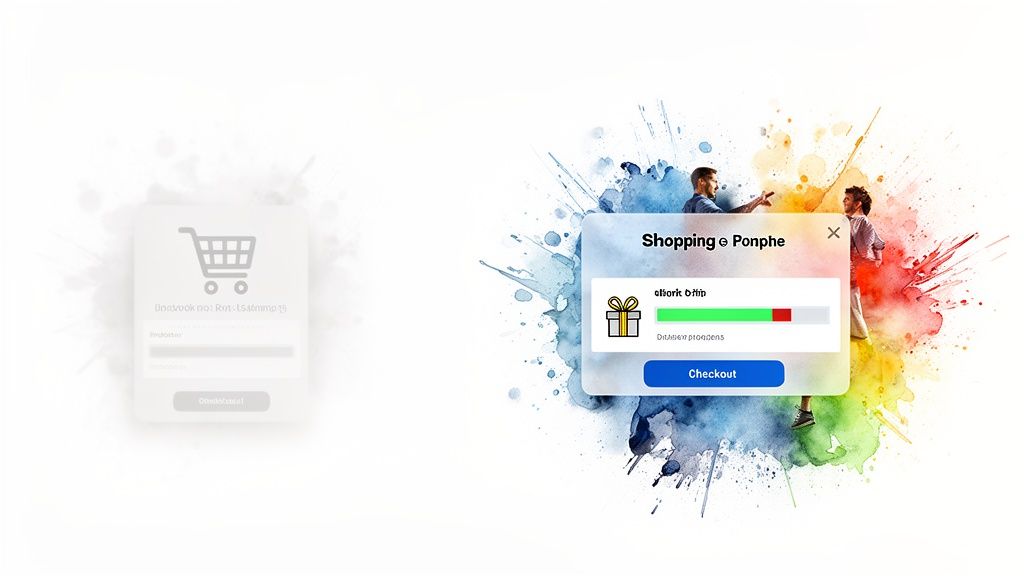
One of the most powerful ways to bring this strategy to life is with a dynamic, slide-out cart that visually tracks a customer’s progress toward their next reward. Instead of just listing items, the cart becomes an interactive rewards engine.
Imagine a progress bar that fills up as a customer adds items, showing them exactly how close they are to unlocking free shipping or a complimentary gift. This touch of gamification creates a powerful incentive to add just one more thing to their order, boosting AOV without a single discount.
For example, a modern cart tool like Monster Cart excels at this. It replaces the standard, static cart with an intelligent slide-out that:
Visually tracks progress toward free shipping or tiered gifts.
Offers one-click add-ons like gift wrapping or product protection.
Suggests relevant products based on cart contents without being pushy.
This approach is far more effective and customer-friendly. It helps you increase AOV and combat cart abandonment without resorting to constant discounts that eat into your margins. A well-executed in-cart strategy is a powerful tactic on its own, and it works even better when you learn how to increase your store's conversion rate with other smart methods.
Essential In-Cart Features That Drive Revenue and LTV
The most effective ecommerce personalization tools don't just personalize—they create real value right where it counts: inside the shopping cart. Let's move past the buzzwords and look at the practical, money-making features that turn a simple cart into a dynamic rewards engine. The goal is to lift your Average Order Value (AOV) and Customer Lifetime Value (LTV) by making the shopping experience better, not just cheaper.
It’s all about breaking free from the cycle of margin-killing, hefty discounts. Instead, these features give customers a reason to spend a little more to unlock something valuable, creating a win-win that protects your profits and builds genuine loyalty.
Progress Bars and Tiered Rewards
One of the most powerful psychological nudges in ecommerce is a simple visual progress bar. When customers can actually see how close they are to earning a reward like free shipping or a free gift, it creates a powerful pull to add just one more item to their order. It gamifies the path to checkout, turning it from a simple task into a fun little challenge.
Key Insight: A shopper who is "$10 away from free shipping" is far more likely to find a small item to add than a shopper who is simply told the shipping cost. This visual cue directly fights a huge reason for cart abandonment and boosts AOV without a single discount.
This gets even more powerful when you pair it with tiered rewards. Instead of a single, all-or-nothing offer, you can build a ladder of incentives that encourages higher spending at multiple levels.
Tier 1: Spend $50, unlock free shipping.
Tier 2: Spend $75, get a free sample-sized product.
Tier 3: Spend $100, receive a full-sized bestseller as a free gift.
This layered approach makes every customer feel like they're on the verge of unlocking something great, which is a core strength of tools like Monster Cart that visualize this journey. It masterfully shifts the customer’s mindset from "How much am I spending?" to "What can I earn next?", encouraging a higher AOV and fostering the kind of positive experience that builds lifetime value.
Smart Recommendations and One-Click Add-Ons
Once a customer has items in their cart, you have the perfect moment to make their experience even better with relevant suggestions. Unlike those annoying, generic pop-ups, in-cart recommendations are contextual and genuinely helpful. A smart personalization tool can look at what's in the cart and suggest items that truly complete the purchase.
For example, if a customer adds a leather handbag, a smart engine might suggest a matching wallet or a leather care kit. This feels less like a pushy sales tactic and more like a helpful friend making a recommendation. To get a better sense of this, you can explore how "frequently bought together" bundles work to drive up AOV.
Finally, one-click add-ons are a frictionless way to add a bit of value and revenue right before checkout. These are small, convenient services that shoppers can add with a single click, no fuss.
Popular examples include:
Gift Wrapping: A simple lifesaver during holidays or special occasions.
Shipping Protection: Offers peace of mind against lost or damaged packages.
Priority Processing: For customers who want their order shipped out faster.
When you put these features together, you create a seamless, non-disruptive system that not only boosts immediate AOV but also builds the kind of positive experience that increases lifetime value.
How to Choose the Right Personalization Tool for Your Shopify Store
Picking the right ecommerce personalization tool can feel a bit like wading through a sea of options. The problem is, they aren't all built the same. To find a tool that actually works for your store, you need to look past the flashy feature lists and really dig into how it will perform inside your Shopify ecosystem. Your goal is to boost AOV and lifetime value, not just tick a box on a checklist.
The best tools feel like they were built just for your brand. They should let you create compelling rewards—like free shipping or a free gift—that get customers excited to spend a little more. This approach is so much smarter than just defaulting to margin-killing discounts, as it protects your profits while making shoppers feel genuinely appreciated.
Integration and Site Speed
Your very first filter should be performance. A personalization tool that grinds your store to a halt is completely self-defeating. Even a one-second delay in page load time can kill your conversion rate. You should be looking for tools built specifically for Shopify, as they’re usually optimized to load asynchronously and stay out of the way of your Core Web Vitals.
A bloated or clunky app can ruin the entire shopping experience before your awesome offers even have a chance to work their magic. You need a solution that runs smoothly and doesn't create any friction for your customers.
Design Control and Brand Alignment
Nothing breaks trust faster than a generic, third-party widget that looks completely out of place on your site. Real personalization means the experience should feel 100% yours. Can you tweak the fonts, colors, and layout until it perfectly matches your store's aesthetic?
The goal is to make your rewards feel like a premium, built-in feature of your brand, not some cheap add-on. This is where a solution like Monster Cart really shines, giving you deep design control to make the in-cart experience totally indistinguishable from your theme, creating a seamless journey that builds loyalty.
This decision tree gives you a roadmap for how to think about personalizing your cart experience based on what you want to achieve.
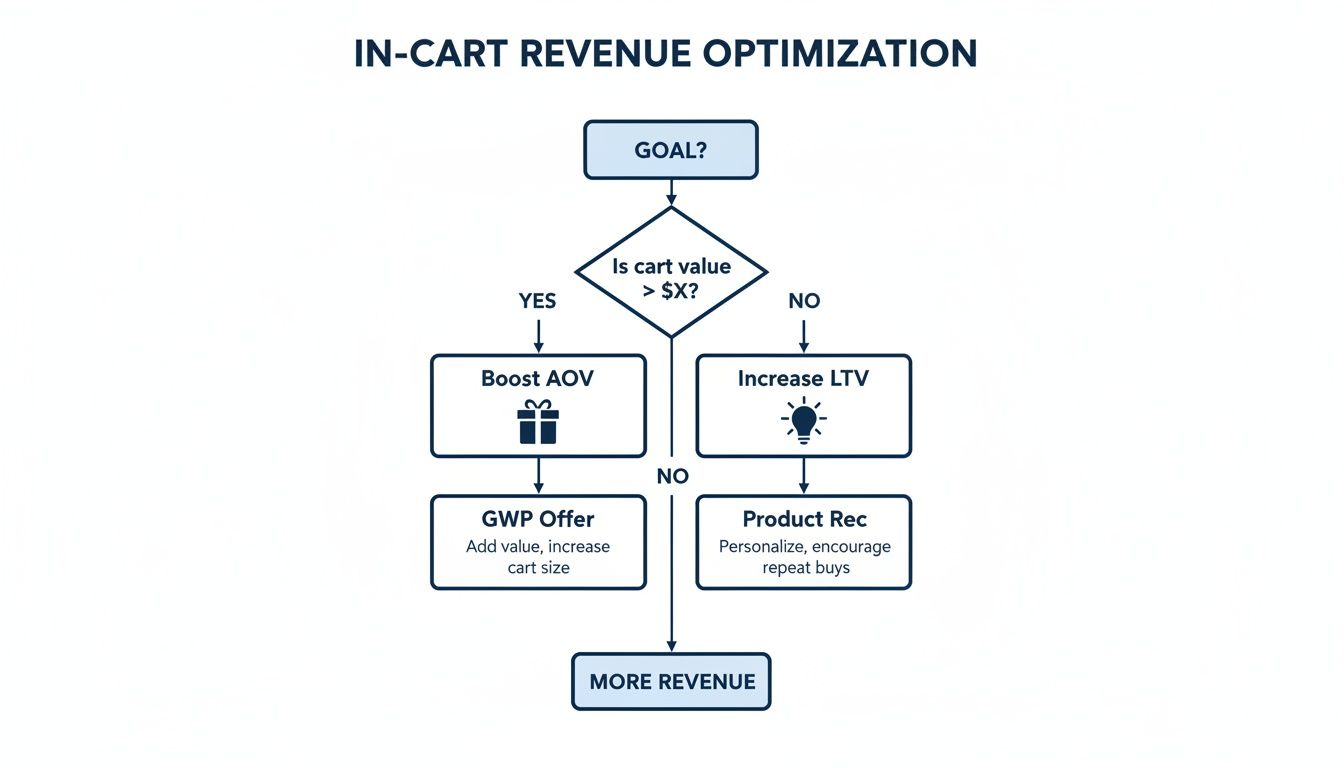
As you can see, your strategic goal—whether it's boosting immediate AOV or building long-term LTV—should directly shape the kind of reward you create. It's about moving away from one-off discounts and towards a strategy that nurtures repeat customers.
Actionable Analytics and Scalable Pricing
If you can't measure it, you can't improve it. A non-negotiable feature is an analytics dashboard that shows you the clear ROI of your campaigns. Can you see exactly how much extra revenue your "free gift at $100" offer brought in? The right tool gives you data you can actually use.
A study found that 80% of consumers are more likely to buy from a brand that offers a personalized experience. This proves that getting this right directly impacts your bottom line, making solid ROI tracking an absolute must-have.
Finally, take a hard look at the pricing model. Does the tool punish you for being successful by jacking up the price as your order volume grows? A good, scalable model should align with your growth, not get in its way.
When you're evaluating options for your store, looking into related tools like the best Shopify chatbots can give you a solid framework for comparing features and pricing. By focusing on these core pillars—speed, design, analytics, and pricing—you’ll be ready to choose a personalization tool that drives real results and makes your brand stronger.
Alright, ready to put these ideas into action? Launching your first in-cart reward campaign is way more doable than you might think. The whole point is to break free from the endless cycle of profit-killing discounts and start building a smarter strategy around value-added rewards that boost both your Average Order Value (AOV) and customer lifetime value.
This isn’t about hiring a team of data scientists or getting lost in complex algorithms. It’s about starting with a simple, powerful campaign that makes your customers feel genuinely appreciated for shopping with you. A clear, step-by-step game plan is all you need to launch with total confidence.
Step 1: Define a Clear and Measurable Goal
Before you build a single thing, you need to know what winning looks like. A fuzzy goal like "increase sales" is impossible to track. You have to get specific.
A great starting point is something like this: "Increase sitewide AOV by 12% in the next 30 days by using a free gift reward." This gives you a crystal-clear target and a deadline, so you'll know for sure if your strategy is actually working. Your goal should always be about sustainable growth through increased AOV and lifetime value, not just a short-term sugar rush from hefty discounts.
Step 2: Segment Your Offer for Maximum Impact
Let's be real: not every customer needs the same offer. The best ecommerce personalization tools let you slice up your audience to make your rewards feel way more relevant and special.
A simple but incredibly effective way to start is by creating a unique offer just for first-time buyers. For example, you could set up a campaign that only targets new visitors with a "Spend $75, get a free welcome gift" offer. This move is brilliant because it not only nudges them to make a bigger first purchase but also introduces them to another one of your products, making it far more likely they'll come back for more and increase their lifetime value.
Step 3: Design Your First Reward Campaign
Now for the fun part: building the actual offer. Using a tool like Monster Cart, you can design your campaign in minutes. A fantastic first play is a classic "Spend to Get" offer, which is proven to lift AOV without giving away your margins.
Campaign: "Spend $100 and Get a Free Gift"
Reward: Choose a gift with high perceived value but a good margin for you. Think a travel-size bestseller or a branded accessory.
Execution: The slide-out cart will feature a visual progress bar, which gamifies the experience and motivates customers to add just one more item to unlock their freebie.
This kind of reward feels like an accomplishment for the shopper and is often way more profitable than a blanket percentage-off sale. Monster Cart makes this incredibly easy to implement, turning a simple idea into a revenue-generating machine.
Step 4: Set Up Your Success Metrics
Finally, you need to track your results. A good personalization app should give you clear, actionable analytics right out of the box. To measure the true health and impact of your campaign, keep a close eye on these key metrics:
Average Order Value (AOV): The big one. Is it going up?
Conversion Rate: Are more people actually completing their checkout?
Offer Redemption Rate: How many shoppers are engaging with and earning the reward?
Customer Lifetime Value (LTV): This is the long game. Are these customers returning to buy again?
By focusing on these numbers, you can easily prove the ROI of your efforts and start refining your strategy over time. This is how you build a more profitable, resilient, and customer-loved brand, and a tool like Monster Cart provides all the data you need to do it effectively.
Your Ecommerce Personalization Questions, Answered
As you start exploring personalization, a few key questions always come up. I've pulled together the most common ones I hear from Shopify merchants to give you clear, straightforward answers.
Will Personalization Tools Slow Down My Shopify Store?
This is a totally valid concern. We’ve all seen how a clunky, poorly coded app can drag a site’s performance down and send customers running. It’s exactly why choosing a tool built for speed is non-negotiable.
Modern solutions like Monster Cart are specifically engineered to be lightweight. They load asynchronously—meaning they don't block the rest of your page from loading—so they won’t hurt your Core Web Vitals. Always look for tools that put performance right at the top of their feature list.
Can I Really Increase AOV Without Offering Discounts?
Absolutely. In fact, this is the very heart of a modern, profitable personalization strategy. Instead of constantly chipping away at your margins with hefty sales, you give customers compelling, value-driven rewards. This is the key to building long-term customer lifetime value.
Think about it: an offer like "Spend $75 to unlock a free gift" is almost always more profitable and enticing than a flat 10% off coupon. It boosts the perceived value of the order, introduces customers to new products, and protects your brand from being seen as a discount-first store. Monster Cart is designed precisely for this strategy.
How Do I Measure the ROI of My Personalization Efforts?
The right tool will have built-in analytics that make this incredibly simple. You should be able to track key metrics like Average Order Value (AOV), your overall conversion rate, and how often specific offers are being redeemed.
A great platform will also let you A/B test different offers to see what actually works. Tools like Monster Cart have real-time dashboards that directly attribute revenue to your in-cart campaigns, giving you a clear, undeniable picture of your return on investment. No guesswork needed.
What Is a Good First Personalization Campaign to Run?
Start with something simple that delivers a high impact. A "Free Shipping at $X" progress bar is a classic for a reason—it works like a charm and directly tackles a major cause of cart abandonment.
Another fantastic option is a "Spend $Y, Get a Free Gift" offer. It gives your AOV a nice bump and leaves customers with a delightful surprise. Both of these strategies are incredibly easy to set up in a tool like Monster Cart and will give you immediate, measurable results without having to rely on hefty discounts. These rewards build positive experiences that lead to higher lifetime value.
Ready to boost your AOV and customer loyalty with smart, value-driven rewards? Monster Cart turns your Shopify cart into a powerful rewards engine. Discover how Monster Cart can elevate your brand today.
Join 7000+ brands using our apps