8 Smart Examples of Price Bundling to Boost AOV in 2026
Jan 7, 2026
|
Published
Boosting your Average Order Value (AOV) doesn't have to mean slashing prices with hefty discounts. The most successful brands are moving away from margin-killing sales and focusing on smarter, value-driven incentives. This is where price bundling excels. It’s a strategic approach that encourages customers to spend more per transaction by offering them enhanced value through rewards like free gifts, complimentary shipping, or exclusive product combinations.
This shift in thinking moves the focus from a one-time sale to building long-term customer relationships. By rewarding customers for spending more, you create a more engaging and profitable shopping experience that nurtures lifetime value. Beyond immediate sales, smart bundling strategies are crucial for cultivating lasting relationships and exploring effective strategies for increasing customer lifetime value. This article breaks down 8 powerful examples of price bundling, showing you exactly how to implement these strategies to not only lift your AOV but also create a loyal customer base.
We'll explore how modern tools, particularly in-cart reward systems like Monster Cart, make these bundles feel less like an aggressive upsell and more like an exciting, interactive part of the shopping journey. Get ready to discover replicable tactics and actionable takeaways you can implement today to enhance customer loyalty and drive sustainable growth.
1. Buy More, Save More (Volume-Based Bundling)
This classic price bundling strategy incentivizes customers to increase their cart value by offering progressive rewards at specific spending thresholds. Instead of a single, flat-rate discount, the value of the reward, such as a discount or free gift, increases as the customer spends more. This creates a powerful psychological pull, encouraging shoppers to add just one more item to unlock the next, better tier of rewards.
This model is a cornerstone for boosting average order value (AOV) without defaulting to deep discounts. It shifts the customer's focus from simply getting a discount to achieving a spending goal, which often leads to higher revenue per transaction and builds a foundation for greater lifetime value.
Strategic Breakdown
Who It's For: Ideal for stores with a wide range of product prices, particularly in cosmetics, fashion, and consumables where customers frequently purchase multiple items.
Pros: Directly increases AOV, clears inventory faster, and enhances the shopping experience by making it feel like a game.
Cons: Requires careful calculation of thresholds and rewards to protect margins. If tiers are set too high, it can discourage, rather than encourage, purchases.
Key Insight: The power of this strategy lies in visualization. When customers can see a progress bar in their cart showing exactly how close they are to the next reward, the motivation to spend more becomes tangible. Tools like Monster Cart excel at this, transforming the in-cart experience into an interactive goal that boosts both AOV and customer engagement.
Implementation Checklist
Analyze Your AOV: Set your first spending tier just above your current average order value to provide an achievable first step for most customers.
Define Tiers: Create 2-3 clear, escalating tiers. For example: Spend $75, get free shipping; Spend $125, get a free gift; Spend $175, get 15% off. This combination of rewards appeals to different customer motivations.
Visualize Progress: Use an in-cart app to display a dynamic progress bar. Use compelling copy like, “You’re only $12.50 away from unlocking your reward!”
Promote Heavily: Announce your tiered offer on your site banner, product pages, and in marketing emails to ensure customers are aware of the potential savings from the moment they arrive. Learn more about how to strategically increase your average order value with these methods.
2. Free Gift with Purchase (GWP) Tiers
This popular price bundling strategy moves beyond discounts to offer tangible value. Instead of lowering prices, merchants reward customers with a desirable free gift once their cart total reaches a specific threshold. This approach leverages the powerful psychological appeal of receiving something extra, making the transaction feel more like a rewarding experience that builds positive brand association.
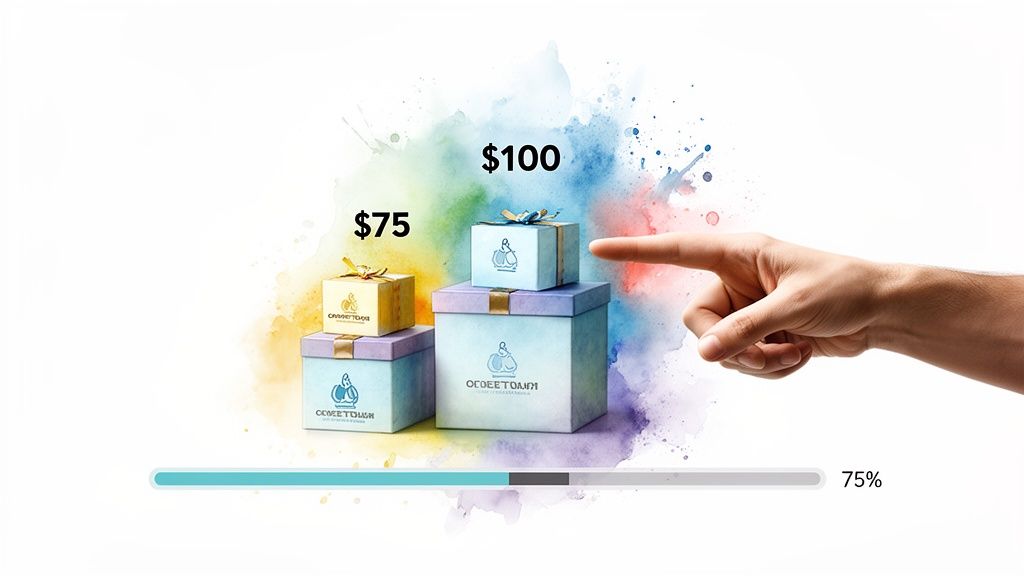
By offering a high-perceived-value gift, you can boost average order value (AOV) and protect your profit margins. It's a fantastic way to foster loyalty and increase lifetime value without resorting to hefty discounts. It encourages customers to add one more item to their cart not to save money, but to unlock a coveted reward.
Strategic Breakdown
Who It's For: Perfect for brands in beauty, wellness, fashion, and food/beverage industries where samples, accessories, or complementary products make compelling gifts.
Pros: Protects brand value by avoiding discounts, increases AOV, and is an effective way to introduce customers to new or different product lines.
Cons: Requires careful inventory management for the gift items. The perceived value of the gift must be high enough to motivate the additional spend.
Key Insight: The trick to a successful GWP campaign is making the reward feel exclusive and urgent. When a customer sees an image of the free gift directly in their cart, along with a message like “You’re just $15 away from this free gift!” the incentive becomes immediate and hard to ignore. This in-cart visibility, a key feature of Monster Cart, is crucial for driving action.
Implementation Checklist
Select the Right Gift: Choose a gift that complements your main products. This could be a best-selling sample, branded merchandise, or an exclusive item not available for sale.
Set an Achievable Threshold: Place your spending goal slightly above your current AOV to create a gentle nudge for customers to spend a little more.
Create Urgency: Promote the offer as a “limited time” or “while supplies last” event to encourage immediate purchases.
Visualize the Reward: Use an in-cart tool like Monster Cart to prominently display the gift, show progress toward unlocking it, and make the offer interactive. To dive deeper, you can learn more about GWP offers and how to set them up effectively.
3. Frequently Bought Together (FBT) Bundles
This data-driven price bundling strategy leverages customer behavior by presenting pre-curated product combinations, often with a value-add like a small discount or a free sample. Popularized by Amazon’s recommendation engine, these bundles group items that are often purchased together, making it easy for customers to discover and add complementary products to their cart. It’s a powerful upselling technique that feels like a helpful suggestion rather than a sales pitch.
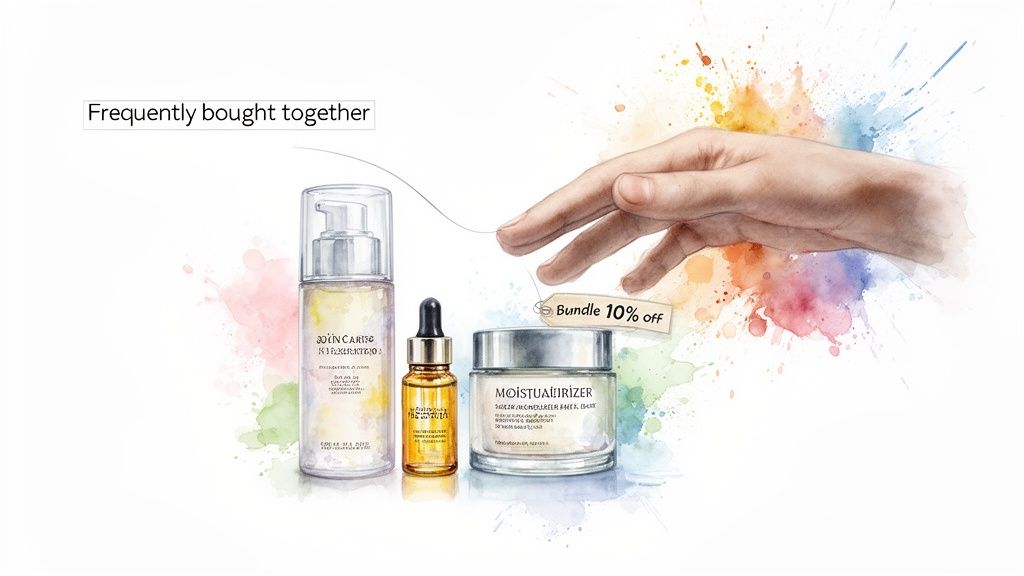
Instead of relying on guesswork, this model uses historical sales data to create highly relevant offers. By framing these bundles as a "complete routine" or "perfect pairing," brands can increase their average order value and improve the customer's product experience, which in turn boosts satisfaction and encourages future purchases.
Strategic Breakdown
Who It's For: Excellent for retailers in beauty (e.g., cleanser + serum + moisturizer), electronics (e.g., camera + lens + memory card), and home goods (e.g., coffee maker + filters + beans).
Pros: Increases AOV by selling more units per transaction, improves product discovery, and enhances customer satisfaction by offering convenient solutions.
Cons: Requires accurate sales data to identify effective pairings. Poorly matched bundles can feel forced and may not convert, potentially damaging trust.
Key Insight: The most effective FBT bundles are presented seamlessly within the shopping journey, especially in the cart. When a customer adds an item, an intelligent cart tool like Monster Cart can instantly recommend the perfect complementary product, making the upsell feel natural and helpful. This frictionless experience is key to boosting conversions and lifetime value.
Implementation Checklist
Analyze Purchase Data: Use your analytics to identify which products are most frequently purchased together. Look for non-obvious pairings that your customers have discovered on their own.
Create Small Bundles: Start with simple 2-3 item bundles. For example, a "Beginner's Skincare Kit" or a "Morning Coffee Essentials" bundle. Keeping it simple avoids overwhelming the customer.
Offer a Value-Driven Incentive: A reward like a free gift, free shipping, or a modest 5-10% discount is often enough to encourage the bundle purchase. The primary value is in the convenience.
Position Strategically: Display FBT bundles directly on product pages and, most importantly, as an in-cart recommendation. Use compelling copy like, “Customers also bought…” or “Complete the look with…” to frame it as a helpful suggestion.
4. Free Shipping Thresholds
This is one of the most effective and widely used examples of price bundling, leveraging a powerful psychological incentive to drive up cart value. Instead of a discount, this strategy removes a common purchase barrier—shipping costs—once an order reaches a specific spending threshold. It transforms a potential negative into a positive reward, motivating shoppers to add more items to their cart to qualify.
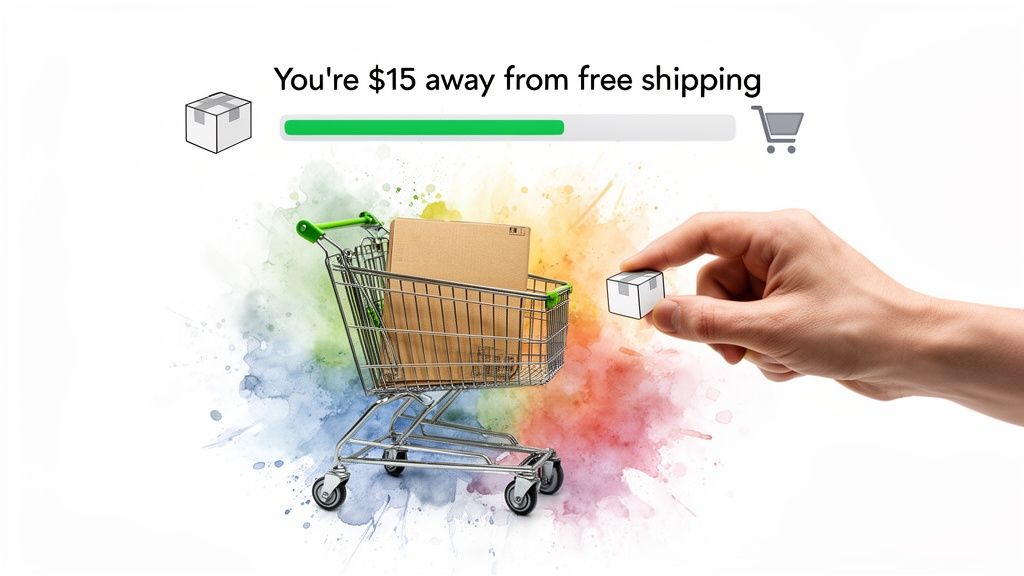
This method directly targets cart abandonment, as unexpected shipping fees are a top reason shoppers leave. By making free shipping an achievable goal, brands can significantly boost their average order value and improve conversion rates without devaluing their products. It's a sustainable way to increase profitability and build customer goodwill, contributing positively to lifetime value.
Strategic Breakdown
Who It's For: Universal applicability, but especially potent for brands in competitive markets like fashion, beauty, and home goods where shipping costs can be a deciding factor.
Pros: Directly increases AOV, reduces cart abandonment, and enhances customer satisfaction by removing a major friction point.
Cons: The threshold must be carefully calculated to ensure shipping costs don't destroy profit margins. If set too high, it can fail to motivate customers.
Key Insight: The strategy's effectiveness multiplies when progress is made visible. A dynamic progress bar in the cart showing "You're just $9.50 away from Free Shipping!" creates a sense of urgency and gamifies the experience. This visual cue, a core feature of tools like Monster Cart, makes the goal tangible and encourages immediate action.
Implementation Checklist
Calculate Your Threshold: Analyze your data to find the sweet spot. A common starting point is setting the threshold approximately 15-20% above your current average order value.
Communicate Clearly: Promote your free shipping offer site-wide. Use a prominent site banner and mention it on product and cart pages so the offer is always top-of-mind.
Visualize Progress in Cart: Implement a real-time progress bar in the shopping cart. This visual feedback is crucial for nudging customers to add that one last item to their order.
Suggest Add-On Items: Pair your free shipping progress bar with targeted product recommendations. Show customers low-cost, relevant items that can help them easily reach the threshold without much thought.
5. One-Click Add-ons and Warranty Bundles
This form of bundling presents high-margin, value-add services as simple, one-click additions directly within the shopping cart. Instead of disruptive pop-ups, these offers, such as extended warranties, shipping protection, or gift wrapping, appear as natural line items. This frictionless approach allows customers to easily enhance their purchase, boosting both order value and peace of mind without discounts.
This strategy is exceptionally effective for increasing average order value (AOV) while also improving the customer experience. By bundling a service with a physical product, you add pure profit to the transaction. It shifts the customer's mindset from seeking savings to securing their purchase, which builds trust and can increase lifetime value.
Strategic Breakdown
Who It's For: Perfect for electronics, high-value goods, jewelry, and gift-oriented stores. Any merchant selling items that could benefit from protection or special handling can leverage this.
Pros: Significantly boosts profit margins with low-cost, high-value add-ons. Increases customer confidence and satisfaction by offering protection.
Cons: Can feel unnecessary or pushy if the offer is not genuinely valuable or relevant to the product. Requires sourcing reputable service partners for warranties or insurance.
Key Insight: The success of this strategy hinges on relevance and simplicity. An offer like "Protect Your Shipment for $1.99" is an easy "yes" for a customer buying a fragile item. Tools like Monster Cart make this seamless by integrating these options directly into the cart, making them feel like a standard, helpful part of the checkout process that boosts AOV effortlessly.
Implementation Checklist
Identify Relevant Add-ons: Brainstorm services that complement your products. Common examples include extended warranties (like those from Square Trade), shipping protection, or premium gift wrapping.
Price Strategically: Keep the add-on price low relative to the main product, typically 5-15% of the item's cost, to make it an impulse-friendly decision.
Craft Clear Benefit-Driven Copy: Use simple, direct language. For example, use “Protect your new device from accidental damage” instead of a generic “Add Extended Warranty.”
Integrate Seamlessly: Place the offer directly in the cart summary using an in-cart upsell tool. To discover the right tools for this, you can learn more about the best upsell apps for Shopify and how they integrate.
6. Product Tiering and Upgrade Bundles
This advanced price bundling strategy presents curated collections at different price points, guiding customers from a basic offering to a premium tier. Instead of selling items individually, merchants create distinct bundles like "Basic," "Standard," and "Premium," where each successive level offers progressively more value, often including exclusive items or services rather than just a discount.
This model is exceptionally effective for moving customers up the value ladder and increasing their lifetime value. It reframes the purchase decision from "which single product?" to "which complete experience?" By clearly articulating the added benefits of higher tiers, brands can significantly increase average order value and introduce customers to a wider range of their product ecosystem.
Strategic Breakdown
Who It's For: Perfect for SaaS, subscription boxes, and brands with complementary products, such as beauty (skincare sets), tech (device + accessories), or specialty foods (coffee tasting kits).
Pros: Increases AOV by encouraging upgrades, simplifies the buying decision, and effectively showcases the value of premium products or features.
Cons: Requires a deep understanding of customer needs to create compelling tiers. Poorly structured tiers can confuse customers or make the basic option seem inadequate.
Key Insight: The persuasive power of tiering comes from creating a clear "value anchor." By highlighting a "Most Popular" or "Best Value" tier, you create a psychological sweet spot that most customers will gravitate towards. An in-cart tool like Monster Cart can visually distinguish this recommended tier, making the decision to upgrade feel both easy and intelligent.
Implementation Checklist
Define Your Tiers: Create 2-3 distinct tiers. For example, a "Starter Kit," a "Growth Kit" (including the starter items plus a popular add-on), and a "Pro Kit" (including everything plus a premium product).
Price Strategically: Set price points at 20-40% intervals (e.g., $49, $69, $99) to make the upgrade feel substantial but achievable. The middle tier should offer the most compelling value proposition.
Name Tiers Effectively: Use value-driven names that evoke aspiration, such as "Essential," "Advanced," and "Ultimate," instead of generic labels like "Tier 1" or "Tier 2."
Visualize the Value: In the cart, use a clear layout to compare the contents of each tier. Use visual cues like checkmarks and bold text to highlight what customers gain by upgrading, making the premium options more tempting.
7. Limited-Time and Seasonal Bundle Offers
This strategy leverages urgency and scarcity by creating bundled offers that are only available for a specific period. These time-sensitive promotions, such as holiday gift sets or seasonal collections, tap into the psychological principle of Fear Of Missing Out (FOMO), compelling customers to purchase immediately rather than delay their decision. The perceived exclusivity and fleeting nature of the offer make it more desirable.
By tying bundles to specific events like Black Friday, Valentine's Day, or the changing seasons, you create a natural reason for the promotion. This makes the offer feel more authentic and less like a random discount, encouraging purchases without devaluing your products. This is one of the most effective examples of price bundling for driving high-volume sales while protecting brand equity.
Strategic Breakdown
Who It's For: A perfect fit for nearly all ecommerce verticals, especially beauty (holiday sets), fashion (seasonal capsules), and food/beverage (seasonal flavors). It’s highly effective for driving sales during key retail moments.
Pros: Creates powerful urgency that boosts conversion rates, excellent for clearing seasonal inventory, and generates excitement and buzz around specific campaign periods.
Cons: Requires significant planning for inventory and marketing. If used too frequently, it can train customers to wait for sales, potentially cannibalizing full-price purchases.
Key Insight: The urgency of a limited-time bundle must be visually reinforced at the point of decision. Displaying a live countdown timer directly in the shopping cart transforms a passive offer into an active, time-sensitive event. This visual cue from tools like Monster Cart makes the deadline tangible, pushing hesitant buyers to complete their checkout now.
Implementation Checklist
Plan Ahead: Schedule your seasonal campaigns 6-8 weeks in advance. This includes sourcing exclusive products, designing unique packaging, and preparing all marketing creative.
Create a Compelling Offer: Combine products that make sense for the season or event. A "Summer Glow" skincare set or a "Winter Warm-Up" coffee blend feels curated and special, adding value beyond a simple discount.
Inject Urgency: Use an in-cart app to add a countdown timer and scarcity messaging. Display clear, direct copy like, “Holiday Bestsellers Bundle: Offer ends in 01:14:32” or “Only 17 left at this price!”
Build Anticipation: Launch an email and social media campaign a week before the bundle goes live. Tease the contents and announce the launch date to build a list of eager customers ready to buy on day one.
8. Loyalty-Based Progressive Bundling
This advanced bundling strategy transforms one-time buyers into loyal advocates by offering progressively better rewards based on their customer status. Instead of treating all shoppers the same, it recognizes and rewards repeat customers with exclusive bundle pricing, unique product combinations, or more valuable free gifts. This method deepens customer relationships by making them feel like valued insiders.
This approach is a powerful tool for increasing customer lifetime value (LTV). It shifts the focus from a single transaction to a long-term relationship, encouraging repeat purchases by offering tangible, escalating benefits. By rewarding loyalty with value instead of just discounts, you build a sustainable and profitable customer base.
Strategic Breakdown
Who It's For: Ideal for brands with repeat purchase potential, such as consumables, beauty, fashion, and subscription-based businesses. It's particularly effective for stores aiming to build a strong community around their brand.
Pros: Dramatically increases customer LTV and retention, fosters brand loyalty, and allows for highly personalized marketing without relying on steep, universal discounts.
Cons: Requires a system to track customer history and segment audiences effectively. The value proposition for each tier must be compelling enough to motivate repeat purchases.
Key Insight: Personalization is the cornerstone of this strategy. When a returning customer sees a message in their cart like, “Welcome back, Gold Member! Here’s your exclusive bundle,” it creates a powerful sense of recognition and appreciation. Tools like Monster Cart can identify customer tags to display these personalized, tiered offers automatically, driving loyalty and higher AOV.
Implementation Checklist
Define Your Loyalty Tiers: Create clear segments based on purchase history or total spend (e.g., New Customer, VIP, Platinum Member). Start with 2-3 simple tiers.
Assign Tier-Specific Bundles: Develop unique offers for each level. A new customer might get a free gift bundle, while a VIP member unlocks a bundle with a premium gift and free shipping, rewarding their long-term value.
Recognize Customers Instantly: Use an in-cart app that can read customer tags. Display a personalized welcome message and the exclusive offer available to their tier, making them feel seen and valued from the start.
Communicate the Benefits: Clearly advertise your loyalty program and its progressive bundle perks across your site, in post-purchase emails, and on social media to incentivize customers to climb the loyalty ladder.
8 Price Bundling Strategies Compared
Strategy | 🔄 Implementation Complexity | ⚡ Resource Requirements | 📊 Expected Outcomes / ⭐ | 💡 Ideal Use Cases | ⭐ Key Advantages |
|---|---|---|---|---|---|
Buy More, Save More (Volume-Based Bundling) | Moderate — configure tiers, thresholds, real-time progress UI | Moderate — pricing strategy, AOV analysis, UI visuals | Boosts AOV and cart size; reduces promo reliance — ⭐⭐⭐⭐ | Shopify merchants aiming to increase order value without broad discounts | Encourages larger carts; scalable across catalog |
Free Gift with Purchase (GWP) Tiers | Moderate — gift selection, inventory limits, cart display | Medium–High — gift inventory, fulfillment, sourcing | Higher perceived value and conversion uplift — ⭐⭐⭐⭐ | Brands with excess/seasonal inventory or premium positioning (beauty, DTC) | Perceived premium reward; reduces price sensitivity |
Frequently Bought Together (FBT) Bundles | Moderate–High — data models or manual curation, dynamic suggestions | Medium — purchase data, analytics, automation | Increases AOV with low friction; higher bundle conversion — ⭐⭐⭐⭐ | Stores with complementary SKUs and sufficient purchase history | Data-driven relevance; simplifies cross-sell choices |
Free Shipping Thresholds | Low — set thresholds and progress indicator | Medium — shipping cost modeling, regional configs | Reduces abandonment and nudges incremental buys — ⭐⭐⭐⭐ | Low-AOV stores or those with moderate shipping costs | Removes top friction point; clear psychological trigger |
One-Click Add-ons & Warranty Bundles | Low–Moderate — UI toggles, conditional logic, partner setup | Low — content, partner integration, legal review | Adds high-margin revenue with minimal friction — ⭐⭐⭐⭐ | Merchants selling higher-value or protection-suited products | Very high margins; low checkout friction |
Product Tiering & Upgrade Bundles | High — create multi-tier SKUs, comparative UI, pricing strategy | High — inventory complexity, design, marketing | Encourages upgrades and increases AOV via anchoring — ⭐⭐⭐⭐ | Stores with varied product lines wanting guided upsells | Anchoring effect; simplifies decision-making toward premium |
Limited-Time & Seasonal Bundle Offers | Moderate — scheduling, timers, scarcity messaging | Medium–High — planning, inventory, creative assets | Drives short-term conversion spikes and inventory clearance — ⭐⭐⭐⭐⭐ | Merchants with seasonal inventory or event-driven campaigns | Urgency and exclusivity produce fast conversion lifts |
Loyalty-Based Progressive Bundling | High — loyalty integration, personalization, tier management | High — customer data, program ops, personalization tools | Increases CLV and repeat purchase rates — ⭐⭐⭐⭐⭐ | Brands with strong repeat customers or subscription models | Strengthens retention; rewards repeat buyers with exclusive value |
Turn Your Cart Into a Revenue Engine with Smart Bundling
As the detailed examples of price bundling in this guide have shown, the art of selling more is rooted in customer psychology, not just aggressive pricing. The most effective strategies move beyond simple discounts and instead focus on creating an experience of discovery and reward. It’s about reframing the customer journey from a simple transaction to an engaging interaction where adding more to the cart unlocks genuine value.
The core lesson is to transform your shopping cart from a passive checkout page into your most active and persuasive sales tool. By strategically implementing offers like free gifts or free shipping directly within the cart, you can guide customer behavior, increase order sizes, and build lasting relationships. This approach allows you to shift away from margin-eroding, site-wide sales and toward a more sustainable model that prioritizes customer lifetime value.
Key Takeaways for Your Bundling Strategy
The journey from theory to implementation is shorter than you think. Here are the most critical, actionable takeaways to start with:
Focus on Perceived Value, Not Just Discounts: Offers like Free Gift with Purchase (GWP) or tiered spending rewards often have a higher perceived value than a simple percentage-off discount, protecting your profit margins while still delighting customers.
Make it Interactive and Visual: Customers are more likely to spend more when they can see their progress toward a reward. A progress bar for free shipping or a visual cue for unlocking a free gift creates a gamified experience that encourages action.
Start with Low-Hanging Fruit: Implementing a "Frequently Bought Together" bundle or a simple free shipping threshold are quick wins. These low-effort, high-impact strategies can provide immediate AOV lifts and valuable data for more complex campaigns later.
Segment and Personalize: As we saw with loyalty-based progressive bundling, your best customers deserve the best offers. Tailoring bundles to specific customer segments (new vs. returning, VIPs) makes the offer feel exclusive and significantly boosts lifetime value.
Ultimately, mastering these examples of price bundling is about creating a win-win scenario. Your customers feel they are getting an exceptional deal and being rewarded for their loyalty, which in turn strengthens their connection to your brand. For your business, the result is a direct and measurable increase in average order value, improved inventory movement, and a healthier bottom line built on value, not just discounts. To further master your e-commerce pricing and delve deeper into various techniques, you can explore comprehensive bundling strategies on our blog.
Ready to turn these bundling examples into reality without custom code? Monster Cart transforms your Shopify cart into a high-converting rewards engine, allowing you to easily implement GWP tiers, progress bars for free shipping, and one-click add-ons. Start building smarter, more profitable bundles today and see the impact on your AOV and customer lifetime value.
Join 7000+ brands using our apps