How Do You Upsell on Shopify Without Annoying Customers
Feb 13, 2026
|
Published
Ever struggled with how do you upsell without making customers want to throw their laptops out the window? The old way usually involves some obnoxious, full-screen pop-up that interrupts the entire shopping flow, all for a tiny bump in sales. This approach is a classic case of prioritizing one sale over the long-term customer relationship and lifetime value. Frankly, it creates more problems than it solves.
The Real Cost of Annoying Pop-Up Upsells
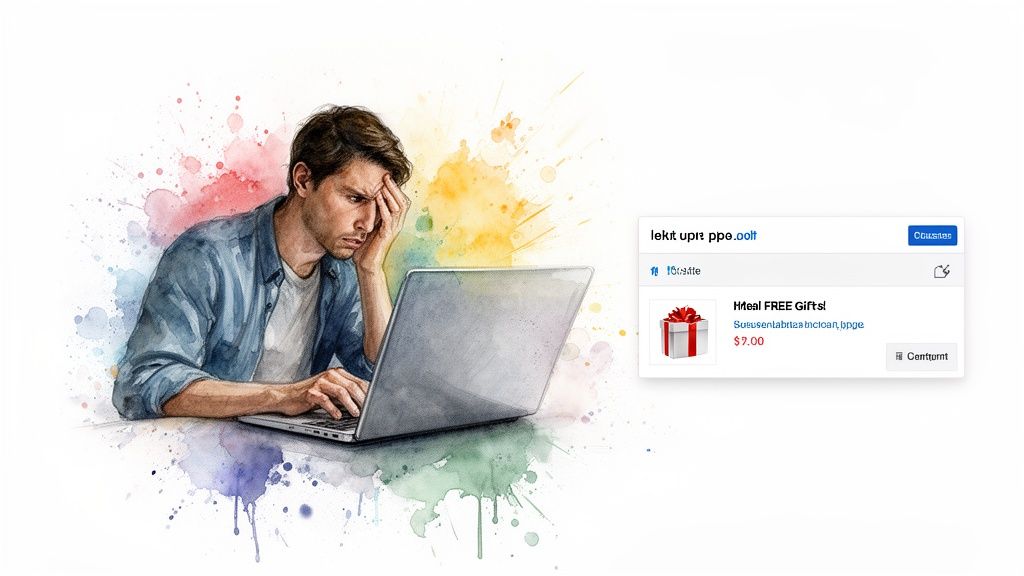
So many Shopify merchants fall into the pop-up trap because it feels like a quick fix to boost their Average Order Value (AOV). You know the ones I’m talking about—the massive overlay that appears right as you’re about to check out, or that unexpected modal that completely blocks the page. And sure, these aggressive tactics can occasionally squeeze out an extra sale, but they come with a heavy hidden cost to customer lifetime value.
This pushy approach creates friction, frustration, and a whole lot of doubt at the most critical moment of the entire customer journey. Instead of feeling like they’re being guided to a great deal, shoppers feel like they’re being cornered. The result? A damaged user experience that leads directly to some pretty nasty outcomes for your brand.
The Hidden Downsides of Disruptive Upsells
When an upsell feels forced or totally irrelevant, it shatters the natural rhythm of shopping. This disruption can trigger a domino effect of negative consequences that will hurt your store's long-term health far more than a single upsell could ever help.
Here’s what you’re really risking:
Skyrocketing Cart Abandonment: A surprise pop-up can feel like a last-minute cash grab, making shoppers second-guess their entire purchase and bolt. When an offer feels like high-pressure sales, customers will almost always choose to walk away. If you're seeing this, it's worth reading our guide on how to reduce cart abandonment.
Brand Erosion: Trust is incredibly fragile. Aggressive sales tactics can make your brand feel desperate or cheap, chipping away at the perceived value of your products and destroying the loyalty you’ve worked so hard to build.
Negative Customer Perception: Instead of seeing an offer as a helpful suggestion, customers see it as a flat-out annoyance. That negative feeling sticks around, making them far less likely to come back for another purchase and tanking their lifetime value (LTV).
The Takeaway: The goal isn't just to increase the value of one order; it's to increase the value of the customer. Focusing solely on a quick AOV win with disruptive tactics often sacrifices the far more valuable metric of customer lifetime value.
A smarter approach rethinks this entire process. Instead of interrupting the user, what if you could weave offers directly into the shopping cart itself? This is the core idea behind in-cart upselling—a method that transforms a simple transactional moment into a rewarding and seamless experience focused on boosting lifetime value.
By embedding offers naturally within the cart, you make customers feel appreciated, not targeted. A well-designed system, like the one powered by Monster Cart, helps merchants shift their focus from single-order AOV to long-term LTV. It lets you build a rewarding journey with incentives like free gifts or free shipping thresholds, encouraging customers to add more to their cart because they want to unlock a benefit—not because a pop-up bullied them into it.
Building an Upsell Strategy Beyond Discounts
Effective upselling is all about creating genuine value, not just slicing prices with hefty discounts. While a quick discount can sometimes nudge a sale over the line, a strategy built on constant markdowns can devalue your brand and, even worse, train customers to wait for the next sale. This eats into your margins and damages long-term customer lifetime value.
The real art is figuring out how to upsell in a way that makes shoppers excited to spend more.
The most successful merchants I see shift their thinking from transactional discounts to relational rewards. Instead of asking, "How can I get them to buy this now?" they ask, "What reward can I offer that makes this purchase feel more special and encourages them to come back?" This simple mindset change shifts the focus from a one-time AOV bump to fostering long-term customer loyalty and lifetime value.
It's a crucial distinction. With global eCommerce sales projected to hit $7.5 trillion by 2025, shoppers have endless choices. To stand out, the experience you provide matters more than ever, and a rewards-based approach makes your brand feel generous and customer-focused.
Gamify the Cart with Spend-to-Unlock Rewards
One of the most powerful ways to encourage a higher spend is by turning the shopping cart into an interactive experience. This is where "Spend-to-Unlock" models absolutely shine, transforming the path to checkout into a mini-game where customers unlock progressively better rewards as they shop. This approach is key to boosting AOV without relying on margin-killing discounts.
This strategy works because it taps into basic human psychology—that desire to complete a goal and earn a prize. When a customer can see they are just a few dollars away from a reward, the motivation to add one more item becomes incredibly compelling. It feels less like a sales pitch and more like a personal challenge.
Key Insight: A visual progress bar is the engine of a spend-to-unlock system. It instantly communicates value and urgency, showing customers exactly how close they are to their next reward. This simple visual cue can dramatically reduce decision friction.
Imagine a customer has $62 worth of products in their cart. A well-designed cart drawer could display a message like, "You're only $13 away from a free gift!" This creates a clear, achievable goal that feels rewarding, not demanding.
Moving Beyond Discounts with Tangible Incentives
To truly boost AOV without sacrificing your margins, your rewards need to feel valuable and desirable. Hefty discounts aren't your only option; in fact, they're often the least creative one when you consider long-term value.
Consider these powerful, non-discount incentives that build brand affinity, drive sales, and improve lifetime value:
Tiered Free Gifts: Offer different gifts at various spending thresholds. For example, a customer might unlock a travel-size sample at $75 and a full-size product at $150. This encourages shoppers to reach for that higher tier.
Free Shipping Thresholds: This is a classic for a reason. Shipping costs are a major cause of cart abandonment. A clear message—"You're $8 away from FREE shipping!"—is one of the most effective motivators out there.
Exclusive Product Samples: Give customers a taste of other products you offer. A free sample of a new serum with any skincare purchase over $50 not only serves as a great reward but also acts as a marketing tool for a future purchase.
Automating these offers is where the magic happens. A tool like Monster Cart can manage these tiered rewards seamlessly within a custom cart drawer. It automatically updates the progress bar as customers add items, displaying the next available reward without any manual effort. This creates a smooth, engaging experience that drives higher spending naturally, which is a key component of learning how to increase average order value effectively.
By focusing on these reward-based systems, you change the customer conversation from "How much can I save?" to "What extra value can I get?" This simple shift builds a healthier, more profitable relationship with your customers, encouraging them to return again and again to see what new rewards they can unlock. It’s a smarter way to grow your brand, one rewarding cart at a time.
Placing Strategic Upsells Inside Your Shopify Cart
So, you’ve got a killer rewards system mapped out. The next big question is where to actually show these offers to your customers. The answer is simple but incredibly powerful: right inside the shopping cart itself.
By placing strategic upsells directly in the cart drawer or on the cart page, you’re catching customers at their peak moment of purchase intent. This turns a standard checkout step into a dynamic, live opportunity to boost your Average Order Value (AOV) and improve their overall experience.
This is a world away from those annoying, journey-killing pop-ups. In-cart offers feel like a natural, helpful part of the process. The goal is to make your suggestions feel less like a sales pitch and more like a thoughtful recommendation that adds value and builds a foundation for long-term loyalty.
High-Impact One-Click Add-Ons
Some of the most effective in-cart upsells are the no-brainers—those low-cost, high-value additions that customers can tack on with a single click. These offers require almost zero thought but can provide huge peace of mind, making them an easy "yes" for a ton of shoppers right before they pull the trigger.
Think about these kinds of seamless add-ons:
Shipping Protection: For just a dollar or two, you can offer customers insurance against a lost, stolen, or damaged package. It’s a tiny cost for a massive amount of reassurance.
Product Warranties: Offering an extended warranty on electronics, apparel, or other big-ticket items is another frictionless way to bump up the order total.
Priority Processing: Let customers pay a little extra to jump to the front of the fulfillment line. This is an absolute lifesaver for last-minute gift buyers.
These one-click offers work so well because they solve a potential problem for the customer at the exact moment they’re thinking about it. A tool like Monster Cart makes weaving these directly into the cart drawer incredibly simple, presenting them as clean, non-intrusive options that enhance the customer experience.
Leveraging Smart Recommendations
Beyond simple add-ons, your cart is the perfect stage for intelligent product recommendations. When a customer adds an item, they’re sending you a crystal-clear signal about their tastes and needs. Using that signal to suggest relevant, complementary products is one of the smartest upsells you can make.
This is where "Frequently Bought Together" suggestions really shine. If a customer buys a dress, the cart can automatically suggest the perfect earrings or handbag to complete the outfit. This isn’t just some random product push; it’s a curated recommendation that actually enhances their main purchase and their relationship with your brand. For a deeper look at this tactic, check out our complete guide on setting up Frequently Bought Together offers.
Expert Insight: AI-powered recommendations take this a massive step further. By analyzing past purchase data and real-time browsing behavior, AI can predict what a specific customer is most likely to buy next with stunning accuracy. This makes your in-cart offers feel incredibly personal and genuinely helpful.
This infographic breaks down how different reward-based upsells can motivate customers once they’re in the cart.
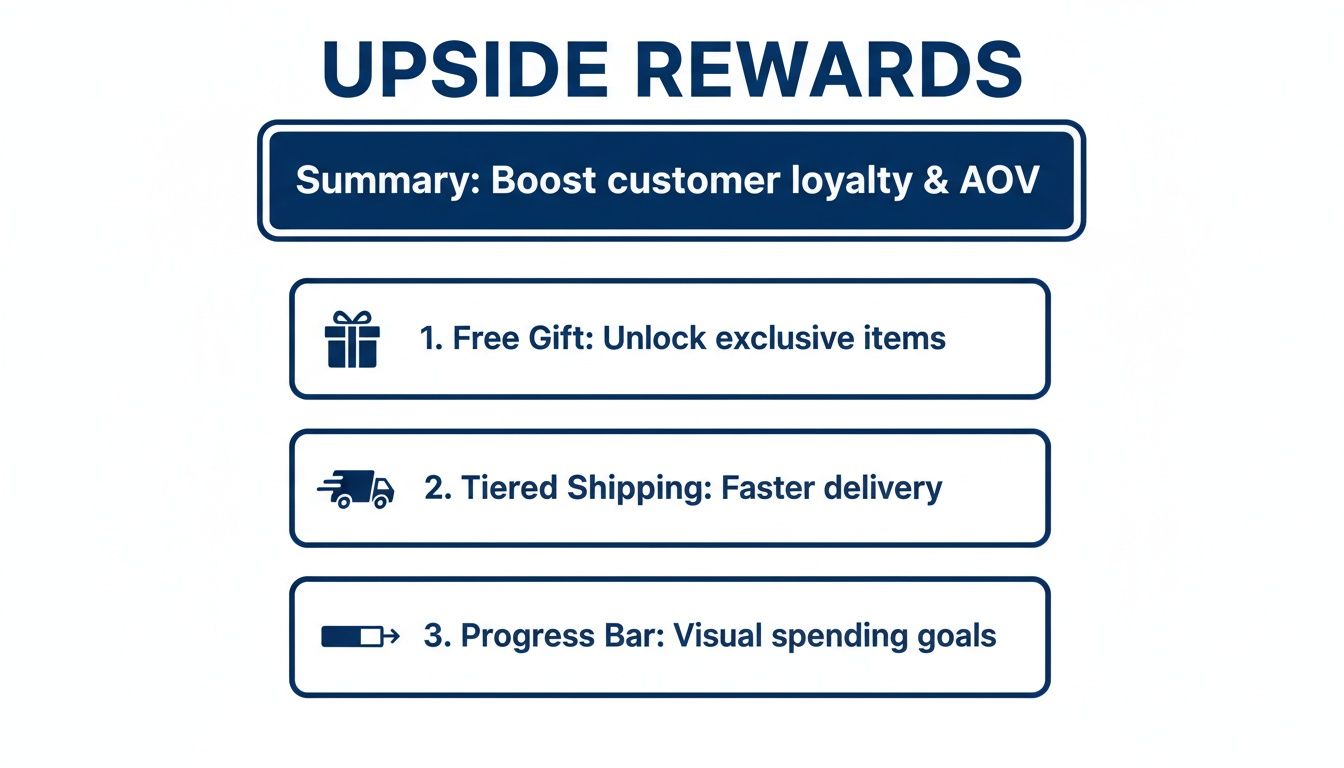
The visualization really drives home how a mix of free gifts, shipping incentives, and progress bars creates a compelling, almost game-like experience that encourages higher spending.
To help you decide which offers to test first, here’s a quick comparison of some of the most effective in-cart upsells we see brands using successfully.
High-Impact In-Cart Upsell Offer Comparison
Offer Type | Primary Goal | Best For | Example Message |
|---|---|---|---|
Free Shipping Threshold | Increase AOV | Stores with clear shipping costs | "You're just $12 away from unlocking free shipping!" |
Gift With Purchase (GWP) | Increase AOV & LTV | Brands with sample-sized or low-cost complementary items | "Spend $25 more to get a free travel-size serum!" |
One-Click Add-Ons | Increase AOV & Customer Peace of Mind | All stores, especially those selling fragile or high-value items | "Add shipping protection for just $1.99." |
Product Recommendations | Increase AOV & Product Discovery | Stores with a catalog of complementary products | "Goes perfectly with: [Product Name]" |
Tiered Rewards | Maximize AOV & LTV | Stores looking to gamify the cart experience | "Unlock your next reward: a free tote at $150!" |
Each of these tactics plays a slightly different role, but they all share the same goal: making the cart a more valuable and engaging place for the customer.
In a world where 85% of consumers are shopping online, mastering the art of the in-cart offer isn't just a nice-to-have; it's essential. Data has shown time and again that upselling top-performing products can lift revenue by 10-30% on average—a massive boost in a market where every dollar counts.
Ultimately, placing upsells inside your Shopify cart is about transforming it from a static summary into an interactive sales engine. By using one-click add-ons and smart recommendations, you create a seamless experience that adds real value for the customer and drives both AOV for today and lifetime value for tomorrow. And you do it all without a single annoying pop-up.
Crafting Upsell Messages That Actually Convert
You can have the most brilliant upsell strategy in the world, but it’ll fall completely flat without the right message. Your offer is only as powerful as the words you use to present it, and mastering persuasive copy is the key to getting shoppers to click "add." The real goal is to guide, not to push—framing every offer as a genuinely helpful suggestion that makes their purchase even better and encourages them to shop with you again.
Great upsell copy is always clear, concise, and laser-focused on value. It has to instantly answer the customer's silent question: "What's in it for me?" Instead of using aggressive, salesy language, you want to communicate the benefit in a way that feels natural and even a little exciting. That simple shift in tone can be the difference between a conversion and an abandoned cart.
The Psychology of High-Converting Copy
The most effective upsell messages tap into some fundamental psychological triggers. They create a sense of achievement, urgency, or exclusivity without ever feeling forceful. When you get it right, the customer feels smart for adding more to their cart, not pressured.
Here are a few principles that make these messages tick:
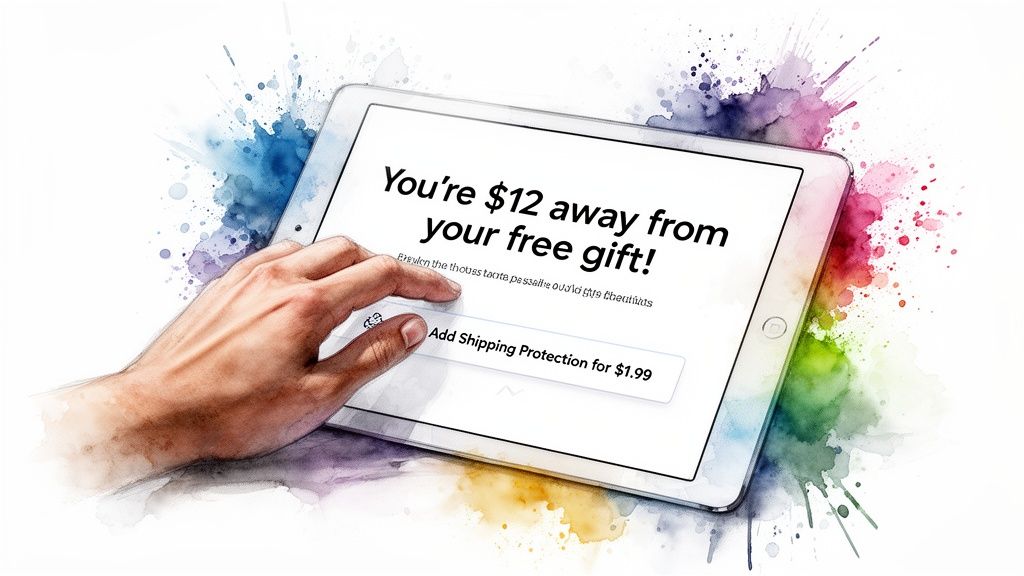
Goal Proximity: When people feel they’re close to reaching a goal, their motivation to finish skyrockets. This is exactly why a message like, "You're just $12 away from a free gift!" works so well. It turns shopping into a mini-game they want to win.
Loss Aversion: We’re all wired to avoid losing something more than we are to gain something. Framing an offer as something they might miss out on ("Don't miss out on free shipping!") can be incredibly powerful.
Clarity and Simplicity: In the fast-paced environment of an online cart, there’s zero time for confusion. A message like "Add Shipping Protection for $1.99" is direct, simple, and immediately understood.
Key Insight: The best upsell copy focuses on the experience, not just the feature. Instead of listing what the customer gets, describe the feeling or benefit—like the peace of mind from shipping protection or the delight of receiving an unexpected gift.
This approach transforms the entire interaction. It moves beyond a simple transaction and starts building a stronger customer relationship, which is the absolute foundation of a high lifetime value (LTV).
Crafting Messages That Resonate
The real secret to crafting a message that converts is aligning it perfectly with your brand voice and the customer's context. Your upsell copy shouldn't sound like a generic script; it should feel like a natural extension of your brand’s personality. Whether your tone is playful, luxurious, or straight to the point, it needs to stay consistent inside the cart.
Just look at these real-world examples of high-converting copy:
For Free Shipping: "You're so close! Add $8.75 more to unlock free shipping."
For a Free Gift: "Congrats! You've unlocked our deluxe sample. Spend $25 more to upgrade to the full-size gift!"
For a One-Click Add-On: "Protect your order from loss, theft, or damage for only $2.49."
For a Product Recommendation: "Complete the look: Add the matching earrings."
Notice how each one is specific, actionable, and focused on the value for the shopper. They don’t just sell; they inform and empower the customer to make a decision that improves their overall purchase.
A customizable tool like Monster Cart is absolutely essential for this level of personalization. It gives you the power to tailor every single word and visual element within your cart drawer, ensuring your upsell messages are always on-brand. Instead of being stuck with rigid, pre-written templates, you can craft unique copy that speaks directly to your audience, turning your cart into a powerful conversion engine that grows AOV and customer lifetime value at the same time.
Measuring and Optimizing Your Upsell Strategy
Launching your in-cart upsell strategy is a huge win, but it’s definitely not a “set it and forget it” kind of deal. How do you actually know if all your hard work is paying off? The real answer isn't just about watching revenue go up; it's about digging into the data to see how your offers are truly influencing shopper behavior and long-term loyalty.
A great upsell strategy should lift your bottom line without wrecking the customer experience. This means you need a solid way to measure success and a game plan for constantly tweaking your approach. If you’re not looking at the numbers, you’re just guessing, and that can lead to a lot of missed opportunities.
Defining Your Key Metrics
To get the full picture, you need to track a few core metrics that tell a complete story. Focusing on just one can be seriously misleading. For instance, a big spike in your average order value looks fantastic on a spreadsheet, but if it comes at the expense of your conversion rate, you might actually be losing money in the long run.
Here are the three essentials every merchant should have their eyes on:
Average Order Value (AOV): This is the most direct pulse check on your upsell success. The math is simple: Total Revenue / Number of Orders. The goal is to see this number climb as more customers add that extra item to unlock your rewards.
Conversion Rate (CVR): This tells you what percentage of your visitors actually follow through and make a purchase. If your upsell offers are too aggressive, irrelevant, or just plain annoying, you’ll see your CVR take a nosedive as people abandon their carts. A healthy strategy grows AOV while keeping CVR steady—or even giving it a little boost.
Customer Lifetime Value (LTV): This is the holy grail for long-term growth. LTV is all about the total revenue a single customer is projected to bring in over their entire relationship with your brand. A killer rewards-based upsell strategy builds loyalty, encouraging those repeat purchases that send LTV through the roof.
The Big Picture: Real success isn’t just about a higher AOV today; it’s about building a system that increases LTV tomorrow. By rewarding customers with free gifts and valuable perks instead of just another discount, you create a positive experience that keeps them coming back for more.
The Power of A/B Testing Your Offers
Once you’re tracking the right numbers, you can start fine-tuning your strategy with A/B testing. This is where you pit two different offers against each other to see which one your audience actually responds to. No more guesswork—you let your customers’ actions tell you what they really want.
Don't be afraid to get a little creative here. The results might genuinely surprise you.
Here are a few high-impact A/B tests you can run right away:
Free Gift vs. Percentage Discount: Test a desirable free product against something like a 15% discount for orders over $100. You might discover that the perceived value of a physical gift drives a higher AOV and conversion rate than a simple price cut.
Shipping Thresholds: Try out two different free shipping goals. Does a lower, more accessible threshold at $75 convert better than a higher one at $100? Look at both AOV and CVR to find that sweet spot.
Offer Messaging: Test the copy for the exact same offer. Does "You're $10 away from a free gift!" outperform "Spend $10 more to unlock a free gift"? Sometimes, the phrasing makes all the difference.
The data you get from these tests is pure gold. It gives you deep insights into your customers' psychology and reveals what truly motivates them to spend a little more. To make sure your upsell messaging is as effective as possible, it helps to understand the broader principles, including these conversion rate optimization best practices.
This data-driven cycle of measuring, testing, and optimizing is what separates the good upsell strategies from the great ones. The right tools make this whole process a breeze. An app like Monster Cart, for example, comes with built-in analytics, letting you track the performance of your in-cart offers in real-time. This makes it incredibly easy to spot trends, identify your most profitable upsells, and keep refining your approach for maximum impact. Research shows that upselling and cross-selling can generate 10% to 30% of all eCommerce sales, proving that a well-optimized strategy is an absolute powerhouse for revenue. You can find more insights on how brands are spiking AOV with smart upsells.
Common Questions About Upselling on Shopify
Jumping into in-cart rewards can feel like a big move, and it's totally normal to have questions. You get the why behind upselling with rewards, but now it’s about nailing the practical details. Let's dig into some of the most common questions I hear from merchants who are ready to ditch the discount-only mindset and focus on boosting lifetime value.
The whole point is to build a strategy that feels generous to your customers but is still a big win for your bottom line. You want to avoid the classic mistakes, like offering too much margin away with hefty discounts or just plain boring your shoppers with the same old promo month after month.
How Do I Set the Right Spending Thresholds?
Finding that "sweet spot" for your rewards is part science, part art. Set the bar too high, and it feels impossible, so customers don't even try. Set it too low, and you're just giving away margin without actually bumping up your AOV.
The best place to start? Your own data. Go calculate your current Average Order Value. A great starting point for your first reward tier is usually 15-20% above your current AOV. This makes the goal feel achievable for most shoppers, nudging them to add just one more low-cost item to unlock their prize.
Pro Tip: Don't just set one and forget it. Build a tiered system. For example, offer free shipping at $75 and then a free gift at $125. This gamifies the whole experience and gives your bigger spenders another milestone to hit, maximizing the value of every single cart.
Will Customers Get Tired of the Same Offers?
Offer fatigue is a real thing, but it’s easy to manage with a bit of planning. You wouldn't run the exact same ad campaign for a year straight, right? The same logic applies here. A great upsell strategy is dynamic, not static. You have to rotate your rewards to keep things fresh.
Here’s a dead-simple rotation schedule you can use:
Quarter 1: Feature a popular travel-sized product as your free gift.
Quarter 2: Switch to an exclusive accessory that people can't buy on its own.
Quarter 3: Introduce a high-value sample of a brand-new product before it officially launches.
This keeps your repeat customers engaged and gives them a new reason to hit that spending goal every time they shop. It turns the cart from a simple checkout tool into a place where they can discover more of what your brand has to offer, boosting their lifetime value.
Should I Still Use Discounts?
Absolutely, but you have to be smart about it. The problem isn't the discount itself; it's the over-reliance on them. Instead of blasting your site with another 20% off sale, think of small discounts as just another type of reward you can offer strategically.
You could try a "Buy More, Save More" model where customers unlock a 10% discount at $100 and a 15% discount at $200.
This approach completely reframes the discount as something customers earn by spending more, not just a handout. It protects your brand's value while still giving shoppers a powerful incentive. By mixing these targeted discounts with tangible rewards like free gifts and shipping, you build a robust system that boosts AOV, improves the customer experience, and builds real, long-term loyalty. An intelligent cart solution like Monster Cart is really the key to managing these kinds of value-driven offers without creating a clunky checkout.
Ready to transform your Shopify cart into a powerful upsell engine? Monster Cart makes it easy to build a rewards-based experience with free gift tiers, shipping goals, and one-click add-ons—all without annoying pop-ups. Join 7,000+ brands and start boosting your AOV today.
Join 7000+ brands using our apps