How to Calculate Lifetime Value for Your Shopify Store
Mar 2, 2026
|
Published
Chasing one-off sales feels like you're constantly refilling a leaky bucket. The real secret to sustainable growth is figuring out how to calculate lifetime value (LTV), a move that shifts your focus from fleeting transactions to lasting customer relationships. It's about knowing the total profit a single customer will generate for your store over their entire time with you.
Why LTV Is Your Most Important Shopify Metric
It’s easy to get caught up in the daily scramble for sales, but the most successful Shopify brands are playing a different game. They aren't just obsessed with today's revenue; they're fixated on the future value of every customer they acquire. This is where Customer Lifetime Value (LTV) becomes your north star.
Knowing your LTV changes everything. It gives you the confidence to make smarter bets on your marketing budget, customer acquisition costs, and retention strategies. Instead of guessing how much you can afford to spend on ads, you'll know exactly what a new customer is worth, paving the way for a much more profitable business.
The True Value of a Loyal Customer
A single loyal customer who comes back for more is exponentially more valuable than a handful of one-time buyers. That's not a hunch; it's a fact backed by hard data.
For Shopify merchants, one of the most eye-opening stats from e-commerce studies is that loyal customers spend a whopping 67% more than new ones. This fact completely reshapes how you should think about your business, moving the focus from single sales to nurturing long-term lifetime value.
This insight reveals the critical mindset shift every successful merchant eventually makes:
Move Beyond One-Off Sales: Focus on building relationships that bring people back.
Prioritize Retention: It's way cheaper to keep a customer than to find a new one. LTV proves it.
Invest in High-Value Segments: LTV helps you spot your best customers so you can find more people just like them.
The goal isn't just to make a sale; it's to create a fan. A high LTV is proof you're delivering an experience that turns your customer base into a predictable revenue engine.
Boosting LTV and AOV Without Deep Discounts
So, how do you actually increase lifetime value? Many store owners instinctively turn to hefty, site-wide discounts. But this is a dangerous game that often erodes margins and attracts bargain-hunters, not the loyal fans who drive high LTV.
A much smarter approach is to boost Average Order Value (AOV) with compelling in-cart rewards that encourage customers to spend more. This strategy builds value, not dependency on discounts.
This is where a tool like Monster Cart changes everything. Instead of annoying pop-ups, it lets you build rewards right into the cart experience. You can create milestones that customers unlock as they shop, such as:
A free gift when the cart hits $75
Free shipping once they spend $100
A small discount on their total order
These tactics nudge shoppers to add more to their cart to unlock something special, directly increasing AOV without slashing your prices. By making the path to checkout more rewarding, you not only make each sale more profitable but also build the kind of loyalty that fuels a high lifetime value. Building this kind of journey is a core part of any solid e-commerce growth strategy.
Gathering the Right Data from Your Shopify Store
Before you can even begin to think about how to calculate lifetime value, you need to have the right ingredients. It’s like baking a cake—miss a key ingredient or get the measurements wrong, and the whole thing will fall flat. For Shopify merchants, your store’s analytics is the pantry, and it's full of everything you need for a perfect LTV calculation.
Your goal is to hunt down three core metrics: Average Purchase Value (APV), Purchase Frequency (PF), and Customer Lifespan (CL). The good news is these numbers are hiding in plain sight inside your Shopify Admin and Google Analytics. Let's walk through exactly where to find them and what they actually mean for your business.
Pinpointing Your Key Metrics in Shopify
The Shopify Admin is your ground zero for customer purchase behavior. Almost everything you need is tucked away in the Analytics section. The first thing you'll want to do is set a proper date range. A period of at least one to three years will give you a much more stable and reliable dataset than just a few months ever could.
Here’s your data-sourcing checklist for Shopify:
Total Sales: Your top-line revenue for the period you've selected.
Total Orders: The total number of transactions that were completed.
Total Customers: The number of unique customers who made a purchase during this time.
These three numbers are the bedrock for the first two parts of your LTV formula. We'll use them to figure out how much customers typically spend and, just as importantly, how often they come back for more.
A critical mistake I see merchants make all the time is confusing revenue with profit. For a real, unfiltered picture of customer value, always use your gross margin in these calculations. Subtracting the Cost of Goods Sold (COGS) from your revenue shows you the actual profit each sale generates.
Diving Deeper with Gross Margin
Focusing on revenue alone can be seriously misleading. A customer who spends $200 on low-margin products might actually be less profitable than someone who spends $150 on your high-margin items. This is precisely why getting a handle on your gross margin is non-negotiable for an accurate LTV.
To calculate your gross margin per order, you need to know your Cost of Goods Sold (COGS). This includes all the direct costs of producing or acquiring the products you sell. Plenty of Shopify apps can help track this automatically, or you can calculate it manually for your best-selling items to get a solid average.
Subtracting COGS gives you a crystal-clear view of profitability, which helps you make much smarter decisions. For example, knowing your margin-adjusted LTV allows you to set more strategic reward tiers. Instead of offering a deep discount that just eats into your profits, you can confidently offer a free gift for orders over $75 because you know it still leaves you with a healthy margin while boosting your Average Order Value—a key driver of lifetime value. For more tips on this, check out our guide on how to calculate Average Order Value.
Moving Beyond Discounts to Strategic Rewards
Gathering this data isn’t just some academic exercise. It’s the first step toward shifting your mindset from reactive, hefty discounting to proactive, profitable growth. Once you truly know your numbers, you can finally move away from those big discounts that only attract one-time bargain hunters and damage your brand's long-term value.
Instead, you can design intelligent rewards that encourage customers to spend more, directly impacting their lifetime value. Rather than giving away 20% off site-wide, you can use a tool like Monster Cart to offer a high-value free gift, free shipping, or a smaller, strategic discount once a customer's cart hits a specific threshold.
This move not only boosts AOV but also massively enhances the customer experience, making them far more likely to return. It’s a win-win that builds both loyalty and profitability at the same time, which is the entire point of focusing on lifetime value.
Alright, let's get into the nitty-gritty of calculating your historical Lifetime Value. This is your starting point, your ground truth. By looking at what your customers have actually done in the past, you get a rock-solid baseline for your store's performance.
Think of it as answering the simple question: “Based on their past behavior, what has a customer been worth to my brand so far?”
The formula itself isn’t complicated. At its heart, you’re just multiplying how much customers spend, how often they come back to buy, and how long they stick around as a customer.
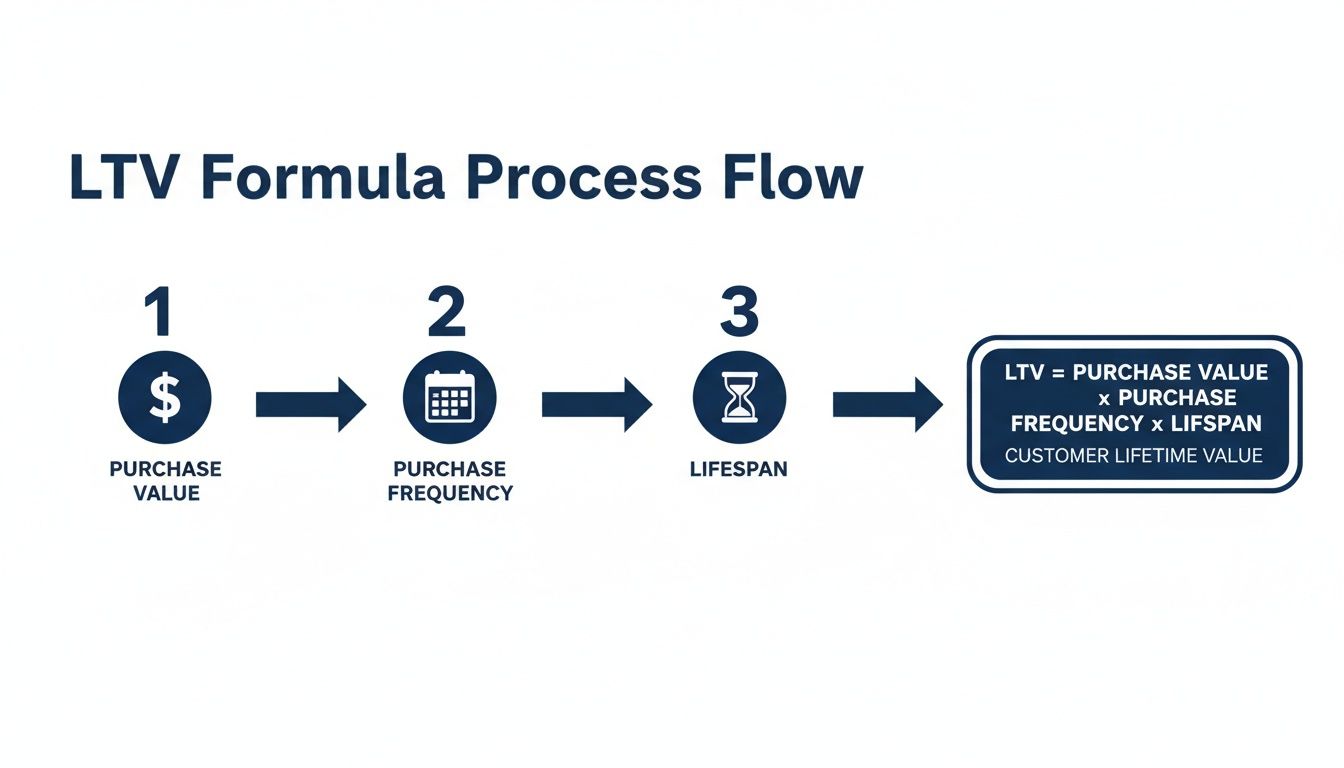
Getting a handle on each piece of this equation is crucial. Why? Because improving just one of these metrics will directly boost your overall LTV.
Breaking Down the LTV Formula
Let’s make this real. Imagine you run a Shopify apparel store and you’ve just pulled the numbers from your analytics for the last year.
Total Revenue: $300,000
Total Orders: 4,000
Unique Customers: 2,500
With just these three numbers, we can figure out the first two parts of our LTV puzzle.
First up is Average Purchase Value (APV). This tells you how much a customer drops, on average, every time they check out.
Calculation: Total Revenue / Total Orders
Example: $300,000 / 4,000 Orders = $75 APV
Next, we have Purchase Frequency (PF). This shows how many times the average customer buys from you in a given period (in this case, one year).
Calculation: Total Orders / Unique Customers
Example: 4,000 Orders / 2,500 Customers = 1.6 Purchases per Year
These two figures already paint a picture. Your typical customer spends $75 and buys about 1.6 times a year. To really stay on top of this data, especially as your store grows, having a solid CRM for your eCommerce business is a game-changer.
Putting It All Together for LTV
The final piece we need is the Customer Lifespan (CL), which is your best guess for how long a customer stays active with your brand. For a new or growing store, this can be tricky to nail down perfectly.
A common and safe starting point is to assume a lifespan of 1 to 3 years. Let’s be optimistic and use 3 years for our apparel store example.
Now we can finally calculate our historical LTV:
LTV = Average Purchase Value (APV) x Purchase Frequency (PF) x Customer Lifespan (CL)
LTV = $75 x 1.6 x 3 = $360
There it is. $360 is your baseline LTV. On average, you can expect to bring in $360 in revenue from each customer over their entire relationship with your brand.
To make this even clearer, here’s a table breaking down that calculation for our sample apparel store.
Historical LTV Calculation Example (Apparel Store) | |||
|---|---|---|---|
Metric | Formula / Source | Sample Value | Notes |
Total Revenue | Shopify Analytics | $300,000 | From the last 12 months. |
Total Orders | Shopify Analytics | 4,000 | From the last 12 months. |
Unique Customers | Shopify Analytics | 2,500 | From the last 12 months. |
Average Purchase Value (APV) | Total Revenue / Total Orders | $75 | The average cart size. |
Purchase Frequency (PF) | Total Orders / Unique Customers | 1.6 | Average orders per customer per year. |
Customer Lifespan (CL) | Business Assumption | 3 years | An estimated active period for a customer. |
Historical LTV (Revenue) | APV x PF x CL | $360 | The total expected revenue per customer. |
This table shows how each individual metric flows into the final $360 LTV figure, giving you a clear benchmark to work from.
The Importance of Margin-Adjusted LTV
While a $360 revenue LTV is a great start, it doesn't tell you how much of that is actual profit. To get a real picture of your profitability, you have to calculate your margin-adjusted LTV. This is the number that truly matters for your bottom line.
Let's say your apparel store runs on a healthy 40% average gross margin. This means after you pay for your inventory (Cost of Goods Sold), you keep 40 cents of every dollar in revenue.
Margin-Adjusted LTV Formula: LTV x Gross Margin %
Example: $360 x 0.40 = $144
Suddenly, the number looks very different. Your actual profit per customer over their lifespan is $144. This is the number you should be using to make critical business decisions, like setting your marketing budgets and deciding what you can afford for your customer acquisition cost (CAC).
Knowing this number unlocks so many strategic possibilities. Think about it: your current APV is $75. Instead of running a margin-killing discount, what if you used a tool like Monster Cart to offer a free gift, free shipping, or a small discount on orders over $85? You're directly targeting and improving the most controllable part of the LTV formula.
This single move encourages customers to spend more, boosting your AOV and increasing your margin-adjusted value with every single order. It's a smarter, more sustainable way to grow that is centered on improving lifetime value.
While historical LTV tells you where you’ve been, predictive LTV is the crystal ball that shows you where you’re going. It's about shifting from rearview-mirror analysis to a forward-looking strategy. This forecasting method helps you anticipate future customer value before it even happens, unlocking far smarter marketing and retention efforts.
Instead of waiting a whole year to see how things shook out, you can start making educated guesses about a customer's total worth much, much sooner. This approach to figuring out how to calculate lifetime value is incredibly powerful for new stores or for brands launching new products where historical data is naturally thin.
Forecasting allows you to be proactive. You can spot high-potential customers early and give them the VIP treatment, while also identifying at-risk customers who might be about to churn. It’s the difference between reacting to sales data and actually shaping it.
A Simple Predictive LTV Model
You don't need a complex data science team to get started with predictive LTV. A simple but surprisingly effective model uses two metrics you either already have or can find in a few clicks: your Average Order Value (AOV) and your Customer Churn Rate.
Average Order Value (AOV): We've talked about this before, but it's simply your total revenue divided by your total number of orders.
Customer Churn Rate: This is the percentage of customers who don't make a repeat purchase within a set timeframe, like a year. If 80% of your customers come back for another purchase, your churn rate is the remaining 20%.
The formula is beautifully simple:
Predictive LTV = Average Order Value / Customer Churn Rate
Let's walk through a quick example. Say your AOV is $80 and your annual churn rate is 25% (meaning 75% of customers are retained each year). The math looks like this:
$80 / 0.25 = $320
Just like that, you have a $320 predictive LTV. It’s a fast, actionable way to estimate the future value of an average customer. The insight here is crystal clear: knocking down your churn rate by just a few percentage points can have a massive impact on your LTV.
Using Cohort Analysis for Deeper Insights
For a more advanced and accurate prediction, you'll want to lean on cohort analysis. A cohort is just a group of customers who share a common trait. The most common kind is an acquisition cohort—all the customers who made their first purchase in the same month (e.g., the "January 2024 Cohort").
By tracking each cohort’s spending over time, you can start to see powerful patterns emerge. Do customers you acquired during a Black Friday sale have a lower LTV than those who found you through organic search? Cohort analysis gives you those answers.
This lets you segment customers into incredibly valuable groups based on their behavior:
Champions: Your absolute best customers. They buy often, spend a lot, and love your brand.
Loyal Fans: Consistent repeat buyers. Their AOV might not be the highest, but they are the reliable backbone of your business.
At-Risk Customers: Customers who haven't bought anything in a while and are on the verge of churning for good.
Knowing these segments is your key to unlocking proactive growth. It’s not just theory—it’s a roadmap for action. You can’t treat a ‘Champion’ the same way you treat an ‘At-Risk’ customer and expect optimal results.
Turning Predictive Data into Proactive Profit
This is where predictive LTV stops being a number on a spreadsheet and starts becoming a real revenue-driver. Once you’ve segmented your customers, you can tailor your strategies. The goal is to move away from hefty, margin-killing discounts and toward intelligent rewards that boost AOV and foster genuine loyalty, ultimately increasing lifetime value.
For your Champions, you can offer exclusive perks like early access to new products or a surprise high-value free gift. They've already proven their loyalty, so your job is to reinforce that relationship without devaluing your brand with constant sales.
For At-Risk customers, a generic "10% off" email is background noise. A much more compelling strategy is a targeted in-cart offer. With a tool like Monster Cart, you could create a campaign offering a specific, tangible free gift with their next purchase. That physical reward can be the exact nudge they need to come back, directly fighting churn and boosting your retention rate.
By using predictive insights, you transform data into action. You're not just calculating lifetime value; you're actively working to increase it, turning every customer interaction into an opportunity for long-term, sustainable profit.
Put Your LTV to Work: Real-World Growth Strategies

Knowing how to calculate lifetime value is only half the battle. The real goal is to actually make that number go up. A high LTV isn't luck; it's the direct result of a deliberate, data-driven strategy. This is where you take your LTV insights and turn them into real-world tactics that grow your revenue.
Once you have a firm grip on your LTV, you can start making smarter, more profitable decisions about where you spend your marketing dollars. It’s a shift away from just acquiring any customer to focusing on acquiring the right customers—the ones who will stick around and deliver long-term value.
Nail Your LTV to CAC Ratio
One of the most critical uses for your LTV calculation is to benchmark your LTV to Customer Acquisition Cost (CAC) ratio. This is the ultimate test of profitability. For every dollar you spend to bring a new customer in the door, how many dollars in profit are you getting back over their entire relationship with your brand?
A healthy target that most successful e-commerce brands aim for is 3:1. This means for every $1 spent on acquisition, you generate $3 in lifetime margin. If your ratio is 1:1, you’re basically running on a treadmill, just breaking even. Anything below that, and you're actively losing money on every new customer.
While the average e-commerce LTV often sits in the $100-$300 range, smart Shopify brands can push that figure two or three times higher. Knowing your margin-adjusted LTV gives you a clear ceiling for your CAC, ensuring your ad spend is a profitable investment, not just an expense.
Ditch Discounts for Tiered Rewards to Boost AOV
The fastest way to increase LTV is by pumping up the "Average Purchase Value" part of the equation. But so many merchants fall into the trap of using margin-killing, site-wide discounts to get there. There’s a much smarter, more profitable way: strategic, tiered rewards that get customers excited to spend more.
Instead of a blanket 20% off sale, think about building a ladder of incentives that improve the customer experience and your lifetime value. This is where a modern in-cart tool like Monster Cart really shines. It lets you create an interactive experience right inside the cart, where customers unlock better perks as their order value climbs.
Here’s a classic, high-impact setup:
Tier 1: Spend $75 and unlock a free gift (like a sample of a bestseller).
Tier 2: Spend $100 and get the free gift plus free shipping.
This structure gamifies shopping. Customers can see themselves getting closer to a real reward—like a free gift, free shipping, or a small discount—which is a powerful motivator to add one more item to their cart. It's a simple, effective way to push your AOV higher without giving away your profit margins. You can explore more tactics like this in our guide on how to increase customer lifetime value.
Make Every Single Transaction More Valuable
Beyond boosting that first order, your cart is prime real estate for increasing the value of every transaction with relevant upsells and cross-sells. The key is to make these offers feel helpful, not aggressive. A pushy pop-up can easily disrupt the checkout flow and send customers running.
A much smoother approach is to build these offers directly into the cart drawer. With a tool like Monster Cart, you can add one-click offers that feel like a natural part of the shopping journey.
Pro Tip: Don't just throw random products at people. Use "Frequently Bought Together" logic to suggest items that genuinely complement what's already in their cart. If someone is buying a new face serum, offering a one-click add-on for the matching moisturizer is a no-brainer.
Consider these high-impact in-cart offers:
One-Click Add-Ons: Offer shipping protection or priority processing for a small fee.
Relevant Cross-Sells: Suggest complementary products that make their main purchase even better.
Post-Purchase Upsells: Even after the order is placed, you can present a last-chance deal on a related item.
Each of these tactics directly targets the "Average Purchase Value" metric in your LTV formula. By making every transaction more valuable, you create a ripple effect that significantly lifts your customer lifetime value over the long haul, turning your cart into a powerful engine for profitable growth.
LTV FAQs: Your Questions, Answered
Now that you've got a handle on calculating lifetime value, let's tackle some of the most common questions that pop up for Shopify merchants. Getting these details right is what turns LTV from a nice-to-know metric into a real, profit-driving part of your business strategy.
What Is a Good LTV to CAC Ratio for a Shopify Store?
The gold standard for a healthy LTV to Customer Acquisition Cost (CAC) ratio is 3:1. In plain English, this means you should be making three dollars back in profit over a customer's lifetime for every dollar you spend to get them in the door.
If your ratio dips below 1:1, alarm bells should be ringing—you're literally losing money on every new customer. On the flip side, a ratio of 5:1 or higher might sound great, but it can actually be a sign that you're playing it too safe. It probably means you're underinvesting in growth and could be more aggressive with your marketing spend to grab more market share.
How Often Should I Calculate LTV?
For most Shopify stores, running the numbers on a quarterly or semi-annual basis is the perfect rhythm. This gives you enough time to spot meaningful trends and see if your strategies are actually working, all without getting lost in the noise of daily fluctuations.
Of course, if your brand is super seasonal or you’re in the middle of a massive marketing push, you might want to check it more often—say, monthly. The most important thing is consistency. Tracking LTV the same way, over and over, is how you’ll see the real impact of tactics like in-cart rewards on your bottom line.
Don't let perfect be the enemy of good. A rough, consistently tracked LTV is far more valuable than a perfect, one-time calculation you never look at again.
My LTV Is Low. What Are the First Steps to Improve It?
If your LTV numbers are looking a little sad, don't panic. The quickest way to turn things around is to focus on the two levers you can pull right now: increasing Average Order Value (AOV) and boosting Purchase Frequency. The smartest way to do this is to step away from hefty, margin-killing discounts.
Instead, try a tiered rewards system with a tool like Monster Cart. For example, you can offer an awesome free gift, free shipping, or a strategic discount once a customer's cart hits a specific threshold, like $75. It’s a simple strategy that nudges people to spend more to unlock a real, tangible reward. Beyond that, focus on optimizing your post-purchase email flows and using smart in-cart cross-sells to bring customers back sooner and encourage bigger carts.
Should I Calculate LTV for Different Customer Segments?
Absolutely. In fact, this is where the real power of LTV is hiding. A single, store-wide LTV is a good starting point, but the actionable "aha!" moments come from slicing up your data.
You’ll want to calculate LTV for distinct customer groups. Think about segmenting by:
Customers from different marketing channels (e.g., Instagram ads vs. Google organic).
Shoppers who purchased from specific product categories.
Buyers who used a coupon code versus those who paid full price.
This kind of analysis will shine a bright light on your most valuable customers, showing you exactly where to double down with your marketing budget and retention efforts for the best possible return.
Ready to stop relying on deep discounts and start boosting your AOV with intelligent, in-cart rewards? Monster Cart is the all-in-one slide cart and upsell engine that turns your Shopify cart into a profit-driving machine. Join thousands of brands and see why they trust Monster Cart to increase AOV and build customer loyalty.
Join 7000+ brands using our apps