A Shopify Merchant's Guide to RFM Customer Segmentation
Mar 6, 2026
|
Published
Ever get that nagging feeling that you're treating all your customers the same, even though you know some are way more valuable than others? You're not just guessing. RFM customer segmentation is the data-backed method that proves it, helping you move beyond gut feelings and generic marketing.
Stop Guessing Who Your Best Customers Are With RFM
Instead of blasting your entire list with the same offer, RFM helps you zero in on your real VIPs—your 'Champions,' your 'Loyal Customers,' and even those who are 'At Risk' of churning.
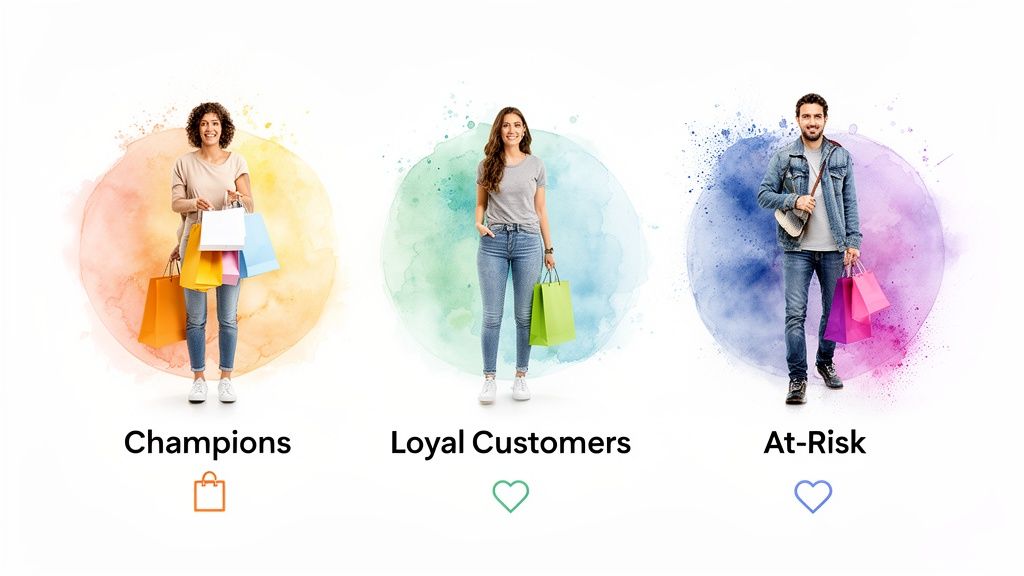
RFM sounds complex, but it’s built on three incredibly simple data points from each customer's buying habits:
Recency: When was their last purchase? Someone who bought last week is worlds apart from someone who hasn't been back in a year.
Frequency: How often do they come back? This separates your loyal regulars from your one-hit wonders.
Monetary: How much have they spent? This is how you spot your big spenders and distinguish them from the bargain hunters.
By scoring customers on these three factors, you stop looking at surface-level stats and start understanding their actual behavior. Suddenly, you have a clear roadmap for building smarter, more profitable relationships.
A Smarter Way to Boost Revenue
The real power of RFM is that it lets you drive growth without constantly resorting to those profit-killing, store-wide discounts. Instead of slashing prices for everyone, you can build targeted reward strategies that motivate specific groups to act. It's just one of many customer segmentation strategies, but it's one of the most effective for ecommerce.
The goal is to elevate the customer experience so they spend more and shop more often because they feel valued—not just because they got a coupon.
This approach flips the script from focusing on one-off sales to building long-term profitability. By nurturing different segments with personalized incentives—like an exclusive free gift for your best customers or a free shipping offer to win back an at-risk shopper—you can systematically increase both Average Order Value (AOV) and customer lifetime value. For a deeper dive, check out our full guide on how to increase customer lifetime value.
Focus on Your Most Valuable Shoppers
There's a well-known business rule called the Pareto Principle, and it's the foundation of RFM. It states that roughly 80% of your revenue comes from just 20% of your customers. This is why RFM is a game-changer for Shopify merchants, especially when paired with a smart rewards engine like Monster Cart.
By identifying and prioritizing that top 20%, you can focus your marketing dollars where they’ll have the biggest impact. The model automatically groups customers into tiers based on their transaction history, letting you create laser-focused campaigns. For example, a customer who bought recently, shops often, and spends a lot would score high on all three metrics, landing them squarely in your 'Champions' segment—the people you should be rewarding the most.
How to Calculate and Score RFM Segments
The term RFM customer segmentation might sound like something you need a data science degree for, but I promise you, it's surprisingly simple. You don't need any fancy software to get started. All the raw data you need is sitting right inside your Shopify admin, waiting to be used.
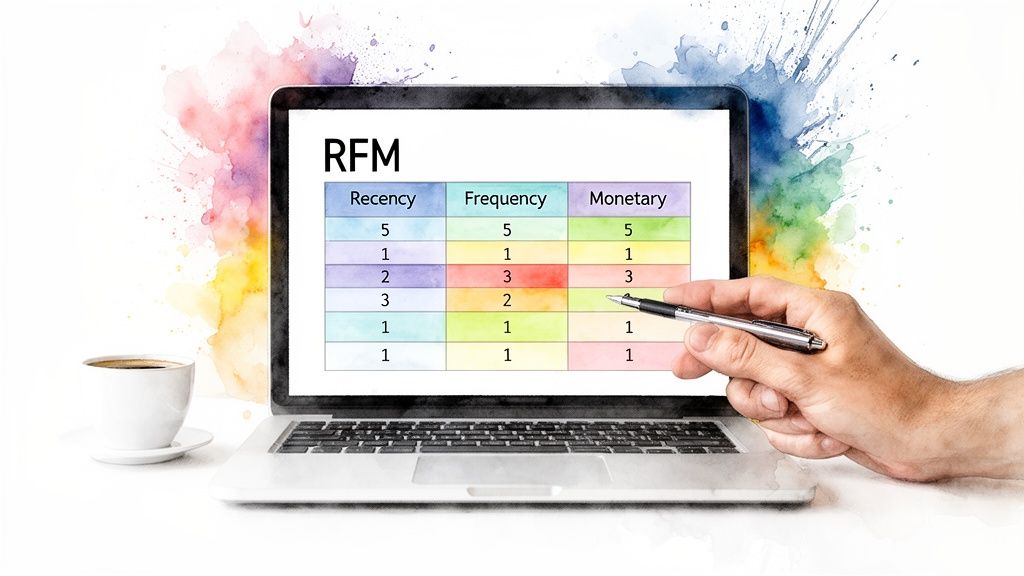
The first step is a simple export of your customer order history. This will give you a spreadsheet with the three pieces of information that matter for every single shopper: their last purchase date (Recency), the total number of orders they’ve placed (Frequency), and the total amount of money they’ve spent with you (Monetary).
Scoring Each RFM Factor
Once you have your spreadsheet, the most common way to score your customers is with a simple 1-to-5 system. Think of it like grading on a curve. For each of the three RFM metrics, you’ll divide all of your customers into five equal groups (also called quintiles).
Recency (R): First, sort all your customers from the most recent purchase to the oldest. The top 20% who bought most recently get a score of 5. The next 20% get a 4, and you keep going until the bottom 20%—the ones who haven't shopped in ages—get a 1.
Frequency (F): Next, do the same thing for their total number of orders. Sort everyone from most orders to least. The top 20% who buy most often get a 5, the next group gets a 4, all the way down to a 1 for your one-time buyers.
Monetary (M): Finally, repeat the process for their total spending. Rank all customers from highest lifetime spend to lowest. The top 20% of spenders get a 5, and the bottom 20% get a 1.
When you're done, every customer has a simple, three-digit RFM score. It could be 555 for a customer who bought last week, has a dozen orders, and spends a ton. Or it could be 111 for someone who bought one small item a year ago and never came back.
By scoring customers this way, you're not just looking at raw numbers. You're creating a relative ranking that instantly shows who your best customers are in relation to everyone else.
An RFM Scoring Example
Let's make this real. Imagine you've exported the data for four different customers. Here’s a quick look at how their raw data gets turned into clear, actionable RFM scores using this method.
Customer | Last Purchase | Total Orders | Total Spent | R Score | F Score | M Score | RFM Score |
|---|---|---|---|---|---|---|---|
Alex | 2 days ago | 12 | $1,500 | 5 | 5 | 5 | 555 |
Brenda | 45 days ago | 6 | $800 | 4 | 4 | 4 | 444 |
Chris | 90 days ago | 2 | $350 | 3 | 2 | 3 | 323 |
Dana | 1 year ago | 1 | $50 | 1 | 1 | 1 | 111 |
Suddenly, their value is crystal clear. Alex is a textbook 'Champion,' while Dana is 'Hibernating.' This is the kind of intelligence that lets you finally stop using one-size-fits-all marketing.
Connecting RFM to Profitable Actions
With these scores in hand, you can finally break free from the cycle of steep, margin-killing discounts. Instead, you can create smarter incentives that build real loyalty and encourage customers to spend more. For a deeper look at this, our guide on how to calculate average order value offers more killer strategies.
The whole point is to use these insights to design targeted reward campaigns. For example, an app like Monster Cart lets you show specific in-cart rewards based on a customer's segment. You could offer a premium free gift only to your 'Champions' (555) or show a "spend $20 more to unlock free shipping" message to 'Potential Loyalists' (like Chris at 323) to nudge their spending up.
This approach shifts your focus to rewarding great behavior and increasing lifetime value, creating a much healthier and more sustainable growth model than just running another sale.
Once you’ve done the math, those RFM scores aren't just numbers on a spreadsheet. Think of them as secret cheat codes for understanding your customers. A score like 555 or 121 tells a rich story about someone's relationship with your brand.
Now, let's start decoding these stories. While you could technically have dozens of combinations, most Shopify merchants find the real gold by focusing on a handful of key RFM customer segmentation groups. These are the core personas that drive your business—from your die-hard fans to the ones who are slowly drifting away.
Key RFM Customer Segments and Their Characteristics
Before we dive into tactics, it helps to see these groups side-by-side. Each segment has a distinct personality, and understanding their traits is the first step toward building a smarter marketing strategy.
Segment Name | Typical RFM Score | Behavioral Traits | Strategic Value |
|---|---|---|---|
Champions | 555, 554, 545 | Your most recent, frequent, and highest-spending customers. Brand advocates. | Highest LTV. Focus on rewarding them to secure long-term loyalty. |
Loyal Customers | X4X, X5X | Shop consistently and frequently. Form the reliable backbone of your revenue. | High potential LTV. Nurture them and increase their AOV. |
Potential Loyalists | 3X3, 4X2, 5X1 | Recent shoppers with promising but not yet consistent buying habits. | High-opportunity group. Your goal is to win them over for a second or third purchase. |
At-Risk Customers | 2XX, 1XX | Previously good customers who haven't purchased in a while. Their engagement is fading. | Critical to re-engage. It's cheaper to win them back than to acquire a new customer. |
Hibernating | 111, 112, 121 | Low scores across R, F, and M. Haven't bought in a long time and didn't spend much. | Lowest priority. Chasing them often yields a low return on investment. |
These core segments give you a powerful framework for action. They tell you exactly who to talk to, what to say, and when to say it.
Champions (RFM Score: 555, 554, 545)
These are your MVPs. Your Champions are the top 1% who just bought, buy all the time, and spend big when they do. They’re the ones leaving glowing reviews and telling their friends about you.
Your job here isn't to convince them to buy—they’re already sold. The goal is to make them feel like the insiders they are. Don't just throw discounts at them; that can actually cheapen the experience. Instead, reward them with exclusive perks that money can't buy, like early access to new collections, a surprise premium gift with their order, or a free upgrade to express shipping. It’s all about reinforcing their VIP status and building lifetime value.
Loyal Customers (RFM Score: X4X, X5X)
Think of your Loyal Customers as the reliable engine of your business. They might not have the jaw-dropping order values of your Champions, but they show up consistently. Their defining trait is a steady, predictable buying rhythm. They trust you, and they love your products.
With this group, the name of the game is nurturing and upselling. Since they already buy often, you can guide them toward bigger purchases by using rewards like free gifts or free shipping. An in-cart tiered rewards system is perfect for this. Using a tool like Monster Cart, you can show them a progress bar that tracks how close they are to unlocking a great reward. That little "you're $15 away from a free gift" nudge is a fantastic way to boost AOV while making them feel valued, focusing on lifetime value over one-time sales.
Potential Loyalists (RFM Score: 3X3, 4X2, 5X1)
This is one of the most exciting groups because the opportunity is huge. Potential Loyalists are shoppers who’ve shown real promise. Maybe they just made their first purchase and it was a big one, or they’ve bought a couple of times but haven't hit a consistent stride yet. They're interested, but they haven't committed.
Your mission is to win them over and turn them into full-blown Loyal Customers. A well-timed incentive can be the final push they need to make that crucial second or third purchase. This doesn't have to be a deep discount. Prompts like "spend $15 more for free shipping" or an attractive gift-with-purchase tier are incredibly effective at both boosting their immediate AOV and training them to come back for more. This is how you build lifetime value from their very first interactions.
At-Risk Customers (RFM Score: 2XX, 1XX)
These are the customers who used to be great shoppers, but you haven't seen them in a while. Their Recency score is slipping, which is a major red flag. They're on the verge of churning, but there’s still time to bring them back.
Acting fast here is critical—it’s almost always cheaper to win back a customer than find a new one. A targeted "we miss you" campaign is your best bet. A personalized offer, like a special gift or free shipping on their next purchase, can remind them why they loved shopping with you and reignite that relationship, preserving their potential lifetime value.
After you've identified these different customer groups, you can start building tailored experiences for each one. This is a fundamental part of effective customer journey optimization.
Hibernating (or Lost) Customers (RFM Score: 111, 112, 121)
This group has low scores across the board. They bought a long time ago, didn't come back often, and didn't spend much. It’s tempting to try and win back every single person who has ever bought from you, but realistically, your marketing dollars are better spent elsewhere.
The real beauty of RFM customer segmentation is that it gives you permission to focus. It creates a clear hierarchy, showing you where to invest your time and budget for the best possible return. Whether you use a simple three-tier model (27 segments) or a more granular five-tier one, you gain incredible clarity. If you're curious about the math, you can learn more about how these scoring systems create up to 125 distinct segments from 111 to 555.
Putting RFM Into Action With In-Cart Rewards
Understanding your RFM segments is like having a detailed blueprint of your customer base. But a blueprint is pretty useless until you actually start building. This is where theory meets profit—translating those RFM insights into real-time, in-cart rewards that lift revenue without cheapening your brand with constant sales.
The goal is to stop thinking in terms of store-wide discounts and start thinking about targeted, value-driven incentives. It’s about making each customer feel seen and appreciated based on their unique history with your brand. This simple shift moves the focus from one-off transactions to building sustainable, long-term customer lifetime value (LTV).
The shopping cart is the perfect stage for this. It’s the final decision point where a well-timed reward can make all the difference. With an advanced cart solution like Monster Cart, you can use RFM segments to trigger specific, automated rewards right inside the cart drawer, creating a personalized experience that feels truly seamless.
Turn Champions into Brand Evangelists
Your Champions (RFM score: 555) are your most valuable asset. They shop recently, frequently, and spend the most. The last thing you want to do is offer them a generic 10% off coupon—they don’t need it, and it can even water down the premium feel of their relationship with you.
Instead, your strategy here should be all about surprise, delight, and exclusivity. Make them feel like true insiders.
Exclusive Free Gifts: Don’t just offer any old freebie. Use Monster Cart to automatically add a high-value, exclusive gift to their cart—something not available to anyone else. This reinforces their VIP status and rewards their loyalty in a way they’ll remember.
Early Access Perks: Give them first dibs on new products. You can set up a special offer that only appears in their cart, letting them add a new item before it's officially released to the public.
Automatic Free Upgrades: Surprise them with an automatic upgrade to expedited shipping at no extra cost. This is a small gesture that delivers a big impact, showing you truly appreciate their business.
For Champions, the goal isn't to persuade them to buy; it's to deepen their emotional connection to your brand. These exclusive, non-discounted rewards are powerful tools for turning your best customers into vocal advocates—which is far more valuable than a single, discounted sale.
Nudge Potential Loyalists Toward a Higher Spend
The Potential Loyalists (e.g., 3X3, 4X2) are where your biggest growth opportunities live. These customers have shown they like you—maybe through a recent purchase or a decent-sized first order—but they haven't yet become consistent, high-frequency shoppers. Your mission is to give them a compelling reason to commit and increase their spend.
This is where tiered, spend-based rewards absolutely shine. By setting clear goals, you can gamify the shopping experience and encourage them to add just one more item to their cart to unlock something special. This tactic is a masterclass in boosting Average Order Value (AOV) without resorting to margin-killing discounts.
This model shows how you can design different actions for your top RFM segments.
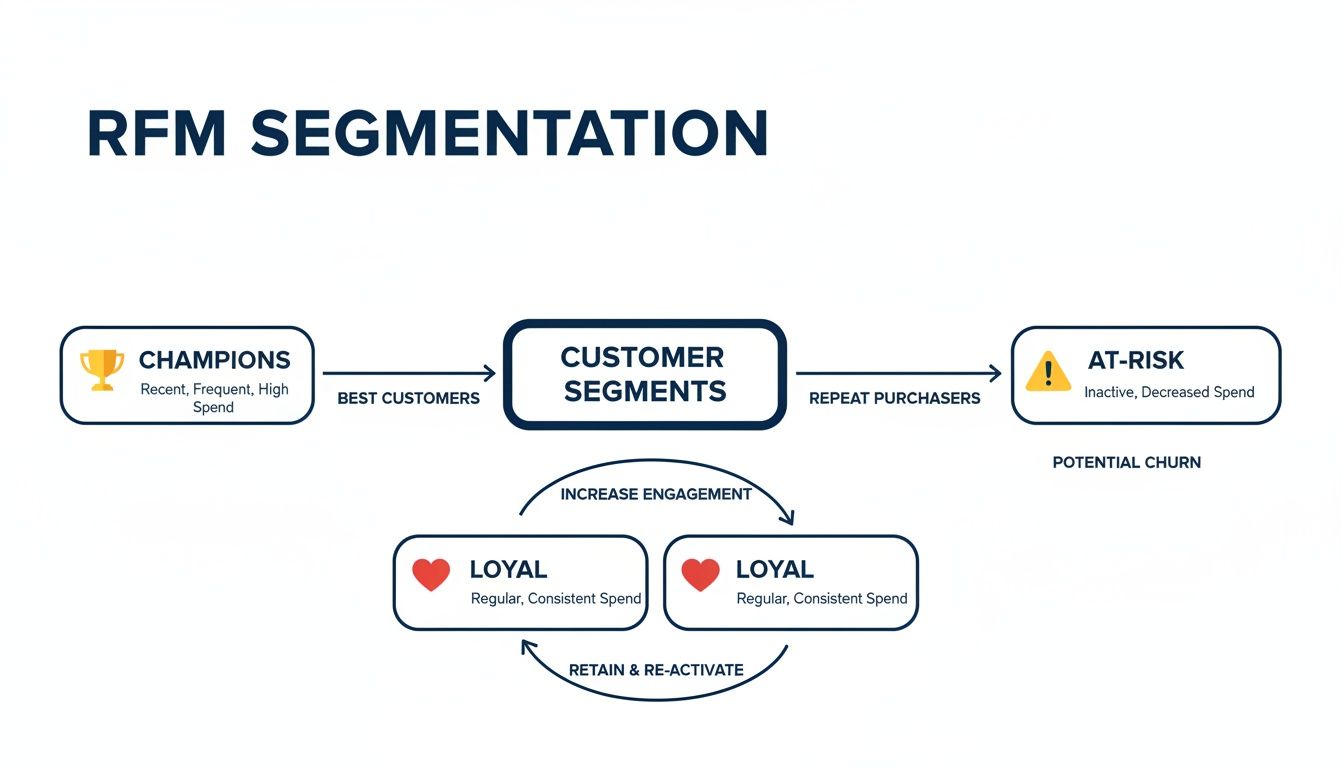
The visual clearly breaks down how to reward your Champions, nurture Loyal customers, and re-engage those who are At-Risk.
Here’s how you can target them effectively right in the cart:
"Spend More, Get a Gift" Tiers: Use Monster Cart’s progress bar to show them exactly how close they are to unlocking a desirable gift-with-purchase (GWP). A message like, "You're only $18 away from receiving our best-selling lip balm for free!" is incredibly persuasive.
Unlock Free Shipping: Shipping costs are a notorious cart killer. For this segment, a free shipping threshold is a powerful motivator. The cart can visually track their progress, turning a potential pain point into a fun little challenge.
This approach gives customers a tangible goal to strive for, increasing their immediate order value while teaching them to see more value in shopping with you. If you're looking for more ways to enhance your cart, check out our guide on the best upsell apps for Shopify.
Win Back Your At-Risk Customers
At-Risk Customers (e.g., 2XX, 1XX) are a critical group to watch. These were once good customers, but their recency score has dropped, signaling they're starting to drift away. Winning them back is often far cheaper than acquiring a brand-new customer. You need a targeted, compelling offer to remind them why they loved your brand in the first place.
Since these customers are disengaging, your offer needs to be both relevant and incredibly easy to act on. The goal is to reignite their interest and secure a purchase right now.
A great strategy for this segment is to present them with a targeted, one-click offer directly in their cart.
Compelling One-Click Add-Ons: When an At-Risk customer adds an item to their cart, show them a highly relevant, low-cost add-on. For example, if they add a shampoo, offer the matching conditioner with a small incentive. This "Frequently Bought Together" style of upsell feels helpful, not pushy.
Smart "Buy More, Save More" Tiers: Instead of a simple discount, create a progressive offer. For example: "Add one more item to get 10% off; add two to get 15% off." This encourages a larger purchase and successfully re-engages them with more of your product line, all while boosting their order value.
By implementing these tailored, in-cart strategies powered by RFM customer segmentation, you move beyond generic marketing. You create a dynamic, responsive shopping experience that speaks directly to each customer's behavior. This is how you build a resilient e-commerce business—not by slashing prices, but by building value and rewarding loyalty at every step of the journey.
Measuring the Impact of Your RFM Strategy
So, you've rolled out your RFM customer segmentation and started targeting customers with personalized in-cart rewards. That’s a huge win. But the job isn't done—now you have to answer the most important question: is it actually working?
To prove the ROI and make your strategy smarter over time, you need to look past big-picture numbers like total store revenue. It's time to zoom in and track specific Key Performance Indicators (KPIs) for each segment. This is what turns a one-off campaign into a powerful growth engine.
Key Metrics to Track for RFM Success
You need a clear picture of how your targeted rewards are changing customer behavior. Are your Monster Cart offers actually getting 'Potential Loyalists' to increase their cart size? Are you successfully bringing 'At-Risk' customers back for another purchase? These are the questions your data needs to answer.
Here are the metrics that matter most:
Average Order Value (AOV) by Segment: Are those spend-to-unlock tiers you set for 'Potential Loyalists' pushing up their AOV? Track this for each group to see if your incentives are nudging them to spend more without you having to give away the farm with hefty discounts.
Purchase Frequency by Segment: Is your re-engagement campaign for 'At-Risk' customers actually getting them to buy again? A rising purchase frequency in a specific segment is a crystal-clear sign that your loyalty efforts are hitting the mark.
Segment Migration: This is one of the most powerful indicators of success, period. Are you moving customers from lower-value segments into higher-value ones? For example, seeing a steady stream of 'At-Risk' customers turning into 'Loyal Customers' proves your retention strategy is paying off in a big way.
Customer Lifetime Value (LTV) Growth: At the end of the day, the whole point of RFM is to increase the long-term value of your entire customer base. Keep a close eye on how the LTV of your 'Champions' and 'Loyal Customers' grows over time. Rewarding these top-tier shoppers should lock in their loyalty and boost their overall spend.
Creating a Performance Feedback Loop
Measuring your RFM strategy can't be a one-time thing you check off a list. The real power comes from using these insights to constantly iterate and improve your campaigns. Think of it as an ongoing conversation with your customers, where their buying behavior is the feedback.
By continuously monitoring segment performance, you can double down on what works and quickly pivot away from what doesn't. This creates a powerful cycle of testing, learning, and optimizing that drives sustainable growth.
For instance, if you notice the free gift you're offering to 'Potential Loyalists' isn't lifting their AOV, maybe the spending threshold is a little too high. You could test lowering it slightly or even swap the gift for a free shipping reward to see if that works better. Without tracking performance at the segment level, you'd just be guessing.
Using a tool like Monster Cart, you can easily A/B test different in-cart offers for the same segment. See if a gift-with-purchase outperforms a "buy more, save more" deal for your 'At-Risk' group. This constant refinement keeps your rewards strategy sharp, effective, and profitable, focusing on what really matters—boosting lifetime value instead of just chasing short-term sales with discounts.
FAQ About RFM Customer Segmentation
Diving into RFM is one of the smartest moves you can make, but it’s normal to have a few questions before you get started. We’ve pulled together the most common ones we hear from Shopify merchants to help clear things up.
Think of this as the final check-in before you start turning your customer data into a serious revenue driver.
How Often Should I Update My RFM Segments?
I get this question all the time. The short answer? It depends entirely on your store’s sales cycle, but a good rhythm for most e-commerce brands is to re-run your RFM analysis every 30 to 90 days.
If you sell products people buy often—like coffee, supplements, or skincare—you’ll want to be on the shorter end of that, probably monthly. This lets you catch shifts in buying habits almost as they happen, so you can act before a great customer starts to drift away.
On the other hand, if you sell high-ticket items with a longer buying cycle, like furniture or custom equipment, updating your segments quarterly is perfectly fine.
The goal is to keep your segments fresh enough to be truly actionable. Stale data leads to bad decisions, like sending a re-engagement offer to someone who just bought yesterday. Regular updates make sure your Monster Cart rewards are always hitting the right person with the right offer at the right time.
Can I Use RFM If I Don't Have a Lot of Customer Data?
Yes, and honestly, it’s one of the best times to start. RFM is incredibly powerful even when your customer base is still small. You might not have thousands of shoppers to sort into dozens of tiny segments, but the core idea of finding your best customers is just as crucial.
Even with just a couple hundred customers, RFM analysis gives you a much clearer picture than just staring at your total revenue. You can immediately spot:
The top 20% of customers who are already driving most of your sales.
Recent first-time buyers who are perfect for a follow-up offer to encourage that second purchase.
Customers who haven’t been back in a while and might be at risk of churning.
Starting with RFM early builds good data habits from the get-go. It forces you to focus your limited time and marketing budget on nurturing the customers with the highest potential, which is the key to building sustainable, long-term growth.
Is RFM Better Than Other Segmentation Models?
RFM’s biggest strength is its simplicity and how directly it connects to action. While there are more complex models out there that pull in demographics or use machine learning, RFM is powerful because it’s based on pure transactional behavior—what your customers actually do, not just who they are.
This makes it incredibly effective for hitting immediate e-commerce goals.
Unlike other strategies, RFM doesn’t require a data science degree or expensive software to get going. Its focus on Recency, Frequency, and Monetary value is directly tied to revenue and customer loyalty. For any Shopify merchant looking to make a real impact on their numbers, RFM is almost always the best place to start.
You can always layer on other data points later on, but RFM gives you a rock-solid behavioral foundation. It helps you break the habit of giving discounts to everyone and instead build a smarter system that rewards your best customers, boosts AOV, and builds relationships that last.
Ready to turn your RFM insights into a high-converting cart experience? With Monster Cart, you can build powerful in-cart rewards that target your specific customer segments, helping you boost AOV and customer lifetime value without endless discounts. Join over 7,000 Shopify brands and see how you can transform your cart into a revenue engine. Learn more at monsterapps.shop.
Join 7000+ brands using our apps