What Is a BOGO Sale and How It Boosts AOV
Jan 31, 2026
|
Published
A BOGO sale—or Buy One, Get One—is one of the oldest tricks in the retail playbook. It's a promotion where buying one item unlocks a second one for free or at a discount. But don't let its simplicity fool you. It’s a powerful psychological tool that frames value in a way that a simple percentage-off discount often can’t.
Understanding the Power of a BOGO Sale
So, what is a BOGO sale, really? It’s a retail strategy that goes way beyond just marking down prices. Think about it: a passive 20% off sign is easy to ignore. A BOGO offer, on the other hand, actively engages customers. It prompts them to add specific items to their cart to unlock what feels like a bonus, creating a sense of accomplishment and incredible value.
The modern ecommerce world has put a new spin on this classic promo. Today, the most effective BOGO-style offers are less about deep discounts and more about creating rewarding shopping experiences that build long-term customer relationships. The goal isn't just to move more products; it's to strategically increase the average amount each customer spends. You can learn more about this crucial metric in our guide to what is average order value.
Beyond the Basic Discount
Many smart merchants now structure these promotions as tiered rewards. Instead of a traditional "Buy One, Get One Free," they're using more creative offers like:
Spending $75 to unlock a free gift.
Purchasing a specific product to get a complementary item.
Meeting a cart threshold to receive free shipping.
These intelligent offers encourage customers to spend more to get more. The concept itself is timeless. The BOGO sale has roots stretching back to the 18th century and was popularized in the 1920s. Even today, 93% of American consumers have used a BOGO discount, with 66% preferring it over any other promotion. You can discover more insights about its enduring appeal from Capital One Shopping's BOGO research.
The key takeaway for merchants is to stop thinking about BOGO as just a hefty discount. Instead, view it as a tool to boost Average Order Value (AOV) and build long-term customer relationships by offering compelling rewards rather than just slashing prices.
A primary goal of BOGO promotions is to boost customer spending; learn more about other proven tactics to increase average order value. By structuring offers that reward higher spending, you transform a simple sale into a powerful engine for growing customer lifetime value. Tools like Monster Cart are designed to do just that, displaying these rewards directly in the cart to guide customers toward higher spending goals without disrupting their experience.
What Are the Different Types of BOGO Sales?
When you hear "BOGO," your mind probably jumps straight to the classic "Buy One, Get One Free." But that's just the tip of the iceberg. The smartest brands know that different BOGO variations serve different goals, whether that's clearing out old inventory, boosting average order value (AOV), or introducing customers to a new product line.
Let's break down the three most common structures you can use.
BOGO Free (BOGOF)
This is the one everyone knows and loves. The power of the word "free" is undeniable—it’s a psychological trigger that grabs attention like nothing else.
BOGOF is fantastic for creating a ton of buzz and moving product fast. It's the perfect play when you need to clear out slow-moving or seasonal inventory. You can pair a less popular item with a bestseller to give it a lift, turning a warehouse problem into a sales win. The downside? It can be tough on your profit margins if you’re not careful.
BOGO Percent Off
A much more margin-friendly approach is the "Buy One, Get One 50% Off" style of deal. While it doesn't have the same punch as "free," it feels like a substantial offer to the customer.
In reality, a BOGO 50% off deal is just a 25% discount on the two items combined, which gives you much more control over your profitability. This format is perfect for upselling customers or encouraging them to try a new product category without giving away the farm.
Conditional BOGO (Spend and Get)
This is where BOGO gets really strategic. Instead of a simple one-for-one deal, you set a spending threshold to unlock a reward, like "Spend $75, Get a Free Gift."
This modern take flips the script. It protects your bottom line by guaranteeing a higher AOV before you give anything away. It shifts the customer's focus from just getting a discount to earning a reward, turning the promotion into a more engaging experience that builds customer loyalty and lifetime value.
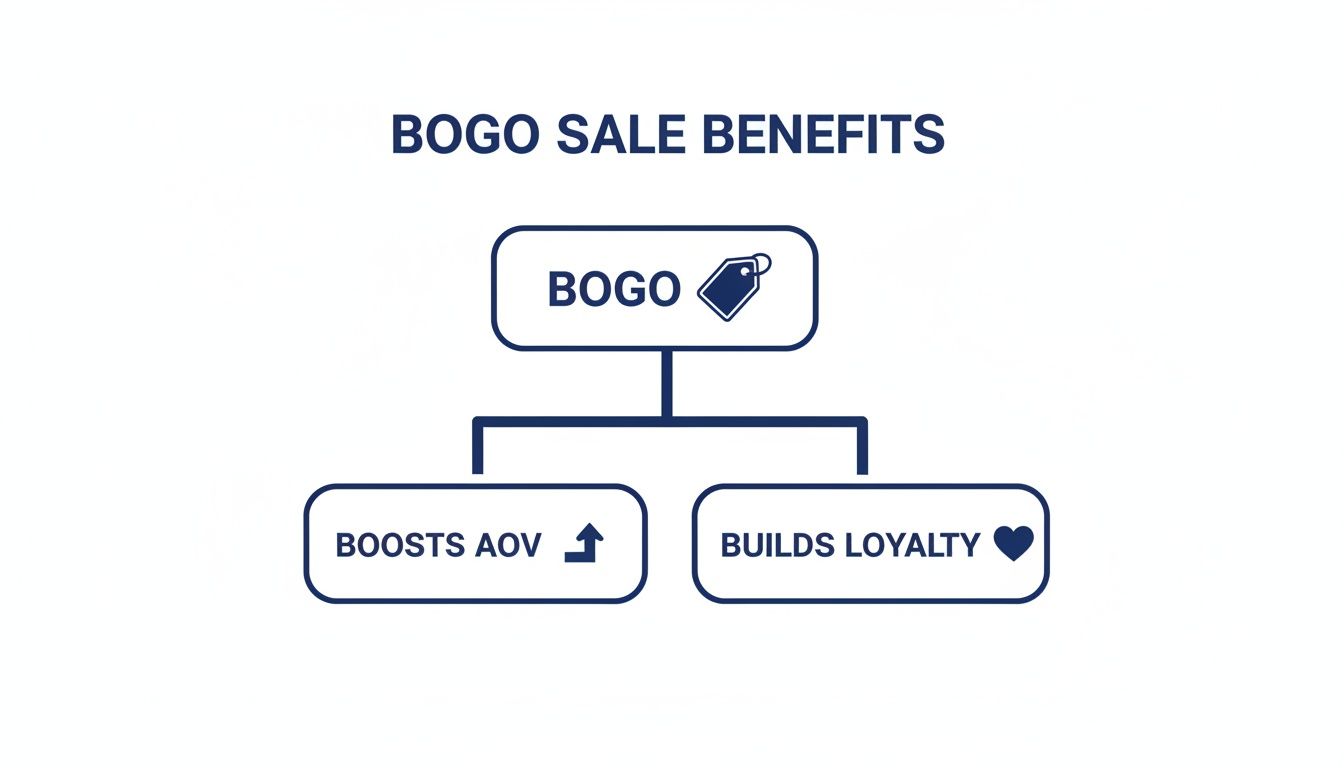
This kind of tiered reward system encourages shoppers to explore more of your catalog to hit that magic number. If you want to dive deeper, we have a whole guide on how to create "Buy More, Save More" deals that build bigger carts.
Comparing BOGO Sale Variations
Choosing the right BOGO structure comes down to your specific goal. The table below breaks down the primary objective and margin impact for each type to help you decide which is the best fit for your next campaign.
BOGO Type | Primary Goal | Margin Impact | Best For |
|---|---|---|---|
BOGO Free | Rapidly move inventory, attract new customers | High | Clearing out slow-moving stock or seasonal items. |
BOGO Percent Off | Upsell customers, introduce new products | Medium | Protecting profitability while still offering a strong incentive. |
Conditional BOGO | Significantly increase Average Order Value (AOV) | Low to Medium | Guiding customer behavior and rewarding higher spending. |
Ultimately, the most profitable and brand-building promotions are the ones that add value to the shopping experience instead of just slashing prices. This focus on rewards over discounts is the key to building sustainable growth and customer lifetime value.
The Psychology Behind Why BOGO Offers Work
Ever wondered why a "Buy One, Get One Free" offer feels so much more exciting than a simple 50% off sale, even when the math is identical? It all comes down to a few powerful psychological triggers that make BOGO a uniquely compelling deal for shoppers. And it starts with one of the most persuasive words in marketing: free.
The word “free” hits different. It triggers an almost irrational emotional spark in our brains. When customers see it, they often stop doing the mental math and just feel like they’re winning. That emotional high creates a much stronger positive vibe around your brand than a standard discount ever could. It feels less like a transaction and more like a reward.

Creating Perceived Value and Loyalty
Beyond that initial jolt of excitement, BOGO offers create a much higher perceived value. Customers aren't just saving a few bucks; they're walking away with a whole extra item. That feeling of abundance makes them feel like they snagged an incredible deal, which is exactly the kind of experience that builds brand loyalty and boosts customer lifetime value (LTV).
By framing a promotion as a reward ("Get a Free Gift") instead of just a discount, merchants can motivate customers to increase their cart size to unlock the prize. This turns a potential margin loss into a guaranteed AOV boost.
At the end of the day, this strategy is all about building a stronger, more human connection with your customers. A well-executed BOGO offer taps into deeper consumer psychology. For instance, understanding concepts like social proof in marketing can shed even more light on why certain promotions just click with people.
When you structure these deals thoughtfully, they become much more than simple price cuts. By using an in-cart rewards tool like Monster Cart, you can create a gamified experience where shoppers actually see their progress toward unlocking a reward. This makes the whole process more engaging and ensures you only give away that "free" item after the customer has already profitably increased their order.
Common BOGO Pitfalls and How to Avoid Them
While a BOGO sale can feel like a magic button for boosting orders, a poorly planned one can quietly drain your profits and damage your brand. The biggest risk here is margin erosion. Giving away products, even with a qualifying purchase, can chew through your bottom line in a hurry if you haven't done the math.
Another major pitfall is attracting the wrong kind of customer. Deep discounts often bring in deal-chasers—shppers who buy once because of the promotion but have zero intention of ever coming back. They get a great deal, but you get a one-time transaction instead of a loyal customer, which does very little for your long-term growth and lifetime value.
A Smarter Playbook for Profitability
So, how do you capture the excitement of a BOGO sale without the painful downsides? The key is to shift your mindset from offering hefty discounts to creating rewarding experiences that protect your profitability and encourage loyalty.
Here are a few strategic ways to avoid the classic BOGO blunders:
Offer Lower-Cost Rewards: This is non-negotiable. Never make your free or discounted item more expensive than the one being purchased. Pair a high-margin hero product with a lower-cost, complementary item to keep your profits healthy.
Set Minimum Spend Thresholds: Instead of a simple BOGO, pivot to a "Spend $X, Get a Free Gift" offer. This guarantees you boost your Average Order Value (AOV) before you give anything away.
Limit the Offer: Restrict your promotion to specific products or collections. This is a brilliant way to move slow-moving inventory by pairing it with a proven bestseller.
The most effective strategy is to build promotions that focus on lifetime value, not just one-time sales. The goal should be to increase what customers spend while making them feel rewarded, turning a potential cost into a guaranteed profit driver.
This is where intelligent in-cart reward systems can make all the difference. An app like Monster Cart sidesteps these risks entirely by building the reward system directly into the cart experience. You can create a progress bar that shows customers exactly how close they are to unlocking a free gift or free shipping, gamifying the path to a higher AOV. This approach ensures your BOGO-style offer always boosts your bottom line first.
How to Build Smarter BOGO-Style Rewards
Let's be honest, traditional discount codes are getting a little stale. It's time to move past them and build BOGO-style promotions that actually get customers excited without destroying your profit margins.
The secret is to stop thinking about it as a simple transaction and start treating it like an interactive, in-cart reward system. This approach captures all the fun of a classic BOGO deal while keeping your profitability firmly in check and boosting customer lifetime value.
Imagine swapping out your store’s standard, static cart for a dynamic slide-out cart. As customers shop, they see a progress bar inching closer to their next reward. A little message pops up: “You’re just $15 away from a free gift!” Suddenly, checking out feels more like a fun, gamified journey. That small change is often all it takes to encourage them to add just one more item to unlock the prize.
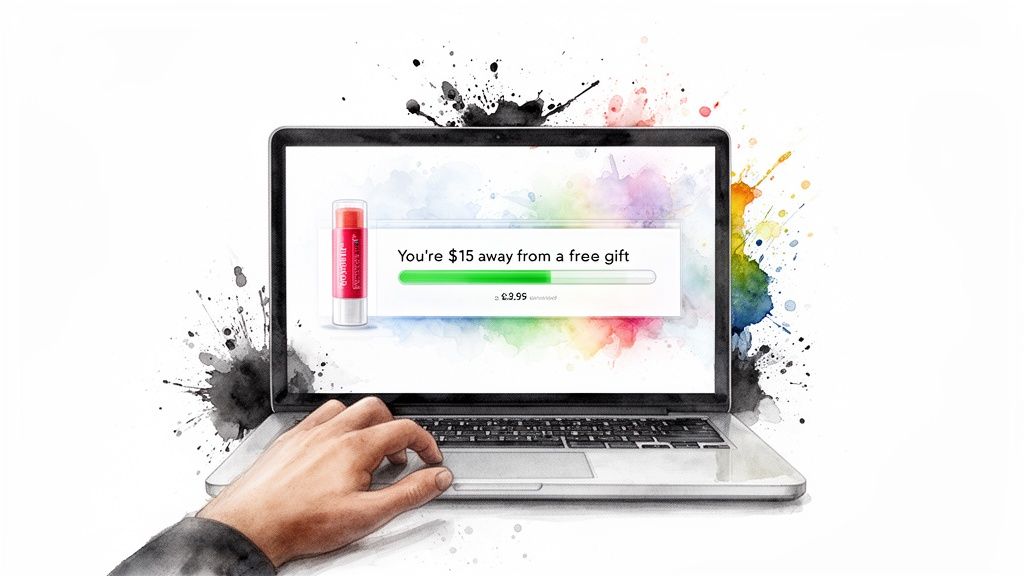
This method puts you back in the driver's seat, gently guiding customers toward a higher average order value (AOV) and giving them a little sense of accomplishment along the way.
Designing a Tiered Reward System
The real beauty of an in-cart rewards engine is how flexible it is. You can create a multi-layered campaign that speaks to different spending levels, all within the same promotion. The whole strategy is about boosting lifetime value (LTV) by making customers feel rewarded at every step.
Here’s a simple, practical example of what a tiered reward structure could look like:
Tier 1: Spend $50, Unlock Free Shipping. This is a low-friction offer that knocks down one of the biggest barriers to purchase.
Tier 2: Spend $100, Unlock Free Shipping & a Free Lip Balm. The second tier adds an actual, desirable product, creating a powerful nudge for shoppers to bump up their cart size.
By stacking rewards like this, you create multiple chances to increase AOV. The customer feels like they're getting more and more value as they spend, which deepens their connection to your brand and gives them a great reason to come back.
This model is so much better than a storewide discount because it guarantees a higher spend before you give anything away. Tools like Monster Cart are built specifically for this, letting you design these gamified progress bars and tiered offers right inside a branded slide-out cart. It turns the entire experience into a profit-driving engine that feels like a natural part of your store.
For more ideas on structuring these kinds of deals, check out our guide on how to make a bundle. It's another fantastic way to package products together and ramp up their perceived value.
Your BOGO Questions, Answered
Let's tackle some of the most common questions merchants have when they start thinking about how a BOGO sale might fit into their brand's growth plan.
Is BOGO 50% Off Just a 25% Discount?
If you pull out a calculator, yes. A "Buy One, Get One 50% Off" deal mathematically works out to a 25% discount across two items. But your customers don't shop with a calculator.
The psychological impact is wildly different. The way you frame the offer—"Get one 50% off!"—creates a sense of action and feels like a much more exciting deal than a simple, passive "25% Off" banner. That framing is often what drives a much higher conversion rate on the products you're trying to move.
How Can I Run a BOGO Sale Without Losing Money?
This is the big one. The key is to stop thinking in terms of discounts and start thinking in terms of rewards.
Instead of a classic, no-strings-attached BOGO, tie your offer to a profitable spending goal. Something like, "Spend $75, Get a Free Gift" completely flips the script. This approach guarantees you secure a larger, more profitable order before you give anything away.
This strategy is all about protecting your margins. It nudges customers to add more to their cart and explore more of your catalog, shifting the focus from a one-off transaction to building long-term lifetime value.
Another smart move is to pick your products carefully. Structure the deal so the qualifying purchase is a high-margin item, and the free or discounted item is something with a lower cost but a high perceived value. This keeps your profits healthy while still delivering that "wow" moment for the customer.
Are BOGO Sales Good for Clearing Inventory?
Absolutely. In fact, it's one of the best tools in your arsenal for moving slow-moving stock without having to resort to a steep, profit-killing clearance sale.
The trick is to pair an overstocked product with one of your bestsellers to create an offer that's too good to pass up.
For instance, a deal like, "Buy our most popular t-shirt, get these socks free," accomplishes two things at once:
It moves that slow-selling inventory out the door—fast.
It introduces customers to a product they might have completely overlooked otherwise.
This approach turns a potential inventory headache into a win for your customer. They feel like they just scored an incredible deal, and you just cleared your shelves and boosted your bottom line.
Ready to build smarter, AOV-boosting rewards without the hefty discounts? Monster Cart turns your Shopify cart into a profit engine with gamified progress bars and in-cart upsells that customers love. See how it works.
Join 7000+ brands using our apps