What is Incremental Revenue? what is incremental revenue explained
Jan 21, 2026
|
Published
Incremental revenue is the extra money your store makes from a specific marketing effort, like an in-cart reward or upsell, that you wouldn't have earned otherwise. It also pushes you to boost your average order value (AOV) using thoughtful incentives—like free gifts, free shipping, and targeted small discounts—instead of relying on hefty discounting. This approach lays the groundwork for increased lifetime value (LTV) and sustainable growth.
It’s the purest way to measure if a strategy is actually working. Instead of looking at your total sales and guessing what caused a spike, incremental revenue zeroes in on the direct impact of a single campaign, proving its real return on investment and encouraging you to focus on rewards that drive long-term customer loyalty.
The Most Important Metric You Might Be Ignoring
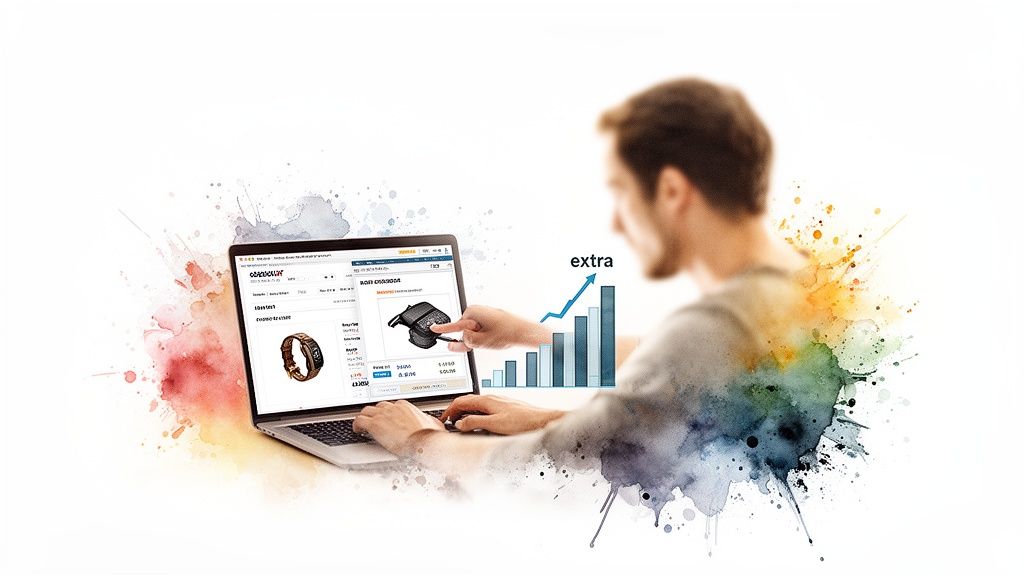
Most e-commerce merchants are obsessed with total revenue, but that big-picture number can be deceptive. It tells you what you made, but it doesn't tell you why. That's where incremental revenue comes in. Think of it as the bonus cash you generate from a specific, targeted action—an action that ideally boosts AOV through free gifts, free shipping, or modest discounts, all designed to enhance customer value and lifetime spend.
Here’s a simple example: a customer is about to check out with $70 in their cart. Right before they pay, a smart cart offer lets them know they can unlock a free gift by spending $80. Intrigued, they toss a $15 accessory into their cart.
That extra $15 is 100% incremental revenue. It’s a direct result of your in-cart reward—a sale that simply would not have existed without that gentle nudge.
Shifting Focus From Discounts to Value
This isn't just about analytics; it’s about a smarter way to grow. Instead of leaning on heavy discounts that erode margins, focusing on incremental revenue pushes you to add genuine value and think about the long-term relationship with each customer. This is where you can get creative and build real brand loyalty.
Instead of just slapping a 20% off banner on your site, you can use smarter tactics that boost cart value and make customers feel rewarded:
Free Gifts: Offer an exclusive product when a shopper’s cart hits a certain threshold.
Free Shipping: This is a classic for a reason. Customers consistently rank it as a top motivator to complete a purchase.
Tiered Rewards: Gamify the experience by letting customers unlock bigger and better rewards as they spend more.
Targeted Small Discounts: Offer a modest discount (e.g., 10% off a next purchase) that feels like a reward rather than a desperate clearance.
These strategies boost your average order value (AOV) without sacrificing your profits and encourage customers to stick around for the next purchase. For a deeper dive, you can check out our guide on what is AOV in ecommerce.
To help clear things up, let's break down the core differences between these two crucial metrics.
Incremental Revenue vs. Total Revenue at a Glance
This table clearly contrasts total revenue with incremental revenue to help merchants understand the distinct value of each metric.
Attribute | Total Revenue | Incremental Revenue |
|---|---|---|
What It Measures | The entire amount of money a business earns over a period. | The additional revenue generated by a specific action or campaign. |
Primary Use | Assessing overall financial health and business scale. | Measuring the direct ROI of a specific marketing effort. |
Strategic Focus | High-level planning and financial reporting. | Campaign optimization and proving the value of marketing tools. |
Example | "$100,000 in monthly sales." | "Our new in-cart offer generated an extra $5,000 in sales this month." |
While total revenue gives you a broad overview, incremental revenue provides the sharp, actionable insights you need to make smarter marketing decisions.
This shift isn't just about a single transaction. By offering value instead of discounts, you build a stronger customer relationship, which is the foundation for increasing lifetime value (LTV).
Ultimately, growing your incremental revenue relies on strong customer retention in e-commerce. When customers feel valued, they come back. Tools like Monster Cart help automate this process, turning a simple checkout into a strategic revenue engine that cultivates loyalty and drives sustainable, profitable growth.
Why Focusing on Incremental Lift Is a Game Changer
If you're only looking at total sales, you're missing the real story behind your store's growth. Shifting your focus to incremental lift is like putting on a pair of glasses that lets you see which marketing efforts are actually making you money, and which are just shuffling sales from one channel to another.
It’s the difference between guessing what works and knowing. This clarity allows you to confidently invest in the tools and strategies that truly boost your bottom line, not just move revenue around.
This mindset also helps you break free from the endless cycle of margin-killing discounts. Instead of just cutting prices, you can start building a brand that adds real value, cultivating loyalty that lasts long after a 20% off coupon expires.
From Discounts to Lasting Value
Think about it this way: offering 20% off an order is a gamble. You're cutting your profit on a sale that might have happened anyway. But what if, instead, you offered a free gift to customers who spend a certain amount?
That simple change flips the script entirely. The free gift encourages shoppers to add more to their cart to hit the threshold, directly pushing up your average order value (AOV). You're not just closing a sale; you're making the sale bigger.
This isn't just a transactional trick. It transforms the customer experience from a simple purchase into something rewarding and memorable, strengthening lifetime value each time.
By creating positive, rewarding experiences, you’re not just making a sale; you’re building a relationship. Customers remember the brands that make them feel valued, and they are more likely to return.
Proving Impact in a Competitive Market
In today's crowded e-commerce world, knowing where your growth actually comes from is your biggest advantage. Incremental lift cuts through the noise. By isolating the revenue generated directly from a specific campaign or tool, you can finally double down on what works and ditch what doesn't.
For example, a US D2C merchant might discover that their in-cart upsells are generating 22% in true incremental revenue, blowing traditional pop-ups out of the water. That’s the kind of concrete data that fuels smarter spending and a winning strategy.
This is where a tool like Monster Cart steps in and changes the game. By turning the standard, boring cart into an interactive rewards engine, it empowers brands to stack free gifts, unlock spend milestones, and offer one-click add-ons. The result is a direct lift in AOV, often by 20-40%—a number that completely dwarfs the global average conversion rate of 1.58%. You can discover more insights about these digital commerce statistics and trends to see just how significant that lift is.
Ultimately, focusing on incremental revenue transforms your store. You move from a reactive, discount-driven model to a proactive brand that customers genuinely love and choose to shop with again and again. It’s the key to building a resilient, profitable e-commerce business.
How to Accurately Calculate Incremental Revenue
Figuring out the real impact of your marketing efforts is simpler than you might think. To accurately calculate incremental revenue, the gold standard is A/B testing, sometimes called a split test.
This method lets you scientifically prove whether a new offer is actually creating new value or just shifting sales that would have happened anyway. Think of it as a controlled experiment for your store.
The process involves splitting your audience into two groups for a set period. One group gets the standard "business as usual" experience, while the other sees your new campaign. By comparing what each group does, you can isolate the exact financial lift your new strategy generated.
Setting Up Your A/B Test
To measure the incremental lift from a new offer, you need to create two distinct experiences:
The Control Group: This segment of your audience sees your store exactly as it is, with no new offers. Their buying habits are your baseline—what would have happened anyway.
The Test Group: This segment is shown the new offer you want to measure. This could be a tiered rewards system, a free gift unlocked at a certain cart value, or any other promotion.
With these two groups in place, you can confidently attribute any difference in revenue to the new offer you’re testing. This simple setup removes all the guesswork and gives you clear, data-backed proof of what really works.
For a detailed breakdown of the components that influence order sizes, you can learn more about how to calculate average order value.
The Incremental Revenue Formula
Once your test period is over, the math is refreshingly simple. You just subtract the total revenue from the control group from the total revenue of the test group.
The difference is your pure incremental revenue.
(Test Group Revenue) - (Control Group Revenue) = Incremental Revenue
Let's walk through a real-world example. Imagine a Shopify store is testing a new tiered rewards system with Monster Cart. They run a two-week A/B test with these results:
The Test Group (who saw the new rewards) generated $25,000.
The Control Group (who saw the normal site) generated $21,500.
Plugging those numbers into the formula: $25,000 - $21,500 = $3,500.
Just like that, the store can confidently say the new rewards system generated $3,500 in pure incremental revenue. That's money that would not have existed otherwise.
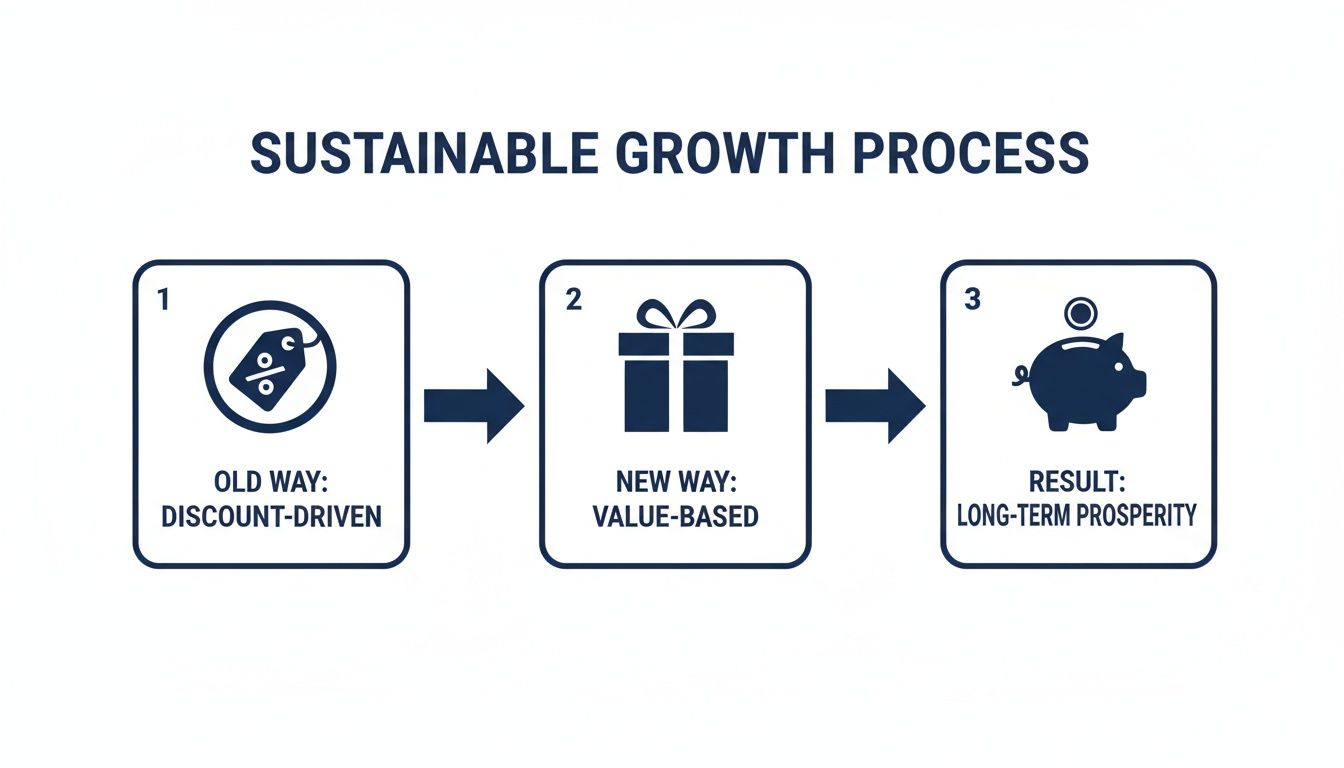
This illustrates the core idea perfectly. You're shifting away from a model that relies on constant discounts and moving toward a strategy that rewards customers for spending more. That's how you build a healthier, more profitable business.
Proven Strategies to Drive Incremental Revenue
Knowing how to calculate incremental revenue is one thing, but actually generating it is where the real work begins. The most sustainable path to growth isn't paved with margin-killing discounts. Instead, it's built on delivering genuine value using rewards—like free gifts, free shipping, and modest, targeted discounts—that drive AOV up and boost lifetime value.
The real goal is to lift your Average Order Value (AOV) by making the shopping experience more rewarding. It's a shift away from a purely transactional mindset toward building real, long-term customer relationships. You want customers to feel smart and appreciated for choosing you, which is the secret sauce for boosting lifetime value.
Gamify the Cart with Tiered Rewards
One of the most powerful ways to generate incremental revenue is by using tiered, spend-to-unlock rewards. This simple tactic transforms the shopping cart from a boring checkout list into an interactive, engaging experience. By setting clear spending goals, you give customers a compelling reason to add just one more item.
Imagine a progress bar right in the cart that fills up as a shopper adds products, showing them exactly how close they are to unlocking the next reward. That visual feedback loop creates a little hit of dopamine and a sense of achievement, motivating them to hit the next tier.
Here are a few reward structures that work like a charm:
Spend-to-Unlock Free Shipping: A simple message like, "You're only $15 away from free shipping!" is incredibly effective. After all, unexpected shipping costs are one of the top reasons people abandon their carts.
Tiered Free Gifts: Offer different levels of rewards to encourage bigger spends. For example, a customer might unlock a sample-size product at $50, a full-size product at $75, and an exclusive bundle at $100.
Progressive Discounts: A classic "Buy More, Save More" model pushes customers toward larger orders. Think 10% off $100, 15% off $150, and 20% off $200.
These are the kinds of smart tactics baked into slide-cart solutions like Monster Cart, which weaves these rewards directly into the shopping flow without resorting to annoying pop-ups.
Offer High-Value, One-Click Add-Ons
Another killer strategy is to offer convenient, high-value add-ons right inside the cart. These are small, useful extras that customers are genuinely happy to pay for because they either enhance their order or provide some peace of mind. The key is to make them super relevant and easy to add with a single click.
Smart add-ons don't feel like an upsell; they feel like a helpful service. They add immediate value to the customer's purchase while generating pure incremental revenue for your store.
Consider integrating these kinds of non-intrusive options:
Shipping Protection: For a small fee, offer insurance against lost, stolen, or damaged packages. It's a no-brainer for many customers.
Priority Processing: Let shoppers pay a little extra to have their order jump to the front of the fulfillment line.
Gift Wrapping: This is a perfect add-on during the holidays or for anyone buying a present.
Many of the most effective strategies for driving incremental revenue are also tied to improving your conversion rates; you can find more in these 10 proven e-commerce conversion rate optimization tips.
When you see these tactics in action, the potential becomes crystal clear. Studies show that well-placed, non-intrusive upsells can increase AOV by 20-30% without hurting the checkout flow. For example, Monster Cart, trusted by over 7,000 Shopify brands, has helped generate over $712 million in revenue—much of it purely incremental from features just like these.
Unlocking More Revenue with a Smart Cart Experience
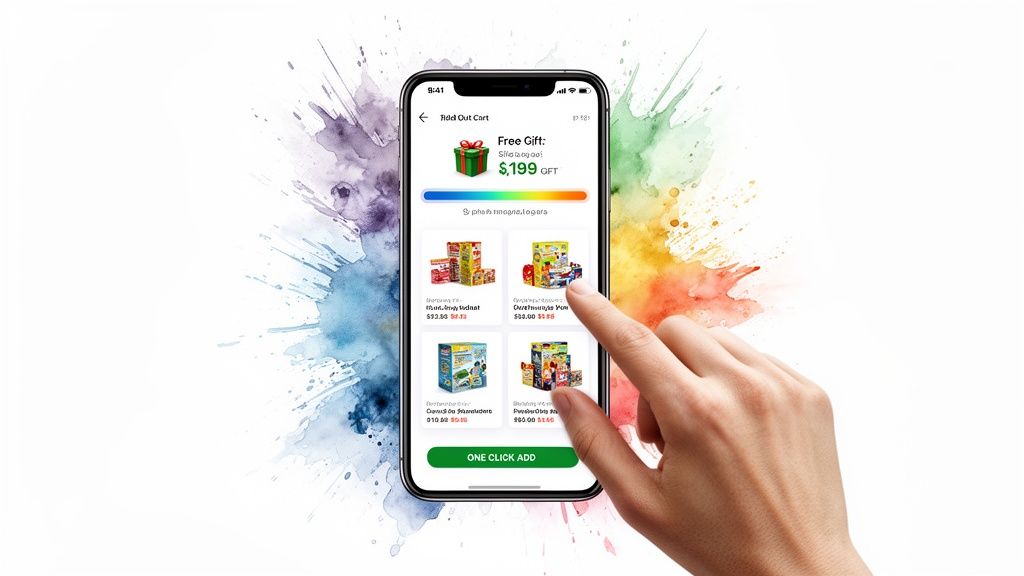
Proven strategies are only as good as the tech you use to execute them. It’s one thing to talk about tactics, but it’s another to see how a real-world tool can take you from theory to action—without resorting to heavy discounting. This is where a modern slide-cart becomes your single most powerful engine for generating incremental revenue.
A smart cart experience completely transforms the final step of the shopping journey. Instead of a passive, boring checkout page, it becomes an interactive rewards hub. Forget about those disruptive pop-ups that interrupt customers and cause more frustration than sales. A tool like Monster Cart integrates rewards—free gifts, free shipping thresholds, and one-click add-ons—directly and seamlessly into the flow, boosting AOV and protecting your margins while growing lifetime value.
Creating a Compelling Feedback Loop
The real magic is in the feedback loop. When a customer adds an item to their cart, they don't just see a new product on a list. They see a dynamic progress bar that visually tracks their journey toward unlocking the next reward tier.
This simple, gamified experience motivates shoppers to add just one more thing to their cart to get that next perk, whether it's a free gift or complimentary shipping. It’s a subtle but powerful psychological nudge that boosts average order value (AOV) without ever feeling pushy or resorting to margin-killing discounts.
This approach is all about adding value, not just cutting prices. By rewarding customers for spending more, you protect your margins while building a healthier, more sustainable business focused on long-term growth and customer lifetime value.
Seamlessly Integrated Recommendations
Beyond tiered rewards, a smart cart is the perfect spot for intelligent product recommendations. Because these suggestions appear right inside the cart drawer, they feel like a natural part of the brand experience rather than an aggressive, last-ditch upsell.
A thoughtful user journey is the key to unlocking consistent, profitable growth. When recommendations and add-ons feel helpful instead of intrusive, customers are far more likely to convert at a higher value.
This is where you can present perfectly timed offers that feel genuinely useful.
Frequently Bought Together: Suggest complementary items that make the products already in the cart even better. You can learn more about how to set up frequently bought together bundles in our detailed guide.
One-Click Add-Ons: Offer convenient services like shipping protection or gift wrapping that customers can add with a single click.
Personalized Suggestions: Recommend products based on what the customer has been browsing or what’s already in their cart.
So much potential incremental revenue gets lost in this in-cart phase. In fact, 70-80% of potential upsell opportunities simply vanish due to friction after a customer adds an item to their cart. Tools like Monster Cart directly tackle this problem, enabling "frequently bought together" recommendations and progressive rewards that visually update as the cart grows, driving AOV hikes of 15-35%. Backed by $712 million in attributed revenue across 7,000+ Shopify stores, this model replaces annoying pop-ups with engaging in-cart rewards that boost AOV without risking checkout abandonment. You can discover more insights about these e-commerce trends.
Frequently Asked Questions
Digging into incremental revenue can feel a little complicated at first, but it's one of the most important concepts for a Shopify store that's serious about growth. Let's tackle some of the most common questions merchants have to help you build a smarter, more profitable strategy.
Getting this right means you can finally step off the discount treadmill and build a more resilient business.
Is Incremental Revenue the Same As Profit?
Nope, but they're definitely related. Think of incremental revenue as the extra sales you generated because of a specific action, like an in-cart offer. It's the top-line boost.
To figure out your incremental profit, you'd take that revenue number and subtract the cost of goods sold (COGS) and any costs tied to the campaign itself. Focusing on incremental revenue is the first step, ensuring your marketing efforts are driving real, profitable growth—not just vanity sales numbers.
How Long Should I Run an A/B Test to Measure Lift?
The perfect test length really depends on your store’s traffic, but a solid rule of thumb is to run it long enough to hit statistical significance. That’s just a fancy way of saying you have enough data to prove the results aren't a random fluke.
For most Shopify stores, this usually means running the test for about two to four weeks. That window is typically long enough to even out daily sales spikes and dips, giving you a clean, reliable picture of what’s actually working.
Remember, the point isn’t just to collect data—it's to collect trustworthy data. A properly timed test gives you the confidence to double down on winning strategies that boost your bottom line.
Can Small Stores Benefit from Focusing on Incremental Revenue?
Absolutely. In fact, you could argue it's even more critical when you're smaller and every single dollar counts. Constantly chasing brand new customers is expensive, but getting more value from the shoppers who are already on your site? That’s pure efficiency.
When you focus on lifting your Average Order Value (AOV) with smart, non-discount rewards—like free gift thresholds, free shipping, or modest spend-based discounts—you can grow your revenue and lifetime value in a much more sustainable way. It's all about making the most of the traffic you already have without resorting to heavy markdowns.
This is where a tool like Monster Cart becomes a total game-changer for smaller brands. It lets you easily set up these powerful in-cart reward systems, turning your shopping cart into an engine for incremental revenue. By encouraging shoppers to add just one more thing to unlock a reward, you grow each sale organically. This focus on adding value instead of just cutting prices is how you build a loyal customer base and a much healthier business.
Ready to transform your cart into a revenue engine? See how Monster Cart helps thousands of Shopify brands boost AOV with engaging, in-cart rewards and one-click upsells. Learn more about Monster Cart.
Join 7000+ brands using our apps