Boost AOV with calculate shipping shopify: 2026 Tactics
Mar 5, 2026
|
Published
To get your Shopify shipping calculation right, you need a solid game plan. It involves setting up your shipping zones, choosing your rate strategy—whether based on weight, price, or live carrier quotes—and making sure every product has an accurate weight assigned to it. This is the only way to ensure customers see the correct shipping cost at checkout, saving you from the headache of overcharging them or, even worse, undercharging and eating the cost yourself.
Why Inaccurate Shipping Costs Are Hurting Your Store
Let’s be real—nothing kills a sale faster than an unexpected shipping fee at checkout. It’s the number one reason for cart abandonment. After all the work you put into your marketing and product curation, that last-minute surprise can make a customer question the entire purchase.
Getting your shipping calculations wrong doesn't just scare off potential buyers; it quietly chips away at your profit margins. If you undercharge, you're paying the difference out of your own pocket on every single order. But if you overcharge, you risk losing the sale for good and damaging your brand's reputation.
The Hidden Costs of Poor Calculations
The fallout from inaccurate shipping goes way beyond a simple logistical problem; it’s a major conversion killer that impacts your entire business.
Just look at the numbers. In 2024, an incredible 16% of all Shopify orders were international, and that figure is on track to blow past 20% in 2025. While this global reach is a massive opportunity, it also means the stakes are higher. A small miscalculation on a domestic order might be a minor loss, but on an international shipment, it can turn a profitable sale into a financial hit. These kinds of checkout surprises are a huge reason why the cart abandonment rate sits at a painful 70% for most online stores. If you want to get that number down, it's worth exploring our guide on how to reduce cart abandonment.
This is exactly why mastering how to calculate Shopify shipping is the first step toward building a smarter, more profitable business. It’s not just about logistics—it’s about creating a predictable financial model.
Shipping shouldn't be an afterthought; it should be a core part of your growth strategy. When you get it right, you protect your margins, build customer trust, and create a seamless path to purchase.
Shifting from a Cost Center to a Revenue Driver
Instead of seeing shipping as a necessary evil, what if you could turn it into one of your best tools for boosting revenue? The trick is to stop thinking about shipping as a cost and start thinking about it as a source of value. It’s a shift away from constant, hefty discounts and toward building long-term customer relationships and lifetime value (LTV).
Here’s how getting your shipping calculations right sets the stage for this strategic move:
Unlocking Free Shipping Thresholds: Once you have a firm grip on your actual shipping costs, you can confidently set a free shipping threshold. This is a classic tactic that encourages customers to add more to their cart to qualify, which directly increases your Average Order Value (AOV).
Building In-Cart Rewards: A well-defined shipping strategy is the bedrock of a dynamic rewards program. Imagine a cart that visually shows customers how close they are to unlocking rewards like free shipping, a free gift, or a future discount.
Enhancing Customer Lifetime Value: A transparent and fair shipping experience builds incredible trust. Happy customers who feel like they got a great deal are far more likely to come back, boosting their lifetime value without you needing to offer endless, margin-killing discounts.
This is where a tool like Monster Cart becomes a game-changer. It takes your accurately calculated shipping rates and turns them into an interactive, profit-driving experience. Instead of a boring checkout page, your customers see a dynamic cart that actively encourages them to spend more to unlock rewards. By nailing your shipping, you're not just solving a problem—you're laying the foundation for a more profitable, customer-focused store that builds LTV.
Figuring out what to charge for shipping can feel like a high-stakes guessing game. You're not just picking a number; you're making a critical decision that hits your profit margins and shapes how customers see your brand. Get it right, and you protect your bottom line while keeping shoppers happy. Get it wrong, and you’re either losing money on every order or losing sales to cart abandonment.
The best approach always comes down to the specifics of your business—what you sell, who you sell to, and what your growth goals are. Let's walk through the core ways you can calculate shipping in Shopify and figure out which one makes the most sense for your store.
Before we dive deep, it helps to see the options at a high level. Each shipping rate method has its own set of trade-offs, and choosing the right one depends entirely on your product mix and operational complexity.
Comparing Shopify Shipping Rate Calculation Methods
Rate Type | Best For | Pros | Cons |
|---|---|---|---|
Flat Rate | Stores with uniform products (e.g., phone cases, prints). | Simple for you and the customer; very predictable. | Can lose money on heavy/distant orders or overcharge on light ones. |
Price or Weight-Based Rates | Businesses with a varied catalog of products. | More accurate cost coverage; protects your margins on every sale. | Requires more setup; can become complex with many rules. |
Real-Time Carrier Rates | Stores that need maximum accuracy for diverse orders. | Highest accuracy; builds trust by showing real-time costs. | Requires Shopify's third-party carrier feature; less control over pricing. |
Hybrid/App-Based Rates | Complex shipping needs (e.g., dimensional weight, multiple warehouses). | Unlocks advanced rules and logic; ultimate flexibility. | Relies on a third-party app; adds another subscription cost. |
This table gives you a quick snapshot, but the real devil is in the details. The right choice is the one that best aligns your shipping costs with your business reality, ensuring you're not just covering expenses, but building a sustainable model for growth.
Flat Rate Shipping
Flat rate shipping is the definition of simple. You charge one fixed price for shipping, either on every single order or on orders that fall within a certain price or weight bracket. It's wonderfully predictable for both you and your customers.
This strategy is a perfect fit for stores with a very consistent product line where everything is roughly the same size and weight. If you sell t-shirts, art prints, or phone cases, you can easily figure out an average shipping cost that covers the vast majority of your orders without much risk. The best part? It creates a dead-simple checkout experience with no last-minute surprises.
Price-Based and Weight-Based Rates
When your catalog is all over the place, price-based or weight-based rates give you the precision you need. With these methods, the shipping cost automatically adjusts based on the total value or combined weight of the items in a customer's cart.
Imagine you sell handmade pottery. A small mug and a massive, heavy vase have completely different shipping costs. Using weight-based rates ensures you don't lose your shirt shipping that heavy vase for the same price as the mug. This approach helps you calculate Shopify shipping with far greater accuracy, protecting your margins on every single order.
Key Takeaway: The goal isn't just to cover your costs, but to build a sustainable shipping model. An effective strategy supports long-term growth by encouraging larger orders and building customer lifetime value, rather than relying on deep discounts that erode your profits.
Real-Time Carrier-Calculated Rates
For the highest possible level of accuracy, real-time carrier-calculated rates are the gold standard. This method connects directly to carriers like USPS, UPS, or FedEx and pulls live shipping rates based on the customer’s address and the package's exact weight and dimensions. Customers see the true cost, which builds immense trust.
This is where Shopify Shipping becomes a massive advantage. Since its launch in June 2019, it has completely changed the game for merchants, who report saving up to 88% through Shopify's pre-negotiated deals. With USPS being the top carrier for 264,000 global stores as of January 2025, having built-in access to these discounted rates is a game-changer for protecting your margins.
A Strategic Approach to Shipping and AOV
Choosing your rate strategy is step one. The real magic happens in step two: using it to grow your business. Instead of defaulting to margin-killing discounts to drive sales, start thinking about how your shipping can motivate customers to spend more. Rewards like a free gift or a tiered discount unlocked at a specific spend are far more effective at increasing both Average Order Value (AOV) and customer lifetime value.
This is where your rate strategy can feed a more powerful rewards system. For instance, once you've dialed in your carrier-calculated rates, you can confidently set a free shipping threshold that encourages shoppers to add just one more item to their cart. When choosing your shipping rate strategy, understanding the capabilities of a dedicated shipping calculator can significantly improve accuracy and customer satisfaction.
Ultimately, your shipping rates shouldn't just be a line item. They should be an engine for growth. By moving beyond a simple cost-plus model, you can create a system that not only covers your expenses but actively increases cart sizes. This is where a tool like Monster Cart shines, turning your calculated rates into visible, in-cart goals that motivate customers to unlock rewards like free shipping, building a more engaging and profitable shopping experience.
Setting Up Your Shopify Shipping Zones and Profiles
Okay, you’ve got a shipping strategy. Now it's time to actually build it in Shopify. This is where your business rules stop being ideas on a whiteboard and become the engine that calculates every single shipping quote.
To get this right, you need to master two core pieces of your Shopify admin: Shipping Zones and Shipping Profiles. These are the two levers you'll pull to make sure every customer gets a fair and accurate price at checkout.
What Are Shipping Zones?
Think of Shipping Zones as your geographical buckets. You group countries, states, or even ZIP codes together and then assign specific shipping rates to each bucket.
It’s how you stop applying a single, one-size-fits-all rate that either loses you money on far-flung orders or scares away local customers with sticker shock. You can set up a simple structure—one rate for domestic orders, another for Canada, and a third for the rest of the world—or get as granular as you need.
This diagram gives you a good sense of how Shopify processes these rules, from the simplest flat rates to the most precise carrier-calculated options.
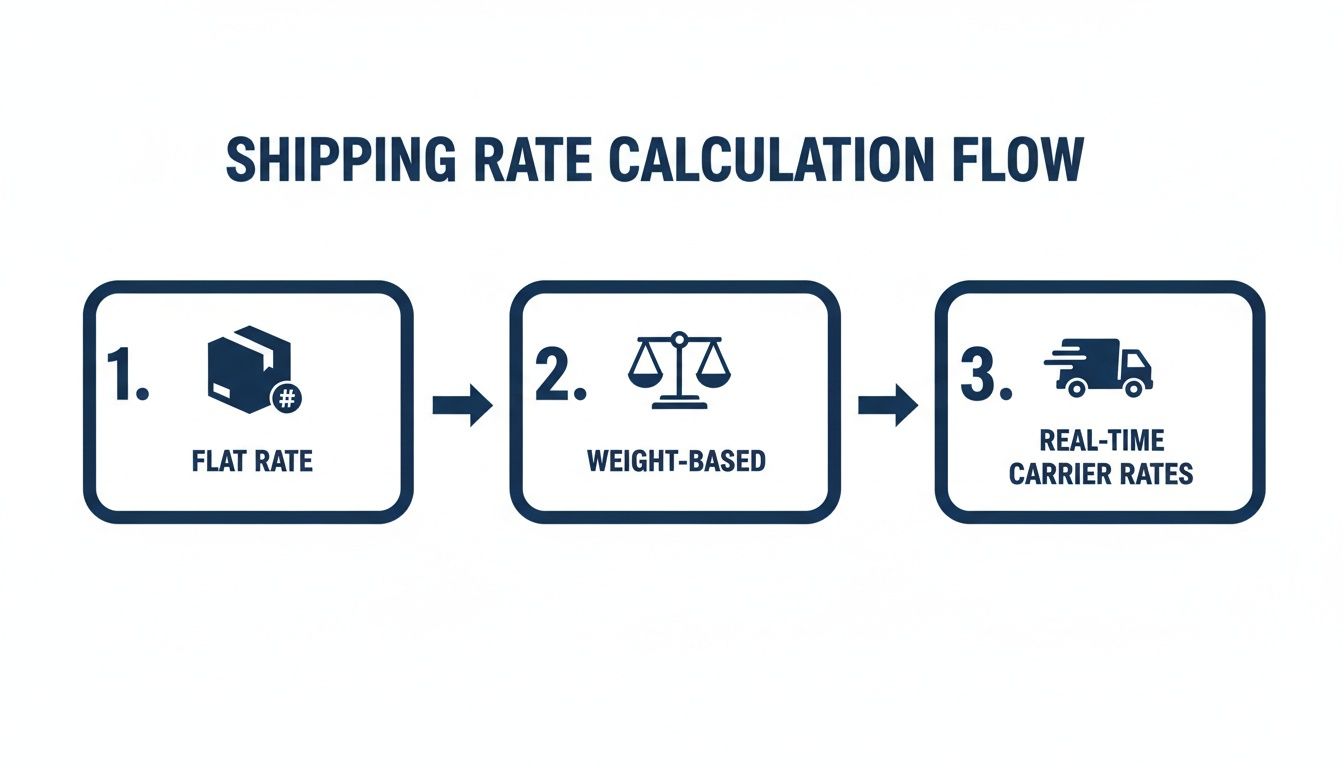
As you can see, it's a logical progression. You start with the basics and can layer on more complexity as your business grows.
What Are Shipping Profiles?
If zones handle the "where," then Shipping Profiles manage the "what." Profiles are your secret weapon for creating custom shipping rules for specific products. Most of your inventory will probably fall under a "General" profile with your standard rates, but this is where you handle all the exceptions.
Let's say you sell t-shirts but just added some large, fragile framed prints. The t-shirts are easy—they ship from your main warehouse. The prints, however, need special packaging and ship from a separate studio. A custom shipping profile lets you attach unique, higher shipping rates only to those prints, leaving your t-shirt rates untouched.
You can create profiles based on:
Specific products: Isolate items that need special handling or have different costs.
Fulfillment locations: Set rates for products shipping from different warehouses, 3PLs, or dropshippers.
This is how you finally stop losing your shirt on shipping those heavy, oversized, or delicate items.
Building a Customer-Centric Shipping Structure
Here's the shift: your goal with zones and profiles isn't just to cover your costs. It's to build a transparent, logical system that you can use as a marketing tool. A smart setup builds trust and lays the foundation for strategies that actually increase what customers spend, boosting both AOV and lifetime value.
Instead of just treating shipping as a cost, think of it as an incentive. For example, your domestic zone might have a standard $8 shipping rate, but you can also offer a free shipping option for any order over $100. Suddenly, shipping isn't a fee; it's a reward to be unlocked.
A smart shipping setup does more than just calculate costs; it becomes a tool for growth. By defining clear rules, you create the perfect foundation for an in-cart rewards program that boosts AOV without relying on store-wide discounts that diminish your brand's value.
This is where your shipping strategy starts working hand-in-hand with your marketing. Instead of a generic "10% off" coupon that cheapens your brand, you can build a far more engaging experience. A shopper who sees they're just $10 away from free shipping is often more motivated to add another item than someone who's just offered a small discount.
By using an app like Monster Cart, you can make these thresholds visible and interactive. As a customer adds items, a progress bar right in the cart shows them exactly how close they are to earning their reward—whether it's free shipping, a free gift, or a future discount. This turns the checkout from a boring chore into an exciting mini-game, boosting AOV and building loyalty far more effectively than another sale ever could.
Using Strategic Shipping to Increase Average Order Value
Alright, you've wrestled your shipping zones and profiles into submission. Now that the technical foundation is in place, it’s time to stop thinking about shipping as a simple cost of doing business. Let's turn it into one of your most powerful tools for growing your Average Order Value (AOV).
Many store owners instinctively reach for discount codes and flash sales. While those have their place, relying on them too often just trains your customers to wait for a price drop. It’s a fast track to eroding your margins and devaluing your brand.
A far smarter, more sustainable approach is to use shipping as a marketing lever. Instead of just covering costs, you can build a system that rewards customers for spending more. It’s a critical shift in mindset—focusing on customer lifetime value (LTV), not just the immediate transaction.
The Power of the Free Shipping Threshold
The star of this strategy is the free shipping threshold. It’s one of the most effective psychological tools in all of ecommerce. When a customer sees they’re just a few dollars away from ditching the shipping fee, the motivation to add one more item to their cart is incredibly strong.
But setting the right threshold is a balancing act. Set it too low, and you'll hemorrhage money on shipping. Set it too high, and it feels unattainable, killing any motivation.
Here’s a practical formula to get you started:
Calculate Your Current AOV: Jump into your Shopify analytics and find your average order value over the last 30–60 days.
Add a Smart Buffer: Set your free shipping threshold about 20-30% higher than your current AOV.
If your AOV is $80, a great starting point for your free shipping threshold is right around $100. This number feels achievable and encourages that small, spontaneous add-on purchase. It's a true win-win: they save money, and you lock in a bigger order.
This is a game-changer for Shopify merchants, especially when you consider that 70% of carts are abandoned, often due to sticker shock at checkout. Turning that friction point into an opportunity is what separates the pros.
From Static Banners to Dynamic In-Cart Motivation
Announcing "Free Shipping on Orders Over $100" in a site-wide banner is a good start, but it's passive. Customers might miss it, forget about it, or lose track of their cart total while browsing. The real power is unlocked when you make this goal visible and interactive, right where the decisions are being made: the cart.
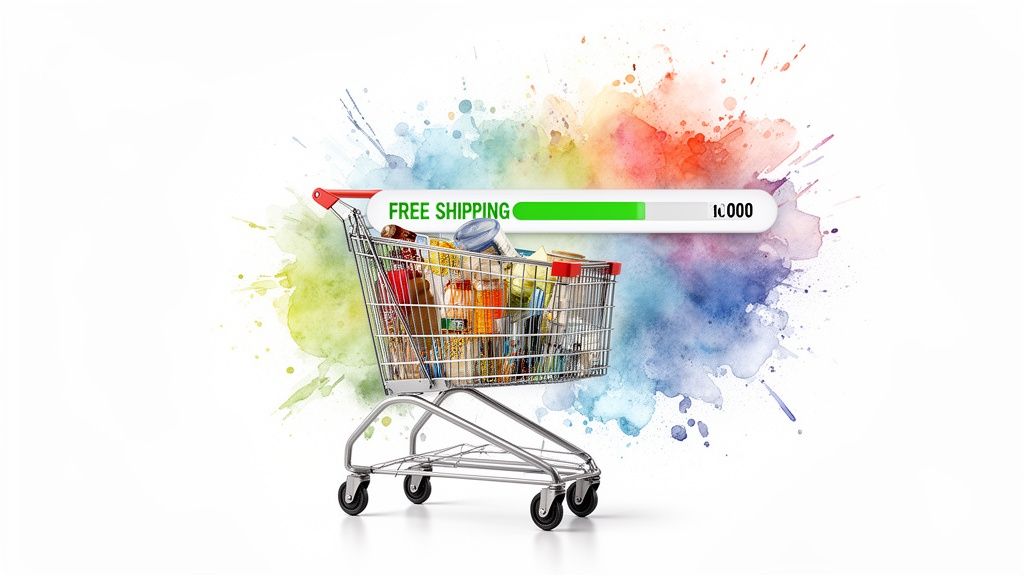
This is where a tool like Monster Cart completely changes the game. Instead of making customers do the math themselves, it provides a dynamic in-cart progress bar that cheers them on.
Imagine this: a customer's cart total is $85. A sleek progress bar in your slide-out cart shows, "You're only $15 away from free shipping!" This simple cue turns the checkout process into an engaging game, not a chore.
This active encouragement is worlds more effective than a static banner. It creates a sense of urgency and accomplishment, motivating customers to find that one last item to push them over the threshold. This visual feedback directly tackles your goal—boosting AOV in a way that feels helpful, not pushy.
And remember, shipping is just one piece of the puzzle. Incorporating other smart tactics, like finding the right upsell app, can also help you increase Average Order Value.
Rewards Beyond Shipping
Once you have a solid free shipping system in place, why stop there? You can build on this foundation to create a more sophisticated rewards journey that further increases both AOV and LTV. With an app like Monster Cart, you can stack multiple rewards to create a ladder of spending goals.
Unlock Free Shipping: The first milestone every customer can aim for.
Unlock a Free Gift: At a slightly higher spend, they get a surprise gift with their order.
Unlock a Special Discount: At an even higher tier, they might earn a discount code for their next purchase.
By turning your perfectly calculated shipping strategy into the first step of a larger rewards program, you create a gamified shopping experience that’s genuinely exciting. This is how you build real loyalty and encourage repeat business far more effectively than a simple coupon ever could. If you want to dive deeper into this topic, check out our guide on Shopify free shipping coupons.
Building an In-Cart Rewards Program with Monster Cart
You’ve put in the hard work to build a smart shipping strategy and set a compelling free shipping threshold. That's a huge win. But why stop there? An accurate shipping setup is the perfect launchpad for a full-blown rewards program that builds real loyalty and pushes your Average Order Value (AOV) through the roof.
Instead of getting caught in the endless cycle of store-wide discounts that train customers to wait for a sale, you can create a gamified shopping journey right inside the cart. This simple shift moves the focus from a one-time transaction to building long-term customer value. It’s all about making shoppers feel rewarded for their loyalty, encouraging them to spend a little more with every single visit.
Moving Beyond a Single Reward
The real power here is in "stacking" your incentives to create a ladder of rewards. This keeps customers engaged, always motivated to reach that next spending goal. You’re turning the simple path to checkout into an exciting, progressive journey that unfolds as they shop.
Here’s what that looks like in the real world:
Tier 1: Spend $75, Unlock Free Shipping. This is your foundation. It solves the number one pain point for almost every online shopper and gets them on board.
Tier 2: Spend $100, Unlock a Free Gift. Once they’ve crossed that free shipping line, you give them a new target. A surprise free gift adds a layer of delight that makes the whole experience feel special and memorable.
Tier 3: Spend $150, Unlock a 10% Discount. For your highest-value customers, a final reward like a percentage off their order or a voucher for a future purchase gives them a powerful reason to max out their cart.
This tiered system transforms a simple purchase into a rewarding journey, all without devaluing your products with constant sales. It's a much more sustainable way to grow your AOV while delivering genuine value and boosting lifetime value.
Creating a Premium In-Cart Experience
The key to making this work is how you present it. Nobody likes those annoying, full-screen pop-ups that interrupt the shopping flow and scream desperation. They’re a major source of frustration and a fast track to cart abandonment. The experience needs to feel seamless, premium, and like a natural part of your brand.
This is exactly where a tool like Monster Cart shines. It replaces Shopify’s basic cart with a sleek, slide-out cart drawer that communicates these rewards in real time. As a customer adds items, a dynamic progress bar instantly updates, showing them exactly how close they are to unlocking the next reward.
This isn't just a cart; it's a conversion engine. By showing progress towards tangible rewards, you make shopping feel like a game. This subtle gamification is far more effective at driving action than a disruptive pop-up ever could be.
This approach feels helpful, not aggressive. It respects the customer's journey while gently guiding them toward a higher spend. The whole thing feels exciting and premium, reinforcing your brand’s quality and commitment to customer care.
Adding More Value with One-Click Upsells
Once you have a sophisticated cart drawer in place, you can also seamlessly integrate one-click upsells that add even more value and revenue. These aren't just random product suggestions; they are highly relevant offers that genuinely enhance the customer's order.
Right inside Monster Cart, you can present offers like:
Shipping Protection: Give customers peace of mind with optional insurance for their package.
Gift Wrapping: Offer a beautiful gift-wrapping service, perfect for holidays or special occasions.
Priority Handling: Let customers pay a small fee to jump to the front of the fulfillment line.
These small, relevant add-ons might not seem like much on their own, but they can make a massive impact on your AOV over time. They are presented as helpful options, not pushy sales tactics, which keeps the customer experience positive. To get more ideas on how to implement this, check out our guide to the best upsell apps for Shopify.
Ultimately, your efforts to calculate shipping shopify rates accurately are just the beginning. By pairing that solid foundation with a rewards-driven tool like Monster Cart, you transform a logistical necessity into a powerful engine for increasing AOV, delighting customers, and building the kind of brand loyalty that lasts.
Common Questions About Shopify Shipping
Wrestling with your Shopify shipping settings is a rite of passage for store owners. I've seen merchants get tripped up by the same few questions time and time again. Getting clear, practical answers is key to building a shipping strategy that doesn't just cover your costs, but actually helps you grow.
Let’s tackle the sticking points that you’re likely to run into. Getting these details right is the difference between a shipping setup that just gets by and one that actively boosts your revenue.
Can Shopify Automatically Calculate Shipping?
Yes, Shopify can automatically calculate shipping rates at checkout. You feed it the product weight, package dimensions, and customer’s address, and it spits out a price.
But here’s the catch: its accuracy is only as good as the data you give it. If your product weights are just rough estimates or your shipping zones are too broad, that "automatic" calculation will be way off. You’ll either end up overcharging frustrated customers or, more likely, losing money on every other order.
How Do I Handle Products with Different Shipping Needs?
This is a classic problem for stores with diverse catalogs, and it's exactly what Shipping Profiles were built to solve. Instead of one-size-fits-all rates, you can create unique profiles for specific items or groups of products.
For example, a smart setup might look something like this:
General Profile: For most of your standard products using your usual rates.
Fragile Profile: For delicate items that need extra padding and insurance, which naturally carries a higher shipping cost.
Heavy/Oversize Profile: For bulky goods that ship from a specific warehouse using freight rates.
Using profiles ensures you don’t lose your shirt shipping a 50-pound kettlebell at the same rate as a t-shirt. It's a fundamental step in making your shipping profitable.
Should I Offer Free Shipping?
Offering free shipping is a powerful sales tool, but it should be used strategically to increase your Average Order Value (AOV), not as a blanket discount that eats into your margins. The goal is to build long-term customer value, not just lock in a single sale with a costly promotion.
Instead of a permanent, site-wide offer, the smarter play is a free shipping threshold. This encourages customers to spend more to unlock a reward. It completely shifts the focus from discounts to value, which is crucial for building a sustainable brand.
Don’t just give away free shipping. Use it as the first step in a tiered rewards program. For example, unlock free shipping at $75, a free gift at $100, and a special offer at $150. This creates a journey that maximizes both AOV and customer lifetime value.
This is where a smart cart solution becomes invaluable. Rather than just relying on a simple announcement banner, you can show customers their progress toward rewards directly inside the cart. A tool like Monster Cart turns this into a visual, engaging experience. As customers add items, a progress bar fills up, showing them exactly how close they are to unlocking their reward.
This gamified approach is far more effective at driving action than a static banner. It transforms your cart from a simple checkout tool into an engine for AOV growth, helping you build a more profitable business without resorting to constant, margin-crushing sales. It's the perfect way to cap off a well-calculated shipping strategy.
Ready to turn your shipping strategy into a revenue driver? Monster Cart helps you build a high-converting, rewards-based cart experience that boosts AOV and customer loyalty. Transform your Shopify cart today.
Join 7000+ brands using our apps