Shopify Free Shipping Coupon a Guide to Boosting AOV
Jan 11, 2026
|
Published
Setting up a Shopify free shipping coupon is easy enough in your admin, but the real strategy isn't about giving things away for less. It’s about using free shipping as a powerful psychological trigger to boost your average order value (AOV) and build better, longer-lasting customer relationships focused on lifetime value.
It's less of a discount and more of an incentive—a tool to encourage shoppers to add a little more to their cart and feel rewarded for it.
The True Power of a Shopify Free Shipping Coupon
Let's be honest, free shipping isn't a delightful surprise anymore; it's what most online shoppers expect. The real question isn't if you should offer it, but how you can do it without torching your profit margins. This is exactly where the conditional free shipping coupon becomes one of your most valuable assets.
Instead of a blanket offer that attracts one-time bargain hunters, a coupon tied to a minimum spend turns a potential cost into a compelling reward. You're gamifying the shopping experience. It motivates customers to add just one more item to their cart to unlock that perk, boosting AOV in the process.
Shifting Focus from Discounts to Rewards
Hefty discounts can, over time, devalue a brand. You accidentally train your customers to just wait around for the next sale. A much smarter, long-term approach is to enhance the customer experience with valuable rewards like free shipping, a free gift, or exclusive access.
Free shipping is the perfect reward because it removes one of the biggest points of friction at checkout: unexpected costs. That surprise shipping fee is one of the top reasons people abandon their carts.
This strategy helps you do a few things at once:
Increase Average Order Value (AOV) by nudging customers to meet the shipping threshold.
Reduce Cart Abandonment by killing the surprise shipping fees that send shoppers running.
Build Customer Lifetime Value by offering a practical, high-value reward that makes their experience better.
Think about the lifetime value of a customer. An initial order sweetened with a free shipping reward is far more likely to create a repeat buyer than an order driven by a simple percentage-off sale. For those just getting started, understanding the basics of something like how to start an online jewelry store can be incredibly helpful before diving into marketing tactics like this one.
Why This Strategy Works So Well
The data doesn't lie: shoppers are incredibly motivated by free shipping. Research shows that 66% of American consumers want free shipping on every online order, and it's no surprise that nearly 88.6% of Shopify stores now offer it in some form.
The key is to position your free shipping offer not as a cost you have to absorb, but as an investment in a higher AOV and a better, long-term customer relationship.
By setting a smart, strategic threshold, you guide customer behavior in a way that helps both them and your bottom line. To get a better handle on this, check out our guide on what is AOV in ecommerce and how to calculate it for your store.
A well-designed offer turns the shopping cart into an interactive tool. This is something modern apps like Monster Cart nail by showing shoppers their real-time progress toward unlocking rewards, directly encouraging a higher spend.
Creating Your First Free Shipping Coupon in Shopify
Alright, let's roll up our sleeves and create your first Shopify free shipping coupon. It's a quick process you can handle right from your admin dashboard, but don't let the simplicity fool you. Understanding how this basic tool works—and more importantly, where it falls short—is the key to building a smarter strategy that actually boosts your AOV.
This native coupon feature is the perfect starting point for any merchant. It gets a simple, effective offer into your customer's hands that they can pop in at checkout.
Navigating the Shopify Discounts Section
First things first, head over to the "Discounts" area in your Shopify admin. From there, you'll create a new discount and choose "Free shipping" as the type. This is your command center for setting up the rules of the road for this offer.
You've got a few critical settings to dial in:
Discount Code: This is what customers will type in, like
FREESHIP75. Keep it simple and memorable.Shipping Destinations: You can offer it worldwide or, more practically, limit it to specific countries to keep your shipping costs from spiraling out of control.
Minimum Requirements: This is where you protect your profit margins. You can require a minimum purchase amount (like $75) or a minimum number of items.
Let's walk through a classic example: free shipping on domestic orders over $75. You’d create the code FREESHIP75, select your primary country for shipping, and plug in $75.00 as the minimum purchase amount.
This is exactly what the setup screen looks like inside Shopify where you'll define these parameters.
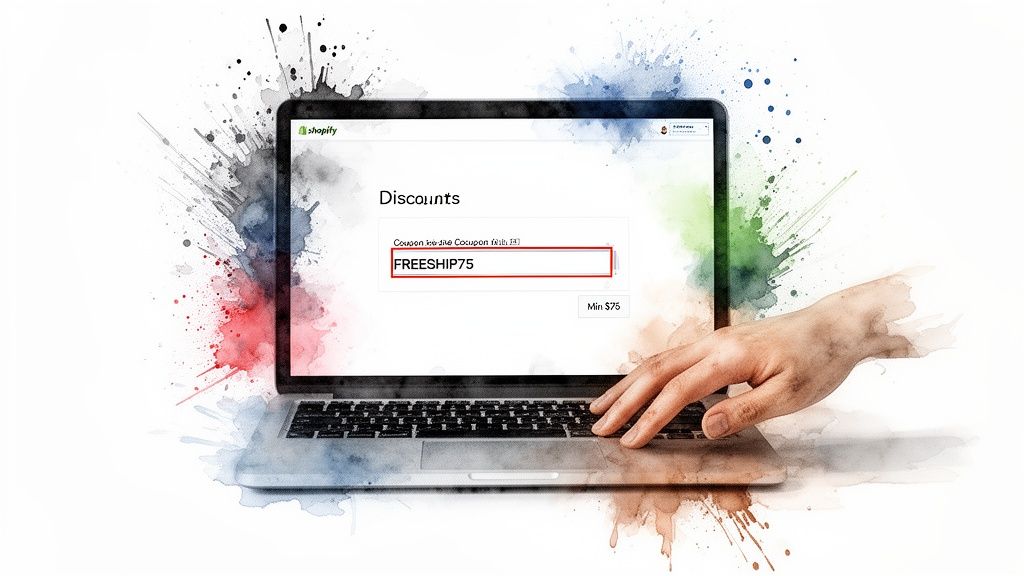
As you can see, the fields are clear and straightforward, making the initial setup pretty painless.
The Core Limitation of Standard Coupons
Once you hit save, that discount is live and ready to go. But here's the catch with Shopify's native feature: its visibility is zero until the last possible moment. A customer only finds out they can use this code when they’re already at the checkout page. That means you completely miss the chance to influence their buying decisions while they are still shopping.
The standard Shopify coupon is a passive tool. It validates a reward at the end of the journey but doesn't actively encourage customers to add more items to their cart to earn that reward.
This distinction is everything. To really drive up your AOV and customer lifetime value, you need to transform that offer from a hidden code into a visible, interactive goal. This is exactly where apps like Monster Cart step in. They take that static coupon and turn it into a dynamic progress bar right inside the slide cart, showing shoppers exactly how close they are to unlocking free shipping or even a free gift.
That visual feedback loop encourages them to add one more item to their cart in real-time, focusing them on the reward and ultimately boosting their lifetime value.
Strategic Coupon Targeting to Maximize Impact
Okay, so you know how to build a basic Shopify free shipping coupon. Now for the fun part: figuring out the who and the when. Tossing a blanket offer at every single visitor is a fast way to watch your profits evaporate. The real art is in creating targeted promotions that feel exclusive and push the right customers to take specific, profitable actions.
Instead of a free-for-all, think about deploying your coupons with surgical precision. This approach protects your margins and, just as importantly, makes the offer feel way more valuable to the person receiving it. It’s a mental shift from just giving away discounts to actively investing in customer lifetime value.
Segmenting Your Audience for Maximum Effect
Not all customers are created equal, so why should their offers be? By slicing your audience into different segments, you can create free shipping coupons that are laser-focused on specific business goals—like winning over new buyers or spoiling your most loyal fans.
This tailored approach blows generic email blasts out of the water. Free shipping isn't just a simple discount anymore; it's a powerful reward that builds loyalty and keeps people coming back. In fact, a report mentioned by Shopify found that the top reason people join a loyalty program is to get free shipping—beating out points or even exclusive products.
Here are a few high-impact segments to start with:
First-Time Buyers: A one-time-use coupon is a killer incentive to help a new customer get over that initial hesitation and finally click "buy."
VIP or Loyalty Members: Make your best customers feel seen. Reward them with an exclusive, standing free shipping coupon as a genuine thank you for their business.
Specific Geographic Locations: If shipping to a certain country is way more affordable for you, why not create a targeted offer just for them? Think "free shipping on all US orders."
The table below breaks down a few common scenarios, showing how you can align your coupon strategy with specific business goals.
Targeted Free Shipping Coupon Scenarios
Goal | Target Audience | Coupon Strategy | Why It Works |
|---|---|---|---|
New Customer Acquisition | First-time website visitors or new email subscribers. | A one-time-use free shipping code valid on their first order. | Removes a key friction point (shipping costs) and lowers the barrier to entry for making that initial purchase. |
Increase Customer LTV | Existing customers who have purchased 2+ times. | An exclusive, ongoing free shipping code sent via email. | Rewards loyalty, making them feel valued and encouraging them to consolidate future purchases with your brand. |
Boost Sales in a Slow Period | All customers, but with a sense of urgency. | A weekend-only free shipping coupon like "FREESHIPWEEKEND". | The time limit creates scarcity, motivating procrastinators to buy now instead of waiting. |
Liquidate Old Inventory | Customers who have shown interest in a specific product category. | Free shipping on orders that include an item from a designated collection. | Nudges customers toward the products you need to move, clearing out stock without resorting to hefty discounts. |
As you can see, a little strategic thinking transforms a simple coupon into a powerful business tool.
Controlling Coupon Usage and Timing
Beyond who gets the code, you need to control how and when it's used. Shopify’s discount settings are your command center for setting clear boundaries, making sure your promotion runs exactly as planned without getting abused.
Think about putting some limits on it. You could restrict a coupon to one use per customer—perfect for a welcome offer. Or, you could limit the total number of times the code can be redeemed, creating instant urgency with something like, "free shipping for the first 100 orders!" This tactic works even better when you combine it with smart in-cart upsells. If you're looking to take this to the next level, our guide on how to use product recommendations on Shopify is a great place to start.
A well-timed, limited offer almost always outperforms a permanent one. Scarcity and exclusivity are powerful psychological triggers that push people to act immediately.
Scheduling your promotions is another key tactic. You can set specific start and end dates for your coupons to perfectly align with a marketing campaign. Imagine creating a "FREESHIPWEEKEND" code that's only active from Friday morning to Sunday night. It's a fantastic way to drive a surge of sales during a flash sale or holiday weekend. By dialing in these details, you turn a passive discount into an active, strategic tool that actually helps grow your business.
Turning Coupons Into a Conversion Engine
A standard Shopify free shipping coupon is a good start, but its biggest weakness is that it's invisible until the final checkout step. By then, it’s far too late to influence how much your customer actually spends.
The real conversion lift happens when you stop passively offering a discount and start actively guiding your customer toward a higher-value purchase. You need to transform that hidden coupon code into a visible, interactive experience that begins the moment they add something to their cart.
Gamify the Cart with Progress Bars
Imagine a customer adds a $45 item to their cart. Instead of nothing happening, a sleek progress bar instantly appears in the slide-out cart, showing them, "You're only $15 away from free shipping!"
This is the magic of a tool like Monster Cart. This real-time feedback loop is incredibly powerful. It does a few critical things all at once:
Creates a Clear Goal: The customer knows exactly what they need to do to unlock their reward.
Motivates Action: The visual progress is a powerful nudge, encouraging them to find another small item to add, directly boosting your AOV.
Reduces Friction: It removes all the mental math, making the path to the reward feel easy and obvious.
This approach gamifies the experience, tapping into our natural desire to complete a task and "win." It's a far more engaging and effective strategy for increasing lifetime value than just hoping a shopper remembers to punch in a code at the very end. For a deeper dive, our guide on how to reduce cart abandonment covers similar psychological triggers.
The Power of Stacking Rewards
Why stop at just one reward? The most successful brands build lifetime value by stacking multiple offers, creating an irresistible bundle that feels like a huge win for the customer. Think beyond just free shipping and get creative with rewards like free gifts, a small discount on a future order, or exclusive content.
For example, you could easily structure a multi-tiered reward system within Monster Cart:
Unlock Free Shipping at $60.
Unlock a Free Gift at $85.
As a customer adds items, the cart updates in real-time, showing them the next reward they can earn. This creates a seamless upsell flow entirely within the slide cart, completely avoiding those disruptive pop-ups that kill conversion rates and focusing on building a bigger, better order.
This decision tree shows how you can tailor coupon strategies for different goals, whether it's acquiring new customers, rewarding VIPs, or driving urgency during a sale.
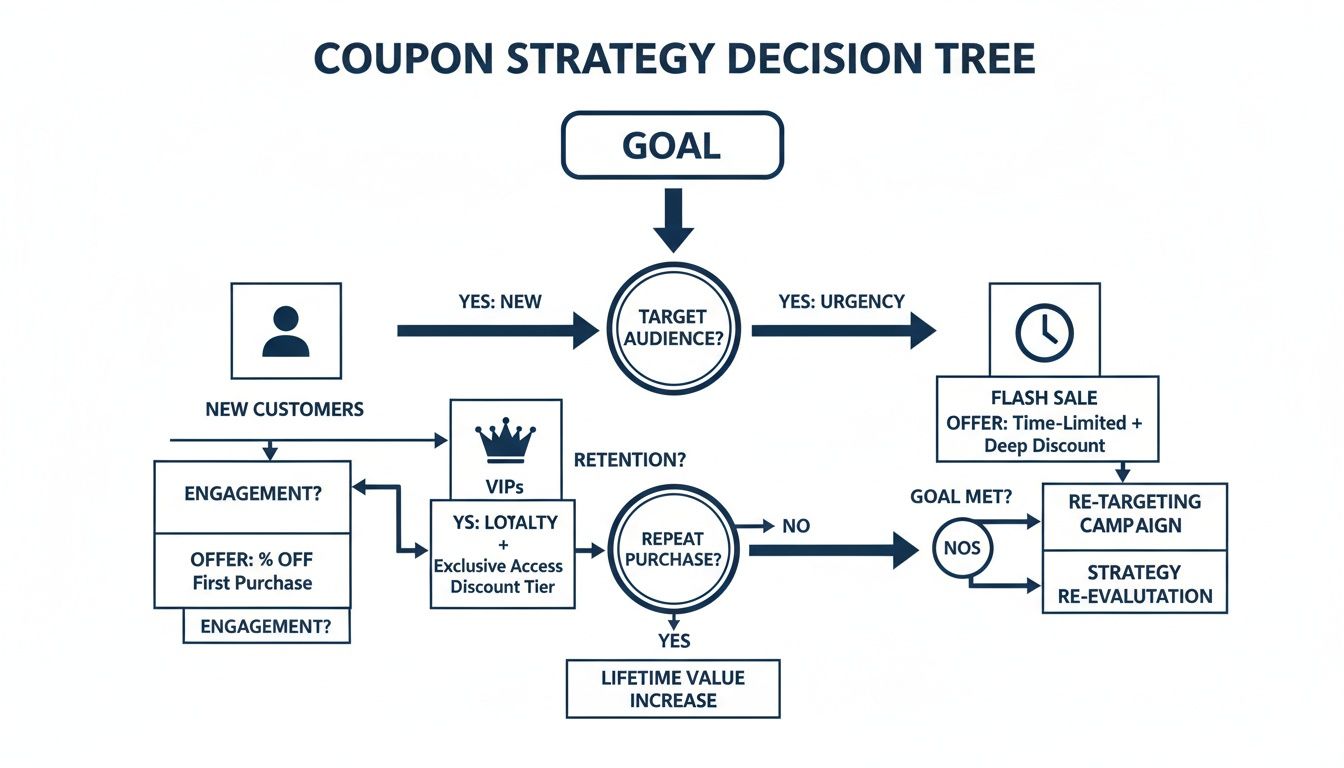
The key takeaway is that a one-size-fits-all approach just doesn't cut it anymore. Smart segmentation is essential for maximizing your ROI.
Building a Smarter Threshold Strategy
Conditional "spend X, get free shipping" offers have become a primary tool for boosting AOV on Shopify for a reason. The strategy is straightforward but incredibly effective: set a minimum spend threshold just a bit above your current average order value.
A store with a $48 AOV, for instance, might set its free shipping reward threshold at $60 or $65. This directly encourages a 25–35% lift in cart size from every single shopper who goes for the reward.
This isn’t about tricking the customer; it’s about transparently offering them a better deal in exchange for a slightly larger purchase. You cover the shipping cost with the increased profit from the higher AOV, and the customer leaves feeling like they got great value. It's a win-win that builds long-term loyalty.
While free shipping coupons are a direct tactic, understanding broader principles on how to improve your website's overall conversion rate can amplify their impact even further.
By turning the cart into a dynamic and rewarding experience, you build a powerful conversion engine that works for both you and your customers, fostering loyalty that lasts far beyond a single transaction.
How to Test and Optimize Your Free Shipping Offers
A strategy is only as good as its results. Launching a Shopify free shipping coupon without a plan to measure its impact is like flying blind—you might be moving, but you have no idea if you're headed in the right direction.
Before you go live, you absolutely have to run a few test redemptions. This simple step can save you from major headaches by ensuring the conditions you set (like minimum spend or specific countries) are actually being enforced correctly. Nothing kills customer trust faster than a promised discount that completely fails at checkout.
Once your offer is live and you've confirmed it works, the real work begins. It’s time to shift your focus from simply giving away discounts to actively building long-term customer value.
Key Metrics to Track in Shopify Analytics
Your Shopify Analytics dashboard is the first place to look. The goal isn't just to see how many people used the coupon; it's to see how the offer actually changed customer behavior.
First, you need a baseline. Look at your store's performance for the 30 days before you launched the offer. Then, compare it to the data after you went live.
Focus on these critical metrics:
Average Order Value (AOV): Did it go up? This is the clearest sign that your minimum spend threshold is successfully encouraging customers to add more to their carts.
Conversion Rate: Are more visitors turning into buyers? Free shipping is meant to remove friction, so you should see this number climb.
Cart Abandonment Rate: Did this number drop? Since unexpected shipping costs are a top reason for abandonment, your offer should make a dent here.
Customer Lifetime Value (LTV): Is this reward encouraging repeat business? Monitor this over a longer period to see if these customers return.
If you don't see the lift you expected, don't panic. This data isn't a report card; it's your roadmap for what to fix.
A/B Testing Your Thresholds for Maximum AOV
Your initial free shipping threshold is your best guess, not the final word. The sweet spot that maximizes your AOV while protecting your margins is almost always found through simple A/B testing. For example, is a $50 threshold more profitable than $75?
Run the $50 offer for a few weeks, measure your AOV, then switch to the $75 offer and compare the results. You might find the lower threshold converts more people, but the higher one produces a significantly better AOV. It’s all about finding the perfect equilibrium.
It's crucial to think beyond one-off sales. The aim is to create a sustainable reward system that encourages higher lifetime value, not just a temporary spike in orders driven by hefty discounts that erode brand value.
This is where a tool like Monster Cart gives you a massive advantage. Its built-in analytics provide real-time insights into how your in-cart offers are performing. You can see which rewards are driving the most upsells and make quick adjustments on the fly, optimizing for long-term profitability without waiting weeks for data to pile up.
This direct feedback loop allows you to fine-tune your strategy, turning your cart into a reliable engine for growth.
Your Free Shipping Questions, Answered
Jumping into the world of free shipping coupons on Shopify can bring up a lot of questions. Let's get straight to the practical answers you need to build a strategy that actually grows your average order value (AOV) and keeps customers coming back for more.
Is Free Shipping Going to Wreck My Profit Margins?
Not if you’re smart about it. The trick is to stop thinking of it as a cost and start using it as a strategic reward to boost AOV. Never offer free shipping on everything, all the time.
Instead, set a minimum spend threshold that’s a little higher than your current AOV. If your store's average order is $45, setting the free shipping reward at $60 gives customers a clear, achievable goal. It encourages them to pop one more item into their cart.
The increased profit from the higher order value should more than cover the shipping fee, leading to a healthier bottom line. You're not just giving away shipping; you're using the promise of it to build bigger carts and increase customer lifetime value.
Can I Do Free Shipping Without a Coupon Code?
You bet. Shopify has a built-in feature for automatic discounts that can apply free shipping once a cart meets your rules. But here's the catch: an automatic discount is invisible until the very last step of checkout. By then, it's too late to influence how much your customer spends.
The real power comes from making the offer visible while they shop. A tool like Monster Cart puts a progress bar right in the slide-out cart, showing shoppers exactly how close they are to unlocking their reward. This visual feedback is way more effective at bumping up AOV than a hidden offer they only discover at the end.
This simple shift turns a passive discount into an active, engaging challenge for your customers, encouraging them to spend more to earn their reward.
What's Better: A 10% Discount or a Free Shipping Coupon?
While every brand is different, a free shipping coupon is often the smarter psychological play for building long-term customer value. Constantly offering a 10% discount can devalue your products and trains customers to only buy during sales, hurting your margins and attracting one-time bargain hunters.
Free shipping, on the other hand, feels like a practical, high-value reward. Customers often perceive its value to be much higher than what it actually costs you. More importantly, it directly removes one of the biggest points of friction at checkout—those unexpected shipping fees that are a primary cause of abandoned carts.
For building a sustainable business with loyal repeat customers, focusing on rewards over hefty discounts is almost always the winning strategy.
How Do I Stop People From Abusing a Free Shipping Coupon?
Shopify gives you a good set of controls to keep your offers from getting out of hand. Inside the discount settings, you can easily limit a coupon's use to one per customer or cap the total number of uses (say, for the first 100 shoppers). You can also set a hard expiration date.
For more targeted campaigns, you can restrict the coupon to specific customer segments, like members of your loyalty program or brand-new email subscribers. This ensures your offer works as the strategic incentive you intended, not as a loophole that eats into your profits.
Ready to turn your Shopify cart into an AOV-boosting machine? Monster Cart helps you create gamified, in-cart rewards like free shipping thresholds, free gifts, and stacked upsells that customers love.
Get Monster Cart on the Shopify App Store and start building a smarter cart experience today.
Join 7000+ brands using our apps