10 Ecommerce Merchandising Best Practices to Boost AOV in 2026
Jan 28, 2026
|
Published
In a world where shoppers are immune to constant sales, the smartest brands are rethinking how they sell. Effective ecommerce merchandising is no longer about just slashing prices; it’s about creating value, enhancing the shopping experience, and building a relationship that lasts beyond a single transaction. It's about moving away from margin-killing discounts and towards strategies that increase both average order value (AOV) and customer lifetime value (LTV).
This guide delivers a modern playbook of ecommerce merchandising best practices designed for ambitious Shopify stores. We will explore 10 powerful, actionable strategies that focus on reward-based incentives, such as free gifts, tiered rewards, and strategic upsells. You'll learn how to motivate customers to spend more because they want to, not simply because you're offering another 20% off. The goal is to transform your shopping cart from a simple checkout tool into your most powerful and profitable merchandising asset—a place where every item added feels like a win for the customer and builds long-term value for your brand.
To truly revolutionize your online store and implement these strategies effectively, it's crucial to first master ecommerce merchandising best practices. This article provides the specific, in-cart tactics to do just that. We'll dive into practical implementation steps for everything from "spend-to-unlock" milestones and one-click add-ons to smart personalization that makes every offer feel uniquely tailored. These techniques are designed to work together, creating a compelling journey that naturally guides customers toward a higher cart value, all while strengthening their loyalty to your brand.
1. Tiered Rewards & Spend-to-Unlock Milestones
One of the most powerful ecommerce merchandising best practices is transforming the shopping cart from a simple checkout tool into an interactive, goal-oriented experience. Tiered rewards and spend-to-unlock milestones achieve this by gamifying the path to purchase, encouraging customers to increase their cart value to unlock progressively better rewards.
This strategy taps into powerful psychological triggers. As a customer adds items, a visual progress bar or notification shows them how close they are to the next reward, creating a sense of momentum and accomplishment. This approach shifts the focus from "how much am I spending?" to "what can I earn next?", effectively increasing average order value (AOV) without resorting to site-wide discounts. It’s a strategic way to boost profitability and customer lifetime value by rewarding bigger carts with things like free shipping, a free gift, or a strategic discount.
Key Insight: The goal is to make customers feel like they are earning value, not just spending money. This positive reinforcement loop builds brand affinity, boosts lifetime value, and encourages repeat purchases.
How to Implement Tiered Rewards
Effective implementation requires a balance of data-driven strategy and compelling user experience. Here’s how to get started:
Set Data-Informed Thresholds: Analyze your store's AOV. Set your first reward tier slightly above your current AOV to encourage a small stretch. For example, if your AOV is $75, set the first milestone at $90. Subsequent tiers should align with natural spending plateaus in your sales data.
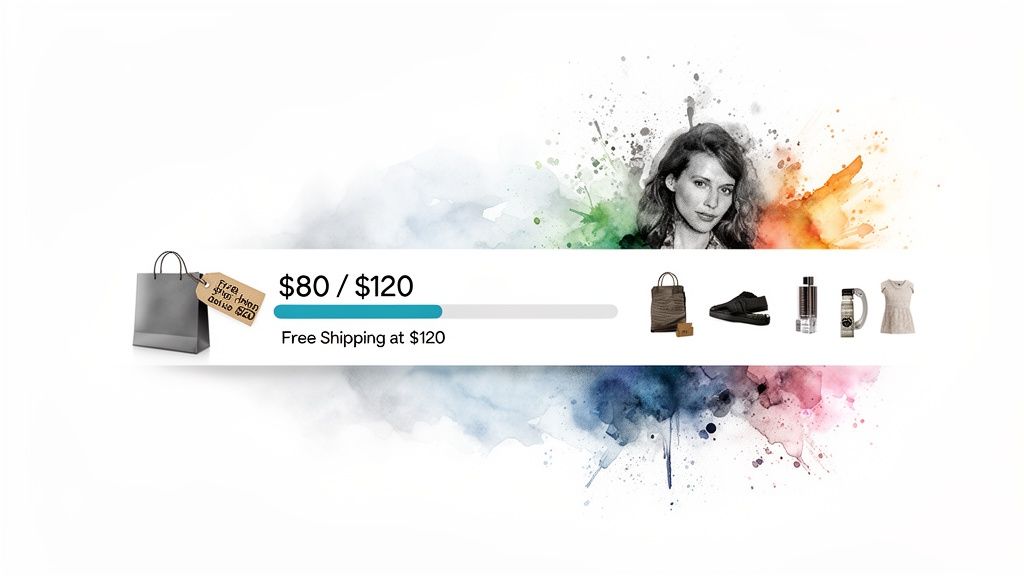
Visualize the Journey: The key is making progress visible and exciting. Use an in-cart progress bar that updates in real-time. Clearly state the next reward and the amount needed to unlock it (e.g., "You're only $15 away from a free gift!").
Align Rewards with Profitability: Offer high-perceived value, low-cost rewards. This could be a high-margin product, a sample of a new item, exclusive content, or free shipping. For instance, a beauty brand could offer a mini version of a best-selling serum.
Use Action-Oriented Language: Frame the rewards with exciting language. Instead of "Spend $100, get a gift," use "Unlock your exclusive reward at $100!" This language creates a sense of achievement and exclusivity.
For Shopify merchants, apps like Monster Cart are designed to build these dynamic, in-cart reward systems. You can easily configure multiple tiers, customize the visual progress bar, and test different reward types (free gifts, percentage discounts, or free shipping) to see what resonates most with your audience. This turns your cart into your best salesperson, consistently upselling customers in a helpful, non-intrusive way.
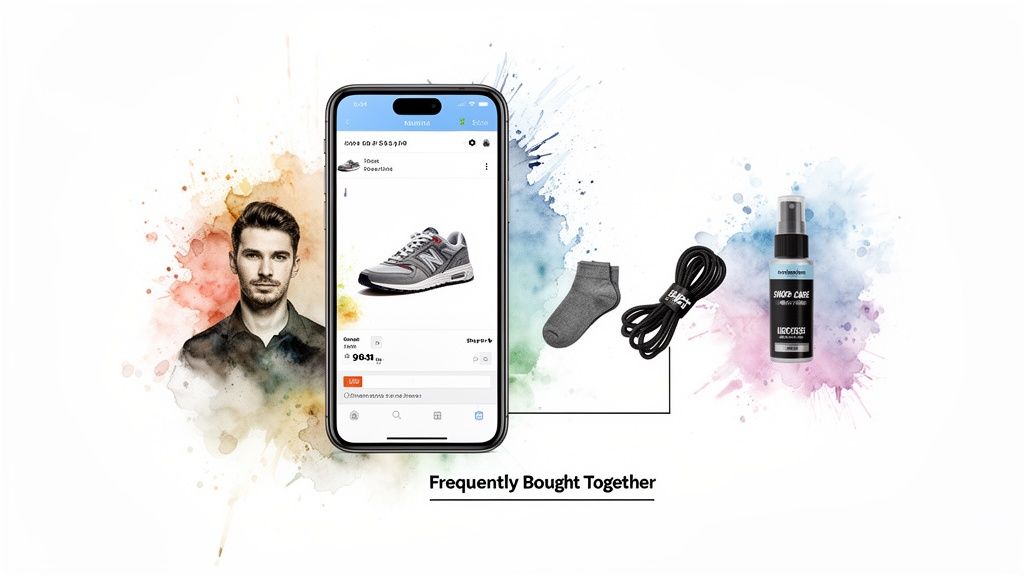
2. Frequently Bought Together (FBT) Recommendations
One of the most effective ecommerce merchandising best practices is leveraging the power of suggestion at the most critical moment: checkout. Frequently Bought Together (FBT) recommendations present complementary items directly within the shopping cart, tapping into a customer’s buying mindset to increase basket size without being intrusive. Unlike aggressive pop-ups, these suggestions feel helpful and enhance the shopping experience.
This strategy works by showing customers items that other, similar shoppers have found valuable. It answers the question, "What else might I need to get the most out of this purchase?" For instance, suggesting a protective phone case to someone buying a new smartphone is a natural, value-added upsell. It shifts the customer’s focus from simply completing the transaction to building a complete solution, boosting AOV in a customer-centric way that builds loyalty over time.
Key Insight: The goal is to make upsells feel like a helpful discovery, not a sales pitch. Relevant recommendations build trust and demonstrate that you understand your customer's needs, contributing to higher lifetime value.
How to Implement FBT Recommendations
Successful FBT implementation is rooted in relevance and data. The suggestions must feel like a natural extension of the customer’s original purchase. Here’s how to get it right:
Analyze Purchase Data: Dive into your order history to identify authentic product pairings. Look for items that are consistently purchased together. Don't rely on assumptions; let your customer behavior guide your strategy.
Limit the Choices: Avoid decision fatigue by presenting only a few highly relevant options. Offering 2-4 curated suggestions is far more effective than a long, scrolling list of random products. The goal is to simplify, not overwhelm.
Prioritize True Complements: Ensure your recommendations genuinely enhance the primary product. For a coffee machine, suggest high-margin coffee beans or a milk frother. For a dress, recommend a matching belt or specific jewelry.
Test and Refine Pairings: A/B test different product combinations to see which pairings convert best. Track metrics like take rate and impact on AOV to continuously optimize your recommendations for maximum profitability.
For Shopify merchants, apps like Monster Cart can integrate these one-click add-ons directly into the cart drawer. This allows you to present compelling FBT offers that are easy for customers to accept, seamlessly increasing the value of each order without interrupting the path to purchase or resorting to margin-killing discounts.
3. One-Click Add-On Upsells (Protection, Services, Upgrades)
A powerful ecommerce merchandising best practice is to offer low-cost, high-value additions directly in the cart that complement the primary purchase. One-click add-on upsells, such as shipping protection, extended warranties, or gift wrapping, are presented as simple checkboxes or toggles. This technique capitalizes on a customer's purchase intent at its peak, making it frictionless to increase their order value just before checkout.
This strategy enhances the core product offering by addressing potential customer anxieties or needs. For a high-value electronics purchase, a small fee for an extended warranty provides peace of mind. For a gift, optional gift wrapping saves the customer time. These small, incremental additions can significantly boost AOV and profit margins without relying on store-wide discounts that erode brand value. They add genuine utility to the customer experience, making the upsell feel helpful rather than pushy and building trust that increases lifetime value.
Key Insight: The most effective add-ons solve a problem or enhance the experience related to the main purchase. They succeed by being a convenient, impulse-friendly solution offered at the perfect moment.
How to Implement One-Click Add-Ons
Successful implementation hinges on relevance and simplicity. The goal is to make the decision to add an item an effortless "yes." Here’s how to integrate them effectively:
Align Add-Ons with Customer Needs: Offer services that address common pain points. For fragile or expensive items, offer shipping protection. For apparel, a "wear and tear" guarantee can be a compelling add-on. Brands like Allbirds have successfully offered carbon-neutral shipping offsets for a small fee, appealing to their eco-conscious customer base.
Use Benefit-Driven Language: Frame the offer around the value it provides. Instead of "Add Warranty," use "Protect your investment for just $5.99." This clearly communicates the benefit and makes the small cost feel worthwhile.
Minimize Friction: Present these options as simple checkboxes or toggles directly in the cart or on the product page. The less thought and fewer clicks required, the higher the conversion rate. Avoid sending the customer to a separate page.
Limit the Choices: To prevent decision paralysis, offer no more than two or three relevant add-ons. The goal is a quick, easy enhancement to the order, not a complex decision that could lead to cart abandonment. You can learn more about the distinction between this type of offer and other sales tactics to refine your strategy on the difference between cross-selling and upselling.
Shopify tools can facilitate these offers, allowing you to present them as seamless additions within the cart. An advanced cart solution like Monster Cart can even trigger these offers based on specific cart contents, making them hyper-relevant. By focusing on helpful, low-cost enhancements, you increase both AOV and customer satisfaction, proving that effective merchandising is about adding value, not just offering discounts.
4. Free Shipping Thresholds as Cart Incentives
Free shipping is no longer a perk; for many online shoppers, it’s an expectation. However, offering it unconditionally can severely impact your profit margins. A strategic ecommerce merchandising best practice is to transform free shipping from a standard cost into a powerful reward by setting a minimum spend threshold. This encourages customers to add more items to their cart to qualify, directly boosting your Average Order Value (AOV).
This approach gamifies the checkout process by setting a clear, achievable goal. Instead of absorbing shipping costs on every transaction, you use it as a tool to drive incremental purchases. The customer perceives the final addition to their cart not as extra spending, but as the key to unlocking a valuable reward: free delivery. It’s a classic win-win that increases revenue per order while meeting customer expectations and protecting your long-term profitability.
Key Insight: Position free shipping as an attainable reward, not a given. This shifts the customer's mindset from "How much is shipping?" to "How can I earn free shipping?" turning a potential point of friction into a motivation to spend more.
How to Implement Free Shipping Thresholds
A successful free shipping strategy is built on data and clear communication. The goal is to make the threshold feel like a slight, worthwhile stretch for the average customer.
Calculate Your Optimal Threshold: Don't pick a random number. Analyze your store's data to find your current AOV and shipping costs. A common starting point is to set your threshold about 20-30% above your current AOV. If your AOV is $60, a $75 threshold is a great place to start testing.
Make Progress Visual and Obvious: The psychological impact comes from seeing the goal. Use a dynamic in-cart progress bar that updates as items are added. Clearly state the benefit, such as "You're only $18 away from FREE shipping!"
Frame it as Savings: Quantify the value to make the incentive more tangible. Instead of just saying "Free shipping at $75," try "Add $12 more to your cart to save $9.95 on shipping!" This clearly articulates the benefit of reaching the goal.
Test and Optimize: Your first threshold may not be the most profitable. A/B test different values (e.g., $75 vs. $85) to find the sweet spot that maximizes AOV lift without negatively impacting your conversion rate.
Shopify merchants can leverage apps like Monster Cart to seamlessly integrate these visual progress bars and dynamic messages directly into the cart drawer or page. By automating this communication, you can ensure every customer knows exactly how close they are to unlocking their reward, effectively turning your shipping policy into a powerful, automated upselling engine that protects your margins and enhances customer lifetime value.
5. Buy More, Save More (BMSM) Progressive Discounting
Another sophisticated ecommerce merchandising best practice is using a "Buy More, Save More" (BMSM) model. This strategy offers escalating discounts as a customer purchases more units of a specific product or items within a category. Instead of a flat-rate discount, BMSM creates a compelling tiered incentive: buy one at full price, buy two for 10% off each, and buy three for 15% off each.
This approach is powerful because it frames the discount as a reward for loyalty and bulk purchasing, rather than a simple price reduction. It encourages customers to stock up on products they already love, significantly increasing both units per transaction (UPT) and average order value. For consumable goods or products with high repeat purchase rates, BMSM is an ideal way to boost customer lifetime value without devaluing your brand through sitewide sales.
Key Insight: Progressive discounting shifts the customer's mindset from "how can I find a deal?" to "how can I maximize my value?". It’s a strategic lever to increase order volume while protecting your profit margins and encouraging long-term loyalty.
How to Implement Buy More, Save More
A successful BMSM strategy hinges on clear communication and smart tiering based on customer behavior. Here’s a blueprint for getting started:
Analyze Purchase Patterns: Review your sales data to identify which products are frequently purchased in multiples. Set your discount tiers to align with these natural buying habits. If customers often buy two of an item, set your first tier at three units to encourage a stretch.
Clearly Visualize the Savings: Make the value proposition undeniable. On the product page and in the cart, use clear visual cues and text like "Add 1 more to save 15%!" or "You save $12 at this quantity!". This transparency removes friction and highlights the benefit.
Start with Subtle Tiers: You don't need to offer steep discounts. Begin with modest incentives like 5% off for two items and 10% off for three. You can A/B test these percentages to find the sweet spot between conversion uplift and margin preservation. For a deeper dive into structuring these offers, you can explore more BMSM strategies here.
Test Category-Wide Offers: Apply BMSM not just to single products but to entire collections. For example, "Buy any 3 skincare items and save 20%." This encourages product discovery and cross-selling while still driving a higher cart value.
For Shopify stores, this can be managed through various discount apps. However, integrating this logic directly within the cart experience is most effective. When a customer adds one item, a tool like Monster Cart can trigger an in-cart message saying, "Add another and unlock a 10% discount!", turning the checkout process into a dynamic, value-driven journey. This makes the upsell feel like a helpful suggestion rather than a pushy sales tactic.
6. Smart Cart Personalization & Dynamic Product Suggestions
Moving beyond a one-size-fits-all approach is a hallmark of advanced ecommerce merchandising best practices. Smart cart personalization uses AI or rule-based logic to show different product recommendations and offers to different customers based on their unique behavior, such as browsing history, purchase patterns, or customer lifecycle stage. A first-time visitor might see your best-sellers, while a loyal customer sees recommendations for a new product that complements their past purchases.
This strategy transforms the shopping cart into a personal shopping assistant. Instead of showing generic upsells, you present relevant, helpful suggestions that feel curated for the individual. This not only increases the likelihood of conversion and boosts average order value (AOV) but also deepens the customer relationship. It shows you understand their needs and preferences, fostering a higher lifetime value far more effectively than a generic discount ever could.
Key Insight: Personalization makes merchandising feel like a service, not a sales tactic. When customers see suggestions that genuinely match their interests, they are more likely to add them to their cart and feel good about their purchase.
How to Implement Smart Personalization
Effective personalization starts with simple segments and grows in complexity as you gather more data. Here’s a practical roadmap:
Start with Simple Segmentation: Begin by creating rules for broad customer groups. For example, show a "Welcome Offer" or a guide to your top products for new visitors. For returning customers, display a "Complete the Look" bundle based on their last purchase or highlight new arrivals in their favorite category.
Leverage Behavioral Triggers: Use customer actions to trigger specific recommendations. If a customer views three different black t-shirts, suggest your best-selling black t-shirt directly in their cart. If they have previously purchased a coffee machine, recommend compatible coffee pods or a cleaning kit.
Personalize In-Cart Offers: Tailor your cart-based incentives. A price-sensitive shopper who has abandoned carts before might see a small, targeted discount. A high-value, loyal customer could be offered an exclusive free gift or early access to a new product as a reward for their continued business.
Recommend Complementary Products: The most effective recommendations add value to what’s already in the cart. If a customer adds a camera, dynamically suggest a memory card and a camera bag. This "frequently bought together" approach is a simple yet powerful form of personalization.
While sophisticated AI can power this, tools like Monster Cart allow you to set up powerful rule-based personalization directly within your cart. You can create different reward tiers or product recommendations that only appear for specific customer segments (e.g., tagged with "VIP") or when certain products are added, turning every cart interaction into a unique, high-converting experience that focuses on long-term value.
7. Gift with Purchase (GWP) Campaigns in the Cart
A classic yet highly effective ecommerce merchandising best practice is the Gift with Purchase (GWP) campaign. This strategy involves offering customers a free item once they meet specific criteria, such as a minimum spend threshold or purchasing from a particular collection. Unlike a straight discount, a GWP feels like a tangible, instant reward, increasing the perceived value of the entire order without devaluing your core products.
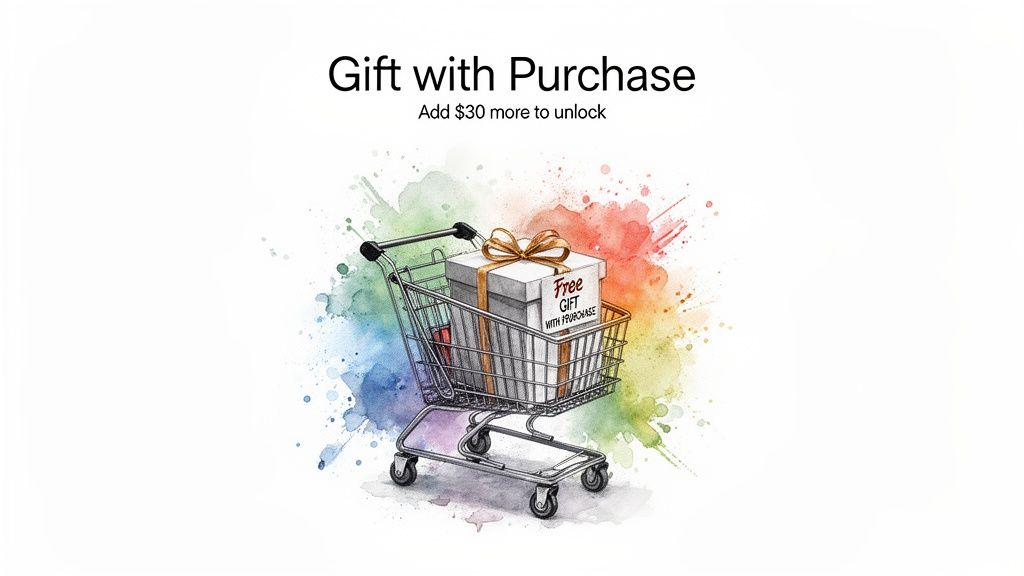
Executing GWP promotions directly within the shopping cart creates a seamless and exciting experience. As customers add items, they see a notification that they are close to unlocking a free gift, motivating them to increase their cart size to meet the goal. This approach is powerful for boosting average order value (AOV) and can be more profitable than site-wide sales, especially when the gift is a high-margin item or a trial-size product designed to encourage a future full-size purchase and increase lifetime value.
Key Insight: GWP campaigns shift the customer's focus from the cost of their order to the value they are receiving. The "free" gift often feels more valuable than an equivalent percentage discount, enhancing brand perception and delighting the customer.
How to Implement GWP Campaigns
A successful GWP strategy requires thoughtful gift selection and clear communication. Here’s how to build a compelling offer:
Choose Relevant, High-Value Gifts: The best gifts complement the primary purchase. A skincare brand might offer a free travel-size serum with a full-size moisturizer purchase. To amplify the perceived value, explicitly state the gift's retail value (e.g., "Get a free Glossing Serum, a $25 value!").
Set Strategic Thresholds: Just like tiered rewards, set your GWP threshold slightly above your current AOV. This encourages customers to add one more small item to their cart to unlock the reward, directly increasing your revenue per transaction.
Showcase the Gift Clearly: Don’t hide the offer. Use prominent banners and in-cart notifications to show customers exactly what the gift is and how close they are to earning it. Visuals are key to building excitement.
Layer Your Offers: Combine GWP with other promotions for maximum impact. For instance, you could run a tiered campaign: "Spend $100, unlock a free gift. Spend $150, unlock a second gift!" This strategy is similar to effective examples of price bundling where value is stacked.
Shopify apps like Monster Cart make it easy to automate these in-cart GWP offers. You can set spend-based rules, display the gift automatically when the threshold is met, and create a dynamic, rewarding checkout experience that drives higher AOV and builds long-term customer loyalty.
8. Scarcity & Urgency Messaging in Cart
While many ecommerce merchandising best practices focus on adding value, creating a sense of urgency is a powerful motivator for immediate action. Strategic scarcity messaging within the shopping cart leverages the psychological principle of Fear Of Missing Out (FOMO) at the most critical moment of decision. By highlighting limited availability, you give high-intent shoppers a compelling reason to complete their purchase now rather than later.
This technique is most effective when the customer is already committed. They've browsed, selected items, and are on the verge of buying. A well-placed countdown timer or low-stock alert provides the final nudge needed to overcome hesitation and cart abandonment. It shifts the customer’s mindset from "I can buy this anytime" to "I need to secure this before it's gone," directly boosting conversion rates without devaluing products with last-minute discounts.
Key Insight: Cart-level scarcity is about converting existing intent, not creating it from scratch. It works because it leverages a customer's attachment to the items they’ve already chosen.
How to Implement Scarcity & Urgency
Authenticity is crucial; manufactured urgency can damage trust. Implement these tactics genuinely to drive conversions effectively:
Be Specific and Honest: Vague terms like "low stock" are less impactful than precise numbers. Use "Only 3 left in stock!" for a tangible sense of scarcity. This must be tied to your actual inventory levels to maintain customer trust.
Combine Scarcity with Time Limits: For maximum effect, pair inventory limits with time-based urgency. For example, a cart notification could state, "Your free gift is reserved for 10 minutes!" This creates a dual incentive to check out quickly.
Highlight Reserved Items: Frame the urgency around securing the items already in their cart. Language like "Items in your cart are not reserved" or using a countdown timer for how long the cart's contents are held can be highly effective.
Tie Urgency to Rewards: Instead of just applying scarcity to products, apply it to your offers. An in-cart banner that says "Your free gift offer expires in 05:32" encourages faster checkout to lock in the added value you're providing.
Tools like Monster Cart can integrate these urgency elements directly alongside your tiered rewards. For example, you can configure a special, high-value free gift that is only available for a limited time, displaying a countdown timer directly in the cart drawer. This powerful combination of reward-driven upselling and time-based urgency is a one-two punch for maximizing both AOV and conversion rates.
9. Loyalty Program Integration & Rewards Acceleration
A powerful ecommerce merchandising best practice is to stop treating your loyalty program as a separate, post-purchase benefit. Instead, integrate it directly into the shopping cart to make rewards tangible and immediate. By showing customers their loyalty points accumulating in real-time as they shop, you transform an abstract concept into an exciting, value-driven experience that builds momentum toward checkout.
This strategy makes the value of your loyalty program impossible to ignore. Customers see exactly how their current purchase contributes to future savings or exclusive perks, creating a powerful incentive to complete their order and even increase its value. It reinforces their smart decision to join your community and directly ties their spending to concrete rewards, boosting both AOV and, most importantly, long-term customer lifetime value.
Key Insight: Making loyalty rewards visible before checkout turns a long-term benefit into an immediate gratification tool. This strengthens the connection between spending and earning, encouraging higher cart values and repeat business.
How to Implement Loyalty Program Integration
Effective integration is about making the rewards feel both accessible and exciting. Here’s how to make it a core part of your merchandising strategy:
Visualize Point Accumulation: Display the loyalty points earned for each item and the cart total directly on the product and cart pages. Use clear language like, "Add to cart and earn 150 points!" to make the benefit obvious.
Offer Rewards Acceleration: Create promotions that offer bonus points (e.g., 2x or 3x points) on specific high-margin products or for reaching certain spending thresholds. This drives sales on profitable items and gamifies the shopping experience.
Show Redemption Value Clearly: Don't just show a point balance; translate it into real-world value. For instance, display "You have 500 points ($5 off your next order!)" to make the reward tangible and enticing.
Create Member-Exclusive Offers: Use your in-cart messaging to highlight special gifts or discounts that are unlocked only for loyalty program members. This reinforces the value of membership and encourages sign-ups.
For Shopify merchants, integrating a loyalty app with a smart cart tool like Monster Cart can supercharge this strategy. You can configure in-cart notifications that celebrate loyalty milestones (e.g., "You've earned enough points for a free gift!") and use the progress bar to show how close a customer is to their next point-based reward, making your loyalty program an active driver of AOV and lifetime value in every single transaction.
10. Contextual Cart Copy & Benefit-Driven Messaging
Effective ecommerce merchandising best practices extend beyond visuals and offers; they live in the words you use. The shopping cart is a critical decision point where generic copy fails. Contextual, benefit-driven messaging reassures customers, reinforces the value of their purchase, and guides them toward completing their order, often with a higher cart value.
This strategy involves shifting your copy from features to benefits. Instead of stating what a product is, you explain what it does for the customer. This transforms transactional micro-interactions into opportunities to build trust and emotional connection. For example, a warranty offer isn't just a technical guarantee; it's "peace of mind." A free shipping reward isn't just a cost-saver; it's "fast, free delivery to your door."
Key Insight: Your cart copy should answer the customer's unspoken question: "What's in it for me?" Framing every message, from upsells to shipping info, around benefits makes the value proposition irresistible and builds lasting trust.
How to Implement Benefit-Driven Messaging
Crafting high-converting cart copy is about empathy and clarity. It requires understanding customer motivations and addressing them directly.
Lead with the Outcome: Frame every message around the end benefit. Instead of "Waterproof jacket," use "Stay dry, no matter the weather." This connects the product feature directly to the customer's desired outcome. Casper’s "Sleep on it for 100 nights, risk-free" is a classic example that sells reassurance, not just a mattress.
Create Context-Specific Messages: Your copy should adapt to the context. A message for a free gift should evoke excitement ("Your exclusive reward is waiting!"). A message for a bundle should emphasize value ("Get the complete set & save 25%").
Use “You” Language: Speak directly to the customer to make the experience personal. Phrasing like "You've unlocked free shipping!" feels more celebratory and engaging than a generic "Free shipping has been added."
A/B Test Your Copy: Don't guess what works best. Test different benefit-driven phrases to see which ones resonate most with your audience and lead to higher conversion rates and average order values.
Tools like Monster Cart allow you to customize the text that appears at each reward tier. You can A/B test messages like "You're $12 away from your free gift!" against "Add $12 to unlock our best-selling serum!" This lets you optimize your messaging to perfectly align with customer psychology, turning your cart copy into a powerful conversion driver.
10-Point Comparison of Cart Merchandising Best Practices
Strategy | 🔄 Implementation complexity | ⚡ Resource requirements | 📊 Expected outcomes | 💡 Ideal use cases | ⭐ Key advantages |
|---|---|---|---|---|---|
Tiered Rewards & Spend-to-Unlock Milestones | Medium — real-time cart UI + threshold logic | Medium — front-end work, reward inventory, marketing ops | +15–30% AOV lift; higher engagement | Brands with margin flexibility and measurable AOV data | Encourages incremental spend without blanket discounts; strong psychological momentum |
Frequently Bought Together (FBT) Recommendations | Low–Medium — rule-based easy, algo harder | Low–Medium — product data, simple algorithms or merchandiser | +10–20% AOV with low friction | Stores with complementary SKUs and sufficient purchase history | Presents relevant add‑ons at point of decision; improves perceived value |
One-Click Add-On Upsells (Protection, Services) | Low — simple toggles/checkboxes in cart | Low — copy, pricing, service setup, basic integration | 5–15% opt‑in uplift per order; good margin lift | High‑value items, warranties, shipping upgrades | High margin, minimal friction; capitalizes on purchase intent |
Free Shipping Thresholds as Cart Incentives | Low — threshold rules + progress UI | Low–Medium — shipping integration, segmentation | +10–25% AOV lift; cost‑effective vs universal free shipping | Broad consumer goods where shipping matters | Clear, easy incentive that reduces perceived shipping friction |
Buy More, Save More (BMSM) Progressive Discounting | Medium — quantity pricing rules and UI updates | Medium — pricing strategy, inventory planning, UX | 15–40% more units per transaction (category dependent) | Consumables, supplements, multi‑unit categories | Drives quantity purchases while feeling reward‑based, protects positioning |
Smart Cart Personalization & Dynamic Suggestions | High — data integration, personalization engine | High — data science, engineering, privacy/compliance | +10–20% conversion uplift; improves with data | Large catalogs, repeat customers, lifecycle marketing | Highly relevant offers; reduces friction and boosts conversion |
Gift with Purchase (GWP) Campaigns in the Cart | Medium — trigger logic + auto-add SKUs | Medium — gift inventory, fulfillment, campaign ops | Increases AOV and perceived value without cutting unit price | Beauty, fashion, launches, moving excess inventory | Feels like a reward rather than a discount; strong promotional appeal |
Scarcity & Urgency Messaging in Cart | Low–Medium — timers/inventory checks + copy | Low — copy, inventory feed; occasional engineering | Reduces abandonment 5–15% when genuine scarcity exists | Limited runs, flash sales, low-stock items | Effective final‑push to convert committed shoppers when authentic |
Loyalty Program Integration & Rewards Acceleration | Medium–High — loyalty data + UI/earn/redemption flows | Medium — loyalty platform integration, design, ops | +20–30% repeat frequency; higher AOV among members | Mature brands with active loyalty members | Makes loyalty value tangible; increases retention and AOV |
Contextual Cart Copy & Benefit‑Driven Messaging | Low — copy updates per context | Low — copywriting and A/B testing | Modest conversion/AOV lift; low cost to implement | All brands; when seeking low-effort optimization | Low-cost, brand‑safe way to reassure and motivate checkout completion |
Transform Your Cart Into a Revenue Engine
Navigating the world of ecommerce merchandising can feel like a constant battle against cart abandonment and shrinking profit margins. The strategies we've explored, however, offer a powerful alternative to the endless cycle of sitewide discounts. By implementing these ecommerce merchandising best practices, you shift the focus from a transactional checkout to an interactive, value-driven experience that builds momentum right within the shopping cart.
The central theme is clear: your cart is not just a final step; it's your most potent conversion and Average Order Value (AOV) optimization tool. Instead of interrupting the user with pop-ups, you can seamlessly integrate incentives that feel like a natural and rewarding part of their journey. From tiered spend-to-unlock rewards and strategic Gift with Purchase (GWP) offers to personalized "Frequently Bought Together" bundles and one-click add-ons, each tactic works to enhance the customer experience while simultaneously boosting your bottom line and lifetime value.
Key Takeaways for Immediate Action
To turn these concepts into tangible results, concentrate on these core principles:
Reward, Don't Discount: Prioritize value-added incentives like free gifts, exclusive products, or accelerated loyalty points over straight-up percentage discounts. This approach protects your margins and trains customers to look for value, not just the lowest price.
Make it In-Cart and Frictionless: The most effective upsells and cross-sells happen directly within the cart drawer or page. Eliminating extra clicks and page reloads is crucial for maintaining conversion momentum.
Personalize the Path to Purchase: Use dynamic recommendations and smart suggestions based on cart contents to make every offer feel relevant and helpful. Generic, one-size-fits-all promotions rarely deliver the same impact.
Communicate Value Clearly: Whether it's a progress bar for a free shipping threshold or contextual copy explaining the benefits of an add-on, clear communication is essential. Customers need to instantly understand "what's in it for me?"
Mastering these ecommerce merchandising best practices is about more than just short-term revenue gains. It’s about building a more sustainable and profitable business model. By creating a delightful and engaging cart experience, you not only increase the value of today's sale but also foster the kind of brand loyalty that leads to higher lifetime value. This strategy becomes even more effective when it's part of a larger, cohesive customer journey. For a holistic approach that seamlessly integrates all customer touchpoints and maximizes online sales, explore powerful Omnichannel Ecommerce Solutions to create a truly unified brand presence.
Ultimately, the goal is to transform your cart from a simple holding area into a dynamic revenue engine. By strategically applying these techniques, you empower customers to build their own better, higher-value orders, creating a win-win scenario that drives growth and builds lasting relationships.
Ready to implement these powerful in-cart strategies without needing a developer? Monster Cart is a Shopify app designed specifically to turn your cart into an interactive rewards layer, enabling you to run tiered gifts, one-click upsells, and progress-bar incentives seamlessly. Start transforming your cart into your best salesperson today with Monster Cart.
Join 7000+ brands using our apps