Shopify Conversion Optimization Your Guide to Higher AOV
Feb 16, 2026
|
Published
Shopify conversion optimization is really just a fancy way of saying you’re making smart, intentional tweaks to your online store to get more visitors to actually buy something. It’s all about digging into how people shop on your site, spotting the sticking points, and then making data-backed changes to your product pages, cart, and checkout to squeeze more revenue out of the traffic you already have.
First Things First: You Need to Know Your Numbers
Before you can even think about boosting sales or your average order value (AOV), you have to get a crystal-clear picture of where you stand right now. Any solid Shopify conversion optimization plan kicks off with one core metric: your conversion rate. It's simply the percentage of visitors who end up making a purchase, and it’s the bedrock of your entire growth strategy.
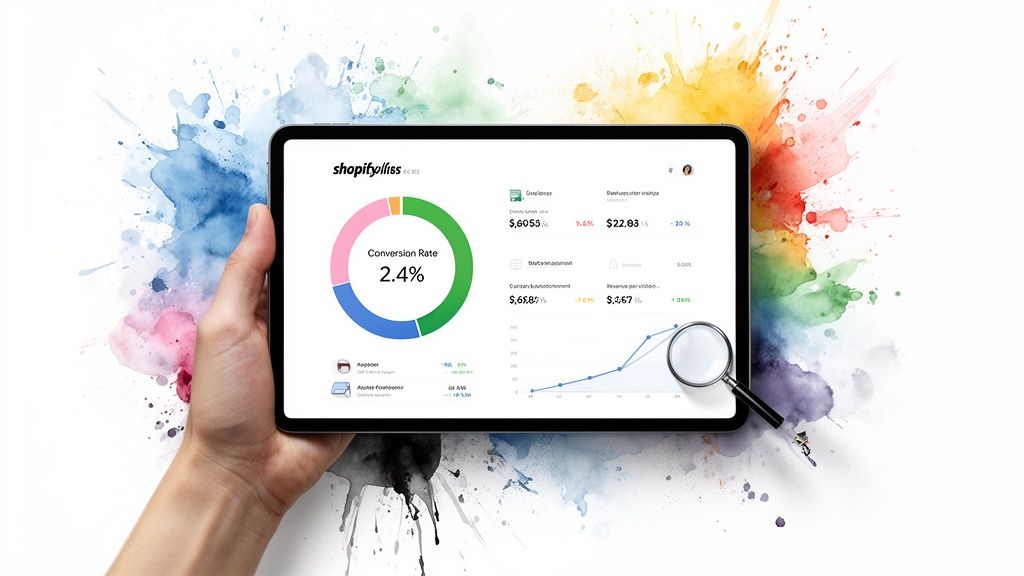
Think of it as your store's vital sign. If you don't know your baseline, you have no real way of knowing if the changes you’re making—whether it’s swapping out product photos or rolling out a new in-cart rewards program—are actually working.
Why Benchmarks Matter
Let's put this in perspective. The average Shopify store has a conversion rate of around 1.4%. That means for every 100 people who visit, maybe one or two actually complete a purchase. It's a sobering number, but it also highlights a massive opportunity.
The top-tier stores? They’re converting at 4.7% or higher. They're not just lucky; they’ve methodically optimized their sites with things like seamless in-cart upsells and loyalty rewards that keep shoppers engaged all the way to checkout.
Here’s a quick breakdown to help you see where you might fit in:
Shopify Conversion Rate Benchmarks At a Glance
Performance Tier | Average Conversion Rate | Key Differentiator |
|---|---|---|
Top 10% | 4.7% or higher | Highly optimized user experience, strong brand trust, and effective retention strategies. |
Average | 1.4% | Standard Shopify setup with some basic marketing and a decent product. |
Needs Improvement | Below 0.5% | Often indicates significant friction in the user journey or a mismatch between traffic and offer. |
This data gives you a vital reality check. If your store is converting below that 1.4% average, don't panic—it just means there are clear, proven ways to improve. If you’re already doing well, the game shifts to fine-tuning your strategy to break into that top tier. For a deeper dive into improving your site's performance, this guide on How to Improve Conversion Rate for Your Website offers some great additional insights.
Finding Your Key Metrics in Shopify
The good news is you don’t need a bunch of fancy, expensive tools to get started. Your Shopify Analytics dashboard has all the core data you need to map out your plan. Just head to your main dashboard, and you'll see your "Online store conversion rate" front and center.
Beyond that main number, a few other metrics will help you tell the full story:
Average Order Value (AOV): This tells you how much your customers are spending per order. Nudging this number up is one of the fastest ways to grow. If you're new to AOV, we've got a great guide on how to calculate Average Order Value.
Cart Abandonment Rate: This shows you how many people add products to their cart but bail before paying. A high rate here is a huge red flag that something is causing friction in your final steps.
Revenue Per Visitor (RPV): This metric ties your conversion rate and AOV together to show, on average, how much every single visitor is worth to your store.
By focusing on these core numbers, you stop guessing and start building a real, data-driven strategy. The goal isn't just about getting more one-off sales; it's about creating a smoother, more valuable shopping experience that encourages customers to spend more and keep coming back, boosting their lifetime value.
Turning Browsers Into Buyers on Key Pages
Once you've got a clear baseline from your analytics, it's time to zoom in on the pages that do all the heavy lifting: your product and landing pages. This is where a customer’s casual interest either hardens into a buying decision or just... evaporates. Let's be honest, a generic, feature-listing approach just doesn't cut it anymore.
The whole game here is to create a dead-simple, frictionless path from the moment a shopper lands on your page to that satisfying click of the "Add to Cart" button. Every single element, from your headlines to your image quality, has to work together to answer one fundamental question for the customer: "Is this product for me?"
Craft Product Descriptions That Solve Problems
Way too many store owners fall into the trap of describing what their product is instead of what it does for the customer. Think about it. Shoppers aren't just buying a face cream; they're buying confidence and clearer skin. They aren't just purchasing a coffee maker; they're investing in a better, less chaotic morning.
Your product descriptions have to lead with the benefit and then use the features as the supporting evidence.
Lead with the outcome: Start by painting a picture of the positive result the customer will get. How will their life improve?
Use bullet points: Break down the key specs, materials, and features into an easily scannable list. This is a huge sign of respect for your user's time, especially on mobile.
Weave in social proof: Pull short, punchy quotes from your best reviews that highlight a specific benefit. Something like, "Customers say it's the only moisturizer that doesn't feel greasy."
This small shift from features to benefits speaks directly to a customer's needs and emotions. It makes the decision to buy feel less like a transaction and more like finding the perfect solution. It’s a subtle but incredibly powerful change that can dramatically improve your eCommerce conversion rate.
Build Trust Instantly with Visuals and Social Proof
In ecommerce, your customers can't touch, feel, or try on your product, which makes your visuals non-negotiable. Grainy, poorly lit photos scream "amateur" and create immediate distrust. Your images and videos have to do the work of a physical product demonstration.
You need a solid mix of studio shots on a clean background, lifestyle photos showing the product in the wild, and short videos. Video, in particular, has become a massive driver of conversions because it can show off details, scale, and function in a way that static images just can't. A video of a backpack, for example, can show exactly how much it fits inside—something that's almost impossible to convey with pictures alone.
Beyond your own media, authentic customer reviews are your single most powerful weapon against purchase anxiety.
Key Takeaway: A staggering 93% of consumers say that online reviews influenced their purchase decisions. Displaying genuine reviews, especially those with photos and videos, gives shoppers the outside validation they need to trust your product and your brand.
Make Your Call-to-Action Impossible to Ignore
Your "Add to Cart" button needs to stand out, but its effectiveness goes way beyond just being a bright color. The language you use and the elements you place around it play a huge role. Instead of a generic "Add to Cart," you could try a more action-oriented phrase that aligns with your product.
Just as important are the trust-builders you surround it with. These are often called "trust badges" or "confidence boosters," and they work wonders. These are the small icons and bits of text that can include:
Free shipping thresholds ("Free shipping on orders over $50")
Easy return policies ("30-day free returns")
Secure payment icons (Visa, Mastercard, PayPal)
These little elements work on a subconscious level, reassuring the shopper that their purchase is safe and risk-free. They systematically remove those final mental hurdles standing between them and the cart, guiding them from simple curiosity to confident commitment.
Turn Your Cart Into a Revenue-Driving Machine
Let's be honest, the standard Shopify cart is a missed opportunity. It's often just a boring, static page that shoppers glance at before hitting checkout. But what if it could be your single best tool for boosting average order value (AOV) and creating a brand experience they won't forget?
The secret is to stop thinking of the cart as a simple holding area and start treating it like an interactive, rewarding part of the customer journey. Instead of falling back on margin-killing, site-wide discounts that train customers to wait for a sale, you can build real excitement right inside the cart. The entire strategy is built around rewarding customers for spending more—a move that lifts AOV and builds genuine loyalty, increasing lifetime value.
Beyond the Basic Cart Page
First things first: ditch the traditional cart page. That extra click to a separate "View Cart" page is clunky, outdated, and adds friction to the buying process. A modern, sleek slide-out cart (often called a cart drawer) is a much smoother experience. It keeps shoppers in the flow, letting them add items and see their rewards update in real-time without ever leaving the product page they're on.
This isn't just about looking good; it's about making the shopping experience feel responsive and engaging. The less time a customer has to second-guess their purchase, the better.
By turning the cart into an interactive rewards engine, you're creating a positive feedback loop. Customers feel smart for unlocking value, which makes them more likely to complete their purchase and come back for more. This is exactly what tools like Monster Cart are designed to do.
Gamify the Shopping Experience with Progress Bars and Tiers
One of the most powerful ways to nudge customers to add more to their cart is through gamification. A visual progress bar showing shoppers how close they are to unlocking a reward is incredibly motivating. It taps into that basic human desire for completion and achievement.
Here’s how you can structure these rewards to get the biggest lift in both AOV and customer lifetime value:
Free Shipping Thresholds: It’s a classic for a reason. A simple bar showing, "You're just $12 away from free shipping!" is a proven winner.
Tiered Free Gifts (GWP): Offer better gifts as the cart value grows. Think, "Spend $75, get a free sample," and then, "Spend $125, get a full-size product."
"Buy More, Save More" Tiers: Instead of a flat discount, create tiers like "Buy 2, get 10% off" or "Buy 3, get 20% off." This encourages higher volume without devaluing your products.
This approach bridges the gap between capturing a shopper's interest and actually closing the sale. The cart becomes the pivotal final step where value is added, not just summarized.
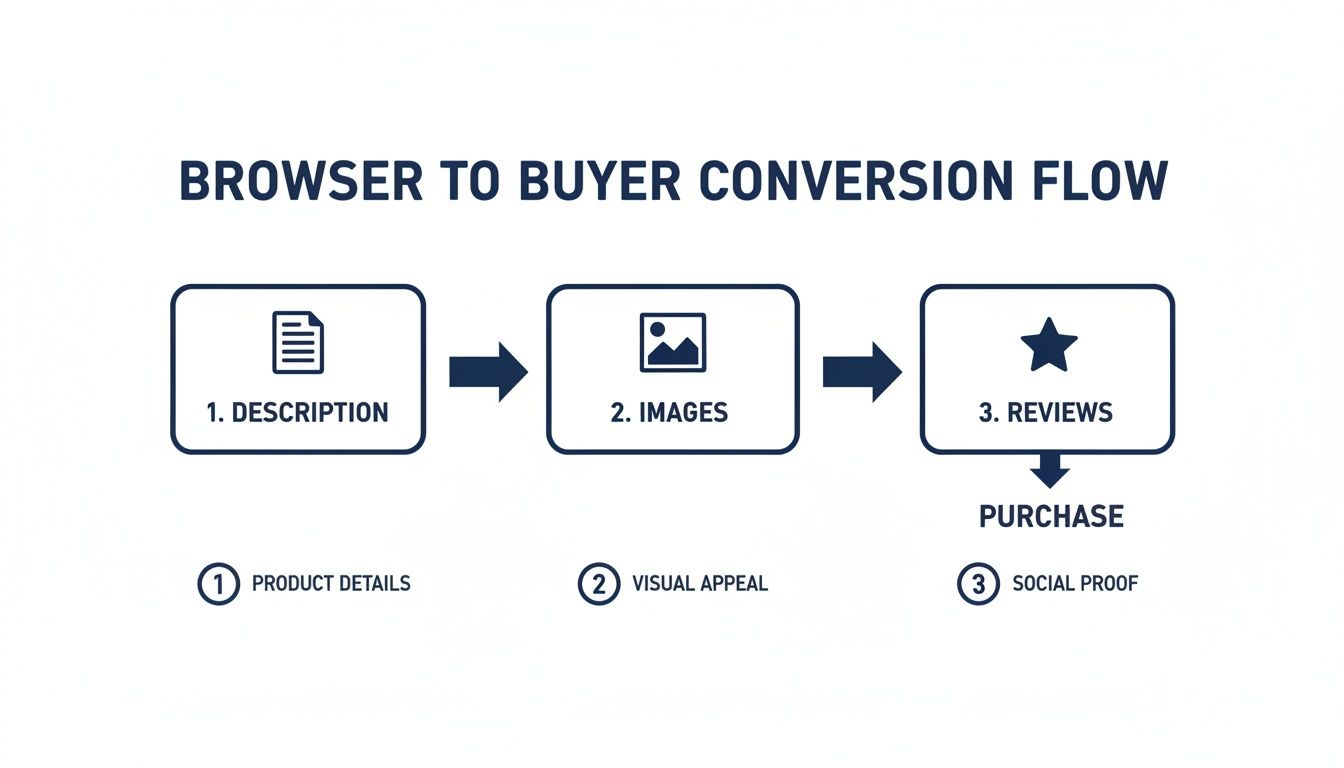
As the flow shows, once you've nailed your product descriptions and images, the final step before purchase is all about building trust and adding value. A well-optimized cart does exactly that.
A Powerful Strategy for Any Industry
This cart-centric approach works so well because it can be adapted to any niche. In the hyper-competitive Shopify ecosystem, conversion rates vary wildly. Beauty and skincare stores, for example, often hover between 2.8-3.6%, while apparel can be lower at 1.2-2.2%. A rewards-based cart can give merchants in any of these sectors a critical edge to outperform their benchmarks. You can learn more about how industry conversion rates for Shopify stores highlight these opportunities.
This is exactly where a purpose-built app can completely change the game. A tool like Monster Cart is designed to replace Shopify's default cart with a fully customizable, rewards-driven slide-out version. It lets you build out these tiered offers, progress bars, and in-cart upsells without touching a single line of code.
Here's a quick comparison of the old way versus the new way:
Traditional Cart vs Optimized Slide-Out Cart
Feature | Traditional Shopify Cart | Optimized Slide-Out Cart |
|---|---|---|
User Experience | Requires leaving the page; adds friction. | Stays on page; seamless and modern. |
Rewards System | None. Just a static summary of items. | Dynamic progress bars for tiered rewards (free shipping, free gifts, discounts). |
AOV Growth | Relies on user to manually add more items. | Actively encourages higher spend with gamification. |
Upsells | Usually non-existent or requires another app. | Integrated one-click upsells & cross-sells. |
Sense of Urgency | None. | Can include countdown timers for offers. |
Overall Impact | Passive. A simple checkout prerequisite. | Active. A powerful revenue-driving tool. |
An optimized slide-out cart transforms a passive final step into an active, engaging experience that directly contributes to your bottom line.
Ultimately, making your cart a revenue driver is about shifting your focus from short-term sales to long-term customer lifetime value. When you reward customers with something tangible like a free gift or complimentary shipping instead of just another hefty discount, you build a much stronger relationship. They feel appreciated, not like they just snagged a temporary sale. That positive experience is what turns a one-time buyer into a loyal advocate for your brand.
Adding Smart Upsells Without Annoying Shoppers
Everyone wants to pump up their average order value (AOV), but the old-school way of doing it—blasting customers with aggressive, full-screen pop-ups—is a well-known conversion killer. Let's be honest, they interrupt the shopping flow, create frustration, and can make your brand feel cheap.
There’s a much smarter way to approach Shopify conversion optimization. It involves weaving helpful, relevant offers directly into the natural path to purchase. The whole goal is to make these suggestions feel like an expert recommendation, not a pushy sales pitch. When you respect the customer's experience like this, you build the kind of trust that leads to real loyalty and a much higher lifetime value.
Move Beyond Pop-Ups to In-Cart Offers
So, where's the best place for these smart upsells? Right inside the cart drawer.
When a shopper sees a relevant add-on just before they're ready to check out, the decision feels easy and intuitive. Instead of stopping them in their tracks on a product page, you’re presenting a valuable option at the exact moment they're reviewing their order. It completely shifts the dynamic from an interruption to an enhancement.
The key is to focus on offers that add true value to the core purchase. Think less about "selling more stuff" and more about "making this order even better for the customer." This mindset shift is what separates an annoying upsell from a welcome suggestion.
Offer Value-Driven, One-Click Add-Ons
The most effective in-cart offers are low-cost, high-value additions that solve a problem or just make the experience better. They need to be simple enough that a customer can add them with a single click, no heavy thinking required.
Here are a few proven ideas that boost AOV without resorting to steep discounts:
Shipping Protection: For a small fee, you can offer insurance against lost, stolen, or damaged packages. It gives customers peace of mind and is an easy, high-margin win for you.
Gift Wrapping: During the holidays or other key gifting seasons, a one-click gift wrap option is a super convenient add-on that many shoppers will happily pay for.
Priority Processing: Let customers pay a little extra to have their order jump to the front of the fulfillment line. This is a lifesaver for last-minute shoppers.
These types of offers work so well because they are services, not just more products. They complement the purchase and show you’re thinking about the customer’s entire experience, all the way from ordering to unboxing.
Make Cross-Sells Feel Like Expert Advice
Another powerful technique is to display "Frequently Bought Together" suggestions directly in the cart. When you frame this correctly, it doesn't feel like a sales tactic. It feels like a helpful tip from you—the person who knows the products best.
For example, if a customer adds a leather handbag to their cart, a logical and genuinely helpful cross-sell would be a leather conditioning cream. If they buy a complex piece of electronics, offering the specific batteries it needs is a no-brainer. This kind of thoughtful suggestion builds your credibility and a customer's trust in your brand. If you want to dive deeper into this, our article on the differences between cross-selling and upselling is a great resource.
The secret is relevance. The suggestions have to make immediate, intuitive sense with what’s already in the cart. When you nail this, you’re not just increasing the order value; you're preventing potential frustration down the road and helping the customer get the most out of their purchase.
This entire strategy hinges on integrating these offers seamlessly. An app like Monster Cart makes this incredibly simple, letting you build these one-click upsells and "Frequently Bought Together" sections directly into a slide-out cart. It removes all the friction, presenting these helpful add-ons in a clean, non-intrusive way that feels native to your store's design. By embedding these opportunities right inside the cart, you elevate the experience, boost your AOV, and encourage the kind of repeat business that truly grows a brand.
Using Marketing Channels to Drive Ready-to-Buy Traffic
Nailing your on-site experience is a massive piece of the Shopify conversion puzzle, but it’s only half the story. A brilliant, rewarding cart experience won't make you a dime on its own if nobody sees it. You have to consistently bring high-intent shoppers back to your store, and that’s where your marketing channels—especially email and SMS—become absolutely critical.
The real goal is to stop thinking about these as separate things. The amazing, value-driven rewards you set up in your cart shouldn't just be a pleasant surprise for new visitors. They need to be a core part of your messaging that brings people back in the door. This simple shift turns your marketing from a basic sales tool into a powerful relationship-building engine.
Rethink Your Abandoned Cart Sequences
Let's be honest, the default abandoned cart email is tired. "Did you forget something? Here's 10% off." We've all seen it a thousand times. While it can sometimes work, it also trains customers to abandon their carts just to get a discount, which slowly chips away at your margins.
There’s a much more powerful way to do this. Instead of leading with a discount, remind them of the value they're leaving behind, not just the products.
Imagine your email or SMS lands in their inbox with a message like: "You were so close to unlocking a free gift!" or "Don't miss out on free shipping for your order." This subtle reframing accomplishes two crucial things:
It reinforces the value you offer that goes beyond the product itself.
It encourages customers to complete their purchase to gain a reward, not just save a few bucks.
This approach protects your AOV and builds a brand perception centered on generosity and rewards, not constant sales. It's about playing the long game—focusing on a customer's lifetime value, not just a one-time conversion. A smart cart tool like Monster Cart can even capture emails earlier in the process, letting you personalize these reminders based on the exact rewards they were about to unlock.
Segment and Personalize Your Campaigns
Your marketing efforts become exponentially more effective when you stop talking to everyone the same way. Segmentation is where the real money is made. You need to divide your audience into meaningful groups so you can send them hyper-relevant messages that actually resonate.
Start with these powerful segments:
First-Time vs. Repeat Customers: Greet new shoppers with a welcome series that introduces your brand story. For your loyal fans, reward them with exclusive early access or special gifts that make them feel like VIPs.
High-AOV Shoppers: You know who your big spenders are. Target them with offers for premium gifts or higher-tier rewards that match their spending habits.
Specific Product Interest: If someone abandoned a cart with a particular type of product, follow up with content about that item's unique benefits or show them complementary products they might love.
By tailoring your messaging, you show customers you understand them on a deeper level. This kind of personalization builds the brand loyalty that drives repeat business and sustainable, long-term growth.
When you connect your on-site experience with your off-site marketing, you create a seamless loop that just works. For example, email marketing is an absolute powerhouse for Shopify stores. In fact, it boasts the highest conversion rate at 4.29%, crushing the platform's average. This proves just how critical that post-visit nurturing really is.
Of course, getting that traffic in the first place is key. To effectively drive ready-to-buy visitors to your store, leveraging proven strategies like optimizing your paid ad campaigns through effective PPC management for small businesses can dramatically boost your reach to high-intent audiences. When those visitors land on a site that's fully optimized with in-cart rewards, your marketing ROI doesn't just grow—it skyrockets.
Measure, Test, and Refine Your Strategy
Okay, so you’ve rolled out some high-impact changes to your product pages and cart. You didn't just set it and forget it, right? Optimizing your Shopify store isn’t a one-and-done project; it’s a constant cycle of improvement. The real work starts now, and it boils down to a simple but powerful framework: test your ideas, measure what actually works, and pour those learnings into your next move.
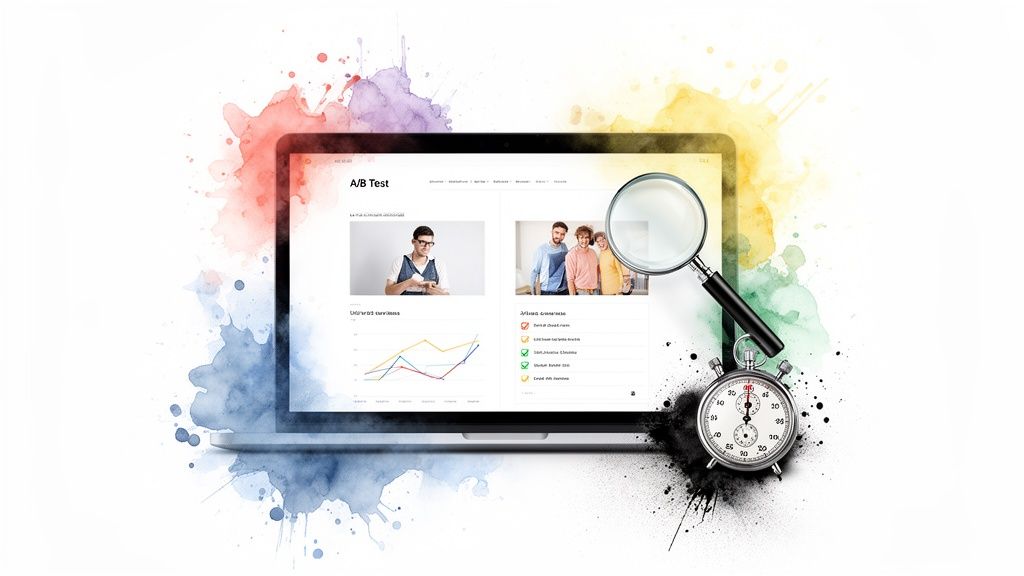
The core of this process is A/B testing, sometimes called split testing. It’s pretty straightforward: you show two different versions of a page or an element to your audience to see which one performs better. The trick—and this is non-negotiable—is to change only one thing at a time. That's how you know for sure what caused the lift.
Prioritizing Your Tests for Maximum Impact
You could test nearly anything on your site, but your time is too valuable for that. You have to focus on the changes with the highest potential to move the needle on your most important metrics, like conversion rate and Average Order Value (AOV).
A fantastic place to start is with your in-cart offers, since they have a direct line to your AOV. Instead of just guessing which reward will click with your customers, put it to the test.
Test A: Offer a free sample as a gift with a $75 purchase.
Test B: Offer free shipping with a $75 purchase.
By running these two variations at the same time, you collect real data on what truly motivates your shoppers. Does the instant gratification of a free product beat out the practical savings of free shipping? Let the data, not your gut, guide the strategy.
This approach is so much more sustainable than just defaulting to big discounts that eat away at your margins and brand value. You're not just cutting prices; you're finding the perfect value-add that boosts AOV and encourages loyalty, ultimately increasing customer lifetime value.
Focus your testing energy where it matters most. Small tweaks to your in-cart rewards and upsells often yield bigger returns than major design overhauls because they directly impact the transaction at its most critical point.
Making Data-Driven Decisions
Your Shopify Analytics dashboard is your source of truth. For every test you run, keep a close eye on your core metrics—conversion rate, AOV, and revenue per visitor—for each variation. When you find a clear winner, roll it out across your store and immediately start thinking about your next hypothesis.
This creates an incredibly powerful feedback loop. You test an idea, measure its impact, learn from it, and refine your approach. For example, let's say you find that free shipping is the undeniable winner. Great. Your next test could be to see if bumping the threshold from $75 to $90 pushes AOV even higher without tanking your conversion rate.
By consistently testing and refining, you build a store that evolves with your customers. The insights you gain don't just lead to short-term wins; they compound over time, building a more profitable and resilient business. A well-designed cart app like Monster Cart makes setting up and tracking these in-cart tests incredibly simple, freeing you up to focus on strategy instead of getting lost in the code.
Got Questions? I've Got Answers
Diving into Shopify conversion optimization always brings up a few key questions. Here are some of the most common ones I hear from merchants, along with straightforward, no-fluff answers.
How Much Can I Realistically Increase My Shopify Conversion Rate?
It's the million-dollar question, isn't it? While the average Shopify store sits around a 1.4% conversion rate, the top players are consistently hitting 4.7% or even higher.
With a focused effort, especially on optimizing the cart and checkout, it's very realistic for most stores to see an initial lift of 15-30% in the first couple of months. Your potential really depends on where you're starting from and what you sell. The goal isn't one giant leap; it's about making steady, smart improvements that make shopping easier and more rewarding.
Do I Need to Offer Discounts to Improve Conversions?
Absolutely not. In fact, constantly running hefty sales can seriously devalue your brand over time and train your customers to only buy when there's a coupon. A much healthier, more sustainable approach is to focus on value-based rewards.
Instead of slashing prices, think about adding value:
Offer a free gift with purchase when a customer hits a specific cart total.
Unlock free shipping to remove one of the biggest reasons people hesitate to buy.
Create "Buy More, Save More" tiers that feel like a smart purchase, not a cheap one.
These strategies make customers feel like they're getting a special perk, not just a discount. You're not just cutting your price; you're adding tangible value, which is the secret to building real loyalty and increasing customer lifetime value.
What Is the Single Most Important Area to Focus On?
While things like product pages and site speed are definitely important, the highest-impact area for Shopify conversion optimization is almost always the shopping cart itself. It's the last stop before a customer commits, and it's where a staggering 70% of potential sales are lost.
Think about it. This is your final chance to make a great impression.
By turning your cart from a boring summary page into a dynamic, rewarding experience with a slide-out cart, you can slash abandonment rates and seriously lift your AOV. Adding things like progress bars for rewards like free shipping or a free gift, or even seamless one-click upsells, transforms this critical moment into your most powerful tool. This is exactly what a solution like Monster Cart is built for.
Ready to turn your cart into a revenue engine? Monster Cart makes it dead simple to add gamified rewards, one-click upsells, and a branded slide-out cart to your Shopify store—no coding needed. See how thousands of brands are boosting AOV and delighting customers at https://monsterapps.shop.
Join 7000+ brands using our apps