Your Shopify Profit Margin Calculator and AOV Growth Guide
Feb 20, 2026
|
Published
Running a Shopify store can feel like you're juggling a dozen numbers at once. Your dashboard might show revenue climbing, but the real question is always lurking in the background: how much of that is actual, take-home profit?
Too many merchants get tripped up here. They diligently track sales but overlook the small, seemingly insignificant costs that quietly bleed their margins dry, day after day. A simple ‘revenue minus cost of goods’ formula just doesn’t cut it.
Why Generic Profit Calculators Fail Your Shopify Store
A basic calculator gives you a dangerously incomplete picture of your financial health. True profitability only comes into focus when you account for every single expense that keeps the lights on. It's the difference between a high-revenue store and a highly profitable one.

Simply subtracting your Cost of Goods Sold (COGS) is a great start, but it’s nowhere near the end of the story.
The Hidden Costs Generic Tools Miss
The real net profit is buried under a pile of necessary, often-forgotten expenses. These are the costs that separate the pros from the amateurs.
A proper Shopify profit margin calculator has to factor in variables like:
Payment Processing Fees: Whether it’s Shopify Payments, PayPal, or another gateway, every transaction has a fee.
App Subscriptions: Those monthly charges for your marketing, review, and logistics apps add up faster than you think.
Shipping & Packaging Supplies: It's not just the postage. It’s the boxes, mailers, tape, and filler material, too.
Returns & Refunds: Every return carries a cost, from return shipping labels to potentially unsellable inventory.
Understanding these nuances is the first step toward building a resilient, profitable business. The goal is to shift your focus from chasing top-line revenue to maximizing your bottom-line profit, which is the only metric that truly matters for sustainable growth.
This kind of financial clarity allows you to make smarter strategic moves—like boosting your Average Order Value (AOV) without resorting to margin-killing discounts. When you know your numbers inside and out, you can confidently offer value-added rewards like free gifts or tiered shipping thresholds. These incentives encourage customers to spend more, building loyalty and increasing their lifetime value, rather than just chasing a one-time sale. A tool like Monster Cart, for example, is built for this. It turns your cart into a rewards engine that drives AOV organically. You can even explore some of the best Shopify apps to increase sales to see how they fit into a profitable growth strategy.
Uncovering Every Cost for an Accurate Profit Calculation
If you want to get a real handle on your store's health, you have to look past the top-line revenue and hunt down every single expense. A Shopify profit margin calculator is only as smart as the numbers you give it, and I've seen countless merchants accidentally leave huge costs out of the equation. This creates a false sense of security, masking the little leaks that slowly drain profitability.
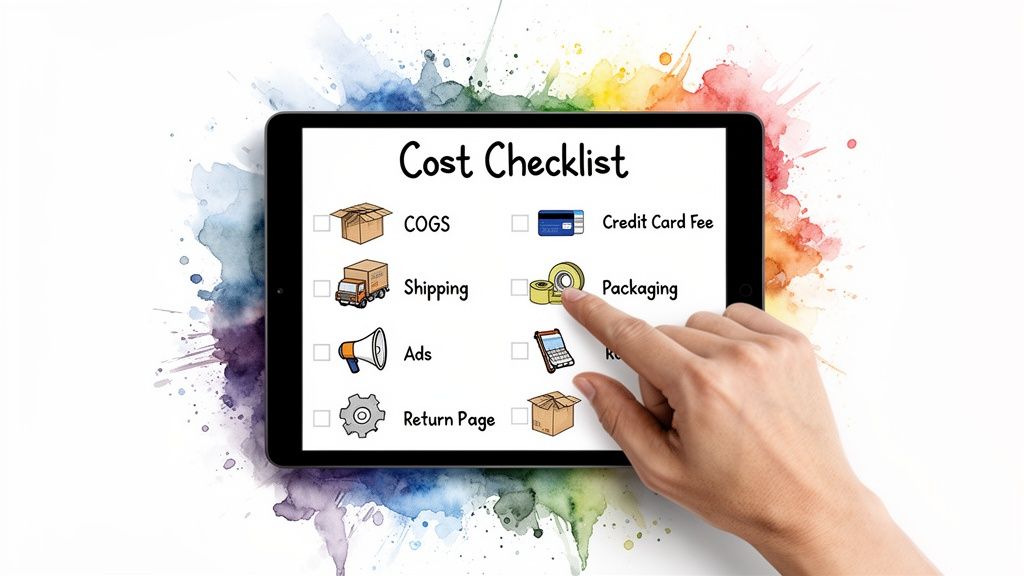
Think of it this way: if your financial foundation is missing a few bricks, the whole structure gets wobbly. Leaving out costs—no matter how small they seem—gives you a warped view of your actual net profit and can lead to some really bad decisions down the road.
The Obvious (And Not-So-Obvious) Shopify Expenses
Let's break down the most common—and most commonly missed—expenses. Each one of these chips away at your revenue, and only by accounting for all of them can you see what’s really left in your pocket.
Cost of Goods Sold (COGS): This is the big one. It’s the direct cost you pay your supplier for the product itself, plus any manufacturing or raw material expenses. Simple, but critical.
Transaction & Platform Fees: These are just the cost of doing business online. You can't avoid them. This bucket includes your Shopify subscription plan and the payment gateway fees (usually 2-3% of every transaction) from services like Shopify Payments or PayPal.
Shipping & Fulfillment: This category is a silent killer of margins and is almost always bigger than you think. You need to account for the carrier costs (what you pay USPS, FedEx, etc.), the price of packaging materials (boxes, mailers, tape, inserts), and any fulfillment labor, whether that's your own staff or a 3PL service.
Marketing & Ad Spend: This one seems obvious, but it's easy to lose track. Every single dollar you put into Google Ads, Meta campaigns, or influencer collaborations needs to be tallied up.
App Subscriptions: Those small monthly fees for every app on your store add up—fast. Don't let them slip through the cracks.
Returns & Refunds: This is a huge one people miss. You need to factor in the cost of return shipping labels, the labor involved in restocking, and the potential loss on any damaged or unsellable returned inventory.
To help you get a complete picture, I've put together a checklist of all the expenses you should be tracking.
Your Complete Shopify Expense Checklist
This table breaks down all the potential costs you need to monitor. Use it to audit your own expenses and make sure nothing is being overlooked.
Expense Category | Description | Example |
|---|---|---|
Product Costs | Direct expenses tied to the products you sell. | Supplier invoices, manufacturing costs, raw materials. |
Platform Fees | The costs for using Shopify and payment processors. | Monthly Shopify plan, Shopify Payments fees, PayPal fees. |
Shipping & Fulfillment | All costs related to getting the product to the customer. | Postage, boxes, packing tape, bubble wrap, 3PL fees. |
Marketing & Advertising | Money spent to acquire customers. | Google Ads, Facebook/Instagram ads, influencer payments. |
Software & Apps | Monthly or annual subscriptions for your tech stack. | Email marketing platform, loyalty app, cart upsell tool. |
Returns & Refunds | The total cost associated with handling customer returns. | Return shipping labels, restocking labor, unsellable inventory. |
Discounts | The value of all coupon codes and automatic discounts applied. | "SAVE15" coupon code, BOGO offers, automatic cart discounts. |
Overhead | Fixed business operating costs. | Office rent, utilities, internet service, employee salaries. |
Professional Services | Fees for freelancers, agencies, or consultants. | Accountant fees, agency retainers, photographer invoices. |
Getting this granular might feel tedious, but this is the work that separates thriving businesses from those that are just getting by. It shows you exactly where your money is going.
This level of detail is non-negotiable. It provides the clarity you need to make smart, strategic adjustments that protect and grow your bottom line. It’s the only way to build a financial foundation strong enough to support real growth.
If you're feeling overwhelmed, it can be incredibly valuable to work with specialized e-commerce business accountants who live and breathe this stuff.
Once you have this complete financial picture, you can start making smarter decisions—like using in-cart rewards to boost customer lifetime value instead of just offering another profit-slashing discount.
The Simple Formulas That Reveal Your True Profitability
Once you’ve gathered all your cost data, it’s time to turn those raw numbers into something you can actually use. A Shopify profit margin calculator isn't just for plugging in values; it's about understanding the simple but powerful formulas that show you the real health of your business. These calculations pull back the curtain on your financial performance, showing you exactly where your money is coming from and where it’s going.
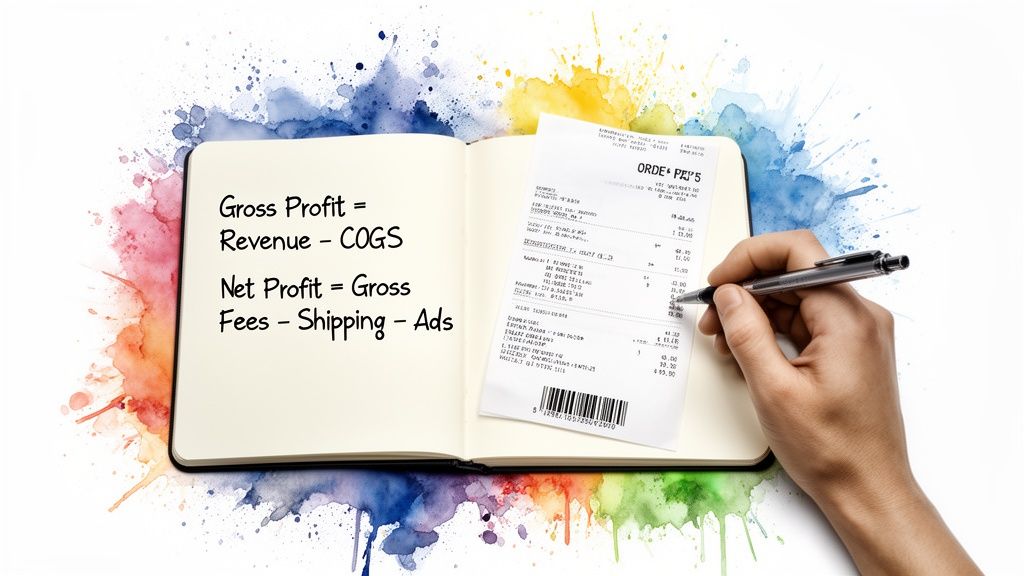
Let's break down the essential formulas you'll be using to measure profitability at every level of your Shopify store.
Gross Profit and Gross Margin
Your gross profit is what’s left over after you subtract the direct cost of the products you sold. Think of it as the first, most fundamental layer of profitability.
The formula is dead simple: Gross Profit = Total Revenue - Cost of Goods Sold (COGS)
From there, you can figure out your Gross Profit Margin, which turns that dollar amount into a percentage. This makes it way easier to track your performance over time.
Gross Profit Margin = (Gross Profit / Total Revenue) x 100
For example, if you brought in $10,000 in revenue with a COGS of $4,000, your gross profit is a solid $6,000. That gives you a gross margin of 60%, which means for every dollar you make in sales, you have 60 cents left to cover everything else.
Net Profit and Net Profit Margin
This is the number that really matters—the true bottom line. Net profit is what’s left after you subtract all your business expenses, not just the cost of your products. This includes your ad spend, app fees, shipping, salaries, and everything else we outlined earlier.
Here are the formulas you need:
Net Profit = Gross Profit - All Operating Expenses
Net Profit Margin = (Net Profit / Total Revenue) x 100
Let’s stick with our example. If that same store with $6,000 in gross profit also had $3,500 in operating expenses, its net profit would be $2,500. That lands you at a Net Profit Margin of 25%, which paints a much more realistic picture of the business's actual health.
This distinction is critical. A high gross margin can easily be wiped out by bloated operating costs. Knowing your net margin is what empowers you to build a sustainable, long-term business.
These metrics give you a powerful high-level view, but the real magic happens when you dive deeper into per-order profitability. To truly get a grip on your store's financial health, it’s a good idea to explore other metrics, like the retention value formula, which helps you see the long-term worth of keeping your customers around.
Focusing on Customer Lifetime Value (LTV) forces you to think beyond just the first sale. Instead of throwing around hefty discounts that kill your margins, you can use smarter incentives like free gifts or free shipping thresholds. This approach not only boosts your Average Order Value (AOV) but also builds real loyalty without sacrificing your hard-earned profit—which is exactly how tools like Monster Cart help merchants grow sustainably.
How to Increase Your Profit Margin (Without Slashing Prices)
Once you’ve got a solid handle on your numbers with a good Shopify profit margin calculator, the real fun begins. Knowing your profit margin is one thing; actively growing it is how you build a business that lasts.
The most common gut reaction for store owners is to drive sales with discounts. But this almost always starts a race to the bottom that absolutely demolishes your margins.
A sitewide 20% off coupon might give you a nice little revenue spike, but it also carves a 20% chunk directly out of your gross profit on every single order. Worse, it trains customers to wait for sales and slowly devalues your brand. It’s a short-term sugar rush that often leads to a long-term financial hangover.
Instead of slashing prices, the smartest brands are now pivoting to adding value. The goal is to encourage customers to spend more per order—not because things are cheap, but because they’re unlocking a better experience or a more valuable reward. This focus on lifetime value is what separates good stores from great ones.
Shifting From Discounts To Value-Added Incentives
The core idea is simple: make it exciting for customers to add more to their cart. This strategy not only protects your profitability but also builds a much stronger, more engaging relationship with your audience.
Here are a few proven, margin-friendly strategies that just plain work:
Free Shipping Thresholds: This is the classic AOV booster for a reason. Clearly telling a shopper, "You're only $15 away from free shipping!" is an incredibly powerful motivator that sends them looking for one more item.
Tiered Free Gifts: This turns shopping into a mini-game. You can offer progressively better rewards as the cart value goes up. Think: "Spend $75, get a free tote bag" or "Spend $125, get a premium skincare sample." The cost of that gift is almost always far less than the profit you’d lose from a steep discount.
'Buy More, Save More' Offers: Instead of a flat discount, create progressive rewards that incentivize bigger carts. A "Buy 2, Get 10% Off; Buy 3, Get 15% Off" structure naturally encourages customers to bundle up, increasing both your AOV and the total profit from that order.
The key is to transform the checkout process from a simple transaction into a rewarding, interactive experience. When customers feel like they are earning value rather than just getting a discount, they are more likely to spend more and come back again.
Here's a quick look at how these two approaches impact your bottom line. Notice how the free gift offer not only protects your margin but actually encourages a higher spend.
Discounting vs Value-Add Rewards Impact on Profit Margin
Metric | Scenario 1: 20% Off Discount | Scenario 2: Free Gift at $75 Threshold |
|---|---|---|
Initial Cart Value | $60.00 | $60.00 |
AOV-Boosting Offer | 20% off coupon code applied | "Spend $75 to get a free gift!" |
Customer Action | Applies discount, pays less | Adds a $20 item to reach the threshold |
Final AOV | $48.00 (20% off $60) | $80.00 ($60 + $20 item) |
Cost of Goods Sold (40% Margin) | $24.00 (COGS for $60 item) | $32.00 (COGS for $80 items) |
Cost of Incentive | $12.00 (The discount itself) | $4.00 (Cost of the free gift) |
Total Costs | $36.00 ($24 COGS + $12 discount) | $36.00 ($32 COGS + $4 gift) |
Gross Profit | $12.00 | $44.00 |
Gross Profit Margin | 25% | 55% |
The numbers don't lie. While the discount hurts profitability, the value-add reward dramatically increases both the order value and the final profit margin.
The Power Of An In-Cart Rewards Engine
This is where a tool like Monster Cart becomes your engine for growth. Instead of just showing a static list of products, it turns your cart into a dynamic rewards system. A visual progress bar shows customers exactly how close they are to unlocking their next reward—whether it’s a free gift or free shipping—creating a compelling, almost irresistible reason to add just one more thing.
This in-cart experience is crucial. It grabs the customer's attention at the moment of highest purchase intent, making your offers feel like a natural part of their shopping journey, not some disruptive pop-up. You can easily learn more about how to calculate Average Order Value and see for yourself why these small, incremental increases have such a massive impact on your store's health.
Ultimately, your goal is a healthy bottom line. After using a Shopify profit margin calculator to subtract payment fees (usually 2-3%), app costs, and returns, you can layer in smart rewards with Monster Cart. Think one-click add-ons or product protection warranties that boost AOV without adding any friction.
Brands using these kinds of value-add tactics consistently report sustained net margins above 20%. It’s proof that focusing on AOV and lifetime value is a far more resilient and profitable strategy than just discounting your way to the bottom.
See How Different Strategies Impact Your Margins
Theory is great, but let's get our hands dirty and see how the numbers actually play out. We're going to model a few common scenarios using a simple framework, just like you would with a Shopify profit margin calculator.
For these examples, imagine we're running a store with a $65 average order value and a 40% COGS. This baseline will help us see exactly why focusing on adding value is a much smarter play than just slashing prices.
The Classic Move: A Sitewide 15% Off Sale
This is the go-to for many stores. A customer has a $65 cart, they slap on a 15% off coupon, and their total drops to $55.25.
You secured the sale, sure. But at what cost?
AOV: $55.25
Revenue: $55.25
COGS (40% of the original $65): $26.00
Lost Profit (The Discount): $9.75
Gross Profit: $19.50
That discount just vaporized nearly $10 of your profit on a single order. While it might juice your sales volume in the short term, you're now on a treadmill, forced to sell way more just to hit the same profit goals. This tactic also erodes brand value and discourages repeat purchases at full price, damaging customer lifetime value.
A Smarter Play: The 'Free Shipping at $100' Threshold
Okay, let's try something different. Instead of a discount, we offer a value-add. The same customer with a $65 cart sees a little nudge: "You're only $35 away from free shipping!"
This simple prompt is often all it takes. They decide to add another item—let's say a $40 product—to their cart to unlock the reward.
The new total is $105, and we'll assume the shipping cost we absorb is $10.
AOV: $105.00
Revenue: $105.00
COGS (40% of $105): $42.00
Shipping Cost: $10.00
Gross Profit: $53.00
Night and day, right? By encouraging a larger cart, you've dramatically lifted both AOV and gross profit, even after eating the shipping cost. You protected your margins and gave the customer a better deal, fostering goodwill that leads to higher lifetime value.
This visual tells the whole story. One strategy subtracts from your profit, the other adds to it.
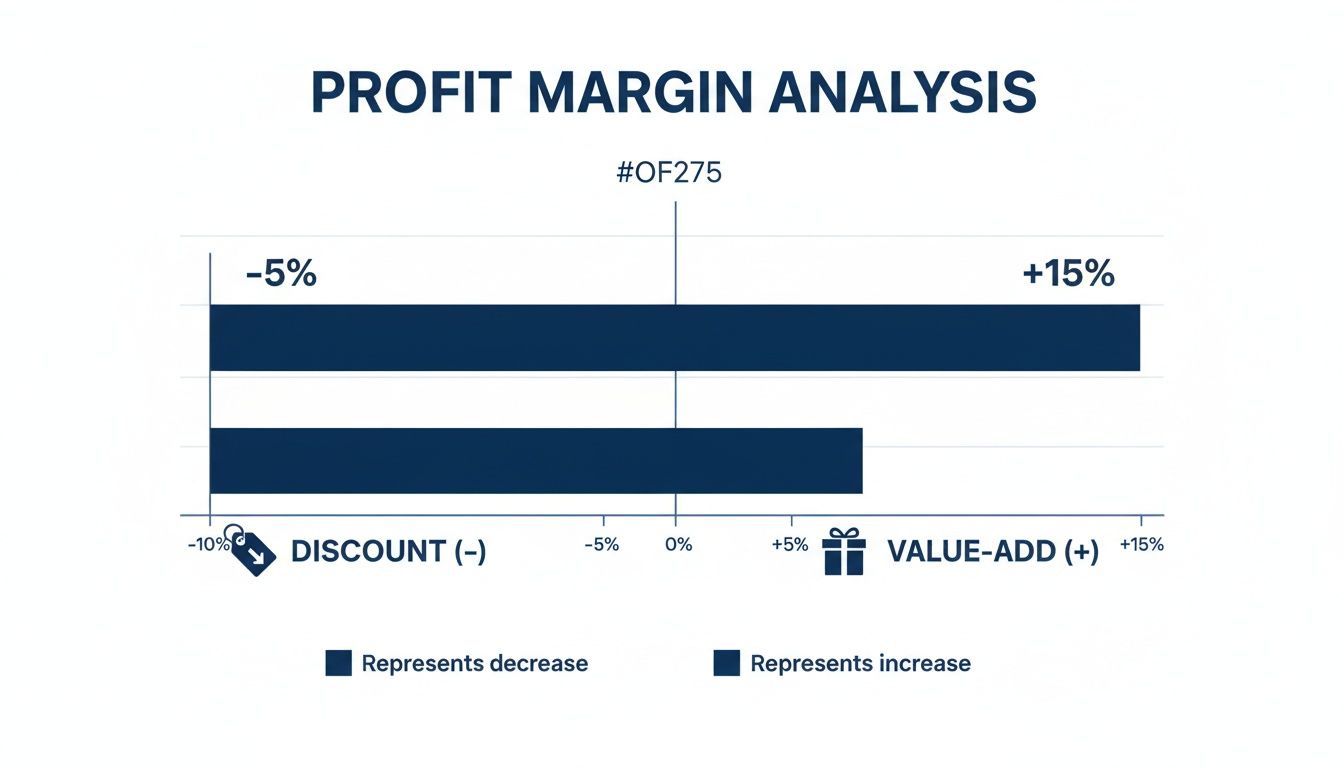
The takeaway couldn't be clearer: discounting is a race to the bottom, while strategic rewards build a more profitable, sustainable business.
The Powerhouse: Tiered Free Gifts
Now, this is where things get really interesting. Let’s use an in-cart upsell tool like Monster Cart. Our customer with the $65 cart sees an interactive progress bar showing them they can unlock a free gift (that costs you $5) if they just spend $100.
Motivated by that tangible reward, they add that same $40 product.
AOV: $105.00
Revenue: $105.00
COGS (40% of $105): $42.00
Cost of Gift: $5.00
Gross Profit: $58.00
This is the clear winner. You hit the same high AOV as the free shipping offer but walk away with an even higher gross profit because the gift's cost was less than the shipping. Even better, you’ve delighted your customer with a surprise, seriously boosting their lifetime value. For more ideas on how to structure these kinds of deals, check out our guide on different examples of price bundling.
For Shopify merchants trying to move away from constant sales, this is a perfect example of how Monster Cart's in-cart rewards can lift AOV by 20-30% without killing your margins. This is exactly why over 7,000 brands trust our app to help them grow smarter, generating over $712M in revenue on a platform that's built for this kind of strategic growth.
Your Shopify Profit Margin Questions Answered
We’ve dug deep into the profit calculator, from rooting out hidden fees to mapping out growth plans. To bring it all home, let's tackle some of the most common questions I hear from fellow Shopify merchants trying to get a real handle on their profitability.
What Is a Good Profit Margin for a Shopify Store?
This is the million-dollar question, isn't it? While a "good" profit margin can swing wildly depending on your industry, a healthy net profit margin for most ecommerce brands usually falls somewhere between 10% and 20%.
Honestly, the most important thing isn't hitting some magic number. It's about consistently tracking your margin and actively working to nudge it upwards with smart plays like boosting your AOV and reining in costs. The focus should be on sustainable growth through increasing customer lifetime value, not just short-term sales.
How Do I Calculate Profit on a Single Shopify Order?
Calculating your profit on one specific order is surprisingly simple, but incredibly powerful.
Just take the total amount your customer paid and start subtracting all the costs tied directly to that sale. This means deducting your Cost of Goods Sold (COGS), the actual shipping fee you paid (not what you charged), the cost of your box and packing tape, and the credit card transaction fee.
What's left is the net profit for that single order. This is the key to understanding which of your products are actually making you money.
Focusing on per-order profit reveals which products are your true winners. It helps you make smarter decisions about marketing and inventory, ensuring you're not just selling more, but earning more on every sale.
Are Shopify Apps Worth the Cost If I’m Trying to Protect My Margins?
Yes, but with a huge caveat: only if the app delivers a clear and measurable return on investment (ROI). An app like Monster Cart, for instance, is designed to directly pay for itself by increasing your Average Order Value through value-added rewards, not just lazy discounts.
Think of it this way: if a $29/month app helps you generate an extra $500 in high-margin sales, it’s a massive win for your bottom line.
Always gut-check your apps. Ask yourself how they either cut your costs or grow your revenue. The right ones help you build a more profitable and sustainable business, one that’s focused on lifetime value.
Ready to turn your cart into a profit engine? With Monster Cart, you can build gamified, in-cart reward campaigns that boost AOV and customer loyalty without margin-killing discounts. See why over 7,000 Shopify brands trust us to grow smarter. Learn more at monsterapps.shop.
Join 7000+ brands using our apps